

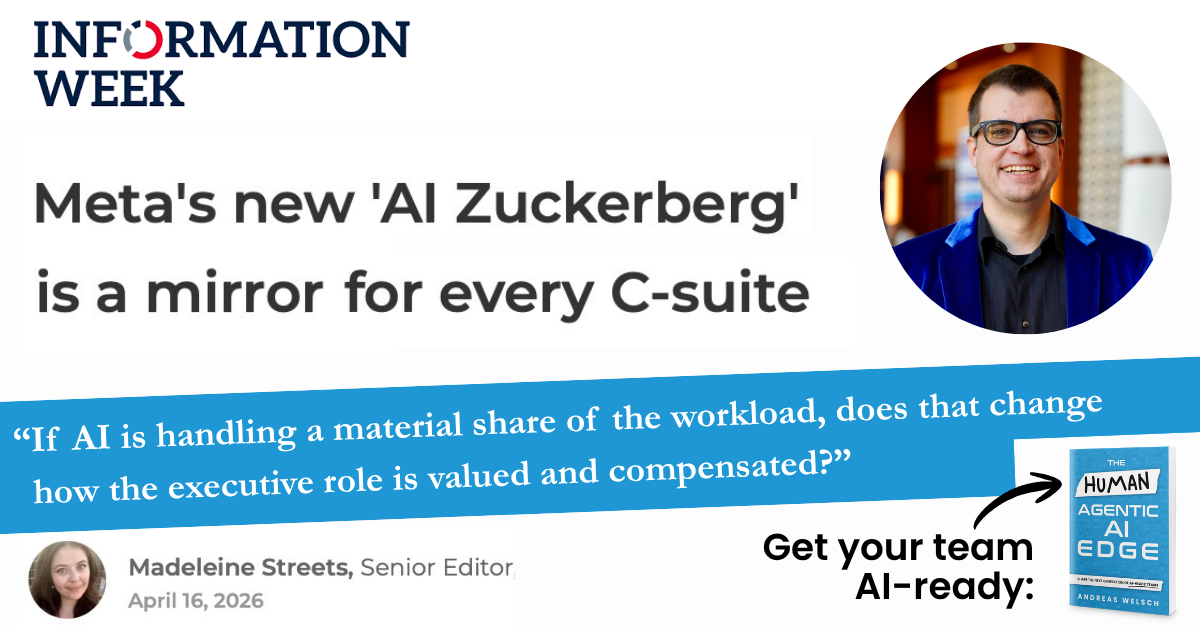
AI leadership means more than deploying tools for productivity: it means embedding AI into how leadership presence, communication, and guidance show up across the enterprise.
What is an executive digital twin, and what does “AI Zuckerberg” signal? An executive digital twin is an AI system trained on a leader’s typical preferences and feedback, so employees can consult it before meetings. It can reduce executive time and improve proposals, but it creates governance risks: drift, eroding employee trust, and unclear ownership of encoded executive knowledge.
That shift is made tangible by reports that Meta is building an AI version of Mark Zuckerberg to interact with employees, field questions, and simulate executive presence at scale.
For CIOs, CTOs, and CHROs, the point is not novelty. The point is governance: how “AI-mediated leadership” changes decision pathways, accountability expectations, and workforce trust, especially as agentic AI expands from information retrieval into coordination and action.
This article draws on InformationWeek coverage that includes commentary from Andreas Welsch, founder and chief human agentic AI officer at Intelligence Briefing, on how executive digital twins are already being used, and where organizations are unprepared for the downstream risks.
Original source: Meta’s new ‘AI Zuckerberg’ is a mirror for every C-suite
Executive Summary
- Executive digital twins can streamline consultation and reduce executive time.
- AI leadership requires explicit boundaries for what AI can represent and decide.
- “Drift” can make AI proxies confidently wrong when executive thinking changes.
- Synthetic leadership access can erode employee trust, even if efficiency improves.
- Organizations must clarify ownership of encoded executive knowledge over time.
Key Takeaways
- Andreas Welsch describes executive digital twins used for employee consultation during development cycles.
- Welsch warns about “drift” when digital twins rely on outdated training and diverge from current intent.
- AI-mediated leadership can accelerate proposal quality by pre-incorporating predictable executive feedback.
- As AI encodes executive preferences, organizations must decide who owns that institutional knowledge after leaders move on.
- If AI performs a material share of the workload, role valuation and compensation expectations may shift.
- AI leadership is not only about automation; it is also about governance for representation, reliance, and trust.
What is AI leadership?
AI leadership is the practice of guiding an organization’s use of AI in ways that shape decisions, accountability, and workforce outcomes. It includes setting direction for adoption, defining boundaries for where AI may act or represent leaders, and establishing governance so the organization can trust AI-mediated outputs. In the context of executive digital twins, AI leadership also covers how AI systems communicate executive intent, how employees rely on those outputs, and how the enterprise manages risks like outdated guidance, trust erosion, and unclear ownership of encoded institutional knowledge.
What is an executive digital twin? AI leadership meets “AI Zuckerberg”
An executive digital twin is an AI system trained on a leader’s typical preferences and feedback. Employees consult it to anticipate how that leader would react, and improve their proposals before a meeting.
Reports that Meta is building an AI version of its CEO spotlight an emerging reality: “executive presence” can be simulated in ways that are functionally useful to employees.
The operational idea is straightforward: employees ask questions, receive guidance, and move work forward without waiting for scarce executive time. The strategic question is harder: what happens when an AI representation of leadership becomes a primary interface for decision shaping?
Key Insight: Executive digital twins shift leadership from a person-to-person interaction model to an AI-mediated interface model. That creates measurable efficiency benefits, but also introduces governance risks: representation accuracy, reliance management, and unclear accountability for decisions shaped by AI outputs.
Example already in use: consultation during development cycles
Andreas Welsch, founder and chief human agentic AI officer at Intelligence Briefing, cites a global electronics company that built digital twins for senior executives so employees could consult them during development cycles.
In practice, employees use the system to anticipate how leaders would react to proposals and then adjust before a meeting. Welsch explains that the system is trained on executives’ typical preferences and feedback, so common feedback points are incorporated earlier, reducing executive time and increasing proposal quality.
What is “drift” in an executive digital twin? The governance problem
Effective consultation with a digital twin depends on accurate, up-to-date training. Welsch flags “drift”: when a digital avatar operates on stale information and diverges from the leader’s current thinking.
The risk is amplified because the outputs can remain confident even when they are no longer aligned with executive intent. In time-sensitive and evolving situations, drift can compound quickly as more employees rely on the proxy.
Key Insight: “Drift” is not just a model quality issue; it is an AI leadership issue. If employees treat AI guidance as executive intent, stale training can quietly reroute decisions, reshape proposals, and create misalignment that leaders only discover after momentum has shifted.
Operational implication: confidence without current context
Drift becomes particularly dangerous when organizational context changes: priorities shift, trade-offs change, or new constraints emerge. Employees may be optimizing for yesterday’s preferences while believing they are aligning with leadership today.
AI leadership must therefore include explicit update discipline: what gets updated, how often, and who signs off that the proxy still represents current direction.
Can executive digital twins erode employee trust? “Synthetic leadership access”
One of the most sensitive consequences of AI-mediated leadership is cultural: employees may want meaningful engagement with leadership but get diverted to an AI proxy instead.
Even if efficiency improves, “synthetic leadership access” can erode credibility and trust. It can also send an unintended signal that a person or team is low on the human executive’s priority list, weakening working relationships.
Key Insight: AI leadership decisions that optimize for speed can unintentionally degrade trust. When a proxy becomes a substitute for leadership engagement, employees may interpret the experience as deflection rather than empowerment, especially during conflict, uncertainty, or high-stakes change.
Who owns the knowledge in an executive digital twin? The “encoded executive” problem
As AI encodes more of an executive’s thinking and preferences, organizations face a structural question that Welsch highlights: who owns that institutional knowledge when the executive moves on?
The question is not theoretical. If the digital twin becomes a tool employees consult to shape proposals, then it becomes part of how the organization operationalizes leadership intent.
Welsch also notes a second-order implication: if AI handles a material share of workload, organizations may need to rethink how the role is valued and compensated.
Workforce transformation impact: institutional knowledge becomes an asset
Once leadership preferences are formalized and reusable through AI, they stop being purely personal leadership style and begin to look like a reusable corporate asset.
AI leadership governance must therefore address stewardship: permissible use, continuity plans, and what happens to AI representations of leaders across transitions.
How can executive digital twins help? Faster alignment and better meetings
Executive digital twins are not inherently negative. Welsch’s example points to a pragmatic benefit: proposals improve before meetings occur because predictable executive feedback is incorporated upstream.
This can reduce time spent on repeated clarifications and help teams anticipate likely concerns, trade-offs, and preferences, especially in large organizations where executives cannot personally engage with every team at every stage.
The operational win must be governed
The same mechanism that speeds alignment can also narrow thinking if employees optimize too early for a proxy’s “expected reaction.” AI leadership should ensure that speed does not become premature convergence on a single set of preferences.
Leadership Implications
- Set boundaries for representation: Define where an AI executive proxy can advise, and where humans must engage directly.
- Govern updates to prevent drift: Establish ownership, cadence, and sign-off for keeping executive twins aligned with current thinking.
- Design trust intentionally: Decide when synthetic access is appropriate, and when it risks undermining credibility or relationships.
- Clarify knowledge ownership: Determine who controls AI-encoded executive preferences when leaders change roles or leave.
- Measure reliance and impact: Monitor where employees use proxies to shape proposals and how that changes decision quality and speed.
Conclusion: AI leadership is a leadership-interface design problem
The discussion sparked by “AI Zuckerberg” is not primarily about one company’s experiment. It reveals a broader shift: leadership can be partially productized through AI systems that employees consult, trust, and follow.
Andreas Welsch’s observations highlight both the upside (improved proposals and reduced executive time) and the risks that require governance, especially drift and institutional knowledge ownership. For the C-suite, AI leadership includes designing how leadership intent is represented, updated, and responsibly relied upon across the enterprise.
Related Reading
Frequently Asked Questions
What does “AI Zuckerberg” mean for AI leadership?
It signals that AI leadership is expanding from tool adoption into AI-mediated executive presence, where employees may consult AI proxies for guidance. That elevates governance needs around accuracy, updates, and reliance, because the proxy can shape proposals before executives engage.
What is an executive digital twin in an enterprise setting?
An executive digital twin is an AI system trained on a leader’s typical preferences and feedback to help employees anticipate reactions and improve proposals. In the cited example, employees consult the twin during development cycles to incorporate common feedback before meetings.
How can executive digital twins improve operational efficiency?
They can reduce repetitive executive involvement by encoding common feedback patterns into an AI consultation layer. Andreas Welsch describes employees using digital twins to adjust proposals in advance, which reduces executive time and improves the quality of results before meetings occur.
Why can AI-mediated leadership erode employee trust?
Trust can weaken when employees want meaningful leadership engagement but are redirected to an AI proxy instead. Even if responses are fast and consistent, “synthetic leadership access” can signal low priority and reduce credibility, particularly in high-stakes or sensitive situations.
Who owns the knowledge encoded in an executive digital twin?
The ownership question becomes unavoidable once AI systems encode executive thinking and preferences. Welsch notes organizations will need to decide who controls that institutional knowledge when an executive moves on, because the AI representation can become part of operational decision shaping.
Does AI leadership change how executive roles are valued?
It can, if AI handles a material share of executive workload. Welsch raises the implication directly: organizations may need to revisit how roles are valued and compensated when an AI-mediated layer absorbs recurring tasks that previously consumed executive attention and time.
What governance controls matter most for executive AI proxies?
Governance should focus on update discipline to prevent drift, clear boundaries on what the proxy can represent, and monitoring how employees rely on outputs. These controls support responsible AI adoption by ensuring that AI-mediated leadership remains aligned with current direction and trust expectations.
How should CIOs and CHROs approach workforce transformation with AI leadership?
They should treat AI leadership as an interface and culture redesign, not just a technology rollout. That means deciding when synthetic access is appropriate, ensuring human engagement remains available, and establishing rules for how AI guidance influences proposals, escalation, and decision readiness.