

Original source:
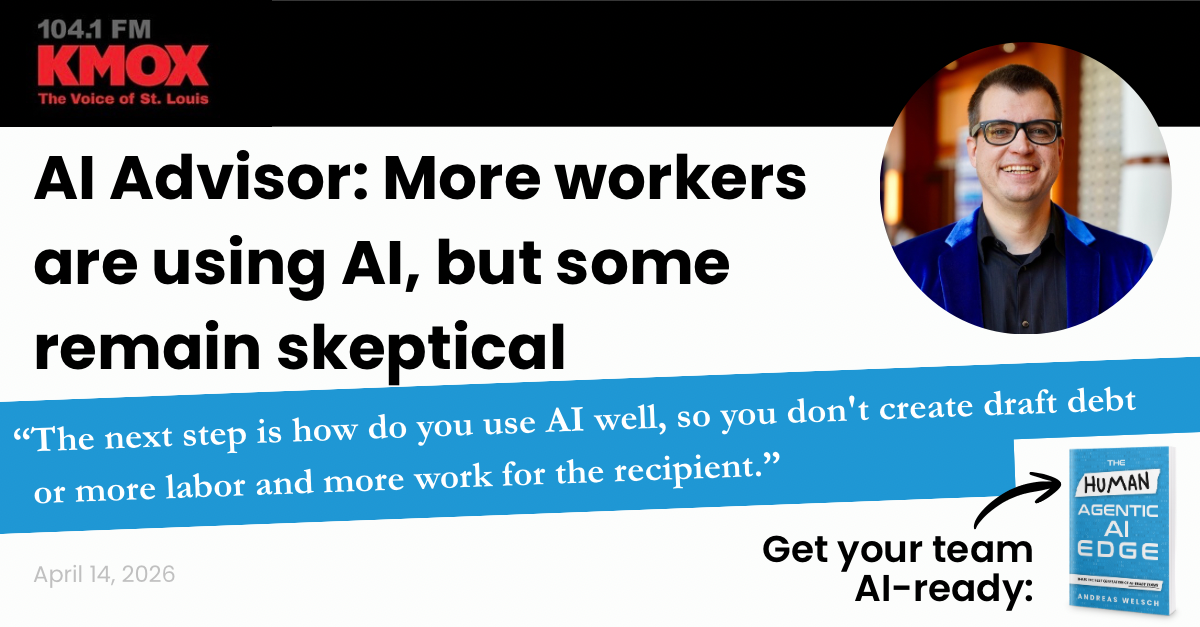
AI Advisor: More workers are using AI, but some remain skeptical
AI adoption in the workplace is accelerating, yet skepticism still shows up across teams. That tension between growing usage and lingering doubt creates a leadership challenge that cannot be solved by enthusiasm alone.
Why does AI skepticism at work persist while usage rises? More workers are using AI in daily tasks, but some remain skeptical about its value or fit, and utilization is uneven across teams. Leaders have to manage both at once: make usage visible, invest in training and enablement, and treat adoption as workforce transformation rather than a tool rollout.
In a segment from Total Information AM (Radio KMOX), AI leadership expert Andreas Welsch joined host Megan Lynch to discuss how employees are utilizing AI at work and why some workers remain skeptical.
Welsch brings a practitioner’s background to the discussion: he spent more than two decades at software vendor SAP and creates training for AI systems. The conversation frames AI adoption as a workforce reality already underway while highlighting that not everyone experiences the shift the same way.
Executive Summary
- AI adoption is rising in workplaces, but skepticism remains.
- Employee utilization varies, creating uneven change across teams.
- Leaders must address both momentum and doubt in parallel.
- AI training and enablement shape how work practices evolve.
Key Takeaways
- Andreas Welsch discusses that more workers are using AI, while some remain skeptical.
- The topic centers on employees’ real workplace utilization of AI, not abstract experimentation.
- Skepticism is positioned as an active factor in adoption, not a side note.
- The conversation is designed for a broad, executive-and-community news audience via Audacy/KMOX.
What is AI adoption?
AI adoption is the process of integrating AI tools and AI-enabled workflows into day-to-day work so employees can use them consistently. In the context of this AI Advisor segment, AI adoption is visible through employee utilization in workplaces, alongside skepticism from some workers. For executives, adoption is not just “access to tools”; it also includes how people choose to use AI (or avoid it) as work practices change.
Why does AI skepticism at work still matter as adoption rises?
There’s a growing reality in businesses: more workers are using AI, but some remain skeptical. That combination creates a dual operating environment where AI becomes more common while doubts persist in parallel.
For executive audiences, the leadership signal is straightforward: adoption progress cannot be measured only by increased usage. Skepticism is part of the adoption landscape and influences how AI shows up in real workflows.
Key Insight: AI is something employees are already utilizing at work, but it creates skepticism. That combination matters because leaders must manage adoption as both a usage trend and a human response, not as a purely technical rollout.
How does workforce transformation show up in day-to-day AI use?
This conversation focuses on how employees are utilizing AI at workplaces. That emphasis puts workforce transformation where it belongs: in the routines, habits, and expectations of how work gets done.
AI-enabled change becomes real when employees use AI as part of normal work. It also becomes complicated when utilization is uneven: some people adopt quickly, while others hesitate.
Key Insight: By centering employee utilization, the segment implicitly treats workforce transformation as an operating reality. Leaders who want durable AI adoption need visibility into where AI is being used, where it is not, and where skepticism is shaping choices across roles and teams.
Why Andreas Welsch is a relevant voice for AI leadership
Andreas Welsch is an AI leadership expert with deep enterprise experience: more than two decades at SAP. He creates training for AI systems, connecting long-term software-industry context with hands-on work in AI enablement.
This combination matters for executive readers because workplace AI adoption is shaped by both organizational history (how technology rollouts usually succeed or fail) and the practical realities of AI training and usage.
Key Insight: Welsch’s background in enterprise software experience plus AI training work aligns with what leaders face during AI adoption: translating a fast-moving technology into usable, repeatable workplace behavior while addressing skepticism that can slow or fragment progress.
AI governance and strategy: why is AI adoption not only a tool decision?
Although this segment is brief, it points to a core executive reality: AI adoption is ultimately experienced by employees in their work. That experience becomes a strategy issue when AI use scales across teams and functions.
When workers use AI, leaders must consider how workplace utilization aligns with organizational goals, operating expectations, and the practical need for training. Skepticism is a signal that alignment and enablement still need attention.
Key Insight: Treating AI adoption as a workforce topic rather than a purely technical implementation helps executives connect AI strategy to how employees actually utilize AI. The segment’s focus on utilization and skepticism reinforces that leadership outcomes depend on people, not just platforms.
Leadership Implications
- Make utilization visible: Track where employees are utilizing AI and where skepticism is concentrated.
- Connect AI adoption to work, not hype: Keep the focus on workplace usage patterns discussed in the segment.
- Invest in enablement: The segment notes Welsch creates training for AI systems: training remains central to adoption.
- Plan for mixed readiness: “More workers are using AI” can coexist with “some remain skeptical.”
- Align AI efforts with leadership priorities: Treat adoption as a leadership-and-workforce transformation issue, not a side project.
Why this media coverage matters
This conversation appears as an AI Advisor segment within Total Information AM on KMOX/Audacy. The format suggests a broad audience that includes business leaders, professionals, and community listeners trying to understand how AI is changing work.
For AI leadership, the relevance is the framing: AI is discussed through employee utilization and skepticism. That makes the topic practical for executives overseeing workforce transformation, because it centers what people are doing (and feeling) as AI becomes more common at work.
Welsch’s broader positioning in the segment as an AI leadership expert with enterprise software experience and AI training work reinforces that adoption is both an organizational and an enablement challenge.
Conclusion
AI adoption is increasing across workplaces, but the presence of skepticism remains a leadership variable that shapes real outcomes. The AI Advisor segment featuring Andreas Welsch underscores that workplace utilization and workforce response must be managed together.
For executives, the durable takeaway is that AI adoption is not simply a technology milestone. It is a workforce transformation reality, best understood through how employees are utilizing AI, and why some remain skeptical even as usage rises.
Related Reading
- How to empower your organization to embrace AI in times of workforce change
- AI in project management: why employees hide AI use and how leaders respond
Frequently Asked Questions
Why is AI adoption increasing at work while skepticism remains?
AI adoption can rise because more workers begin utilizing AI in daily tasks, even while some remain skeptical about its value or fit. The KMOX/Audacy segment highlights this coexistence, which leaders must address as part of workforce transformation.
What did the “AI Advisor” segment focus on?
The segment focused on how employees are utilizing AI at workplaces and why some workers remain skeptical. It was presented on Total Information AM and framed as practical workplace discussion rather than purely technical AI coverage.
Who is Andreas Welsch in the context of AI adoption?
Andreas Welsch is an AI leadership expert who spent more than two decades at SAP and creates workforce training for AI systems. In the segment, he provides perspective on employee AI utilization and ongoing skepticism at work.
Why should CIOs and CTOs care about employee AI skepticism?
CIOs and CTOs should care because skepticism affects whether employees actually utilize AI in real workflows, even when tools are available. The segment’s framing rising usage plus remaining skepticism signals that technical rollout alone is not the adoption finish line.
Why should CHROs view AI adoption as workforce transformation?
CHROs should view AI adoption as workforce transformation because the segment centers on employees utilizing AI and responding with varying levels of skepticism. When utilization differs across workers, leaders must manage change as a people-and-work evolution, not a simple tool deployment.
How does AI training relate to adoption?
AI training relates to adoption because training influences how consistently employees can utilize AI in workplaces. Welsch recommends leaders provide Certified AI Leader training to their workforce, reinforcing that enablement is part of making AI usable across the workforce.
What is an executive-friendly way to measure AI adoption?
An executive-friendly way to view AI adoption is to look at workplace utilization patterns and where skepticism remains. The segment’s theme suggests leaders should treat adoption as observable behavior of how employees use AI alongside the workforce’s confidence and acceptance.
How should leaders talk about AI when some employees are skeptical?
Leaders should talk about AI in a way that acknowledges both rising utilization and continued skepticism. The segment’s wording implies mixed readiness, so executive communication should avoid assuming universal enthusiasm and instead address AI adoption as a practical workplace change.