

Certified AI Leader™ Program — Upskill Your Team for Agentic AI
Most AI training teaches people to use tools. Your team needs training that teaches them to lead with AI — set direction, govern deployments, assess readiness, and turn pilots into production. That’s what the Certified AI Leader™ Program delivers.
Every tier runs 4 weekly live sessions (8 hours of live instruction) plus structured homework and a capstone project applied to a real business problem in the participant’s own role. Participants leave each tier with results their business can use immediately.
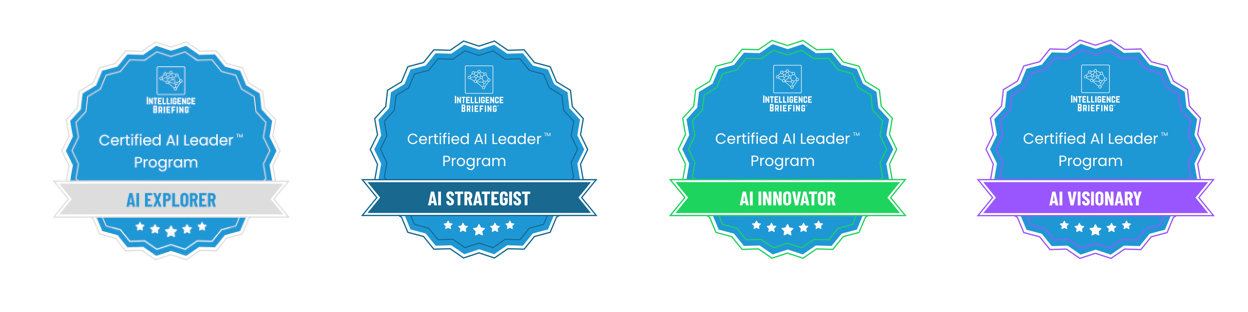
Multiple upskilling programs are available, from foundational programs that introduce the practical use of AI in everyday work to advanced, hands-on coursework that prepares you to become an AI strategist.
Our Clients Include





Who This Training Is For
The Certified AI Leader™ Program serves three audiences with one shared outcome: building durable AI leadership capability across the organization.
– L&D, Talent, and Learning Leaders (CLO, VP Learning & Development, Head of Talent) — building AI capability as an enterprise learning asset. You want cohort-based certification, measurable capability lift, and alumni who apply what they learn to real business problems.
– Executive Sponsors (CEO, CIO, CTO, CHRO) — funding AI upskilling because your workforce needs to make AI decisions, not just use AI tools. You want leaders, not users.
– Individual Senior Contributors — leaders adding certified AI leadership credentials to their professional profile. Open-enrollment cohorts welcome individual professionals who are investing in their own capabilities.
If you are responsible for organizational AI capability or accountable for your own, the program was built for you.
Become a Certified AI Leader™
Choose from two complementary tracks. The Capability Track builds durable AI leadership skills across four tiers — from foundational AI use to enterprise AI leadership. The Platform Enablement Track gets your organization up and running on a specific AI platform — Anthropic Claude or Microsoft Copilot — and turns early adoption into measurable, governed results.
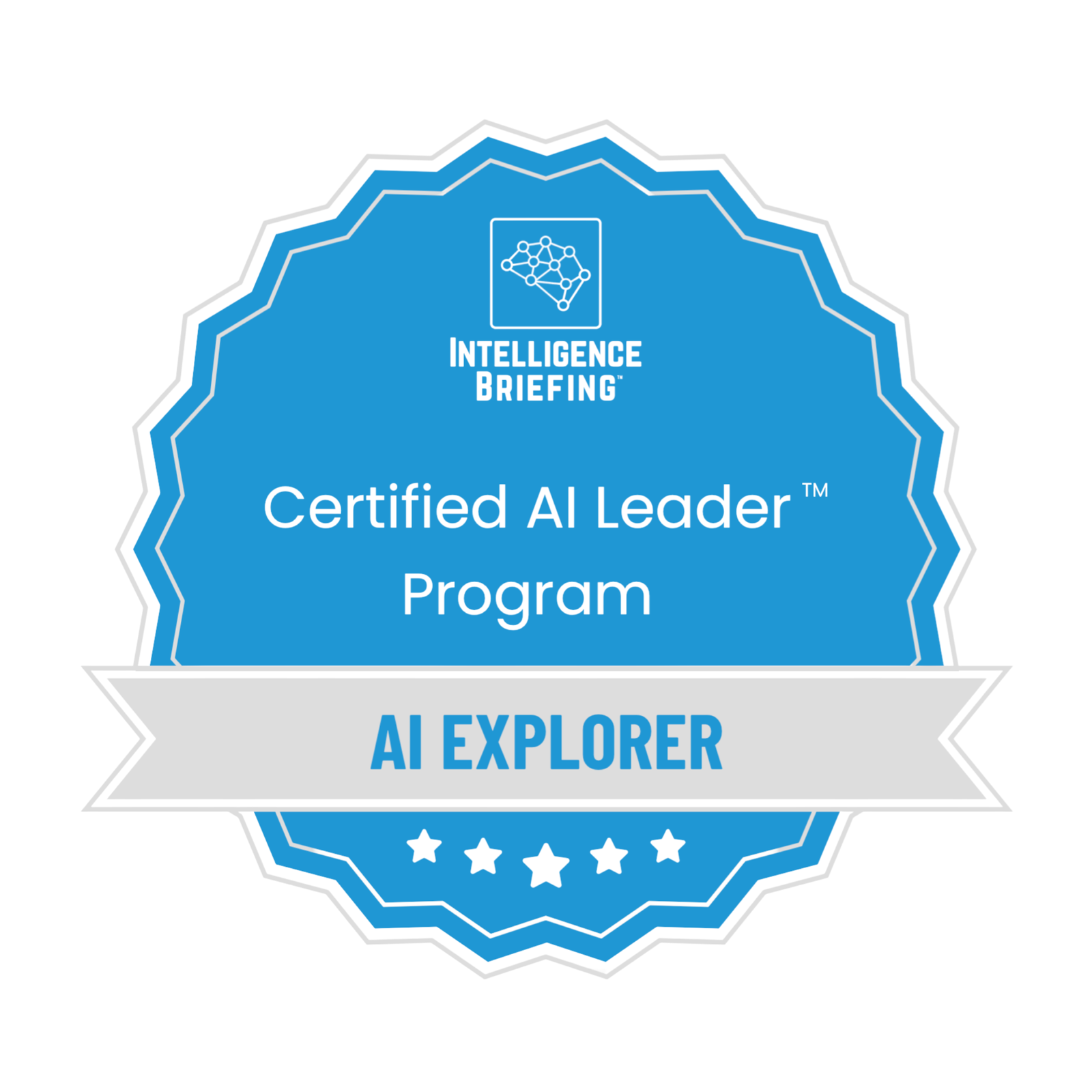
Foundations:
AI Explorer
Introduces professionals to the practical use of AI in everyday work. Learn how AI is reshaping business, how to collaborate effectively with AI tools, and how to structure tasks for clearer, more consistent outputs.
Explore the AI Explorer Learning Journey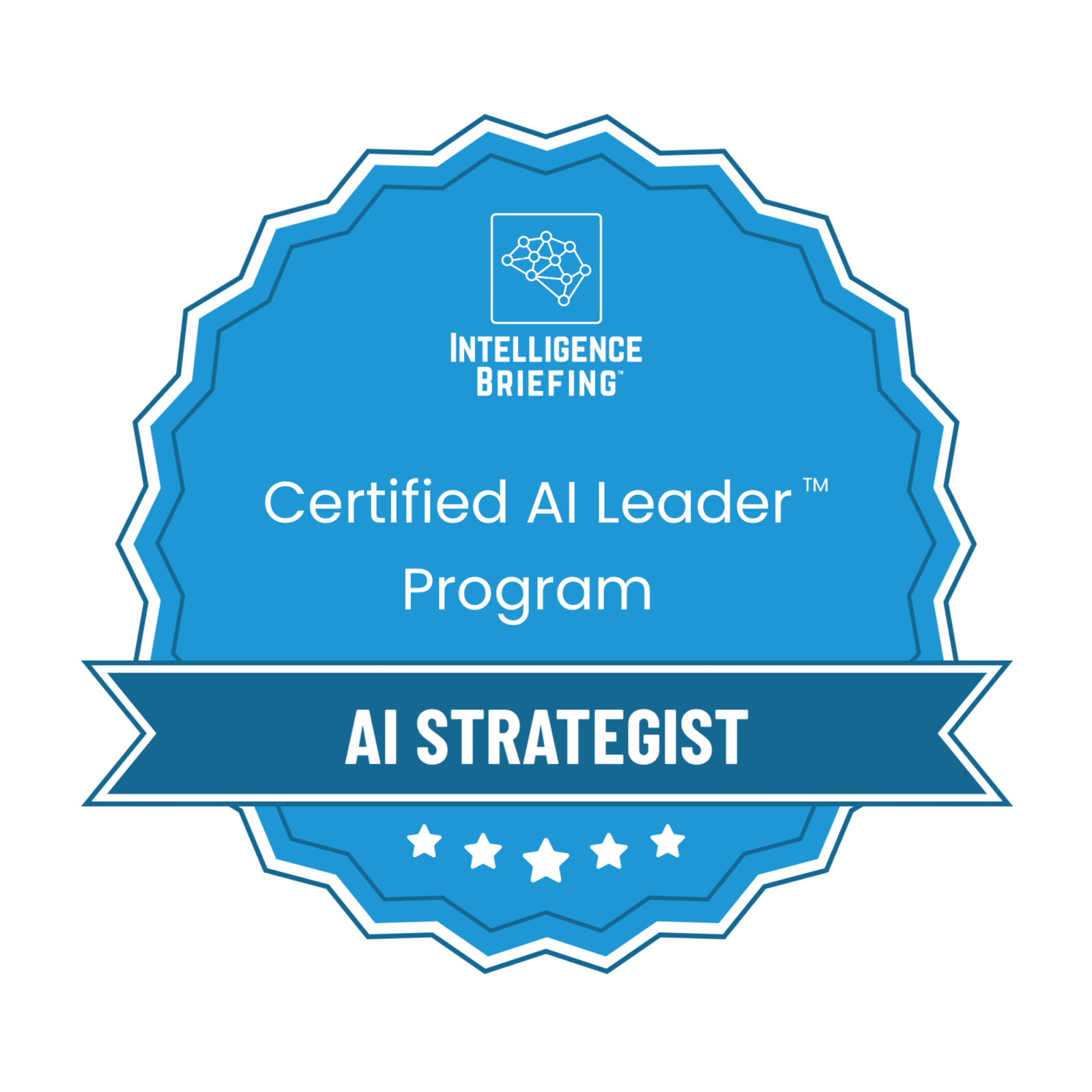
Advanced:
AI Strategist
Provides advanced, hands-on training for professionals who want to use AI as a strategic partner in their work. Apply advanced prompting techniques and learn to collaborate with AI assistants.
Explore the AI Strategist Learning Journey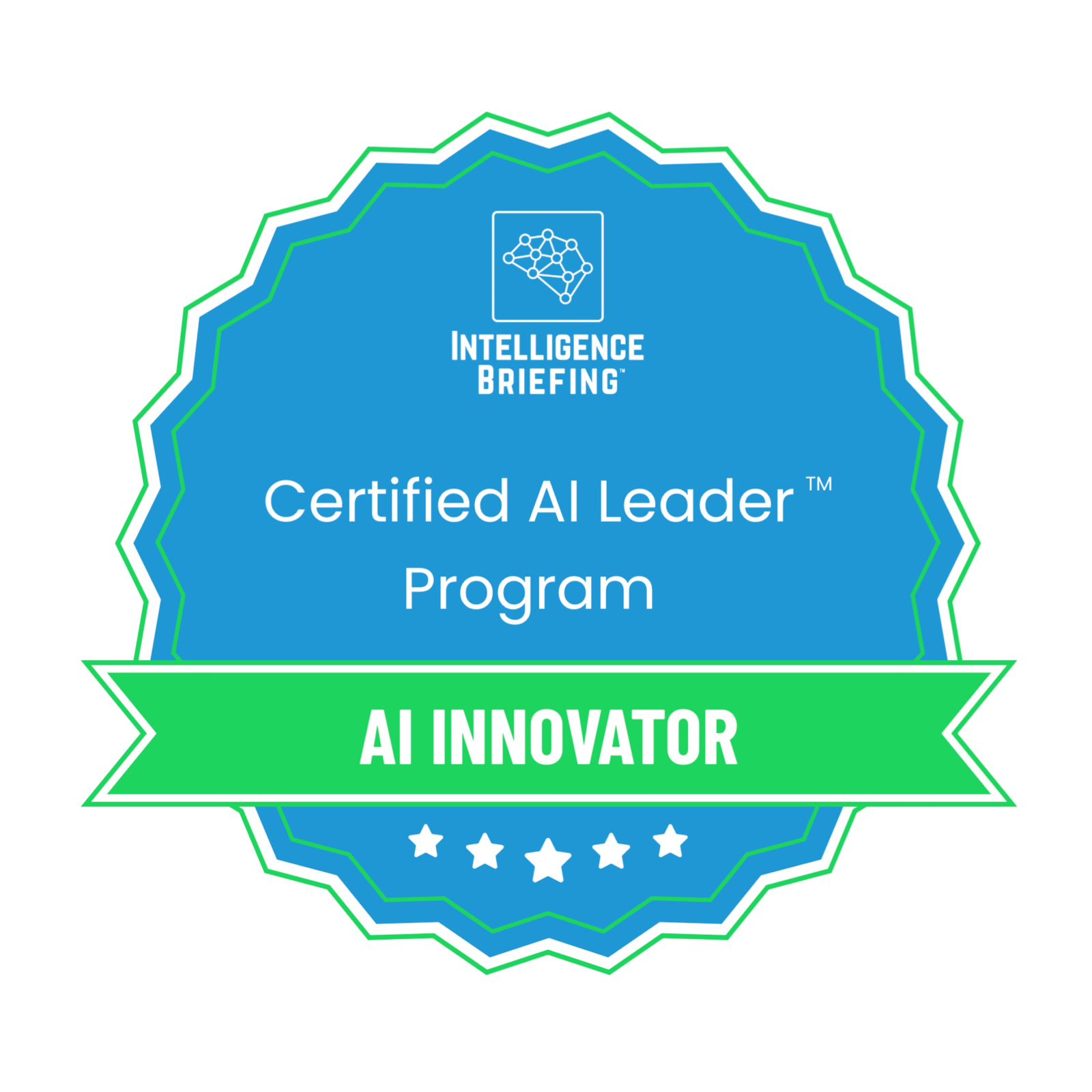
Expert:
AI Innovator
Offers practical, expert-level training for professionals looking to integrate agentic AI into everyday work. Design agentic workflows and collaborate effectively with AI.
Explore the AI Innovator Learning Journey
Leadership:
AI Visionary
Equips leaders with practical guidance to adopt AI agents responsibly, strengthen decision-making, automate complex work, and align team usage with organizational goals.
Explore the AI Visionary Learning JourneyLaunch Your AI Platform with Confidence
Buying licenses is the easy part. Most mid-sized organizations stall between “we rolled it out” and “our teams use it well.” The Platform Enablement Track closes that gap. These programs combine hands-on skill building with the rollout decisions that determine success: setup, governance, use-case selection, adoption measurement, and ROI.
The AI Operator program is platform-specific by design and available in a Claude Edition and a Microsoft Copilot Edition — same structure, same rigor, tailored to the platform your organization runs on.
Foundations: AI Operator
Equips professionals and rollout leads in mid-sized organizations to set up, adopt, and govern an enterprise AI assistant. Assess opportunities and risks, master everyday workflows, and go deep on AI across Microsoft 365 — available for Microsoft Copilot and Anthropic Claude.
Explore the AI Operator Learning Journey
Vibecoding:
AI Builder
Introduces leaders to vibecoding in Lovable — turning business ideas into working software prototypes without writing code. Build real applications with Lovable, learn where AI-built software creates value, and govern citizen development responsibly.
Explore the AI Builder Learning JourneyWhat You Can Expect From a Cohort
Flexible Format
Available as four, 2-hr long sessions or two, half-day sessions. Cohorts run 20–25 participants; corporate cohort sizes vary based on customer request.
Interactive Elements
Homework and microlearnings between modules reinforce learning and repetition.
Learner Satisfaction
Participant satisfaction averages 4.8 out of 5 across cohorts.
Digital Badge & Certificate
Learners can show their proficiency upon program completion.
Testimonials
“The session was practical, well-paced, and immediately applicable.”

Alison Conant
Communications Executive
MilkPEP
“This course was very useful in helping equip our company to use AI more effectively.”

Josh Hatcher
Marketing Leader
Control Chief Corporation
“The Certified AI Leader program gave our senior team a shared operating model for empowering their teams to confidently use AI. Since completing the program, participants have increased their productivity and identified opportunities for operational excellence improvements.”
President
Global Powdered Metal Manufacturing
“We ran a cohort with our business-unit leaders. The combination of live sessions, hands-on exercises, and the applied capstone produced a visible capability lift.”
Head of Learning & Development
U.S. Financial Services Firm
AI Explorer
This foundational program introduces professionals to the practical use of AI in everyday work. Participants learn how AI is reshaping business, how to collaborate effectively with AI tools, and how to structure tasks for clearer, more consistent outputs using ChatGPT.
Learners develop core prompting skills, apply AI to common workflows across functions, and explore simple no-code automations that reduce manual effort. This course also discusses and builds awareness of ethical use, bias, and responsible adoption.
Complete the program with a capstone project in which participants design their first AI-enhanced workflow tailored to their role. By the end of the course, participants can use AI confidently, productively, and responsibly across their day-to-day work.
Key Topics & Learning Objectives
Understand how AI enhances everyday work
>> Explain core AI concepts, recognize where AI can support common tasks, and identify opportunities to improve productivity.
Use AI tools effectively and responsibly
>> Apply clear prompting strategies, collaborate with AI systems to refine outputs, and follow responsible-use guidelines.
Create simple AI-driven workflows that improve efficiency
>> Design practical, repeatable workflows using AI assistants that address the needs of your job and organization.
Week 1
- Module 1: Understanding the Foundations of AI in Business.
- Understand the Foundations of AI in Business. Learn how AI is changing business and what it means for your role. Explore the differences between traditional and generative AI, understand key terminology, and identify opportunities within your business context.
- Module 2: Shifting Behaviors to Work with AI.
- Shift Behaviors to Work with AI Adjust habits, communication, and workflows to collaborate with AI. Develop the mindset necessary to work effectively alongside AI tools, including how to structure problems, provide context, and iterate efficiently.
Week 2
- Module 3: Discovering High-Value Opportunities for AI Agents.
- Prompting Like A Pro: Practice effective prompts and tool interaction strategies. Learn advanced prompting techniques, understand how to provide clear instructions, and develop strategies for consistent, high-quality AI output.
- Module 4: Applying Agentic AI Responsibly Across Business Functions.
- Learn how AI in your role applies to HR, marketing, finance, or operations tasks. Implement AI tools for common workflows in your role to enhance productivity and address department-specific challenges.
Week 3
- Module 5: Automating with Agentic AI.
- Automate with Agentic AI and explore no-code automations and multi-step agents. Learn how to create automated workflows that combine multiple AI tools, set up recurring processes, and implement time-saving systems.
- Module 6: Leading AI-Augmented Teams.
- Lead AI-Augmented teams and understand new responsibilities, risks, and best practices. Guide teams through AI adoption, establish governance frameworks, and create policies that maximize benefits while minimizing risks.
Week 4
- Module 7: Building Inclusive Governance Frameworks.
- Ethics, Bias & Responsible Use. Build awareness of bias, hallucinations, and misuse. Develop frameworks for the ethical use of AI, learn to identify and mitigate biases, and establish responsible use guidelines for your organization.
- Module 8: Capstone Project: Creating an AI-generated Explainer Video.
- Capstone Project: Automating Your First Workflow with AI. Design one AI-enhanced workflow from your job. Apply everything you’ve learned to create a practical, immediately applicable solution tailored to your role and organization.
AI Strategist
This program provides advanced, hands-on training for professionals who want to use AI as a strategic partner in their work. Participants apply advanced prompting techniques, learn to collaborate with AI assistants, and identify opportunities to streamline workflows using AI-generated insights with ChatGPT.
This course covers selecting the right tools for each task, integrating reliable research methods, and designing repeatable workflows using custom GPTs in ChatGPT. Learners practice multi-step prompting, structured reasoning, and turning insights into slide-ready content with Gamma, while applying responsible data and privacy practices.
Complete the program with a capstone project in which participants design and deliver a custom GPT tailored to a real process in their organization. By the end, participants can apply AI strategically, create reliable workflows, and produce clear, high-quality outputs that support better decisions and stronger communication.
Key Topics & Learning Objectives
Identify high-impact opportunities for AI in processes
>> Assess processes, pain points, and performance gaps across business functions, and identify AI’s potential for improvements.
Analyze how to use AI effectively in business functions
>> Distinguish which tasks benefit from AI and select appropriate tools based on the task, context, and business value.
Apply advanced prompting and workflow techniques
>> Design prompt chains, integrate generative AI into existing workflows, and adapt outputs to meet stakeholder requirements.
Week 1
- Module 1: Strengthening Prompting Skills.
- Create clear and effective prompts that support common business tasks. Explore advanced prompting patterns, including roles, constraints, structured formats, and multi-step prompts that enable more reliable output.
- Module 2: Working with AI as a Thought Partner.
- Build work habits that enable effective AI collaboration. Break tasks into manageable steps, provide helpful context, and iteratively refine outputs. Review, adapt, and version work in ChatGPT Canvas.
Week 2
- Module 3: Discovering AI Opportunities in Workflows.
- Analyze workflows and identify where AI can reduce effort or increase impact. Evaluate performance gaps, pain points, and how to discover additional opportunities by using AI assistants.
- Module 4: Selecting AI Tools and Researching Information.
- Examine how different AI tools can support your business tasks. Select the most appropriate tool for each task based on value, complexity, and responsibility, including ChatGPT web search.
Week 3
- Module 5: Accelerating Workflows with Repeatable Assistants.
- Design repeatable and reliable AI workflows. Build custom GPTs with clear instructions, reference materials, and reusable templates. Understand data privacy and security within and across teams.
- Module 6: Elevating Prompting and Presenting Information.
- Strengthen multi-step prompting and structured reasoning techniques. Integrate ChatGPT deep research to generate insights and translate structured outputs into presentation-ready content with Gamma.
Week 4
- Module 7: Ensuring Quality, Reliability, and Accuracy in AI Results.
- Apply review and validation techniques to ensure AI-generated content is accurate, complete, and aligned with organizational standards. Apply structured quality checks and cross-referencing methods.
- Module 8: Capstone Project: Automate a Common Task or Process.
- Apply the skills developed throughout the program by designing and delivering a custom GPT for a real process in your organization.
AI Innovator
This expert-level program provides practical, advanced training for professionals looking to integrate agentic AI into everyday work. Participants learn how to design agentic workflows, collaborate effectively with AI systems, and identify high-value automation opportunities across business functions.
The program covers advanced patterns for multi-agent coordination in Relay, cross-system orchestration, and multimodal communication using tools such as HeyGen, Suno, and Runway. Participants also explore responsible adoption practices, including governance, data ethics, and operational oversight.
The program concludes with a hands-on capstone project in which learners design and deliver an AI-generated explainer video showcasing a real process from their organization. By the end of the course, participants can safely and confidently use agentic AI in their work.
Key Topics & Learning Objectives
Build an agentic AI workflow to automate knowledge work
>> Identify tasks for agentic AI, configure agentic workflows, and monitor performance to ensure outcomes align with objectives.
Explore multimodal AI tools to generate video, audio, and text
>> Apply visual creation tools to enhance communication and clarity.
>> Evaluate when and how to create multimodal results responsibly.
Promote responsible AI use and peer learning at scale
>> Establish team practices that encourage experimentation, create feedback loops for learning, and model responsible use.
Week 1
- Module 1: Designing Agentic AI Workflows.
- Identify knowledge-work tasks suited for agentic AI and translate them into workflows. Explore how AI agents interpret goals, coordinate tools, and execute tasks autonomously.
- Module 2: Developing Effective Practices for Human–Agent Work.
- Build collaborative habits that help teams integrate agentic AI safely and confidently. Define goals, guardrails, constraints, and review points that ensure human oversight remains effective.
Week 2
- Module 3: Discovering High-Value Opportunities for AI Agents.
- Analyze complex processes to identify tasks that benefit from agentic autonomy. Evaluate feasibility, operational risks, and expected outcomes. Identify opportunities to combine agentic automation & human expertise.
- Module 4: Applying Agentic AI Responsibly Across Business Functions.
- Examine how agentic AI supports operations, HR, procurement, finance, customer engagement, and strategy. Learn to assess when agent-led processes add meaningful value and when human-led work remains key.
Week 3
- Module 5: Expanding Agentic Workflows Across Business Systems.
- Create advanced patterns for agentic AI, including multi-agent collaboration in Relay, tool orchestration, and decision pathways. Learn how agents coordinate across systems, handle exceptions, and adapt.
- Module 6: Working with Multimodal AI Tools for Richer Communication.
- Explore how professionals can use images to kick-start workflows and expand the communication of insights through multimodal content with AI tools such as HeyGen, Suno, and Runway.
Week 4
- Module 7: Building Inclusive Governance Frameworks.
- Design governance structures that help your organization implement agentic AI safely and responsibly. Address privacy, security, data ethics, operational oversight, and transparency.
- Module 8: Capstone Project: Creating an AI-generated Explainer Video.
- Apply the skills developed throughout the program by designing and delivering a multimodal explainer video about a real process in your organization.
AI Visionary
This course prepares leaders to empower and encourage their teams to use while maintaining high accountability and high-quality results. Participants learn how AI agents accelerate analysis, automate complex tasks, and enhance decision-making across business functions. Participants gain a structured view of AI’s capabilities, the strategic impact for their organizations, and the foundational steps to adopt AI responsibly.
Designed for business leaders navigating digital transformation, this training provides a grounded, forward-looking roadmap to use AI and AI agents to improve performance, enhance adaptability, and sustain competitive advantage without creating AI slop. Understand how proper project identification minimizes rework.
Complete this course with a capstone project in which participants develop their Team AI Charter as a framework for clear, responsible AI use. By the end, participants can encourage their teams to use AI in alignment with their company’s goals and objectives.
Key Topics & Learning Objectives
Recognize how leadership roles evolve with Agentic AI
Week 1
- Module 1: Understanding How AI Changes Leadership.
- Introduce the Dual-Lens Principle as a leadership model for balancing speed and scale with human accountability and quality when teams use AI and AI agents.
- Module 2: Defining Quality and Preventing the Slop Spiral.
- Define what high-quality AI-supported work looks like using the HUMAN Agentic AI Edge Operating Model and learn how unclear standards lead to the Slop Spiral and declining outcomes.
Week 2
- Module 3: Encouraging Responsible AI Use without Creating Rework.
- Learn how to promote transparent, responsible AI use that builds trust, avoids shadow AI practices, and reinforces clear expectations for disclosure, review, and accountability across teams.
- Module 4: Choosing the Right Work for AI Agents to Avoid Draft Debt
- Apply the HUMAN Agentic AI Edge Operating Model to decide which tasks suit AI support and how poor task selection creates Draft Debt and downstream rework.
Week 3
- Module 5: Designing Accountability with the HUMAN Agentic AI Edge Operating Model
- Use the HUMAN Agentic AI Edge Operating Model to define ownership, review points, escalation paths, and leadership responsibilities for AI-supported work at the team and organizational levels.
- Module 6: Assessing Readiness and Interrupting the Slop Spiral.
- Assess organizational readiness across skills, culture, incentives, and governance, and identify early warning signs of Slop Spiral behavior before AI use scales and quality erodes across teams.
Week 4
- Module 7: Scaling AI Use While Controlling Draft Debt and Slop.
- Learn how leaders scale AI adoption while maintaining quality, controlling Draft Debt, and reinforcing consistent standards through governance, feedback loops, and leadership behaviors.
- Module 8: Capstone Project: Creating a Team AI Charter.
- Create a Team AI Charter grounded in the Dual-Lens Principle and Operating Model that clearly defines purpose, guardrails, accountability, and quality expectations for responsible AI use.
AI Operator
This program equips professionals and rollout leads in mid-sized organizations to launch Microsoft Copilot or Anthropic Claude successfully — from first setup to measurable, governed adoption. Participants move from strategic assessment to hands-on product fluency to governance, building capability in the same order their organization will need to execute it.
Participants evaluate the opportunities, challenges, and risks of enterprise AI assistants, configure Copilot or Claude for their organization, and build the everyday skills that turn licenses into results — including deep, product-by-product work across Microsoft 365: Excel, PowerPoint, Outlook, Teams, and SharePoint, plus the AI assistant’s agentic and connector capabilities.
The program closes with a capstone project: a 90-day rollout playbook for the participant’s department or organization — use cases, guardrails, adoption plan, and KPIs included. By the end, participants can lead their organization’s Copilot or Claude adoption confidently, responsibly, and with results leadership can measure.
Key Topics & Learning Objectives
Evaluate the opportunities, challenges, and risks of enterprise AI assistants
>> Build the business case for your organization, assess readiness, and identify the risks — privacy, security, shadow AI, change resistance — that derail rollouts.
Set up and configure Claude for your organization
>> Configure workspaces, roles, and data controls; establish usage policies; and design a pilot that produces early, visible wins.
Drive adoption across Microsoft 365 workflows and measure impact
>> Apply Claude product by product across Excel, PowerPoint, Outlook, Teams, and SharePoint, and track adoption, time savings, and quality against defined KPIs.
Week 1
- Module 1: The Enterprise AI Assistant Landscape — Opportunities, Challenges & Risks
- Examine how enterprise AI assistants are reshaping knowledge work in mid-sized organizations and where Claude creates the greatest business value for your teams. Identify the risks that stall rollouts — data privacy, security, compliance, shadow AI, and change resistance — and assess your organization’s readiness before committing resources.
Week 2
- Module 2: Setup, Personalization & Core Skills
- Configure Claude for team and enterprise use: workspace setup, roles and permissions, single sign-on, and data controls. Personalize the experience — preferences, communication style, and Projects for shared team context — and build the prompting fundamentals that make adoption stick from day one.
Week 3
- Module 3: Deep Dive — Claude in Excel and PowerPoint
- Apply Claude directly inside Excel to analyze data, build and audit models, and accelerate reporting — and inside PowerPoint to turn analyses, documents, and meeting notes into clear, on-brand presentations. Practice real workflows and learn where human review remains essential.
Week 4
- Module 4: Deep Dive — Claude in Outlook, Teams, SharePoint & Beyond
- Connect Claude to Outlook, Teams, and SharePoint to triage email, prepare for meetings, and synthesize conversations and documents — with data governance in view at every step. Extend into Claude’s agentic capabilities, browser workflows, and business-system connectors, and evaluate which workflows in your organization are ready for agent-led execution.
Week 5
- Module 5: Governing Adoption, Measuring ROI & Capstone
- Rollout Playbook Define the KPIs that prove value — adoption rate, time saved, output quality — and the feedback loops and governance practices that scale usage without eroding standards. Close the program by presenting your 90-day rollout playbook: prioritized use cases, governance guardrails, enablement plan, and success metrics leadership can track.
AI Builder
This enablement program introduces leaders to vibecoding in Lovable: turning business ideas into working software without writing code. Participants build real applications with Lovable, learn to translate business problems into requirements AI can build, and develop the judgment to know when a prototype should become a product — and when it shouldn’t.
The program covers the full journey from idea to working prototype: framing requirements, designing user flows, adding data and logic, connecting AI capabilities and business services, and reviewing quality and security risks in AI-generated software. Participants also learn how citizen development fits into their organization’s governance — including when to involve engineering and how to avoid accumulating invisible technical risk.
Complete the program with a capstone project in which participants build and demo a working prototype that addresses a real problem from their organization. By the end, participants can prototype solutions in hours instead of quarters, make sharper build-vs-buy decisions, and lead conversations with technical teams from experience rather than theory.
Key Topics & Learning Objectives
Build working software prototypes without writing code
>> Create functional applications with Lovable, iterate through natural-language prompts, and refine designs until they match your intent.
Translate business problems into requirements AI can build
>> Frame problems clearly, define user flows and data needs, and structure prompts that produce reliable, purposeful software.
Govern citizen development responsibly
>> Evaluate quality and security risks in AI-generated software, decide when to involve engineering, and set guardrails that let teams build safely.
Week 1
- Module 1: Understanding Vibecoding and What Leaders Can Build.
- Explore how AI-assisted development changes who can build software and what that means for your organization. Examine real use cases, understand the limits, and rethink the economics of build vs. buy.
- Module 2: Building Your First App with Lovable.
- Create your first working application from a natural-language prompt. Learn how Lovable structures projects, iterate on design and behavior, and develop the prompt-refine-review rhythm that produces usable results.
Week 2
- Module 3: Turning Ideas into Requirements AI Can Build.
- Frame business problems so AI can build against them. Define users, flows, and success criteria; structure prompts for clarity; and avoid the vague requests that produce unusable prototypes.
- Module 4: Adding Data, Logic, and Users.
- Extend your application with forms, databases, and user accounts — no code required. Understand how data flows through your app and what that means for privacy and security decisions.
Week 3
- Module 5: Connecting AI and Business Services.
- Add AI-powered features to your application and connect it to the services your business runs on. Evaluate which integrations create value and which introduce risk.
- Module 6: Reviewing Quality, Security, and Risk in AI-Built Software.
- Assess the risks hiding in AI-generated code: security gaps, data exposure, and maintenance debt. Learn what leaders must review before anything reaches real users, and when to hand off to engineering.
Week 4
- Module 7: From Prototype to Business Decision.
- Validate prototypes with real users, estimate the true cost of taking them further, and make the build, buy, or hand-off decision with evidence. Publish and share your work responsibly.
- Module 8: Capstone Project — Build and Demo a Working Prototype.
- Apply the skills developed throughout the program by building and demonstrating a working prototype that addresses a real problem from your organization.
Frequently Asked Questions
How long does each tier take?
What does the capstone project involve?
How big are the cohorts?
Is the program available in languages other than English?
Do you integrate with our LMS?
Is the Certified AI Leader™ credential recognized externally?
Can we book a private corporate cohort?
How do we get started?
Why Intelligence Briefing for AI Training
Most AI training is delivered by generalists who added AI to their deck in 2023. The Certified AI Leader™ Program is built and delivered by an internationally recognized AI leader with real-world experience.
Andreas Welsch spent 25+ years in enterprise technology leadership — including global AI roles at SAP — before founding Intelligence Briefing. He is the 2x best-selling author of The HUMAN Agentic AI Edge and the AI Leadership Handbook, an Adjunct Professor at West Chester University of Pennsylvania, and on the Editorial Board of the Journal of AI, Robotics, and Workplace Automation.
His work has been featured in CIO.com, VentureBeat, InformationWeek, CNBC, and the American Management Association. He has been named a LinkedIn Top Voice, a Thinkers360 Top 10 AI Thought Leader, and a Data & AI Leader of the Year Finalist. As a LinkedIn Learning instructor, he has taught courses on AI for business leaders to 100,000+ learners globally.
The Certified AI Leader™ program isn’t a rebranded consulting workshop. It’s a structured, credentialed curriculum developed by a practitioner with Fortune 500 experience.
Next Steps
– For L&D and talent leaders: Book a program consultation to discuss corporate cohort design, sequencing across tiers, and capstone alignment to your business priorities.
– For executive sponsors: Request the program overview and competency framework to evaluate fit with your workforce AI strategy.
– For everyone: Read The HUMAN Agentic AI Edge — the operating framework the entire program is built on.