

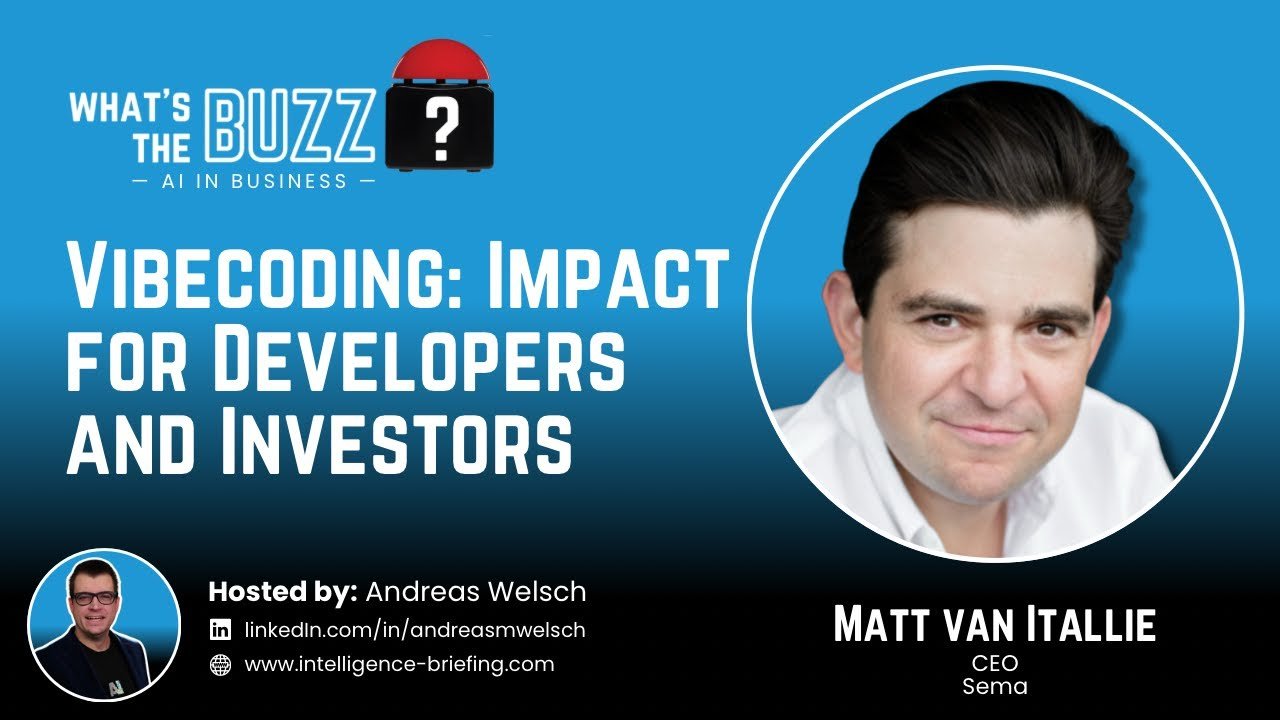
Guest: Matt van Itallie, CEO of Sema
Host: Andreas Welsch
Episode: What’s the BUZZ?, Season 4, Episode 8
Published: April 1, 2025
Episode Summary
Matt van Itallie, founder and CEO of Sema, joins Andreas Welsch to answer whether vibe coding is safe for enterprise software and what it means for developers and investors.
Matt separates vibe coding, which uses only natural language to create and edit code, from the wider practice of GenAI-enabled software development. He sees product management as the place where vibe coding has taken off most, because it lets teams prototype without taking time from engineers. He names four risks of GenAI code: security, code quality and maintainability, copyright protection, and exit risk in technical due diligence. He closes with Sema benchmarking on how much GenAI code investor-backed companies use, and a case for blending human work into GenAI output.
Key Takeaways
- Matt says everyone should try vibe coding, or vibe writing if coding feels like too much, because the faster you understand AI, the better you grasp its capabilities and limits.
- Matt calls vibe coding a spectacular way to enable prototyping, especially for product management teams that want to get to testing faster while protecting engineers’ time.
- Matt names four risks of GenAI code: security vulnerabilities, code quality and maintainability, a lack of copyright protection under certain circumstances, and exit risk in technical due diligence.
- Matt says pure GenAI code is extremely risky in enterprise settings. Developers must stay in the loop and blend GenAI output with their own work.
- Matt reports that, in Sema’s benchmarking of investor-backed companies, the median organization starts about 11% of its production code with GenAI, and pure, unmodified GenAI code is at most 3% to 9%.
Timestamps
- 00:48 Matt introduces himself and Sema
- 02:09 The icebreaker: if AI were a band
- 03:56 What a code analyst makes of the vibe coding trend
- 04:36 Matt’s own experience with vibe coding prototypes
- 07:02 Who vibe coding is for and how far it democratizes software development
- 08:41 Product managers prototype without waiting for engineering
- 10:13 Will developers lose relevance to AI?
- 14:45 The four risks of GenAI code
- 17:04 Exit risk in technical due diligence
- 18:28 What investors and private equity firms look for
- 23:06 Sema benchmarking on GenAI code usage
- 25:26 The Goldilocks zone for GenAI code
- 26:10 Matt’s three takeaways
About Matt van Itallie
Matt van Itallie is the founder and CEO of Sema, a software company that brings executive insight into engineering for non-technical audiences in the C-suite and on the board of directors. He describes himself as the son of a math teacher and a computer programmer, and says Sema has helped analyze codebases for the last eight years.
Full Transcript
Read the full transcript
Andreas Welsch: Today, we’ll talk about vibe coding and its impact for developers and investors, and who better to talk about it than someone who’s actively working on that, Matt van Itallie. Hey, Matt. Thank you so much for joining.
Matt van Itallie: Thank you so much for having me. I’m really excited to be here.
Andreas Welsch: Wonderful. Hey, why don’t you tell our audience a little bit about yourself, who you are and what you do.
Matt van Itallie: Sure. So I am the founder and CEO of a software company called Sema. What we do is bring executive insight into engineering, demystify engineering and software development for non-technical audiences in the C-suite and on the board of directors. I’m the son of a math teacher and a computer programmer, so I was born to treat code as data. I have had the great pleasure, through Sema, to help analyze more than a trillion and a half worth of code bases over the last eight years.
Andreas Welsch: Wow. That sounds impressive. So I’m super excited to have you on. Should we play a little game to kick things off?
Matt van Itallie: Absolutely. Let’s do it.
Andreas Welsch: Okay. What do you think? If AI were a band, who or what would it be?
Matt van Itallie: If AI were a band, who or what would it be? It’s probably a cop-out to say electronica. Who are the folks who do “Whip It”? Is it Devo? Normal, but also kooky. That is how I think about AI. It is human-like, but also kooky in some surprising ways.
Andreas Welsch: I love that. That’s a great answer. I’m always surprised with what my guests come up with when I ask these questions and what the analogies are, but that’s definitely a great one. It seems that the internet lately has gone pretty crazy in the last couple of weeks about a new trend, right? And lots of people are having a good time with that too: vibe coding. With a few prompts and the right tool, anyone can quickly build an app, and pretty much any app too, right? All you need is an idea and an AI tool that can generate the code for you. Now I know you’ve been in this space for code analysis for a number of years, like you said. I’m just curious, what are you making of this trend as somebody who professionally looks at these types of things and helps companies understand how good their code is, and is it usable and is it modern and all these kinds of things?
Matt van Itallie: Exactly. I always like to start with the personal take. I, myself, have been trying out vibe coding and have used it to build simple prototypes of applications over the last few months. I absolutely understand what the buzz is about. I am pretty technical but definitely not a professional software developer. Using these vibe coding techniques, I am able to take an idea, heavily refine it first, and then produce working code that is live, just through my own efforts. It’s personally incredibly exciting to be able to build that way, to have outputs that are accessible to me that weren’t accessible before. It’s also really helpful to our business, to be able to take prototyping to the next level by showing real products in the wild, so to speak. It makes what we’re building next come alive much more than ideas, words on a page or images, or even a clickable prototype. A real live app really goes a long way.
Andreas Welsch: I have a couple of follow-ups for you in a second, specifically around prototyping. I’ve been experimenting with vibe coding as well, and spent a couple of long nights, short nights, depending on how you look at it, going down the rabbit hole of getting excited about something that I built in a couple of minutes and then spending hours trying to get it to where I really want it to be. I’m just amazed and excited by the opportunity too. You know me. I learned about software development in college. I did some scripting when I was in an IT organization. I’ve never really been a professional software developer. Like you shared, I know enough about how you write code and what the different elements and functions and variables and constants are and what they do. So being able to have that booster and do that much more quickly, I can only share the excitement. It’s amazing these days. But I’m curious: you work with a lot of startups and founders, probably among many other kinds of companies. Who are you seeing vibe coding actually for, and to what degree does it democratize access to software development?
Matt van Itallie: Yeah. I use the very narrow term of vibe coding to mean only using human-language-based techniques to produce code and only editing it through the human language interface. That is a particular subset, a very important and obviously very sexy subset, of the overall approach of GenAI-enabled software development, which involves not only perhaps starting with a human language interface but then using professional software development techniques to modify. In the strictest definition, there is absolutely a democratization, with many non-coders actually trying to build full and complete applications just through vibe coding. I believe the latest from Y Combinator is that maybe 10% of their products, if I understand it right, from their recent class are almost 95% GenAI-generated code, and they’re able to generate some meaningful revenue from it. We also know that inside product management functions within organizations, vibe coding has skyrocketed, which makes sense. Traditionally, product managers would build very detailed requirements and then turn them over to an engineering team. For prototyping, now for prototypes, and we’re going to talk about the risks and the limitations of vibe coding, but certainly for a prototype that just needs to get the idea across, product managers are able to do that themselves and skip a step. Thinking about how busy our developers are, this removes some of the lower priority work. Software engineering is so valuable, and what they do is so valuable. Anything we can do to take non-essential work away from them and let them focus on the hard stuff, the meaningful stuff, is good for them, good for the organization, and ultimately good for users. So I know from our experience, and more broadly, product management is probably the place where vibe coding has taken off the most significantly at the enterprise level.
Andreas Welsch: That’s exciting and still also a little bit concerning. I could imagine software developers saying, “Well, if anybody can do what I have learned and trained, or maybe even they think they can do it but they actually can’t, because I have spent years honing my craft.” Where do you see this going? There are certainly leaders out there, leaders of AI labs, who say that by a certain point in time in the not too distant future, we will only be using AI to code and software development is losing relevance. What do you make of that?
Matt van Itallie: I studied history in undergrad, and I take a longer-term historical view here. Let’s say 70 years ago, to be a computer programmer meant to manage punch cards and keep track of them and make sure they were sorted, and then feed them into the computer. You were a computer programmer and you literally were working on these cards. Since then, in no particular order, came version control systems and IDEs, like workspaces where folks can get work done, and open source code, where you pull what you want to build so you don’t have to build it yourself. In that sense, the history of software development is one of greater and greater abstraction, where you know the idea and then you have more and more adept tools to carry it out. Even before the rise of AI for coding, if you take the ratio of software developers working on the Apollo mission, the NASA space control systems in the seventies, and you compare that to the number of software engineers working at SpaceX, individual coders are something like a thousand times more productive over that time period. AI is a continuation of that. We all believe it’s a greater acceleration of what is possible. But I think the nuance is in the understanding of how to manage edge cases, how to manage a complex system, how to handle existing code. It’s different perhaps if you’re starting with new code and how far you can get, but to take existing systems that are powering everything we do, since software has been eating the world for some time, developers will remain extremely critical in managing enterprise systems. They’ll be empowered by AI, but they’ll remain absolutely critical.
Andreas Welsch: Something that I’ve experienced firsthand, and I feel it aligns pretty well with some of the research in other areas when it comes to GenAI use: AI helps those that have a certain level of proficiency be even more productive, but it also helps those who are more at an entry level get to a similar level as those that are proficient. When I vibe coded my business simulation app, I felt like it was propelling me and accelerating parts of what I know, because I know where some of the gaps are, where some of the issues are, or when I ran into issues, I could troubleshoot or had an idea what to look for and how I can tweak it. So I think you absolutely have a point there. If you are a professional software developer, this helps you accelerate what you do. On the other hand, you need to have that knowledge so you can also either counteract or figure out why it’s not working exactly as you want it to, and guide it too. It’s almost like pottery. Not sure how many software developers will like that statement, but we’ll figure that out in the comments. Now, you mentioned prototyping, right? It helps you if you’re in product management, or maybe if you want to create a sales demo or just show the art of the possible to some extent. But I’m concerned that people might take this a step further and say, “Well, it’s not just the art of the possible, it is the possible, and we deploy it and we maybe monetize it. We put it out in the open. We have a new app.” But maybe they have not applied the same rigor that professional software developers today would apply. What unexpected challenges do you see that novice coders might run into?
Matt van Itallie: Yeah, so there are four primary risks for using GenAI to code, whether it’s vibe coding, purely using natural language, or using GenAI as a start and then also coding directly. The risks are greater with pure vibe coding for sure than with GenAI-enabled or enhanced coding. The first is security risk. GenAI code leaves behind or introduces security vulnerabilities that let bad actors act or information leak out. By the way, so does all kinds of code. So does human-written code, so does open source code. The point is not that one way is necessarily riskier than others, but that they all need a human in the loop. They need a review in order to manage that risk. A second is code quality, maintainability and accuracy. Again, a prototype might have a simple number of use cases, but to get the edge cases right, and if you’re going to use it in an enterprise setting for sure, it needs to be exactly right. Getting it close really doesn’t cut it. Coming along with that, there’s such an increase in volume of code because it’s so easy to just have the system spit out so much code that it becomes harder to understand and therefore harder to maintain. Then there are two other issues that are at least relevant in specialized situations. The third is that GenAI code will, under certain circumstances, likely not get copyright protection, a form of intellectual property protection. For enterprise organizations who copyright their code, this isn’t about copyright infringement but copyright protection. It seems increasingly clear that they’re going to have to change their approach to IP management and emphasize the importance of software developer involvement in the code itself. If you’re listening to this and you work at an enterprise that copyrights code, please go talk to your lawyers to make sure they’re helping you on a go-forward plan. The fourth and final reason is something we call exit risk. Exit risk is the possibility that, if you’re trying to sell your business, organizations conducting technical due diligence, which is to say looking under the hood at the code itself, might conclude, “Well, if your code was entirely vibe coded or GenAI generated, what are we buying? We can just produce this ourselves.” Think about a professor assigning a term paper. The analogy breaks down a little bit, but the student comes back and the professor says, “How much did you do?” and the student says, “I just fed it into an LLM and it spit out the answer.” That’s of course unethical, although I guess good on this student for telling the truth. But it certainly does not in any way suggest there is intellectual knowledge in the underlying document. That’s the very real risk in diligence situations. By the way, it’s already begun to happen, where organizations are walking away from deals where the code is almost entirely GenAI generated.
Andreas Welsch: And what are some of the reasons why they’re walking away? Is it because there’s no actual IP in the business?
Matt van Itallie: Yeah. There’s no IP. If you can prompt your way to code, nothing’s stopping the buyer from building it themselves.
Andreas Welsch: Yeah. Now, even before vibe coding was a thing, I think investors and PE firms, and I know you’ve worked with some of the largest PE firms on the planet, started to get interested in this composition: how much is actually human coded, how much is AI coded? What are some of the other reasons? You mentioned IP as one part, but why should one be careful there on one hand with vibe coding, and have the human in the loop?
Matt van Itallie: Yeah, exactly. Humans in the loop. Speaking of another reason why developers remain so essential, they are the best way to address all four of those risks. On the security risk side, there is in our view a presumption that if the GenAI code has not been modified, that means it has not gone through a security review. It’s not feasible for code that comes straight out of the LLM to be security risk free. So there’s a default presumption that sellers would have to justify. Having humans in the loop, obviously involved in modifying or blending that code instead of using it pure, is at least a signal that they are addressing security, quality and maintainability. Same thing if it just came out of an LLM: there’s a presumption that it hasn’t been deeply understood and the edge cases haven’t been added. So the human blending really makes a difference on exit risk. There is a huge difference between code that started with GenAI and was modified, which is to say pure GenAI becoming blended GenAI, and GenAI code that stayed pure from the beginning. It makes a really big difference in terms of the likelihood of the intellectual property. And then finally, on the intellectual property risk side, the copyright side, this is not legal advice. You should most certainly talk to your lawyers if your organization seeks copyright protection. But the US Copyright Office announced earlier this year that prompting is not enough to get that protection. You need to have humans actually creating the work. Human involvement is a fundamental component of that IP protection.
Andreas Welsch: Thank you for sharing that. I really appreciate how you’re speaking with depth and experience on what you’re seeing in the market. It sounds so easy on one hand. Soon enough we won’t be coding, AI will do all the work in so many different sectors and professions, and software development is one as well. But then when you look under the hood, like you just did, and you say IP, security, exit risk and so on, those are real risks, especially if you want to sell your business at some point or you want to sell your app to an investor. We’ve already covered a lot of ground, from vibe coding as this cool new trend, where you don’t have to be a programmer and you can just instruct the LLM or the tool to create an app for you using natural language and refine it. You either should know what you’re doing, is what I’m hearing, or you should know somebody who can help you figure out what you’re doing and that you’re doing it right, so that you’re protected further down the line. What are some of the other things that you’re hearing in the industry when it comes to GenAI coding, especially as far as investors, PE firms and private equity are concerned? What’s top of mind for them?
Matt van Itallie: Yeah. I’m happy to share with you and your audience the results of our benchmarking, which we believe is some of the first benchmarking there is on GenAI code usage, certainly among investor-backed companies. What we found, at enterprise-grade code, for the large part among investor-backed companies: for the median organization, and I’ll just get it right, organizations are using GenAI to start about 11% of their production code. That’s the 50th percentile. The 25th percentile is 6% and the 75th percentile is 16%. So half the organizations are between 6% and 16% starting with GenAI. The pure GenAI code, where it started with GenAI but has not been modified, is at most between 3% and 9% of the code. To us, that is a really good sign, because it means everybody’s getting the message that starting with GenAI code is a good idea in at least some circumstances, which we most certainly agree with. But my goodness, pure GenAI code is really risky and should be kept to the minimum in enterprise settings like this. Developers know code is a craft. It is not just reducible to a mechanical process, and they know they have to be involved to make sure it’s correct and that they are building the right thing and building it with care. The organizations they are a part of have also gotten the message that GenAI is a very powerful tool and it’s only going to grow in importance in the developer’s toolchain. But my goodness, that needs to be done with care and precision in the production stack, when the code that actually gets used by enterprise users is concerned.
Andreas Welsch: The question that I wanted to ask earlier goes in the same direction. When you hear again that AI is going to make coding not just easier but automate it, and then you hear about the risks on the one hand, that it’s not as simple and not as straightforward, especially not if you want to patent it or copyright the work that you’re doing, take it with a grain of salt. And on the other hand, to your point, the data seems to show that it’s already a great starting point to build upon, to refine and to extend. So a good happy medium, as in many things in life, right?
Matt van Itallie: Exactly. We say the Goldilocks zone. Literally, we explain to our clients that with too little GenAI code, you are missing out on a great opportunity for productivity, for job satisfaction, for all of the above. But too much, and certainly too much pure as opposed to blended code, and you’re opening up the organization to some real risk.
Andreas Welsch: Now, Matt, we’re getting close to the end of the show today, and I was wondering if you can summarize the key three takeaways for our audience from our episode.
Matt van Itallie: All right. Certainly number one is that if AI was a band, it would be Devo. Wait, that doesn’t count. Number one, everyone should be trying vibe coding, and if that feels like too much, just try vibe writing. Have it produce an article for you in human language. Everything we’re doing these days, everything we’re doing electronically at least, is going to be AI enabled if not AI based, and the faster you can wrap your head around it, whether it’s picking a movie or doing something at work, the easier you’ll be able to understand its capabilities and its limits. That could be through vibe coding if you want to build something or see what it’s like. Give it a shot. But if not, pick something and put it to work. Everyone has to be AI enabled. You’d just be massively missing out, again, whether it’s vibe coding or not. Second, vibe coding in particular is a spectacular way to enable prototyping, and especially to help product management teams get to testing faster, in particular by protecting engineers’ time. And third, GenAI coding in general and vibe coding in particular is incredibly dangerous in enterprise settings. To mitigate that, you must have a human in the loop, and you must have developers blending that GenAI code. Pure GenAI code is extremely risky and, in our view, should not be used in enterprise settings beyond a de minimis amount.
Andreas Welsch: Thank you so much, Matt. It’s been a pleasure having you on and learning from you, and hearing all these insights from you on how you can use GenAI as a developer and also what it means if you’re an investor, if you’re trying to sell your app to an investor. Things that we should all be aware of, especially in the enterprise. Matt, thank you so much for joining us.
Matt van Itallie: Thanks so much for having me. I really enjoyed it.
Andreas Welsch: Wonderful.
Listen and Subscribe
Related Reading
Frequently Asked Questions
What is vibe coding?
Matt uses the narrow definition: producing code using only human-language techniques and editing it only through that human language interface. He calls it a subset of GenAI-enabled software development, which can also start with a human language interface and then use professional software development techniques to modify the result.
What are the main risks of using GenAI to write code?
Matt names four: security vulnerabilities, code quality and maintainability, a likely lack of copyright protection under certain circumstances, and exit risk, where a buyer doing technical due diligence concludes it could produce the code itself. He says the risks are greater with pure vibe coding than with GenAI-enabled or enhanced coding.
Why do buyers walk away from deals where the code is mostly GenAI generated?
Matt says there is no intellectual property if you can prompt your way to code, because nothing stops the buyer from building it themselves. He reports that organizations have already begun to walk away from deals where the code is almost entirely GenAI generated.
How much of their code do investor-backed companies create with GenAI?
In Sema’s benchmarking, Matt says the median organization starts about 11% of its production code with GenAI, with a 25th percentile of 6% and a 75th percentile of 16%. Pure GenAI code that was never modified is at most between 3% and 9%.
Will AI replace software developers?
Matt expects developers to remain extremely critical in managing enterprise systems. He points to the history of software as one of greater abstraction and says that managing edge cases, complex systems and existing code still needs developers who are empowered by AI.