

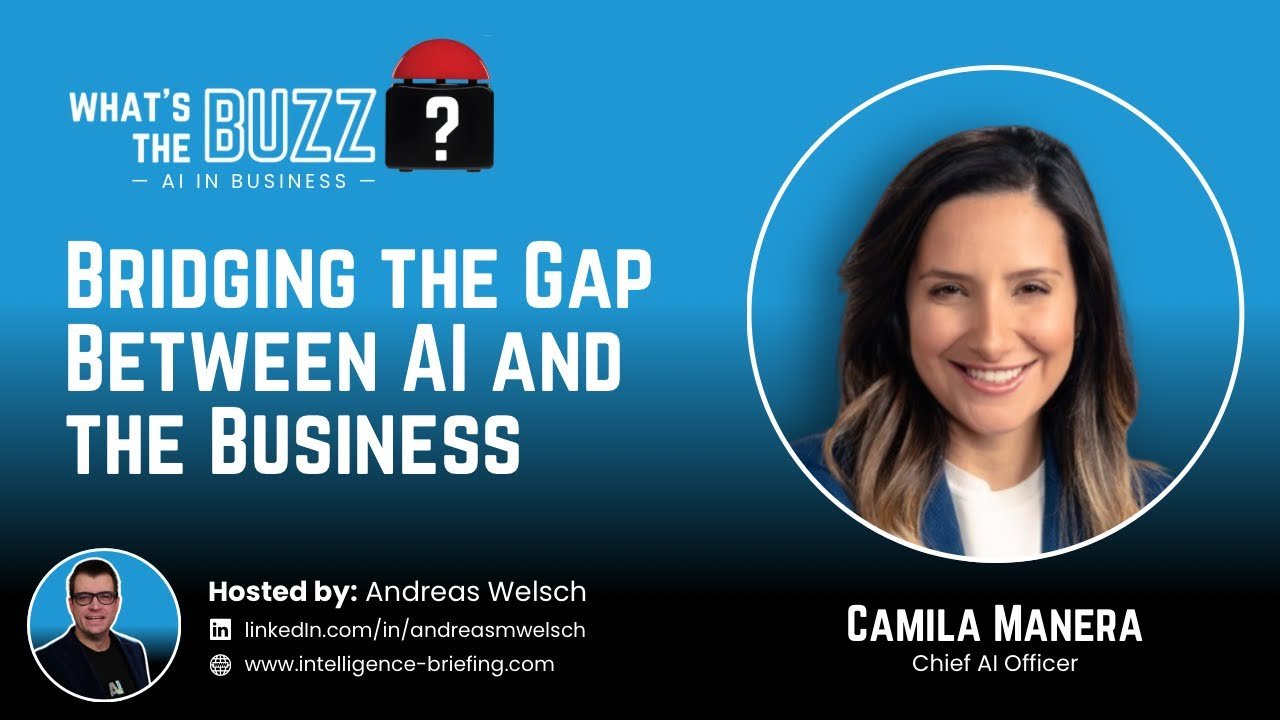
Guest: Camila Manera, helps companies use data and AI; former Disney data scientist and co-founder of an AI sports startup
Host: Andreas Welsch
Episode: What’s the BUZZ?, Season 4, Episode 9
Published: March 25, 2025
Episode Summary
Camila Manera, who helps companies use data and AI and started as a data scientist at Disney, joins Andreas Welsch to answer how business and AI teams can work together. She argues that every team needs someone with AI skills, whom she calls the AI translator, so that projects do not wait on a central IT or data roadmap.
Camila describes listening as the first step of any AI project and sees companies in Argentina and South America moving from experiments to implementation in 2025. Andreas and Camila also weigh the promise of agentic AI against how slowly companies adopt it.
Key Takeaways
- Camila recommends an AI translator: a person with AI skills and knowledge in every team, so teams can run their own projects instead of waiting on the roadmap of a central IT or data team.
- Listening comes first. Camila built her first AI project at Disney by sitting with people, listening to their problems and asking questions until the underlying problem surfaced.
- Culture and communication about change are the biggest challenge. Camila says leaders should create the vision and think about culture before implementation.
- Camila sees companies in Argentina moving from learning and small experiments last year to implementation this year, and cites the statistic that only three of ten AI projects go into production.
- Andreas notes that agentic AI adoption trails the headlines, and Camila advises centering on what the company and its culture need with a long-term vision, not a one-month AI implementation.
Timestamps
- 00:09 Getting business and AI teams to work together
- 00:43 Camila Manera joins the show
- 01:15 Camila Manera on moving from design to data science
- 04:00 Icebreaker: if AI were a book
- 05:36 Why business and AI teams talk past each other
- 06:40 The AI translator role in every team
- 10:28 AI adoption in Argentina and South America
- 13:48 How leaders should work with the business on AI
- 17:25 Will agentic AI help or hurt collaboration
- 22:40 Adoption is slower than the headlines
- 23:45 Headlines that matter for business and AI teams
- 27:05 Key takeaways
- 28:08 Wrap-up
About Camila Manera
Camila Manera is from Buenos Aires, Argentina. She is a graphic designer by profession who moved into AI about eight years ago, starting in the creative team at Disney and then becoming a data scientist there for more than seven years. Her team launched a product that won the Best of Disney Award in technology, data and AI.
She then co-founded a startup that applies AI to soccer, and she now works with companies around the world to help them use data and AI.
Full Transcript
Read the full transcript
Andreas Welsch: Hey, welcome to What’s the BUZZ?, where leaders and hands-on experts share how they have turned hype into outcome. Today we’ll talk about bridging the gap between AI and the business, and who better to talk about it than someone who’s actively doing that, Camila Manera. Hey Cami, thank you so much for joining.
Camila Manera: Thank you. I’m very happy to be here. We have had an amazing time together at a lot of conferences, so I am very happy to share this space with you and all of your audience.
Andreas Welsch: Fantastic. Why don’t you tell our audience a little bit about yourself, who you are and what you do.
Camila Manera: I am from Buenos Aires, Argentina.
Camila Manera: If you don’t know, it’s very much the south of the world. We are in that part of the continent. I am a graphic designer by profession, but I have changed to work in AI for the last eight years. I started my career working for the World Disney Company in the creative team. And one day I woke up and said, I want to study AI before ChatGPT launched.
Camila Manera: So it was eight years ago. At that time it was very hard to find courses and places to study AI. So I went to India to study there, and I had an idea of how Disney could use data and AI. I changed from the creative team to being a data scientist. I was at Disney for more than seven years.
Camila Manera: We launched a product that won the Best of Disney Award in technology, in data and AI worldwide. And after that I resigned and went on to co-found my startup of AI applied to sports. To football, or soccer if you are in the United States. We developed a product to help clubs and agents find the correct player for their squad and their teams.
Camila Manera: And now I have also left the startup and I am working with a lot of companies around the world to help them use data and AI to empower their business and also the careers and objectives that they have.
Andreas Welsch: Awesome. Thank you so much. I’m super excited to have you on the show today.
Andreas Welsch: Like you said, it’s been a while since we’ve been at some of the conferences and panels together, so I’m excited that you have made time to be with us today.
Andreas Welsch: Camila, I remember I forgot to brief you on this.
Andreas Welsch: So there’s a little surprise here. There’s a little icebreaker. And that icebreaker is a little game called In Your Own Words. So I’ll read you this question. And you have 60 seconds to answer. I’m curious, what’s the first thing that comes to mind and why, in your own words. Are you ready?
Camila Manera: Yes, I’m ready.
Andreas Welsch: Perfect. If AI were a book, what would it be? 60 seconds on the clock, go.
Camila Manera: I think it makes sense to compare AI to a book because of its super intelligence and all the information that it has.
Camila Manera: If it were a book, it would be a little bit limited because it would have just that information and that’s all. So I think it would be a word, like transformation. I think I would go with that.
Andreas Welsch: Good answer. Yes. We’ll let that count too. There’s a lot of transformation happening. And sometimes even a whole book of words doesn’t get across what we actually need to convey. Which in many ways brings us to today’s topic, right? It seems that there are so many words and sentences and concepts being discussed in the exchange between business and AI teams and vice versa.
Andreas Welsch: Even though they seem to be speaking the same language, evidently they’re not. A lot of times we see that the technology folks just want to play around with the latest stuff. And on the other hand, the business doesn’t even know what’s new and what’s hyped, what’s cool and what we can do.
Andreas Welsch: But it’s all a matter of bringing those two together, right? When 80 to 85% of AI projects fail or don’t deliver the value. And we see AI is getting cheaper and that will create more demand. I also feel we’ll see even more pressure on AI teams to do something with AI, to deliver projects.
Andreas Welsch: But if they’re not already communicating well enough and understanding what the requirements are and what we’re actually building, that just leads to more failures, I assume. What issues do you see in your work, or have you previously seen in your work?
Camila Manera: I think the problem that most companies are having right now is about what I like to call the AI translator.
Camila Manera: You have a lot of teams that have a lot of problems and perhaps a lot of ideas. But previously it was most common to call the IT team or the data team. And when they want to move ahead with some projects, they don’t know who to call, whether there is a person inside the company who carries the AI strategy or the projects.
Camila Manera: I think that is a problem at the starting point of any project. And from the other side, if they call the technology team or the data team, they have a roadmap or a timeline. And when they want that project to jump in, the answer is, let’s talk next year. And now we are not in a moment where we can wait for one year.
Camila Manera: So my vision in this moment, with the AI hype and everything that is going on, is that we need to have somebody with AI skills and knowledge in every team inside the company. That would help a lot to be more independent.
Camila Manera: To carry on their own projects, because now with all the tools that we have we can have that type of structure. The sales team, perhaps, has somebody with an understanding of AI inside the team and they would go much faster. They will have independence and also somebody inside the company who carries the strategy.
Camila Manera: So not having that at the table of conversations and decisions now makes teams go a little bit slow. And also be a little bit afraid of what to do, what not to do, if they can use tools or not, if they’re secure or not. So I think that we are in that moment of the process.
Camila Manera: And without these profiles inside the company, I think the adoption is going to be a little bit slower than we all want, because we want to do a lot of things and go much faster. But we need to think about the culture, the teams, and the structure and how they adapt to all the new things that are going on.
Andreas Welsch: I think that’s a really important point that you’re making, right? There’s so much push and so much pressure to do something with AI. And just seeing how companies and leaders have evolved over the last three years when it comes to AI, from what is this generative AI thing, to we need an AI strategy, to let’s pilot a bunch of things and see what we can actually build and if there’s something meaningful and useful out of it.
Andreas Welsch: To now actually saying, show me the money. But it’s not just show me the money. It’s also I need to invest in training and in that cultural change, like you’re saying, to bring people along on their journey. It’s not just about giving them a new tool and expecting them to be more productive the next day.
Camila Manera: I think the key is to have a very solid idea and ambition and not to do things all separately, but have a vision of where you want the company to go and really create an AI journey for the company. That is my desire, but it’s a little bit difficult to achieve.
Andreas Welsch: I’m curious there, what are you seeing in South America? What are you seeing in Argentina, maybe specifically? I know that the continent is very innovative and very forward-leaning when it comes to these technologies, with lots of opportunities. What are you seeing when it comes to AI adoption?
Camila Manera: I think we are a very high-talent region and also a high-talent country. I have the chance to meet very young people with very strong AI and technology skills. But I think we need to be a little bit more empowered and expanded in what we do, because the region does not have many resources and things are more difficult for us to achieve.
Camila Manera: So everything is a little bit harder for us. When I work with companies, trying to help them achieve their AI goals, they all started last year with something very small, to be on trend. But they were not thinking in terms of a long-term vision for the project.
Camila Manera: I think this year that is changing a little bit and we are more in the year of implementation. Last year we were more in, I want to listen, I want to learn, I want to go a little bit slower in the implementation. But this year it’s changing.
Camila Manera: And now companies reach out to me and say, I want to do this. That is the biggest change I’m seeing. I think it’s very good for not just Argentina but the region, because we are going to start seeing a lot of use cases, products and projects that are more hands-on than last year, which was more experimental. There is a very bad statistic that of 10 AI projects, just three go into production. So I think this year we are going to go from ten to five perhaps. That’s good because we are going to go up a little bit in numbers.
Camila Manera: We are a passionate country and also region, but we need to create more ecosystem and more connections. I am working a lot on that in the country and the region, to have meetups, to learn from others, to listen to other stories, in order to incentivize the region to achieve this step. Because I think if we make that happen we are going to have a lot of business opportunities and we have very good professionals here in Argentina.
Andreas Welsch: That’s really exciting, right? And I think that speaks also to the broader community and how you can bring people along on their journey, not just within your company, but to your point, within your region, within your country, to get them excited about this too.
Andreas Welsch: Now, look, I come from a tech background myself, and it’s super exciting to see what a new kind of technology can do for you and where its limitations are. I’m wondering how you recommend that leaders and their peers work together with the business on these AI projects?
Camila Manera: I think we are developing a very old-school ability, and that is listening. I think we are in an era of needing to be very good listeners. Because it’s very human, the first part of implementing an AI project is seeding. For example, my experience when I created the first AI project at Disney was that I sat with a lot of people and just listened to their problems. And I asked good questions, and over time you start understanding and going very deep into the problem the other team or person has.
Camila Manera: And that is not any tech, it’s just a human skill. Because when you have a first conversation with somebody and they say, this is my problem, you ask a lot of different questions and you start understanding that the problem is another problem that they have but did not realize they have.
Camila Manera: So I think that is the starting point of anything, regarding business problems and also leadership strategies. And once you have that, understanding the pipeline, the roadmap and the projects is the easiest part. But you also have to work on the culture and on how you are going to communicate the changes that these projects are going to bring.
Camila Manera: And all the more on the human side of implementation. I think that is now the biggest challenge we are having, because we are telling a lot of people to forget the 20 years of work they have been doing and that now they have to do things completely different. So I think we have to be very careful in that part of the transformation. It is chaotic. We receive a lot of information about the models and everything, and for final users it’s very confusing. So I think leaders and the business have to create the vision, think of the culture, and after that the implementation is going to go very smoothly.
Andreas Welsch: That sounds great. And again, it emphasizes that you need to work together. You really need to start to listen in and understand what it is that my stakeholders are actually looking for. How can we help them improve their business, improve their process and help them work better and more efficiently?
Andreas Welsch: And I think sometimes we tend to forget that in all of that mix of technology and the excitement on one side or the fear and concern on the other. And, hey, we’re actually just people working together and trying to figure this out.
Andreas Welsch: It also wouldn’t be an episode in 2025 if we didn’t talk about the industry’s favorite buzzword of the year, agentic AI. How do you see that making things better or worse in that collaboration?
Camila Manera: I think it’s going to be very good for businesses, because for the last years AI has been evolving very fast. First we talked about AI, then we talked about Gen AI.
Camila Manera: Then we have the Shipt perplexity deep and all the language. For a battle. And now we have another thing that is agentic AI. If we think about it going backwards in the line, it all makes sense. Previously we talked about data, because we need the data. Now that we have the data, we can develop models. Now that we develop models, we can create new stuff, and now we can make them operate for ourselves.
Camila Manera: If, for example, we have a lot of different needs in the day as professionals, we could have different agents to resolve different kinds of problems. We all want that. Because now we have to be very complete professionals. We have to study, things are changing all the time, we have to develop content. We are here doing that also. So I think the professional scope has changed a lot and we do so much more than before.
Camila Manera: Thanks to all this technology that is evolving very fast, if every human can have their own circle of agents resolving things that we don’t want to do, it’s going to be great. That is where we start putting the limits. These things, yes. These things, no. I want to go faster at this point because I don’t like it, but perhaps other people like to do that.
Camila Manera: So that’s why I think it is good, because we are going to set our limits depending on what we enjoy of our day-to-day and what we do not. That is my vision, because I’m very optimistic about AI. But other people are going to say, this is going to take a lot of jobs, and that is not my point of view, because I think that we drive the tech and not the tech drives us.
Camila Manera: Although I don’t see a lot of implementation of agents here in the region, I think for the next months it’s definitely going to be the game changer of this year.
Andreas Welsch: By the way, I must say I share your sentiment around adoption, right? There’s a lot of talk in the market.
Andreas Welsch: It seems everybody that’s been doing some kind of machine learning all of a sudden did AI, then they did Gen AI. Now they’re doing agentic AI, and they’ve been doing all of this for a very long time, if you believe them. But I think the proof is still in the pudding. We still need to see more companies adopt this beyond the lighthouses, beyond the ones that say, hey, we’ve been experimenting with this for a while.
Andreas Welsch: We’ve rolled this out. And I think it’s the classic in innovation management, the innovation adoption dilemma. You have a few very early adopters, then there’s a big gap, and then the rest will eventually follow. And I think once that happens it’ll be really interesting to see how that progresses.
Andreas Welsch: I think there’s a lot of opportunity and, as I’m thinking about this, honestly I’m split a little bit. How big is the opportunity, or how big is the promise, compared to what is actually real? We’ve seen this with technologies like RPA, Robotic Process Automation. A couple of years ago, we were going to automate everything in a business, and people started looking at this and said it’s actually not that easy.
Andreas Welsch: We won’t be able to do everything. Part of me thinks, well, are we going to see the same thing with agents as well? Is there just so much optimism and so much hype that we’re not seeing beyond that yet? Have we not seen enough implementations yet? And maybe the truth is somewhere in the middle.
Andreas Welsch: But also here in North America, I think companies are slowly starting to look at this and figure out what this actually is and how they want to use it.
Camila Manera: And I think we are also putting boundaries on everything. We are also in that moment of deciding what is okay and what is not.
Camila Manera: So we are finding the right way to do things with agents also.
Andreas Welsch: Yeah. And I was thinking about this the other day. On one hand we see so much innovation come out on a regular basis. You mentioned a few of the things that were in the news just in January and February, from we’re headed for AGI and we know exactly how to build it, to we are running out of public data to train on, to, hey, here’s this thing called DeepSeek and it’s way cheaper than the Western models and incumbents, to I don’t know what the next thing was.
Andreas Welsch: Grok, GPT-4.5 and so on and so on. So there’s a whole range of news if you want to get into that. Yet I feel the adoption in companies will be a lot slower, because there are risks, there are concerns, there are skills you need to build, you want to try this out.
Andreas Welsch: So on some level there’s more technology than you can adopt fast enough to keep up. Which is an interesting time to live in, I think. Now you mentioned some of the headlines. To me it feels like the last four weeks, yes, there was an Nvidia GTC. Yes, there were a couple of other things, but were there any big headlines that stand out to you, maybe even from this first quarter, that are relevant for business and AI teams?
Camila Manera: I think that from different aspects, all the companies want to show us how good they are or how important they are or how they are the best.
Camila Manera: And I think that is not the scope or the vision that we have to have. We have to center more on people than on companies. This is mainly because people are going a little bit slowly in the adoption, as we were talking about, and having all the time this big tech battle to say I’m the best, I’m the best.
Camila Manera: It doesn’t matter who is the best, what matters is what is best for people. So I think companies have to be a little bit more humanized than they are now, not trying to be in that battle over who is the strongest or biggest. From that aspect, my favorite news of these weeks is all the launches that OpenAI has given, mainly because I think they’re the ones that are going a little bit further in the capabilities of the model, in deep search and in making agents operate.
Camila Manera: Because what is the best answer or the best model now? I’m not sure for now. And also a product that I have been using a lot is n8n, for making some automation, and I think they are making a very good user experience and interface for non-code. I think those are the most important launches of this month.
Camila Manera: I don’t want to go much deeper into Grok or DeepSeek, because I think what they have launched is quite the same and not very innovative in that aspect. But I think OpenAI with the agents and also n8n are the most innovative right now. Although I know that in April we have Google Next, so Google is going to launch, I think, very important stuff for that event. So perhaps that will surprise us a bit.
Andreas Welsch: Who knows? Seems like there’s surprises all around us in this day and age with AI.
Andreas Welsch: Now, hey, we’re getting close to the end of the show and I was wondering if you can summarize the key three takeaways for our audience today.
Camila Manera: First of all, for all businesses that want to apply AI, you need a translator. You need a business AI translator in your company. You have to think of independent structures so everybody can create and develop AI inside the teams.
Camila Manera: Don’t get confused with all the information that is going around out there. You have to center on what your company needs and what your culture needs, and develop long-term vision plans and not just a one-month AI implementation, because if not, you are going to get frustrated on the road. And once you want to get really big changes, you need to have very good long-term strategies.
Andreas Welsch: Wonderful. Camila, it was a pleasure having you on the show. Thank you so much for sharing your insights and your learnings and how business and AI leaders can work better together.
Camila Manera: Thank you. It was a pleasure to be here, to tell you a little bit about how South America and Argentina are developing, and strategies around AI.
Camila Manera: So it was a pleasure for me to share this space with you.
Listen and Subscribe
Related Reading
- AI Leadership for Enterprise Leaders
- Agentic AI for Enterprise Leaders
- AI Leadership Handbook
- Why AI Adoption Starts With Becoming AI-Ready
Frequently Asked Questions
What is an AI translator?
Camila Manera uses the term for a person inside a team who has AI skills and knowledge and can carry the team’s AI strategy and projects. She recommends one in every team, so that teams do not depend on a central IT or data team’s timeline.
Why do business and AI teams talk past each other?
Andreas Welsch observes that the two groups seem to speak the same language but do not. Technology teams want to try the latest tools, while the business often does not know what is possible. Camila adds that without someone with AI skills at the table, teams slow down and hesitate about which tools they can use and whether they are secure.
How should leaders work with the business on AI projects?
Camila says to start by listening. At Disney she sat with people, listened to their problems and asked questions until she understood the real problem. After that, leaders need to build the vision and the culture and to communicate the changes a project brings.
How fast are companies adopting agentic AI?
Camila does not yet see many agent implementations in Argentina and South America, but expects agents to be a game changer in the coming months. Andreas shares her view on adoption: the proof is still in the pudding, and companies need to move beyond the early adopters.