

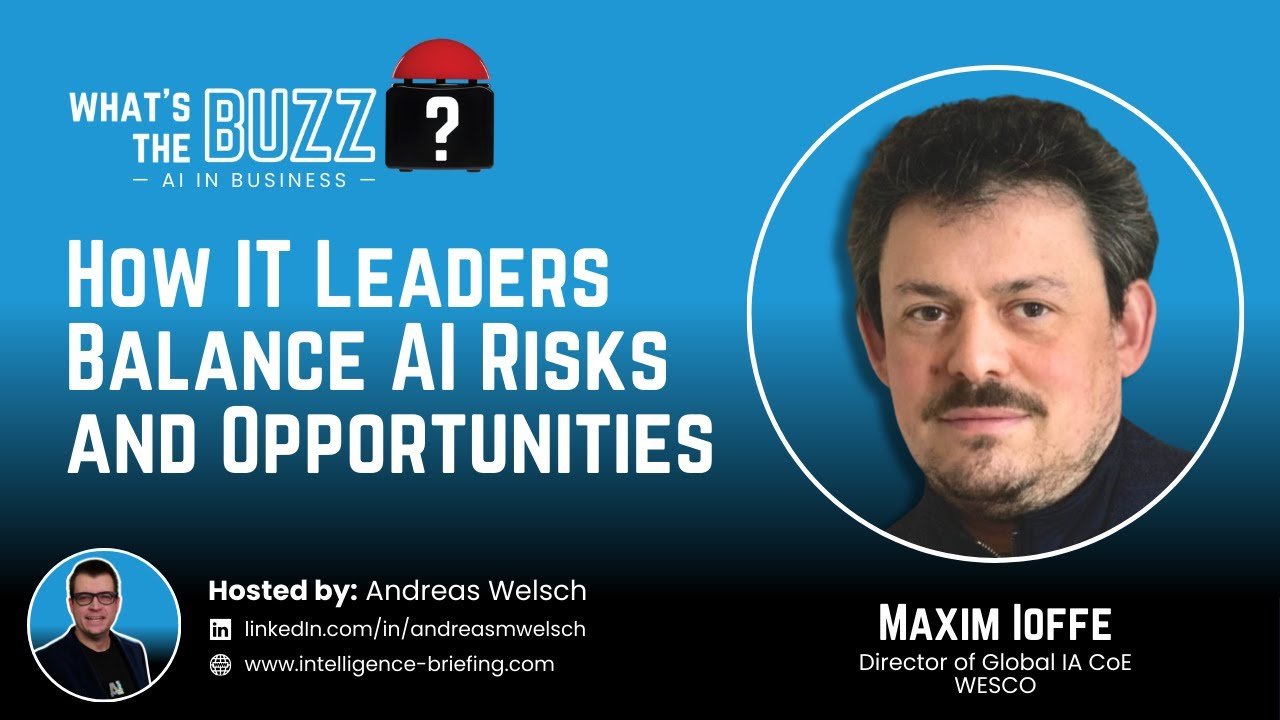
Guest: Maxim Ioffe, Director, Global IA CoE at WESCO
Host: Andreas Welsch
Episode: What’s the BUZZ?, Season 4, Episode 10
Published: April 8, 2025
Episode Summary
Maxim Ioffe, Director, Global IA CoE at WESCO, answers a question many IT and AI automation leaders face: how do you build momentum for an AI initiative while keeping data, risk and cost in view? He names three pillars for a successful program, which are strategy, funding and governance.
Andreas and Maxim then work through how employee education, a consistent intake framework and honest value reporting move AI from science experiments to a program. Maxim also covers who should own AI governance and why the best ideas start with the business.
Key Takeaways
- Maxim names three pillars for a successful AI program: strategy (a mission, a value calculation and a steady stream of processes), funding, and governance. In his words, strategy without funding is more about dreams than reality.
- Governance works as a consistent framework that treats every idea like a factory input, with fixed criteria for security, privacy, data handling and tool proliferation, and one financial yardstick for budget.
- Maxim wants ideas to come from employees, who then present the results to their own executives in their own language, while his team provides the governance, framework, training, implementation and support.
- Maxim reports real dollars that reach the P&L and calls savings that never hit the financial statements “imaginary dollars.”
- Continuous education keeps expectations realistic: Maxim repeats the message often and teaches employees to place a vendor pitch on Gartner’s hype curve.
- Maxim’s closing advice is to measure twice and cut once: settle strategy and governance before buying licenses, signing agreements or starting implementation.
Timestamps
- 0:10 Building momentum for your AI initiative
- 0:45 Maxim Ioffe joins the show
- 1:00 Maxim Ioffe on leading an intelligent automation center of excellence
- 2:20 Icebreaker: if AI were a plant
- 3:24 How AI leaders become an innovation engine
- 3:56 Pillar one: strategy and mission
- 6:08 Pillar two: funding
- 6:40 Pillar three: governance
- 8:37 Employee education and realistic expectations
- 11:38 Running the governance rhythm
- 13:21 Showing value top down and bottom up
- 15:16 Who should own AI governance
- 18:45 Teaching employees what the technology can do
- 21:41 Key takeaways
- 23:18 Wrap-up
About Maxim Ioffe
Maxim Ioffe is Director, Global IA CoE at WESCO. In the episode he describes driving the global intelligent automation center of excellence at a Fortune 200 wholesale distribution company that works with 50,000 suppliers, and says he has run the robotic process automation side of the program since 2019.
He appeared on What’s the BUZZ? before to discuss the center of excellence, and returned to talk about governance.
Full Transcript
Read the full transcript
Andreas Welsch: Welcome to What’s the BUZZ?, where leaders and hands-on experts share how they have turned hype into outcome. Today, we’ll talk about establishing strong governance between technology and business teams, and who better to talk about it than someone who’s actively doing that in their business.
Andreas Welsch: Maxim Ioffe. Hey, Maxim, thank you so much for joining.
Maxim Ioffe: Thanks for having me.
Andreas Welsch: Wonderful. Why don’t you tell our audience a little bit about yourself, who you are, and what you do?
Maxim Ioffe: Sure. My name is Max and I drive the Global Intelligent Automation Center of Excellence for a Fortune 200 wholesale distribution company. It’s about 20 billion dollars annual. We are partnered with 50,000 suppliers, hundreds of thousands of customers, and that’s millions of products. With that scale, there is no shortage of automation, and my mission is to help everybody and anybody to be more effective and more efficient.
Andreas Welsch: That’s awesome. I love that. You’ve been on the show before and we talked about a pretty similar topic, but not quite the one about governance. So we wanted to make good on that now as well. Now, Maxim, in good old fashion, should we play a little game to kick things off?
Maxim Ioffe: Sure.
Andreas Welsch: All right, so let’s do this. If AI were a plant, what would it be? 60 seconds on the clock. Go.
Maxim Ioffe: All right. It’s probably going to be something from the cacti family. It’s going to be difficult to climb. It’s going to be difficult to handle, but if you handle it just right, the prickly pears are pretty delicious.
Andreas Welsch: Wonderful. I love that. Really good answer. And there are all these little spikes, if you don’t know they exist, it can get pretty interesting. Speaking of interesting and some of the spikes that I think business and technologists feel on a regular basis: how do we even work together? We want to do AI, we need to do AI, but how do we actually get everybody around the same table and move in the same direction? I keep hearing these concerns from IT leaders when it comes to adoption. We need to look at the data. We need to mitigate risk, we need to keep an eye on our costs, and how can I become an innovation engine rather than being the brake pads, if you will. I’m curious, what are you seeing in your role? How can IT and AI automation leaders become an innovation engine while still keeping all these things in view?
Maxim Ioffe: That’s a great question. And I don’t think there is a one-size-fits-all answer that would cover every use case, every possibility, everybody and anybody. That’s just not realistic. But I think fundamentally we have a couple of pillars that need to apply to building a successful model. The first is definitely strategic, and the strategy starts with something as basic as a mission. What is the mission of AI? And, broadly speaking, of the automation program that we’re trying to run. I’ll do a simple example. A lot of missions seem to be about, let’s build an autonomous enterprise. Let’s build some sort of a self-driving engine. And then you turn around at the company and the corporate values are talking about people as the greatest asset. And how do you think our greatest asset feels? If we say our mission is to build an autonomous enterprise, right? So crafting that mission, crafting a goal that resonates with business, that resonates with employees, that resonates with everybody and makes sense, is a big part of the strategy. The other part of the strategy is defining what we are after and how we calculate value. I don’t want to use the word ROI. ROI seems to be a little bit limiting for some of those things, but at the end of the day, it is a financial calculation. How do we bring finance in and ask them, help us define the appropriate levers and how to calculate them? So you have the strategy around it. And then the other part of the strategy is probably process selection and evangelizing, so you keep the stream of processes coming. It’s probably not that hard to find the first project to work on. Maybe the first two, three, four. How to get into the hundreds? In our program we had a small milestone. We have 500 ideas in the automation hub that are either implemented or being worked on. And 500 ideas is not the end of the game. It’s just the beginning. We’re going to keep growing, adding more and more. And frankly, 500 is what’s live now. There is a number that were already automated and archived because they outlived their usual lifespan, and there is nothing wrong with that either. So that’s your strategy piece, right? The second pillar is probably funding. How do you go about funding? Because frankly, strategy without funding is more about dreams than reality. You can dream up whatever strategy, but if you don’t have the budget to build it, it’s not going to get built. And on top of that, they’re interconnected. You might have a strategy that requires many millions of dollars, but the budget is much smaller. So be it. You have to adjust the strategy to meet the budget. And I think the third pillar is governance. How do you build a framework where every idea becomes handled as in a factory? It’s not a one-off, where I approach this idea this way and that idea that way. Back to our plant analogy, there are a lot of spikes and a lot of turns, and if you build a process where you handle each one of them in a consistent manner and you know exactly how to do it, so you don’t run into those obstacles, life is going to be a lot easier. And to me, that’s what makes the difference between a program and a science exercise or a one-off attempt.
Andreas Welsch: That’s right. Great point, especially around making it a program and not just a science experiment. And I feel in many cases we’re likely going to see more of these science experiments if people are not yet following that three-step approach because, hey, here’s a new technology, we need to try that out. We’ve seen that with Gen AI. We’re now seeing that with agentic AI, although I think that’s still in its infancy when it comes to evaluation. Your words of wisdom definitely are important here. I also think it’s harder than ever to put proper governance around using AI in a business. You have team members that might already use AI apps on their phones. They might be putting confidential data in there and what have you. Especially if you try to clamp down from a corporate point of view and you say you’re not allowed to use Gen AI because we’re afraid you put data there. Chances are people are starting to use apps on their own phones and they’re still going to put company data in there. And training can be an effective way to raise that awareness. But how do you see IT leaders handling that part of AI adoption, or reckoning that it’s here? How do we deal with that now?
Maxim Ioffe: That’s a great question. And again, I doubt one size fits all, but I would start with something basic as employee education. Prior to this call, when I was talking to new employees about the job of the future, I was talking about, hey, here’s what we can do. Here’s how automation can help you. Hopefully those bits of education coming from me and from my peers (I’m definitely not the only one in the company doing that) help employees understand where it is coming from, where business is coming from, where everybody’s coming from, and the lines of caution. Yes, there are tremendous benefits to AI. Yes, there is significant risk to AI, and there is security, there is compliance, there are biases. But as you educate the employees, a couple of things happen. One is that the pipeline of opportunities becomes more realistic. How often do we get approached by an employee saying, I want to build an AI model that will do something? And you start asking the questions: do we have the data? No, not really. Do we have the process? No, we don’t really have a process. Do we have a good understanding of how things connect? You’re the AI guy, you should be able to figure it out. Oh, it doesn’t work that way. On the flip side of it, to your point, there needs to be, in my opinion at least, a very consistent framework. Here are the things that IT is looking for before they allow an AI solution. And it has to do with security, it has to do with privacy, it has to do with handling data, it has to do with every aspect that IT and security and infrastructure are concerned about. It also has to do with tool proliferation. Everybody seems to have an IDP solution. If we have 30 companies doing intelligent document processing for us, are we gaining anything, or do we want to standardize? All those different things are important. The financial calculation needs to be, again, the same yardstick. This is back to my governance standpoint. If you have that yardstick that says if we do this project, we’re going to save X, that determines the budget for building the implementation. The implementation should not cost more than that. Otherwise it’s a negative ROI implementation right there. And if you get all those pieces together, you have IT governance saying, here’s what we need in order to allow it. You have business employees who are educated enough to bring real examples and to separate the hype from reality, and you have consistent metrics on the value it brings. The problem becomes a little bit easier. Again, it’s the difference between a science exercise where the loudest voice gets the project, versus approaching it methodically. We know the ROI. We know the governance, we know the strategy, let’s go build it. And if it all fits together, it becomes that factory setting.
Andreas Welsch: So how do you do that? How do you get into that rhythm? Do you set up a formal program? Do you meet on a regular basis? Who do you invite? What do you review?
Maxim Ioffe: I don’t know if our example would work for every company. What we do is meet on a regular basis. Prior to intakes we worked very diligently and very hard to build rules of engagement, and I will speak from my experience on the intelligent automation program. On the RPA side, since I’ve been doing that since 2019, we met, we built the framework, we tweaked the framework, we got the framework. Every new idea I can get through approvals in a matter of minutes. Literally. We’re not there with AI yet. It takes longer, but that’s the aspiration. There has to be a matrix that you populate to say, does it fit? And if the answer is yes, it fits on every account, it just goes. If the answer is yes, except for this one point, we need to discuss just this one point. But you have to make sure that the boundaries are set. The boundaries don’t move, and business needs to respect the boundaries. I’m not an IT security person. I may not understand all the implications. I cannot speak to everything around security, so I trust the professionals to do that. They tell me what needs to happen, and I make it happen in order to move forward. That’s part of the governance framework.
Andreas Welsch: And how do you bring that transparency into the organization, if you collaborate with your business stakeholders, to also show and demonstrate the value that your teams are bringing from an automation and an AI point of view?
Maxim Ioffe: I think there are two answers here. One is top down. I use every opportunity, and I direct my reports to talk about the program, our existence and what we can deliver. I do the same thing bottom up, where most of the ideas come from the employees. And I want the employees to be our investors. I want the employees to go to their managers, to their executives and say, look at the cool automations we built. Look at this cool agent, or whatever solution it is that we implemented. Look how it helps us hit the goals. I will not be able to speak the language of every executive. I’m not an HR professional. I’m not a legal professional. I’m not a sales professional. I’m not a supply chain professional. I know enough to be somewhat dangerous, but I’m not a professional there. So let the employees who do the work be my spokespeople. They will use the right language, and they will communicate the ROI much better. My work is to provide the governance, the framework, the training, the implementations and the support. But let the others do the sale. I think that’s a lot more efficient and effective. But again, I might be in a unique position where I’m able to do it that way.
Andreas Welsch: Yeah, I really love it, especially the part about empowering employees to identify where the opportunities are in their business processes, in the area that I’m deeply familiar with. And I remember last time you were on the show, we talked about what you need to do from a center of excellence point of view. So your pipeline of ideas doesn’t dry up. That goes hand in hand with that topic. Absolutely. You mentioned governance, and who should own that AI governance, and what other teams do you need to have around the table? I think you already mentioned a few, but are there others in finance or HR that you have in your business program?
Maxim Ioffe: There are many players out there, and I don’t have a good answer for who should own it. I think it depends on the company. In some companies it’s better with IT, in some companies it might sit better with some sort of value realization office and the CFO organization. It might be the executive branch. It doesn’t really matter where it sits. It’s all about that collaboration. Because ultimately there is a lot of input from IT: the infrastructure, the security, the data. But there is also input from data governance and data modeling, and people that build AI models and people who understand the data and the technology, and there is input from the business. And ultimately the ideas have to start from the business. The business needs to want to automate. Coming to the business saying, hey, I’m from IT and I’m here to automate your work, is probably not ideal. The business gets very apprehensive. A lot of fears of job protection are out there, and a lot of them are probably unfounded, but it doesn’t matter. They’re still fears, and we still need to deal with change management. And I choose to deal with change management from the bottom up. If the business brings the ideas to us and we want to do it, not the business leader but the employees within the business line, I know that they don’t need change management, because the employees are already happy to do it. Maybe we can steer it, maybe we can help them scale it, maybe we can help them think bigger. But to me, that’s also how you record the value in a consistent manner, so you don’t have an AI project that saves millions of dollars and those millions never hit the P&L. They never hit any financial statements. So those are imaginary dollars. It’s fine to report it that way if that’s what the finance organization wants us to do. But most of the time they want us to report on the real dollars, and let’s report within the numbers and the guidelines that they want us to report within. Saves time, saves friction, makes life easier. And employee education: it might be sitting within a business, within IT or somewhere else, but to me it’s one of the staples. If you don’t have employees who know what to ask for, they will not ask for the right things. If you don’t have employees who know how the technology works, they will come with unrealistic expectations. Asking for the wrong thing, having unrealistic expectations, is never useful.
Andreas Welsch: Wow, there was so much good information in there. Let me pick out a few things. What I heard you say was, we need to report on hard, actual savings, not just the funny money that we shift around between business units, but how we are actually making an impact on the business, on the P&L. That’s what our business wants, and we can report it and we should. So we show the real impact. I love that, because too many times we still see the sandbox projects or pilots. Let’s figure out what we do with AI and then maybe we roll it out, and it’s actually not that easy. But to your point, if you start with that from the very beginning, align it with your business strategy, take something that’s measurable that solves that problem, you don’t even run into it. The other part I wanted to ask is, how do you get employees to that point where they are aware of what the technology can actually do? What is available at our disposal? And could this even be something that we can solve with technology? How do you do that?
Maxim Ioffe: It’s all about continuous education. I’m not a marketing person, but I’ve heard something about a message needing to reach a person at least three times before it sticks. I took that to heart and I try to do it more than three times. Every opportunity I get to talk to employees and present, it could be a lunch and learn, it could be five minutes during the town hall, we have an automation minute, if you will, where I just go in and present. I offer it on every call, in everything I do: hey, if you want a targeted presentation for your employees, I’m happy to do it. It’s up to us, who understand the technology and can speak about it not in the IT language but in the language that business can relate to and understand, to be the ambassadors of the technology. It will not happen on its own, and employees are bombarded by advertisement, and that advertisement, with all the right intentions, creates a very unrealistic picture. We are going to put AI in place for your organization that will reconcile every invoice. We’re going to put AI into your organization that is going to take care of all the recruitment. P2P is going to be handled by our AI agent. How often do we see that on LinkedIn feeds? How often do we see that during presentations? So equipping the employees, talking about it. And again, just right before this call, I was talking about Gartner’s hype curve to new employees. And we say, look, when you get a new presentation about a technology, think about where it falls on that curve. Is it at the peak of inflated expectations or is it within the trough of disillusionment? It doesn’t have to be that terminology, but it gives you some sort of framework to talk about, look, this is what is needed. This is how you identify reality versus hype. By the way, employee, if you bring to me something that sounds great but we can never implement it, nobody wins, right? So if you know that it won’t work, let’s talk about it upfront and see how we can deal with it. There’s no magic in that technology. A lot of folks try to pretend that AI is some sort of a magical tool that does a lot of things. In a way it is. But the reality is that teaching the employees to check for that foundation is very effective, because, again, we’re not experts. Typically, the people who implement AI are not experts in the business problem. So we cannot say if that foundation is solid, we need employees to help us with it.
Andreas Welsch: That’s awesome. Maxim, there’s been so many great pieces of information, so many nuggets that you’ve shared in the last 20, 25 minutes. I was wondering if you can summarize the key three takeaways for our audience today.
Maxim Ioffe: I wish I had your LinkedIn post from yesterday open. You summarized it really well. Where the technology is going, and building 10 bots is not a good strategy. Three is enough, 10 is not a good strategy. The strategy needs to be about the technology and the measurable impact of that technology, and the strategy needs to be something that you are willing and going to execute and include a North Star. Where do you see it going and how do we get there from where we are to where we want to be within that strategy? We want to make sure that we are supported by funding and we know how to get funded and how to execute it. And then the governance. The governance is key because you cannot treat each project as a one-off. It has to be an autopilot. And if it’s an autopilot, there is no friction between it and business and everybody else. Everybody expects and respects those boundaries and follows them. Life becomes easy. You spend less time arguing, more time doing, and that’s the goal. And the last thing I will say, maybe it’s number four, is measure twice, cut once. Prep, prep, all the things. Figure out the strategy, the governance, everything else before you buy the licenses, before you sign the agreement, before you start implementing. It makes life a lot easier and a lot fewer mistakes get made. So that would be my summary.
Andreas Welsch: Fantastic. Thank you so much, folks. We’re at the end of the show. Thank you so much, Maxim, for joining us today and for sharing your experience with us. It was a pleasure having you on again.
Maxim Ioffe: My pleasure. Thank you so much for having me.
Andreas Welsch: Wonderful.
Listen and Subscribe
- Watch on YouTube
- Listen on the What’s the BUZZ? show page
- Newsletter & Podcast on Intelligence Briefing
Related Reading
Frequently Asked Questions
What are the three pillars of a successful AI program?
Maxim names strategy, funding and governance. Strategy covers the mission, how value is calculated with finance, and how a steady stream of processes is selected and promoted. Funding keeps the strategy tied to a real budget. Governance is a consistent framework that treats every idea the same way instead of as a one-off.
How should IT leaders deal with employees who use AI tools outside company rules?
Maxim starts with employee education about the benefits and the risks, including security, compliance and bias. He pairs it with a consistent framework that states what IT looks for before it allows an AI solution, covering security, privacy, data handling and tool proliferation.
Who should own AI governance?
Maxim does not give a single answer. He says it depends on the company: it may sit in IT, in a value realization office under the CFO organization, or with the executive team. In his view, where it sits matters less than the collaboration between IT, security, data and the business.
Why does Maxim start change management from the bottom up?
He wants ideas to come from the employees who do the work. When employees bring the idea, he says they are already willing to adopt it and do not need change management, and they can present the results to their own executives in the right language.
How should AI value be reported?
Maxim says to report real dollars within the numbers and guidelines the finance organization wants, because savings that never reach the P&L or the financial statements are what he calls imaginary dollars.