

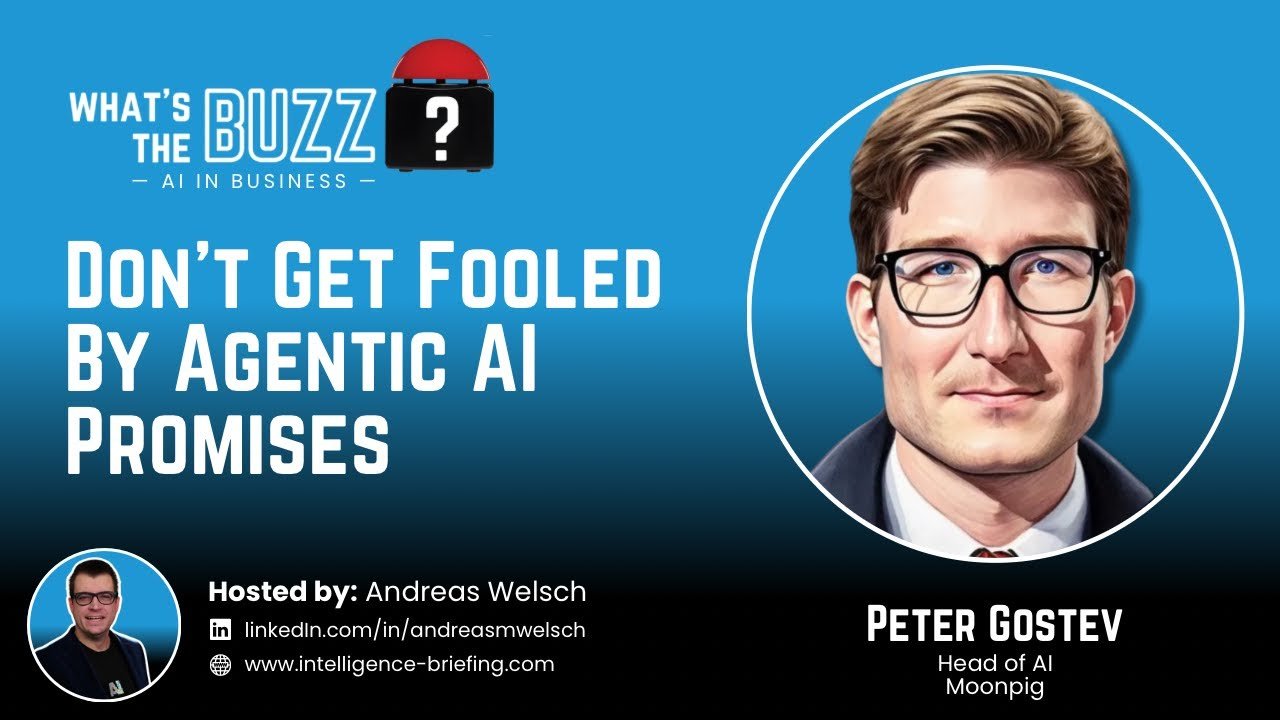
Guest: Peter Gostev, Head of AI at Moonpig
Host: Andreas Welsch
Episode: What’s the BUZZ?, Season 4, Episode 11
Published: April 8, 2025
Episode Summary
Peter Gostev, Head of AI at Moonpig, joins Andreas Welsch to answer a question every leader faces in the agentic AI hype cycle: how do you avoid being fooled by claims about AI agents? Peter separates true agents, which can go beyond a predefined workflow and decide what to do, from workflows that merely contain AI steps.
He explains why he tests tools himself before writing about them, why Moonpig has struggled to find internal use cases that justify adding ambiguity to a reliable process, and where agents already work well, in research and coding. He closes with three takeaways: define what agentic means, treat agentic AI as early, and build your own intuition by trying the tools.
Key Takeaways
- Peter draws one line: a system with a strict, predefined workflow is not agentic, and a system that can go beyond that workflow, make decisions, use multiple tools and go back on itself is.
- Peter says the word agents tends to exaggerate capability, because people jump on any hype-based term to describe their product.
- Peter’s rule for himself is not to write about a tool he has not tried, and he tells leaders that trying AI is the only way to build an intuition for what it can and cannot do.
- Peter sees research and coding agents as the strongest applications today, but notes that access to tools through MCP does not mean the models are good enough to use them well.
- For internal business processes, Peter does not yet see enough benefit to introduce the ambiguity of an agent into a process that a defined workflow handles reliably.
Timestamps
- 0:08 Not getting fooled by agentic AI claims
- 0:42 Peter Gostev joins the show
- 1:16 Peter Gostev on leading AI at Moonpig
- 2:38 Icebreaker: if AI were a book
- 4:17 Who is the fool in the agentic AI hype
- 6:44 Why you have to try AI yourself
- 10:27 How to tell a real agent from a workflow
- 14:53 Head of AI versus head of generative AI
- 18:52 Why add ambiguity to a reliable process
- 21:20 Who is using agents beyond the marketing
- 23:46 Access to tools does not mean capability
- 26:12 Key takeaways
- 27:55 Wrap-up
About Peter Gostev
Peter Gostev is Head of AI at Moonpig, an e-commerce company that offers greeting cards and gifts. Before Moonpig, he worked for a bank. He writes regularly about AI on LinkedIn.
Full Transcript
Read the full transcript
Andreas Welsch: Today we’ll talk about how to avoid getting fooled by AI and agentic AI claims, and who better to talk about it than someone who’s passionately posting a lot of information about that and gives actionable advice to the community, Peter Gostev. Hey Peter. Thank you so much for joining.
Peter Gostev: No, thanks a lot for having me.
Andreas Welsch: Hey, I’ve been following you on LinkedIn for quite some time, and I’m always amazed and inspired by the posts that you share because I see that you take a really pragmatic view on things that are happening and you also give some really good advice.
Andreas Welsch: But maybe for those of you in the audience who don’t know Peter yet, maybe Peter, you can tell us a little bit about yourself, who you are and what you do.
Peter Gostev: Yeah, sure. So apart from writing here on LinkedIn I’ve got a day job as well. I lead AI at Moonpig. Moonpig is an e-commerce company.
Peter Gostev: We offer greeting cards and gifts, which is actually a really interesting space to apply AI because, apart from all the usual use cases, we’ve got images and maybe video, audio, music. Not that we’ve done a lot of that yet, but it gives us a lot of extra dimensions to apply. And before that, I was working for a bank.
Peter Gostev: Where the type of use cases that we were looking at in the AI space were much more the corporate ones that you expect.
Andreas Welsch: Hey, it’s great to have you on the show. So thank you so much. Peter, what do you say? Should we play a little game to kick things off?
Peter Gostev: Yeah, sure. Let’s do it.
Andreas Welsch: Alright, so this one is called In Your Own Words, and when I hit the buzzer, the wheels will start spinning and when they stop, you see a sentence. I would love for you to answer with the first thing that comes to mind and why, in your own words. So you only have 60 seconds for your answer to make it a little more interesting.
Andreas Welsch: Are you ready? Okay, then let’s do it. If AI were a book, what would it be? 60 seconds on the clock, go.
Peter Gostev: I feel like it would be a combination of the most crazy, fact-based book that you would ever read. A lot of the things that are actually happening now, we are used to them now, but if we had heard them five years ago you’d feel like it’s completely insane. So it’s a factual story, but the other half is a lot of hype and not very well-founded information as well.
Peter Gostev: So I feel like you’d get really lost trying to make sense of this book.
Andreas Welsch: I really like that idea. It’s indeed a good mix of everything that captivates you, but also keeps you wondering how far have we come and how far do we yet have to go? I really like that.
Andreas Welsch: Thank you so much. Great answer. But obviously that’s not all we want to talk about today. If you look at what’s happening in the market, certainly there’s a lot of hype and a lot of buzz around this topic of AI agents or agentic AI. All of a sudden, we’re not just pointing and clicking anymore.
Andreas Welsch: We’re not just entering information in form fields. The idea is that we have a more natural conversation with this software, with this piece of technology, and we can give it a goal. It goes and figures out what needs to be done. Researches information maybe. Some agents are connected to the internet, some are more connected to your own database.
Andreas Welsch: But overall, it seems that over the last quarter, one headline has chased the next. So I’m wondering where we are in April. April Fools’ Day. Who’s the fool here with all the information? What do you make of that?
Peter Gostev: It’s very hard to make sense of what’s going on and what is good information and what is bad information. So I always try to sense check: am I being a fool? Am I making judgements that are wrong? I definitely don’t feel like I’m on firm ground where I know everything about what’s going to happen and so on.
Peter Gostev: So I think we’ve all got the potential to be fools, but there are two extremes. One is you get carried away by everything that’s being claimed and the hype around agents, that we are all about to get AGI and all of that. I think that’s one direction, but there is equally another direction where you just assume that everything is nonsense and you don’t actually take it into account.
Peter Gostev: The only antidote to that that I can think of is that you just have to try and get an intuition for what’s actually real or not, and it’s a hard thing to do. Whenever I write I do try to stick to that rule of not writing about something if I haven’t tried it. It is a bit hard to stick to just because of the volume of things that are going on, but there’ve definitely been some very hyped tools that I haven’t written about just because I haven’t tried them.
Peter Gostev: There’s no point in me hyping it or criticizing it if I have no idea what it actually is like.
Andreas Welsch: That sounds like a very sensible approach. In many conversations it seems to come down to that as well. First of all, see if you can filter the information. What is really relevant to you right now in your industry, in your business, and what’s all the other noise that vendors are talking about, that management consultancies are talking about, that just happens to flood the news. I also really like the tangible advice of, see if you can try it out for yourself. And I think sometimes that’s not even as easy as it sounds for many of us.
Andreas Welsch: When you’re in a leadership role or in your daily business and you’re rushing from meeting to meeting to meeting, and at the end of the day you’re wondering, what did I do today other than be in meetings or talk about things. So being able to sit down and have that time to experiment, to your point, is critically important.
Andreas Welsch: We all need to make that time. So we can also assess for ourselves, is this real? Is that something useful? Or is somebody just making big claims and maybe a quarter or two down the line things will.
Peter Gostev: And I think we are really lucky that with the field of AI it’s actually very accessible.
Peter Gostev: If you compare it to some other previous trends that we had in tech, such as cloud, you can’t really sit down and try cloud. That’s not really a meaningful thing that exists. So before, if you were to read about cloud, it’s quite reasonable to say, okay, I’ve read some consultant reports or something, that’s good enough.
Peter Gostev: But with something like using language models or image models to see what’s possible there’s really no good reason why you shouldn’t just try it instead of freezing about it. And the other dimension to it is that there is really nothing in our previous experience that can give us intuition for what it can do and what it cannot do.
Peter Gostev: It’s just completely new, it’s like a new alien being. So how could you guess? It’s completely unreasonable to expect anyone to have any intuition for how it works. So combined with it being completely new and actually easy to try, you really have to try it. There’s no other way.
Andreas Welsch: What you said deeply resonates with me.
Andreas Welsch: I remember a little more than 10 years ago when cloud was that big trend that came up. Yes, there was a lot of reading and learning about it. What is infrastructure, platform, software as a service. But it also seemed pretty standard, pretty cookie cutter. You either rent the bare hardware or you have a little more on top if you’re a developer or you get the application.
Andreas Welsch: But it was pretty much the same concept for any vendor. So, great point there that you have to experiment with it because it’s moving very, very quickly and, to your point, you cannot really talk about it or predict where it’s going unless you’ve seen it yourself. But I think that brings up another point.
Andreas Welsch: Having been in the industry myself and having seen how large technology companies go to market, how they do their marketing, how others in the industry act, I feel like all of a sudden every vendor has an agentic AI product.
Andreas Welsch: So how can leaders avoid getting fooled and tell what’s a real agent and what’s just an LLM or a workflow with some AI? What are you seeing or what’s your recommendation there?
Peter Gostev: The biggest problem there is the lack of clarity of definition around what is meant by agents.
Peter Gostev: And I would assume that whenever we hear the word agents, it’s closer to exaggerating its capabilities rather than understating its capabilities. The reason for that is that for any hype-based term, people always try to jump on that trend to describe their product.
Peter Gostev: There are definitely several different flavors of what is meant by agentic, and everyone seems to claim it. So the big distinction I would draw is whether that use case is defined within one specific workflow, with maybe small deviations, or maybe there are three ways you can go.
Peter Gostev: So that could be one category. And the second category is, does it have freedom to go and do things in a more open-ended space? There are probably many more variations to this, but that’s probably the distinction. And my personal definition, where I would draw the line, is that I would not call
Peter Gostev: systems which have a strict workflow agentic. There are many different steps that they might go through, but I would not call them agentic. The reason for that is that if we forgot that this term existed, you could have built these kinds of systems two, three years ago. People stitched together different steps and they got a good answer.
Peter Gostev: So there’s not really any reason to invent new terminology to describe workflows which have AI steps in them as agentic. I think the only reason to call something agentic is if it truly has some
Peter Gostev: capacity to go beyond a predefined workflow and then make certain decisions about what it should do, use multiple steps, different tools, go back on itself. That sort of thing is agentic. So coming back to your specific question, how do you distinguish, I think establishing that distinction is key.
Peter Gostev: Is it a workflow that someone’s defined and built, or is this truly something that goes around and does certain things? And by the way, it doesn’t mean that you always want it to be an agent. I actually think a lot of the time you don’t want it to be an agent, but I think that’s at least a somewhat clear line you can draw.
Andreas Welsch: I really like that part that you said about determining, is it a straightforward workflow, something that you could have done already a couple of years ago, or is there more of this variation, more of this research, this thinking, reasoning to some extent in there that really makes it agentic, more capable, more intelligent in that sense.
Andreas Welsch: But I also agree with you. It’s very easy to conflate different terms or for vendors to subsume different capabilities under this new term agentic and say, hey, we’ve had this all along. So I really like your recommendation of, think about what this thing actually does. Is it a straightforward workflow? Is it more reasoning? Is it more complex? And look behind the curtain, basically.
Andreas Welsch: Now I saw on LinkedIn your title is Head of AI, not Head of Gen AI, not Head of Agentic AI. What does it mean? Does it mean you’re not working on the latest stuff? Or should we not get fooled by titles? What’s your recommendation to other AI leaders who might also have a title of Head of AI but not Gen AI or Agentic AI?
Peter Gostev: The way we split it within Moonpig is that we do have a data science team which is doing machine learning and also data architecture and all of that really important work.
Peter Gostev: And we also have an AI team, which is my team, and we could have called ourselves Gen AI. The focus there is much more on taking the mostly APIs, although not entirely, but to simplify it, taking APIs and applying them somewhere around the business. I think it’s a mistake that a lot of businesses are making, that they take their data science team, who are machine learning PhDs, and they say, by the way, can you just stop doing your PhD work and call this API and back the model up with JSON.
Peter Gostev: It’s not necessarily their skill set anyway, and you’re also just wasting the thing that they’re actually good at. It doesn’t mean that they can’t do that. Obviously they’re smart people and there have been a lot of successful transitions, but I don’t think we should assume that because it’s vaguely in the same space we should have one stop doing the other.
Peter Gostev: So that’s why we have a split. We collaborate on things where it makes sense, but essentially we wouldn’t say, you used to do a pricing algorithm this way, can you stop that and do some LLM stuff. It doesn’t really make sense. With Gen AI, what we are focused on much more is building software with the latest technology.
Peter Gostev: And to your point about agentic, we do experiment with things, and whenever new models come out we always test and see what new capabilities we can bring. I would say we have really struggled to find anything where we would want to put anything highly agentic inside Moonpig.
Peter Gostev: The reason for that is that whenever we have some workflow or some specific thing that we want to achieve, it’s not very clear why you would want to introduce any ambiguity into that process. At least at this stage of our development, we still have quite a lot of opportunities where we would say, okay, we’ve got some data here or some interaction here, our current teams go through these steps to process the data and put it in this system, and then they put it in that system.
Peter Gostev: There are quite a lot of use cases along these lines, which I guess you could design to be agentic, but I don’t really see the point. Why wouldn’t I just say, take it from this system, output it in this way, put it in this way. There are enough problems as it is in making sure that that works properly, and it feels like we need a really, really strong benefit to say, by the way, it is now agentic so it can decide whether it should go here or there.
Peter Gostev: And maybe it is. Because we’re not such a crazy complicated business, maybe we just don’t have that. But even in a bank, if I go back to my bank days, I don’t see a lot of reason why you would design it in that kind of more free-flowing way. So at least for internal use cases, for your own business processes, at this stage of development, I’m not convinced agentic is necessary at all. I could be wrong. I could be surprised, but at this point I don’t see a lot of reason to go down that route.
Andreas Welsch: Well, there are so many good points in those last few minutes of what you shared.
Andreas Welsch: I think what I heard was, on one hand, don’t focus so much on the title. Rather look at what outcomes and output you can deliver and go and experiment with new tools. It doesn’t matter if you’re Head of AI, Head of Gen AI, or Head of Agentic AI. It’s rather what is your team’s mission? And they’re great and skilled people that can help you do that. The second part, around agents, is honestly something that I sometimes wonder about as well. If I heard you right, you said, why introduce something that is not necessarily reliable into a process, maybe a process where you need a higher level of reliability or where a straightforward automation would give you repeatable results.
Andreas Welsch: Same input, same output every time, not most of the time, or sometimes.
Andreas Welsch: On one hand, I see companies looking for that as well. That’s why we have processes. That’s why things are coded, things are supported in workflow tools or in other kinds of enterprise software. Yet we’re introducing that level of ambiguity, just because we can do more complex things with agents, but if we don’t really know how they work, are they repeatable every time, do they get the same quality output every time, I can certainly see the concerns that you mentioned. Which actually brings me to my next question. To stay with the term fooling, who’s fooling around with agents? Who’s rolling them out? Who’s had them for a while?
Andreas Welsch: I’m sure you’re attending different conferences or talking to other professionals in the area. Who’s actually doing something beyond the marketing buzz that this is here to stay, this is awesome, try it out? Who’s actually doing it?
Peter Gostev: The best ones that we see publicly,
Peter Gostev: I would say there’s a really good application of that ambiguity when you don’t actually know where to look for information. So research is a genuinely good application of it. I said earlier that if you’ve got a clear process where you’ve got inputs and outputs, you don’t need it. When you don’t have that, then it’s great.
Peter Gostev: Deep research is an obvious example where it’s constrained in the sense that it just goes around browsing the web, but it’s also unconstrained in the sense that it can go anywhere. I think that is an excellent application, and research is uniquely well positioned in terms of exploring the different areas. So that’s clearly a very good one. Then we’ve seen coding agents also being a popular category. This one is interesting in terms of how successful they’re going to be.
Peter Gostev: The key point there, and I’ve seen some examples of them doing it, is when they close the loop and are able to write unit tests or actually click the buttons on the website, for example, if that’s what you’re building. Then I think the agentic approach could be great.
Peter Gostev: I’ve also seen some bad examples of it. Personally, I don’t find the Sonnet 3.7 approach to agentic very good. It just seems to go around in circles and it does way too much and it kind of goes off the rails. That’s an example of how it’s actually quite hard to get that balance right, because you want the agents to be proactive, but if they go too far, they go off the rails as well. And we’ve obviously seen a lot of MCP hype going around as well. It’s hard to say how much of it is actually getting real traction versus people just trying things out, which is great, they should. But it’s also hard to say whether this has really properly taken off, and would we still talk about it six months later? It’s hard to say for sure.
Andreas Welsch: Maybe also give it a little more time to settle and have more people explore it and poke holes into it. Then you see how real and how durable it really is, right?
Peter Gostev: Yeah. And one thing about agents as well is that the sense I get is that people imagine, for example with MCP, it’s a connector, so there’s now a capacity to go and interact with different tools, which is fundamental. If you don’t have the pipes, there’s nothing you can connect to, so it doesn’t matter how clever the model is, you’re still constrained.
Peter Gostev: Then we’ve got coding agents that can go around and build their own software autonomously. All of that. I think what people are forgetting is that if you give access, it doesn’t mean that the models are good enough to do that. I do get the sense that we’re getting a little bit carried away with how good the models are.
Peter Gostev: I think the models are just not that good. Even silly examples like Claude playing Pokemon. It can mechanically play, but is it actually good at it? And the answer is no. It’s pretty terrible. It’s obviously a toy, not that it’s useful, and it is very interesting. But that’s the state we’re in. We have the physical capability to let Claude play Pokemon, but it’s awful.
Peter Gostev: So I think we need to calibrate the two sides of hype. It’s very exciting in the sense that you can feel the AGI, you can feel the potential, but it’s also not there. It’s still missing that actual capability. So it’s exciting, but when you get excited about this stuff, you should remind yourself, I’m letting myself imagine the future rather than saying, I’m going to actually build this tomorrow, because we are definitely not in that space.
Andreas Welsch: I think that’s a very pragmatic lens through which you’re seeing that and recommending that others do as well. Certainly exciting, all the things that AI and technology are now able to do that we haven’t been able to do before, but there’s always a little further that we can go. Peter, thank you so much so far for sharing all your insights. I was wondering if you can summarize the key three takeaways for our audience today on how not to get fooled by agentic AI claims.
Peter Gostev: Yeah, sure. The thing about agents is that you need to be clear whether they’re truly agentic, where they have the capacity to make decisions and operate in a more free way, or whether they’re more of a specific workflow that is predefined. That is the clear distinction that I draw in my head.
Peter Gostev: The second point is that, as far as I’m concerned, agentic AI is still a little bit too soon. While we do have really good applications such as research and coding agents, which are really good as a generic capability, we’re a little bit early and we’re just building the pipes with things like MCP and so on. And the third point is that the only way for you to know where we are is to test it and try it yourself.
Peter Gostev: And definitely do not rely on what anyone is writing, including me. The only way for you to really know and have your own intuition, and that’s the important part, is to ask what your intuition is for how well it works. And the only way you get there is when you actually try these things for yourself.
Andreas Welsch: I love that. That’s very practical, very tangible advice. Peter, thank you so much for joining us today and for sharing your experience with us. It was a pleasure having you on.
Peter Gostev: Oh, brilliant. Thank you. This was fun.
Listen and Subscribe
Related Reading
Frequently Asked Questions
What makes an AI system truly agentic?
According to Peter Gostev, a system is agentic only if it can go beyond a predefined workflow, make decisions about what to do, use multiple steps and different tools, and go back on itself. A system with a strict workflow that includes AI steps could have been built two or three years ago and is not agentic.
How can leaders tell a real AI agent from a workflow with AI in it?
Peter suggests asking whether someone defined and built the workflow, or whether the system truly goes around and does things on its own. He also assumes that vendors using the word agents are more likely to exaggerate capabilities than to understate them.
Why does Moonpig avoid agentic AI for internal processes?
Peter says that when a workflow has clear steps, it is not clear why a team would introduce ambiguity into it. His team would need a really strong benefit before making a process agentic, and so far it has struggled to find one.
Where do AI agents work well today?
Peter names research, such as deep research tools, and coding agents that close the loop by writing unit tests or clicking through a website. He adds that access to tools through MCP does not mean the models are good enough to use them.
How should leaders avoid being fooled by AI claims?
Peter’s advice is to try the tools yourself. Nothing in previous experience gives intuition for what AI can and cannot do, and AI is easy to try, so he says not to rely on what anyone writes, including him.