

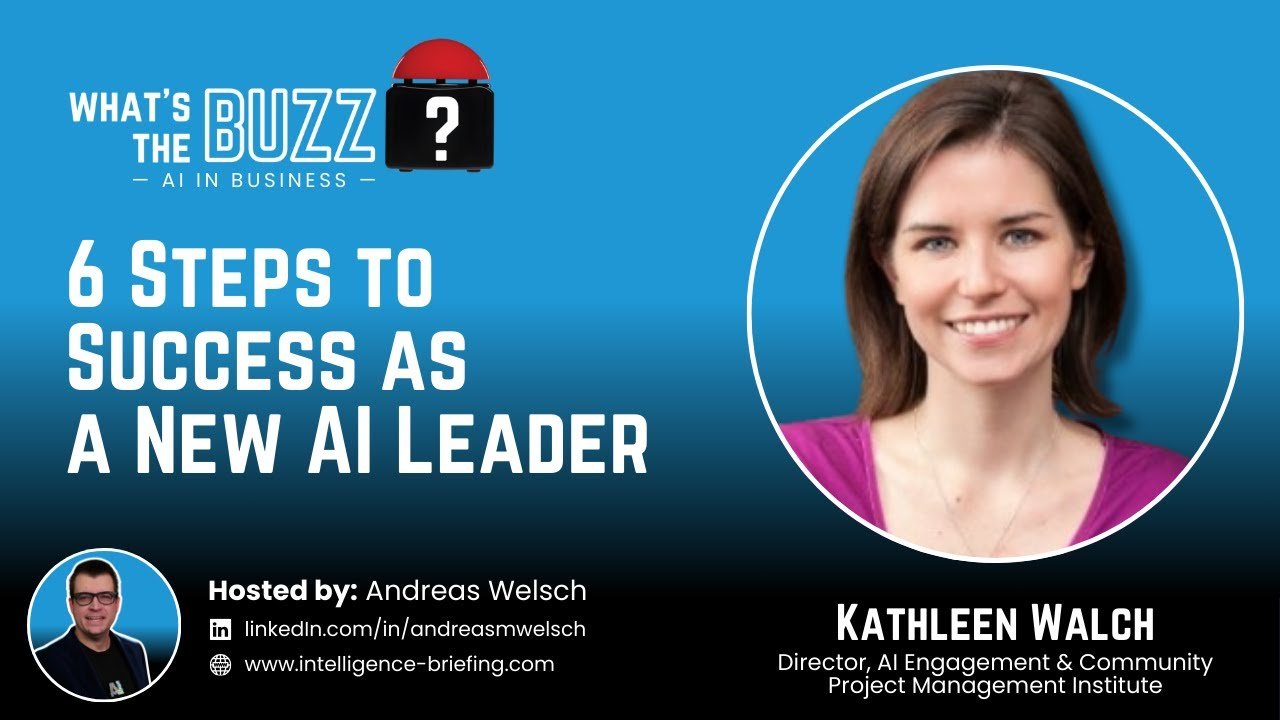
Guest: Kathleen Walch, Director of AI Enablement and Community at the Project Management Institute
Host: Andreas Welsch
Episode: What’s the BUZZ?, Season 4, Episode 17
Published: June 17, 2025
Episode Summary
Kathleen Walch, Director of AI Enablement and Community at the Project Management Institute (PMI), joins Andreas Welsch to answer how a new AI leader runs a successful AI project. Kathleen explains that AI projects are data projects, lists the common reasons they fail, and walks through the six iterative phases of the CPMAI methodology. She also covers the seven patterns of AI, the US Postal Service example of starting with one question, and the observers, taskers, early adopters and leapers she uses to describe AI adoption. Her summary is to think big, start small, and iterate often.
Key Takeaways
- Kathleen says AI projects are data projects, so they need a data-centric methodology instead of a software development one.
- Kathleen names the common failure causes: treating the project like software development, data quality and quantity, ROI that is not justified or measured, a proof of concept that proves nothing in a controlled environment, and over-promising and under-delivering.
- CPMAI runs in six iterative phases: business understanding, data understanding, data preparation, model building, model evaluation and operationalization. Kathleen says going back a phase is normal.
- Kathleen recounts how the US Postal Service answered one question, tracking a package, to reduce call center volume, showed positive ROI, and then added more questions in later iterations.
- Kathleen describes the leaper as someone who uses AI across an entire workflow, and says the mindset of courage to try matters more than technical skill.
Timestamps
- 00:01:04 Guest background: PMI, Cognalytica and CPMAI
- 00:05:20 Why AI projects fail
- 00:11:02 The six-phase CPMAI approach starts with business understanding
- 00:12:10 The seven patterns of AI
- 00:14:23 The remaining phases: data understanding to operationalization
- 00:20:11 Think big, start small: the US Postal Service example
- 00:22:53 Is agentic AI smoke and mirrors?
- 00:26:52 The leaper mindset
- 00:30:49 Three takeaways
About Kathleen Walch
Kathleen Walch is Director of AI Enablement and Community at the Project Management Institute (PMI), where she joined from the Cognalytica acquisition. She co-founded Cognalytica in 2017, an AI-focused research, advisory and education firm, which developed the CPMAI methodology (Cognitive Project Management in AI).
Kathleen says she has trained thousands of people on CPMAI, and she has a podcast, the AI Today Podcast, which is now an official PMI podcast.
Full Transcript
Read the full transcript
Andreas Welsch: Today, we’ll talk about the six steps to leading successful AI projects and programs, and who better to talk about it than someone who’s built an entire methodology around that. Kathleen Walch. Hey, Kathleen. Thank you so much for joining.
Kathleen Walch: Hi. Thanks so much for having me.
Andreas Welsch: Wonderful. Why don’t you tell our audience a little bit about yourself, who you are and what you do.
Kathleen Walch: Sure. As you said, I’m Kathleen Walch. I am the Director of AI Enablement and Community at Project Management Institute, PMI. I joined there about 10 months ago or so at this point. I came from the Cognalytica acquisition. I had co-founded Cognalytica back in 2017. We started out as an AI-focused research, advisory and education firm covering the AI markets, and then quickly realized that our clients wanted help with running and managing AI projects. There was no formal methodology for doing so, because data is the heart of AI. AI projects are really data projects, so you needed a data-centric methodology. So we came up with CPMAI, the Cognitive Project Management in AI methodology. We have trained thousands of people at this point. We also have a podcast called AI Today Podcast, and we are coming up on season nine, which I can’t believe. It’s an official PMI podcast now, so season nine will be launching on July 16. We also had a lot of content that we brought over, a lot of articles and some research that we had done.
Andreas Welsch: I’m super excited to have you on, and obviously going back to 2017, that was before AI was cool, or when it was cool the last time, however you want to look at it, right?
Kathleen Walch: I always say that I’ve been in the AI space since before Gen AI made it cool.
Andreas Welsch: Like I said, excited to have you on. I’m going through the CPMAI certification myself at the moment, and obviously we’re also collaborating around PMI a little bit. Now, Kathleen, should we play a little game to kick things off?
Kathleen Walch: Sure.
Andreas Welsch: All right, so let’s do this. This one is called, obviously, What’s the BUZZ? That’s the whole idea of the buzzer and the show. When I hit the buzzer, you’ll see the wheel spinning and a word appear, and you have 60 seconds for your answer. Are you ready for What’s the BUZZ?
Kathleen Walch: I’m ready.
Andreas Welsch: Let’s do this. If AI were a book, what would it be? 60 seconds on the clock.
Kathleen Walch: That is a really great one. I would say Jack of All Trades and Master of None, especially when it comes to Gen AI.
Andreas Welsch: Why that?
Kathleen Walch: Because it’s really great at giving you basic information, especially one inch deep. To go very deep into things you need to provide better prompts and really understand how to work with AI systems. If you’re at that surface level, then I think it provides you a one-inch-deep response.
Andreas Welsch: I love that. I’m sure many of you have found this as well in your journey of using AI over the last two and a half years, or maybe even longer. It can do a lot of different things, but what’s the one thing you really want to do, where it delivers value and where you can go deep? Awesome answer. That brings us to our questions. We’re seeing more leaders take on AI projects and programs, which I think is fantastic. More businesses are thinking about it and more business leaders are thinking about it. I see a lot of times they look to data leaders, AI leaders, technology leaders. Maybe there is even an AI department or center of excellence that already exists, and it’s, hey, you’ve always worked on this technology, can you now figure out what we do with AI, what’s our strategy, and how to make this real? But I also hear that for many leaders in this space, it’s the first time in their career that they’re leading an initiative like that. It’s not just technology, obviously, as we know. I’m curious, what are some of the common challenges that you see leaders run into, and why do they take CPMAI?
Kathleen Walch: That’s such a great question, and you’re right. Despite AI being around since it was officially coined in 1956, many leaders and many teams and individuals, this is maybe their first time running and managing an AI project, which I always like to say is different than using AI tools. A few years ago we identified common reasons why AI projects fail and what you can do to avoid that, because I always think you can learn so much from other people and some of the mistakes that they’ve made, so that you don’t make them yourself. Some of the common reasons that AI projects fail: you treat them like a software application development project, so you try to use software development methodologies. A lot of people say that they’re using Agile, which you can do in an Agile way. But as I mentioned earlier, data is the heart of AI. You need data-centric methodologies, because these are fundamentally data projects. With that, if data is so important, we get issues around data quality and data quantity. Is our data good, and is it good enough, and do we have the amount of data we need? We always say you don’t need Google-sized amounts of data, depending on what it is that you’re trying to do, but you do need data, and you need to make sure that it’s representative of whatever it is that you’re trying to do, and that you also have access to that data. Far too often teams move forward and say, yeah, our organization has this data, let’s just move forward, and then they get to needing that data and it takes some months to access it. That’s going to slow down your project, right?
Andreas Welsch: For sure. Yes.
Kathleen Walch: Then we’ve also seen issues with return on investment. You have to make sure the ROI is justified and that you’re measuring things effectively, because your projects are not going to be free. It’s money, time, and resources. I always like to say, make sure you measure. Even if the AI system is working as expected, if it’s costing more than it’s saving, is that really successful? Probably not. We also have issues around proof of concept versus pilot. A lot of times people will say, I’m going to run a little proof of concept and see if it works. But we say your proof of concept is really proving nothing, because you’re doing it in a super controlled environment and you’re using the best quality data that you have, and usually the person who has built the solution is the one testing it. When you put it out in a pilot, in the real world, now things start to get interesting. People aren’t using it as expected, data can be messier, maybe data sources are different than you expected. So we say always move to a pilot and see how it’s actually being used, and then continue to iterate. And the most common reason that we’ve seen AI projects fail: I talked about how AI was officially coined in 1956. That’s almost 80 years ago at this point, and you’re like, what’s going on? Why haven’t I heard about it more? We’ve gone into two previous AI winters, which are periods of decline in investment, popularity and funding. People moved towards other methods to get to their solution. The big overarching reason for this is over-promising and under-delivering on what AI can do, and I’m still seeing that today. You have to understand what AI is good at, what it’s not good at, how you can use it as a tool, and make sure that you’re actually setting realistic expectations.
Andreas Welsch: I like that part, especially the last one about over-promising and under-delivering. Just recently we’ve seen that even the biggest tech players in the industry and in the world are not immune to that. Take Apple as an example, with the announcements of Apple Intelligence last year. I think they were very close to shipping something, and then they found it’s actually really hard to do this reliably without hallucinations, without some of the unwanted side effects, biases and what have you. There’s this tension as well. When you want to ship something, you need to ship it to be competitive. But at the same time, if millions and millions of people use your product, you’d better make sure that it’s right and accurate. Otherwise you get the customer feedback on the other side. So not an easy situation to be in, whether it’s with machine learning, predictive analytics, or now with more generative AI or maybe even agentic AI. The other point that deeply resonates with me is data. I remember working with large Fortune 500 customers, and we said, here’s an idea for a prototype or even a pilot. We agreed on the scope, yes, we want to do this, for example in finance, to estimate our liquidity forecast. Then we needed data. Guess what? All of a sudden legal gets involved, IT needs to extract the data, and it comes to a grinding halt until you finally have it three months later, six months later. If you think you can have a quick win, six months to get the data is not so quick. To your point, those are real challenges that you still run into, especially when you’re doing this for the first time. You mentioned earlier in your introduction that you’ve trained thousands of leaders over the years to learn those fundamentals of running successful projects. What would you say are the key steps to success if somebody’s new in that role or wants to move into that AI leadership role?
Kathleen Walch: That’s also a great question, because what we’ve seen is far too often people, sometimes it’s that FOMO, that fear of missing out. You feel like your competitors are doing it, and so people rush to get things out. When you rush anything, especially when it comes to AI, you’re going to quickly realize that the move fast and break things mentality does not work with AI projects. That’s why we came up with the CPMAI methodology, because it’s a six-phase iterative approach. We always start with business understanding, which sounds simple enough. You’re supposed to be answering, what problem are we trying to solve? Like I said, it sounds simple enough, but a lot of times people just move forward with it. We say, make sure you’re solving an actual business problem. Once you know the problem you’re trying to solve, is AI the right solution? If you don’t know if AI is the right solution, we say, okay, let’s break it down one level deeper. A few years ago, back in 2019, a lot of people were really caught up in the term and the hype. They were asking, is this an AI project? Is this not an AI project? It would paralyze them. And we said, dig down one level deeper and ask, what are we trying to do? That’s where we came up with the seven patterns of AI. We present it as a wheel because none is more important than the other. There’s hyper-personalization, treating each individual as an individual. The recognition pattern is about making sense of unstructured data. We think about facial recognition: you can’t really program your way to understand individual faces, so this helps make sense of that unstructured data. Then we have our conversational pattern, where humans and machines talk to each other in the language of humans. We think about AI-enabled chatbots, but LLMs also fall in that pattern. Then we have patterns and anomalies. Machines are really good at looking at large amounts of data and making sense of that data quickly. Then we have predictive analytics, where you take past or current data to help humans make better decisions, so we’re not removing the human from the loop. Then we have our autonomous pattern. The goal of this pattern is to really remove the human from the loop, and whenever you’re trying to remove the human from the loop, it’s going to be one of the hardest patterns of AI. I think about autonomous vehicles, which is still my dream, even though we don’t have commercially available, fully autonomous vehicles. But we can also think about autonomous business processes: how can you have an AI tool navigate autonomously through your business? And last, we have goal-driven systems. This is really around reinforcement learning and finding the most optimal solution to a problem. We think about game playing and scenario simulation here. A really fun example that I like to bring up is that the city of Pittsburgh used reinforcement learning and the goal-driven systems pattern to help optimize their traffic light patterns. They wanted to reduce idle time and make sure traffic was flowing, to help with emissions as well. I thought that was a really fun example.
Andreas Welsch: Wonderful. That’s indeed a great example, and something where everyone benefits in the end too.
Kathleen Walch: Exactly. That was just phase one, so now we’ve got five more phases. We go through our patterns and ask, does it fall into one or more of those patterns? If yes, let’s move forward with our AI project. Phase two is data understanding. Now we need to understand what data we need, and you brought up an example, three or six months later maybe you’re finally getting your data. It’s really not uncommon, especially for large organizations. Maybe you have data in different systems, some internal, some external. Because this is iterative and we can do this over many sprint cycles, we say start with the smallest amount of data that you need to get the result for this first iteration. Control the scope. Maybe start with just one small feature. If you’re building a chatbot, for example, you don’t need to start off with the chatbot being able to answer 10,000 questions. It just needs to answer the most frequently asked question. When I talk about ROI, if you’re measuring whether it’s reducing call center volume or increasing customer satisfaction, just start with that one. Then you get it out there, you see how it’s working, and you can add additional questions and features as you go on. Then we have data preparation. Now we have the data, and we need to prepare it: clean it, de-dupe it, normalize it, anonymize it, whatever we need. Then we get to the fun stuff, building our models. A lot of people want to start at phase four, but it’s really important that we go through phases one through three first. Then we need to evaluate the model. Is it performing as expected? Even if we’re using AI tools, we need to make sure that they’re performing as expected. And then we have finally model operationalization. This is using the model in the real world, wherever you’ve decided that the model is going to be, on the cloud, on premise, on an edge device like a phone or in your car. Those are the six phases of CPMAI, and they’re iterative. If you start in phase one, business understanding, then you go to data understanding, you think you have the data you need, now you need to clean it, and then you realize in the cleaning phase that you don’t have enough, you go back a phase. That’s okay. Like I said, we always say think big, start small, and iterate often, because you don’t need to do everything in one iteration.
Andreas Welsch: I think that’s such an important point, especially the fact that AI projects are iterative a lot of times. We’re so conditioned to running a project from start to finish. It’s got a start date, an end date, and deliverables in between. Let’s look for quick wins, let’s see how we can build this and ship this very quickly, and then you throw it over the fence. Somebody else needs to maintain it and they haven’t been involved, and they say, what am I supposed to do here? How does it even work? Or it’s missing some critical things. So the iterative nature, I think, is absolutely critical. I have a new course coming out on LinkedIn Learning, probably in the next couple of days, about the risks in AI projects, and that was one of the things that I picked up on as well. Managing that expectation with your leadership is critically important. It’s not a straight shot, it’s not start to finish. There are many iterations and many loops. Going back one or two steps and fixing things and improving them is absolutely normal, but shaping that awareness I think needs to happen as well, and not everybody has that awareness yet.
Kathleen Walch: Exactly. And I think that when you realize they’re data projects and you follow data-centric methodologies, then it helps a lot.
Andreas Welsch: You said you’ve been working on this since 2017, since before AI was cool, when it was cool the last time. What’s the one thing that still surprises you about these AI projects and what happens when leadership is involved or gets involved, after all these years?
Kathleen Walch: I think going back to those common reasons why AI projects fail, despite it being known and out there, we still continue to fall into these same reasons. One of the most important things is to always start with business understanding, what problem are we trying to solve, and never to downplay that. Each phase of CPMAI is important, but phase one is arguably the most important, because if you’re not solving a real business problem, you shouldn’t move forward with the idea. It doesn’t matter how much you like it or how good you think it’s going to be. If it’s not solving a real problem, you shouldn’t move forward. Far too often, organizations and leaders feel pressure to just get something out. They want to have an AI tool in the market or have an AI solution, and so they just go ahead and start creating something, and then they get 6, 12, 18 months into the project and have nothing to show for it except a large pile of debt.
Andreas Welsch: How do you see leaders addressing that then? Certainly one part is through the methodology, but it seems like a lot of these issues are soft issues, if you will, or interpersonal things. There’s culture, there’s politics. There may be individual career aspirations. There’s the challenge of losing face or not wanting to lose face, greenwashing, right? Dashboards from red to yellow to bright green the higher you go in the hierarchy. What do you see there? How can leaders shape that awareness that it’s not as easy as it seems in a vendor demo, for example?
Kathleen Walch: I think it’s managing expectations and taking out the hype versus the reality, and also really thinking big but starting small. A really great example that I always like to use, because then you can still show wins, is this. They might not be as grand as you want, but they’re successful, you’re going to get buy-in, you’re going to have these small wins, and you can continue to work on these projects. The US Postal Service asked, what’s the number one question that we get asked? Track a package, right? They were trying to reduce call center volume, especially around the holidays and seasonality, so that they couldn’t just hire up a ton of people but needed to control the call center volume. So they said, let’s just answer that one question really well. Our goal is to reduce call center volume, and we can measure that. It’s really easy to measure. That’s the return on investment. They showed positive return on investment, so they were able to report back and say, hey, look at this win, look at what we did. Then they can say, okay, now let’s go to the number two or number three, or get the 10 most frequently asked questions, and in the next iteration add an additional 10 and then add an additional 10. Rather than saying we need a chatbot that’s going to be able to answer 10,000 questions in five different languages, let’s go. What happens, right? We have to control the scope, especially, from Project Management Institute, right? All the project managers out there who are working on AI projects know you have to set expectations, especially with stakeholders, and you have to control the scope, because scope creep is real. It helps when you have an understanding of how to run and manage AI projects, and what should and shouldn’t be an AI project. AI, as much as I love it, and I’m a big proponent of AI, is not the right solution for every single problem. Sometimes you can have straight automation. Sometimes you can code your way to get the results that you need. You don’t always have to use AI.
Andreas Welsch: Love it. By the way, in a lot of the conversations that I’m having, I’m hearing the same thing. We need a chatbot to do something. It’s like, why? What is the problem that we’re actually trying to solve? First of all, let’s understand that. Is AI the right solution, to your point? And then is something like conversational AI, the conversational pattern, or even a chatbot the right way to do this? Are people really going to chat with their PDF, for example, or are there other ways in which we can get similar or even better results? A great point. We’ve obviously accelerated things in the industry from predictive analytics to machine learning to generative AI. This year it’s all about agentic AI. 2025 is the year of agentic AI, if you want to believe some. We were talking about this just before we went live. We’re already halfway into the year. What is up with agentic AI? How will that change the paradigm of what AI leaders need to do? What do you see, and is that just smoke and mirrors at this point?
Kathleen Walch: We were talking earlier about how it’s the year of agentic AI, 2025, and what does that mean? We’re halfway through the year, so are people really using agents, is it part of their workflow, and how has it really been changing the game? I have not seen it as widely adopted as the hype. This is also where you have to avoid the hype and be grounded in reality and expectations, apply critical thinking skills. I have not seen it as widely adopted as it was first portrayed. But there’s also opportunity around this. At PMI, we have a tool called Infiniti, which is free for all of our members, and I encourage anybody who’s watching this who’s a PMI member to go check out Infiniti. Later this year we will be introducing agents into Infiniti. Sometimes agents are in the background and they’re running and you’re not even aware that they’re going on, so for the user it’s just a normal experience. What’s nice about different AI tools, and when it comes to agentic AI as well, is that you don’t need to be super technical in order to get benefits and value from this. At PMI, and other organizations have this as well, for folks that are starting to move forward with agentic AI, we have the opportunity to help define what that means. Part of the reason we came up with the seven patterns of AI originally is that there’s no commonly accepted definition of AI. When there’s no commonly accepted definition of AI, it’s, am I doing AI? Am I not doing AI? I don’t know, there’s no definition. So we said, let’s break it down one level deeper, and that’s when the seven patterns came about. I presented to the OECD, the Organization for Economic Cooperation and Development, back in February of 2020, literally before the whole world shut down.
Andreas Welsch: Yeah.
Kathleen Walch: They’ve adopted the seven patterns as their definition of AI, which is now in the EU AI Act. So at PMI we have that opportunity again to help define what is AI, how project professionals particularly should be looking at this, and how it can be used to enhance what you’re doing today.
Andreas Welsch: Wonderful. I wondered there as well. At the end of last year we saw Slack come out with a report called the Workforce Index, where survey participants shared, hey, I’m not telling my manager that I use AI, because they might think I’m lazy or incompetent. While many of these vendor-sponsored studies are nice and fair, you might also easily dismiss them. Now in May, Duke University came out with a study among 4,500 professionals, and they came to the same conclusion. Individuals, professionals, are reluctant to share that they use AI. So I wonder if there are some reasons below the surface why we’re not hearing so much about AI and agents. First of all, individuals don’t want to share that they’re using it, being afraid that they might be seen as lazy or incompetent. I would actually say it’s quite the opposite. If you find ways to incorporate AI in your work, you are at the cutting edge of things, and you should be there. You should think about how you can improve what you do and what you deliver. The other part that I wonder about is whether these technologies are still relatively nascent, not basic in the sense of what they do, but in how the tools work. They’re at a level where you maybe need to be a little more of a developer, or even for low-code, no-code, putting together your agentic AI workflow, you need to have some technology affinity or awareness. So I’m assuming that as that gets easier and baked into other solutions, the adoption will flourish as well.
Kathleen Walch: It’s interesting too, because I talk about this idea, especially when I deliver keynotes, of the leaper mindset. What is a leaper? We have identified four different types of people, broadly. One are observers. Those are people that sit on the sidelines and watch other people use AI, but they don’t themselves. The second is taskers, and this is where a large majority of people fall today. They’ll use AI to help with certain parts of their workflow, but not their overall workflow. Maybe I’ll use it to help me brainstorm ideas for an article, or I’ll use it to help me generate images for a slide deck, but I’m still mostly writing the article, or I’m still putting together the slides, and I’m just using it to maybe summarize all the bullet points that I have so that there’s less text, or create images for me. Then we have early adopters, and they’re going to embrace any new technology. AI is just another new technology to them. They love quantum and blockchain and AR and VR and all the different technologies that are out there. Then we have this idea of a leaper. What is a leaper? It’s someone who takes AI and uses it in their entire workflow. Now I can have the large language model of my choice go in and help me brainstorm slides and a presentation, then outline what the slide deck should look like. The human always should be in the loop. Go back and forth, say, yes, I like this, let’s tweak some of this. Okay, now I’m going to upload a template for a PowerPoint presentation that I want. Now create the slides for me. Then you can go and edit it, and it can also create images for you and really put together that entire presentation and save you hours of work. After you’ve reviewed it, you can say, okay, now send it out for review to the different teams that need it, or send it to whoever is going to upload it for your presentation. You have now really used AI through this entire process. That’s what a leaper is. What are the characteristics of a leaper? They need to have courage. They need to have the courage to try. It’s really about their mindset, right? Don’t be afraid of this technology. I always say that with prompting there’s a really low risk of failure, because you don’t need to involve those other teams. In the past, maybe you’ve needed to involve data teams to get the data, or IT departments to give you access to different tools or help you with programming different things. You don’t have to do that with AI, and that’s what makes this leaper mindset so important. It really is about overcoming your own fears and your own hesitations and your own doubts, rather than being super technical. I can see that happening with agentic AI as well. I also liked how you brought up this idea around people not wanting to share that they’re using AI. One, because they don’t want to be perceived as lazy, but two, it also comes down to they don’t want to be perceived as not working, because if they’ve used AI and it now saves them three hours a day, they don’t want to be perceived as not working, or sometimes have more work added to their plate, right?
Andreas Welsch: Yes. 20% more efficiency, productivity. Here you go, right? We know how this works.
Kathleen Walch: Yeah.
Andreas Welsch: So what I take from that response is almost, don’t be a sleeper, become a leaper.
Kathleen Walch: Oh, wow. Okay. I like the rhyme.
Andreas Welsch: Yeah. Definitely lots of potential there. Now Kathleen, we’re coming up to the end of the show and I was wondering if you can summarize the key three takeaways for our audience today.
Kathleen Walch: I always say think big, start small, and iterate often. Understand that AI projects are data projects, and make sure that you follow data-proven methodologies for AI success.
Andreas Welsch: Wonderful. I haven’t had anybody on the show recently who’s been able to articulate it that clearly and concisely. So thank you so much for summarizing it as you just did. Kathleen, thank you so much for joining us today. I really appreciate you sharing your experience and expertise with us. It was a super insightful conversation.
Kathleen Walch: Thank you so much for having me. I really enjoyed it.
Andreas Welsch: And folks, for those of you in the audience, see you next time for another episode of What’s the BUZZ? Bye-bye.
Listen and Subscribe
- Listen to this episode on Buzzsprout
- Watch this episode on YouTube
- All episodes of What’s the BUZZ? on Buzzsprout
Related Reading
- AI Leadership for Enterprise Leaders
- AI Readiness for Enterprise Leaders
- AI Leadership Handbook by Andreas Welsch
- How to Run Successful AI Projects Without Overspending
- Why AI Strategy Should Start With Business Goals
- How to Build an AI Learning Culture With AI Champions
Frequently Asked Questions
Why do AI projects fail?
Kathleen Walch names several causes: treating an AI project like software development, poor data quality or quantity, ROI that is not measured, a proof of concept run in a controlled environment, and over-promising and under-delivering. She calls the last one the most common overarching reason.
What is the CPMAI methodology?
CPMAI stands for Cognitive Project Management in AI. Kathleen describes it as a data-centric, six-phase iterative approach: business understanding, data understanding, data preparation, model building, model evaluation and operationalization. Teams can go back a phase when they find a gap.
What are the seven patterns of AI?
Kathleen lists them as hyper-personalization, recognition, conversational, patterns and anomalies, predictive analytics, autonomous, and goal-driven systems. She presents them as a wheel because none is more important than another, and uses them to decide whether a problem is an AI problem.
What is the difference between a proof of concept and a pilot?
Kathleen says a proof of concept runs in a super controlled environment with the best data, and usually the builder tests it, so it proves little. A pilot runs in the real world, where people use the system in unexpected ways and the data is messier.
What is a leaper in AI adoption?
Kathleen sorts people into observers, taskers, early adopters and leapers. A leaper uses AI across an entire workflow, with the human always in the loop. She says the main characteristic is courage to try and the mindset to overcome fear, not technical skill.