

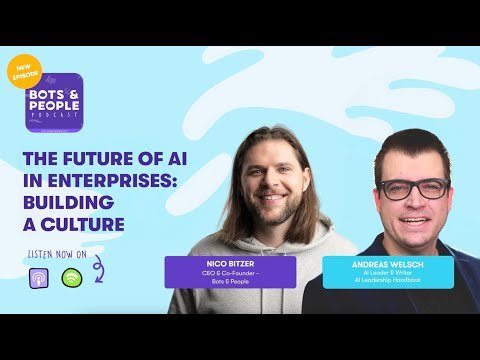
AI leadership is increasingly defined by a single challenge: translating AI hype into measurable business outcomes while managing adoption, risk, and responsibility. In a conversation on the Bots and People podcast, AI leadership expert Andreas Welsch explains why technology-first approaches fail and what leaders can do differently.
How do leading organizations build an AI learning culture? They start with business problems, give employees an approved, enterprise-grade “safe path” to use AI, and invest in structured training and hands-on practice. A champions community with executive sponsorship then multiplies skills across functions and feeds real needs back into the AI roadmap.
Welsch emphasizes that scaling AI is not only a technical problem. It is equally a change-management problem: bringing people along, shaping safe usage, and redesigning work without disrupting critical processes.
The discussion spans process automation and AI, enterprise data privacy risks, AI upskilling, community-based enablement, and the emerging reality of agentic AI. It also addresses why many AI initiatives never reach production, and what leaders can do to improve the odds.
Why this conversation matters
This podcast conversation is aimed at leaders responsible for learning, digital transformation, and enterprise technology decisions. It is especially relevant to CIOs, CTOs, CHROs, and business executives who need to accelerate AI adoption while maintaining governance and workforce trust.
Andreas Welsch, an AI leadership expert and author of the AI Leadership Handbook, frames AI as a basic technology on a “hockey stick” trajectory, similar in potential impact to electricity. The leadership imperative is making AI scale with minimal disruption across systems, processes, and people.
Executive Summary
- Start with business problems, not technology capabilities.
- Combine AI and automation to handle both repeatable and uncertain workflow steps.
- Adopt a product mindset: prioritize users over project end dates.
- Reduce data leakage risk by offering enterprise-grade, approved AI tools.
- Drive AI adoption through training and a champions community.
Key Takeaways
- Welsch warns that a technology-first AI approach is “a sure way to failure.”
- AI and RPA reinforce each other, especially when agents must interact with UI-level systems.
- Many AI efforts fail because they stall between pilot and production, not because of model quality alone.
- Productivity use cases (emails, meeting minutes, drafts) are valid early wins that build belief.
- Enterprise risk grows when employees use public AI tools with sensitive data; leaders should provide compliant alternatives.
- Training, transparency, and visible enablement reduce fear and resistance more effectively than messaging alone.
- Communities of practice create multipliers who spread adoption and bring feedback to leadership.
What is AI leadership?
AI leadership is the discipline of guiding an organization to create tangible business value with AI while managing adoption, change, and responsibility. In Welsch’s view, it includes aligning AI efforts to real business problems, shifting from project thinking to a product and user-centered mindset, and ensuring responsible use through governance, privacy, and compliance. AI leadership also requires workforce enablement: training people to use AI in daily workflows, creating safe and approved paths for adoption, and building communities that scale knowledge across the enterprise.
Why should AI initiatives start with the business problem, not the model?
Welsch’s central warning is straightforward: AI initiatives commonly fail when leaders begin with the technology and then search for places to apply it. Technologists may be excited by what AI can do, but capability does not equal value.
His recommendation is to reverse the flow. Technology teams should actively engage business stakeholders to understand processes, pain points, and constraints. The operational question is not “Where can AI be used?” but “What problem needs solving, for whom, and do they actually have it?”
Key Insight: Andreas Welsch argues that AI work must be anchored in business context. Without clarity on who experiences the problem and what success looks like, AI becomes an impressive demonstration that fails to translate into adoption, production deployment, or measurable outcomes.
How do process automation and AI work together?
In Welsch’s framing, the question is not whether AI is more important than automation. The practical answer is that they need each other, because they solve different parts of work.
Robotic process automation (RPA) excels at standard, repeatable steps, often where system-level integration or APIs are missing. AI performs well when work includes uncertainty, pattern recognition, or judgment-like interpretation (for example, extracting meaning from documents).
Welsch connects this directly to agentic AI. Agents can be given a goal and can propose steps toward that goal, but they may hit a limit when they must act inside systems that lack APIs. He pointed to emerging model capabilities that allow interaction with UI elements, reinforcing the synergy between AI and automation.
Key Insight: Welsch highlights a practical boundary for agentic AI: real enterprise workflows often require interaction with systems that cannot be reached via APIs. In those cases, AI capabilities and UI-level automation are complementary, not competing approaches.
Why do AI projects fail to reach production, and how does GenAI change the adoption path?
Welsch cites industry research indicating high AI project failure rates in earlier cycles, particularly where initiatives did not move from pilot to production. He notes that numbers have improved over time, including in generative AI, but the underlying risk remains: many initiatives never reach real operational use.
According to Welsch, the failure mode is often not purely technical. It is the absence of “everything around the technology”: culture, enablement, adoption pathways, and responsible practices.
He also distinguishes two adoption paths. First, “AI in the flow of work” drives productivity through quick wins like drafting emails and summarizing meeting minutes. Second, redesigning end-to-end business processes is more complex and risk-heavy, especially where processes have been customized for years and operational fallback plans are unclear.
Key Insight: Welsch recommends leaders treat AI less like a linear project with fixed end dates and more like a product journey centered on end users. This shift helps organizations adapt when AI behaves imperfectly, requirements change, or workflows need iterative redesign.
AI governance starts with a “safe path”: how can leaders keep confidential data out of public AI tools?
Welsch describes a structural tension: IT is expected to maintain secure, compliant systems, yet any employee can access public AI tools on personal devices. That gap increases the probability of confidential data entering unapproved tools.
He cites widely reported examples to illustrate risk. In one case, employees at a large semiconductor manufacturer reportedly entered meeting minutes into a public AI tool to summarize and extract action items, potentially exposing proprietary information. Welsch also references public concerns about generated code resembling internal codebases, adding IP risk to the governance agenda.
His recommendation is not denial, but controlled enablement: provide approved, enterprise-grade options (such as enterprise deployments where data is used for inference but not shared to further train vendor models). Several organizations also create controlled “playgrounds” where employees can experiment with different models under governance and guidance.
Key Insight: Welsch’s governance stance is pragmatic: employees will use AI tools. The leadership task is to offer compliant alternatives, explain real risks (privacy, IP leakage), and train users so the default choice becomes the safe choice.
How do training and AI champions build an AI learning culture?
Resistance to AI is contextual, Welsch explains. Culture and leadership credibility shape whether employees view AI as support or as a threat. Transparent communication about intent helps, but actions matter more than words.
Welsch points to training and hands-on learning as trust-building mechanisms. When employees see practical benefits, such as avoiding repetitive email drafting or quickly parsing meeting minutes, they become more willing to engage.
He also recommends building a champions network (a community of practice, multipliers, or “AI champions”). The model: secure executive sponsorship, ask senior leaders to nominate people with both business understanding and technology affinity, run a structured enablement program over multiple months, and create regular opportunities for peer exchange.
The community serves two purposes: it scales adoption through peer influence, and it creates a feedback channel for concerns, training gaps, and real workflow opportunities.
Key Insight: Welsch compares AI enablement to historical software adoption: organizations never handed employees spreadsheets and expected instant mastery. AI upskilling requires structured training, guided experimentation, and a social mechanism (champions) that multiplies learning across functions.
A real enterprise example: AI in finance operations
Welsch shares an example from a large biopharma company during the machine learning cycle: using AI to match incoming payments to open invoices. The work was described as tedious and error-prone, with high daily volume and limited scalability through manual labor.
Two success factors stand out in his description. First, leaders were transparent with the finance team about why AI was being explored and how it could shift people toward more valuable tasks. Second, expectations were managed: AI was positioned as imperfect, requiring iteration during pilots and continued oversight in production.
The outcome Welsch highlights is operational: accelerating close cycles dramatically (he describes a reduction from weeks to days). That kind of result, he notes, builds momentum for subsequent AI initiatives by making value visible to stakeholders.
Where is agentic AI heading? More autonomous processes
Welsch described rapid movement from concept to product in agentic AI. Over roughly a year, early agent frameworks evolved into major vendor offerings (for example, copilots and agent frameworks). He expected continued momentum, including more autonomous process execution and agents collaborating across systems and organizations.
At the same time, he emphasizes that autonomy raises behavioral and ethical questions. Welsch argues that HR should play a larger role in defining how agents behave, since HR already codifies expectations, guidelines, and norms for human behavior at work.
He also cautions against simplistic optimization. If an agent maximizes company revenue at the expense of customers, the long-term impact can be negative. Responsible AI adoption must shape both objectives and boundaries.
Leadership Implications
- Reframe the operating model: Evaluate AI initiatives by user outcomes, not by project timelines.
- Design governance around behavior: Provide approved tools and enforce safe defaults to reduce data leakage risk.
- Balance productivity and transformation: Pursue quick wins, but plan carefully for core process redesign and fallback paths.
- Invest in AI upskilling: Create guided training and hands-on practice so employees can apply AI responsibly in daily work.
- Scale through communities: Build champions networks to multiply adoption and feed real needs back into the AI roadmap.
Conclusion
AI leadership is no longer about experimentation alone. As Welsch explains, it is the work of aligning AI to business problems, designing adoption and governance mechanisms, and enabling employees to use AI safely and effectively.
Enterprises that combine AI with automation, provide compliant tools, and invest in workforce enablement are better positioned to move from pilots to production. As agentic AI matures, leadership attention will increasingly shift from capability to behavior, boundaries, and responsibility.
Related Reading
- How Real AI Deployments Change Learning and Development Organizations
- AI Leadership: How to Run Successful AI Projects Without Overspending
Frequently Asked Questions
What is the biggest mistake leaders make with AI initiatives?
Starting with technology instead of a business problem is the most common AI leadership mistake. Welsch argues this creates solutions searching for a problem, which limits adoption and prevents projects from moving from pilot to production. Prioritizing business context changes outcomes.
How are RPA and AI related in enterprise automation?
RPA and AI are complementary, not competing, especially in real workflows. Welsch explains RPA handles repeatable steps and UI-level integration, while AI handles uncertainty and pattern-based work such as document understanding. Together, they support more complete automation.
Why do so many AI projects fail to reach production?
Many AI projects fail because organizations treat them like linear projects and ignore adoption factors. Welsch notes that culture, enablement, and responsible practices must be shaped alongside the technology. Without that, proofs of concept stall and never scale into operations.
What are safe early use cases for generative AI at work?
Productivity use cases are common early wins in AI adoption. Welsch points to drafting emails, summarizing meeting minutes, and generating first drafts of presentations or copy. These help employees experience value quickly, building belief before larger process changes are attempted.
How can leaders prevent employees from pasting confidential data into public AI tools?
Prevention starts by offering a compliant, easy alternative rather than relying on policy alone. Welsch recommends approved enterprise-grade AI tools and controlled playgrounds, plus training that explains real privacy and IP risks. This creates a “safe path” for adoption.
What is the technical difference between public ChatGPT and an enterprise setup?
The key difference is whether prompts and data are used to further train vendor models. Welsch explains that many enterprise offerings allow inference (generating outputs) without sharing customer data for model improvement. That reduces the risk of proprietary data exposure.
How does AI adoption improve employee buy-in?
Employee buy-in rises when leaders combine transparency with hands-on enablement. Welsch observes that training and real use (like avoiding tedious emails or manual meeting analysis) shows AI’s value. Visible action matters more than messaging when trust is fragile.
What is an AI champions community, and how does it help?
An AI champions community is a structured group of multipliers who learn and share practical AI usage. Welsch recommends executive sponsorship, leader nominations, and recurring peer sessions. The approach scales skills, reduces fear, and creates feedback loops for the AI roadmap.