

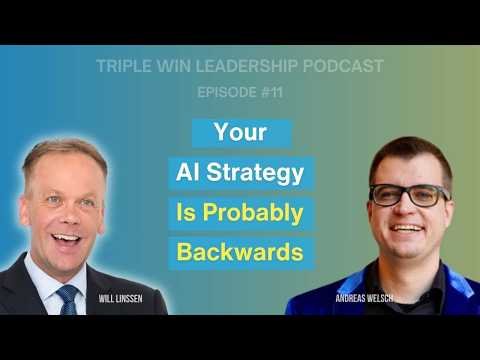
Most executives who set out to build an “AI strategy” are already asking the wrong question. That is the argument AI strategist and author Andreas Welsch made in a recent conversation on the Triple Win Leadership Podcast, hosted by executive coach Will Linssen. Their discussion moved past tool selection and prompt tricks into the leadership work that actually determines whether AI adoption produces results: business strategy, delegation, accountability, and trust.
The conversation centered on a familiar boardroom scene. A CEO or board asks for “an AI strategy,” and the organization scrambles to produce one, often without a clear view of what problem it is solving. Welsch’s position is that this sequence is backwards, and that getting it right is now one of the defining leadership challenges facing enterprise teams navigating agentic AI, workforce transformation, and AI governance at the same time.
The episode, recorded for Global Leadership Coaching’s Triple Win Leadership Podcast Podcast, is aimed at leaders and coaches who are past the “should we use AI” question and into the harder one: how do we lead the human transformation AI adoption actually requires.
Executive Summary
- AI strategy should follow business strategy, not the other way around.
- Delegating to AI still requires the same discipline as delegating to people.
- Unreviewed AI output, or “AI slop,” quietly erodes team trust and authenticity.
- Communities of AI multipliers spread adoption faster than top-down mandates.
- Workforce transformation is about changing skills, not simply cutting headcount.
Key Takeaways
- Treat AI as a way to execute an existing business strategy faster and cheaper, not as a strategy in itself.
- Apply the same delegation discipline to AI that good leaders already apply to people: task, goal, collaborators, definition of done, and information sources.
- Watch for “AI slop”: low-effort, unreviewed AI output that reads as generic or carries obvious AI telltales.
- Disclose AI use rather than hide it; disclosure builds trust, concealment erodes it.
- Build a community of multipliers: curious, credible employees who pilot AI in their own function and report back both ways.
- Measure AI initiatives by business impact, not by how much output they generate.
- Plan for workforce transformation, not just headcount reduction, before cutting roles.
What Is AI Strategy?
AI strategy is the set of decisions an organization makes about where to apply artificial intelligence to advance its existing business goals, not a standalone plan built around a specific technology. A sound AI strategy starts with where the business needs to be in the next 24 to 36 months, then asks how AI or agentic AI can help it get there faster, at lower cost, or through new revenue models the technology now makes possible. It is a business strategy question with a technology component, not a technology question with a business footnote.
Why Most AI Strategies Start in the Wrong Place
Welsch traced the pattern back roughly two to three years, when boards and CEOs began challenging their leadership teams to “come up with an AI strategy.” Few people had a clear definition of what that meant, but organizations began running toward the goal anyway. The result, in his description, resembles throwing spaghetti at the wall: teams chase a new, shiny capability and look for use cases to justify it, which is useful for technical exploration but rarely translates into business value on its own.
Key Insight: Welsch argues that “what is our AI strategy” gets the sequence backwards. The more durable question is where the business needs to be in 24 to 36 months, and how AI can help it get there faster, cheaper, or through new revenue models.
The more successful path, he said, starts from business strategy and works outward: identify where the organization is headed, then ask which technology, AI included, accelerates that journey. The strategy itself rarely changes much; what changes is the focus and speed of execution.
Delegating to AI Without Losing Accountability
As AI takes on more of the work leaders and teams used to do themselves, Welsch said the underlying skill leaders need is delegation, applied to a machine rather than a person. Leadership, in his framing, is shifting away from “knowing the answer” toward setting objectives, asking sharp questions, and staying accountable for outcomes, since the leader remains responsible for the results regardless of who or what produced the draft.
Key Insight: Delegating to AI still calls for the discipline used to delegate to a person: a defined task, a clear goal, named collaborators, a shared definition of done, a description of what good looks like, and the information sources the work should draw on.
He described this as a six-point framework leaders already know from delegating to people, and argued that applying it deliberately to AI and AI agents is what keeps a leader in control of the outcome rather than simply approving whatever the tool produces.
AI Slop, Authenticity, and the Trust Problem
Getting hands-on with AI, Welsch said, also trains leaders to spot what he called “work slop” or “AI slop”: output that looks polished but was never meaningfully reviewed. He pointed to certain stylistic telltales, like overly uniform phrasing patterns, as signals that content may be AI-generated and under-checked rather than carefully produced.
Key Insight: Welsch described AI slop as low-effort, insufficiently reviewed AI output presented as finished work. Leaders and team members who send it without disclosure risk being seen as disengaged or inauthentic, which directly damages the trust that AI adoption depends on.
His recommendation is disclosure rather than concealment. Telling a colleague “I used AI to help draft this, and I’ve reviewed and stand behind it” reads as transparent; quietly passing off unreviewed AI text as personal, considered feedback does not, and people notice the difference quickly.
Building a Community of AI Multipliers
Top-down AI mandates rarely work, Welsch said, echoing the failure pattern of earlier technology rollouts. His alternative is a “community of multipliers”: a network of employees across functions, not necessarily technologists, who have a natural affinity for new tools and enough credibility in their own domain that colleagues take their recommendations seriously.
Key Insight: A community of multipliers is a cross-functional group of technically curious, respected employees who pilot AI in their own area and report lessons back to leadership, creating a two-way flow of adoption information instead of a one-way mandate.
Practical mechanisms he pointed to include recurring show-and-tell sessions, such as a short monthly presentation where a multiplier shares how they built an agent or refined a prompting technique, paired with enough psychological safety that colleagues feel comfortable asking basic questions.
Workforce Transformation Without the Headcount Illusion
Welsch cautioned against the assumption that AI automatically means fewer people. He pointed to IBM as a cautionary example: after CEO Arvind Krishna said in 2023 that the company would cut roughly 7,800 back-office roles as AI took on more of that work, IBM’s own HR leadership was later reported tripling entry-level technical hiring, citing the need to rebuild a talent pipeline for the years ahead.
His broader point, drawn from past technology cycles like supply chain systems, CRM, and e-commerce, is that organizations historically added headcount as they scaled with new technology rather than shedding it wholesale. Some roles disappear, but the business that emerges is typically larger and more capable, not simply leaner.
Leadership Implications
- Anchor every AI initiative to a specific business outcome before approving it, not to the technology itself.
- Apply a consistent delegation framework, task, goal, collaborators, definition of done, and sources, to any work handed to AI or AI agents.
- Set explicit team guidelines on when AI use must be disclosed, especially on personal feedback and performance-related communication.
- Identify and support a cross-functional community of multipliers rather than mandating adoption from the top down.
- Model the behavior being asked of the team: leaders who visibly experiment with AI earn more genuine engagement than those who only issue directives.
Why This Conversation Matters
The conversation lands squarely in the gap many enterprise leaders are navigating right now: pressure to show AI progress, uncertainty about where it actually creates value, and a workforce watching closely for signs of whether leadership is serious, careless, or simply following a trend. Welsch’s framing, that AI strategy is a business strategy question first, offers CIOs, CHROs, and business unit leaders a way to evaluate their own initiatives against something more durable than the news cycle.
Conclusion
The throughline of this conversation is a shift in what leadership means once AI enters the picture: less about having the answer, more about setting direction, delegating deliberately, and staying accountable for what gets shipped. Getting AI strategy in the right order, business first, technology second, is what separates initiatives that produce measurable outcomes from ones that generate a lot of activity and little else.
Frequently Asked Questions
What does it mean for an AI strategy to be “backwards”?
It means starting from a specific technology or tool and searching for use cases, instead of starting from the business strategy and asking how AI can help execute it faster, cheaper, or through new revenue models. Business goals should come first.
Why do most AI initiatives fail to produce business value?
Most stall because they are unstructured and bottom-up: teams explore a new capability without tying it to a specific business objective. Technical exploration is valuable for learning, but it rarely converts into measurable outcomes on its own.
How can leaders delegate to AI without losing accountability?
Leaders should apply the same delegation discipline used with people: define the task, the goal, the collaborators, what “done” looks like, and the information sources the work should draw on. The leader stays accountable for the outcome either way.
What is AI slop, sometimes called workslop?
AI slop is output produced by AI that looks polished but was never meaningfully reviewed for quality, accuracy, or fit. It often carries recognizable stylistic patterns and creates low-quality work product that erodes trust when passed off as finished, considered work.
Should leaders disclose when they use AI to draft something?
Yes. Disclosing AI use, along with confirming that the output has been reviewed and is something the leader stands behind, reads as transparent. Quietly passing off unreviewed AI output as personal, considered feedback damages trust once colleagues notice.
What is a community of AI multipliers?
It is a cross-functional network of employees, not necessarily technologists, who are curious about AI and credible in their own domain. They pilot AI in their function and report lessons back to leadership, spreading adoption faster than a top-down mandate.
Does AI adoption always mean cutting headcount?
Not necessarily. Past technology shifts, including supply chain systems, CRM, and e-commerce, generally led organizations to grow rather than shrink over time. Some roles disappear, but the business that emerges is typically larger and more capable overall.
How should leaders provide stability while AI keeps changing?
Leaders should clearly separate what is staying fixed, such as strategy direction and budget goals, from what is still being tested and may change. Naming both explicitly builds the clarity and trust teams need during a period of rapid change.
What is one practical technique leaders can try immediately?
Ask the AI tool what questions it needs answered before it has enough information to complete the task well. This surfaces gaps in the prompt before the work is generated and reduces the risk of confidently wrong output.
How should leaders measure the success of an AI initiative?
By business impact rather than by output volume. Generating content or reports has become easy; the harder and more important question is what impact that work has on the customer or the business outcome it was meant to serve.