

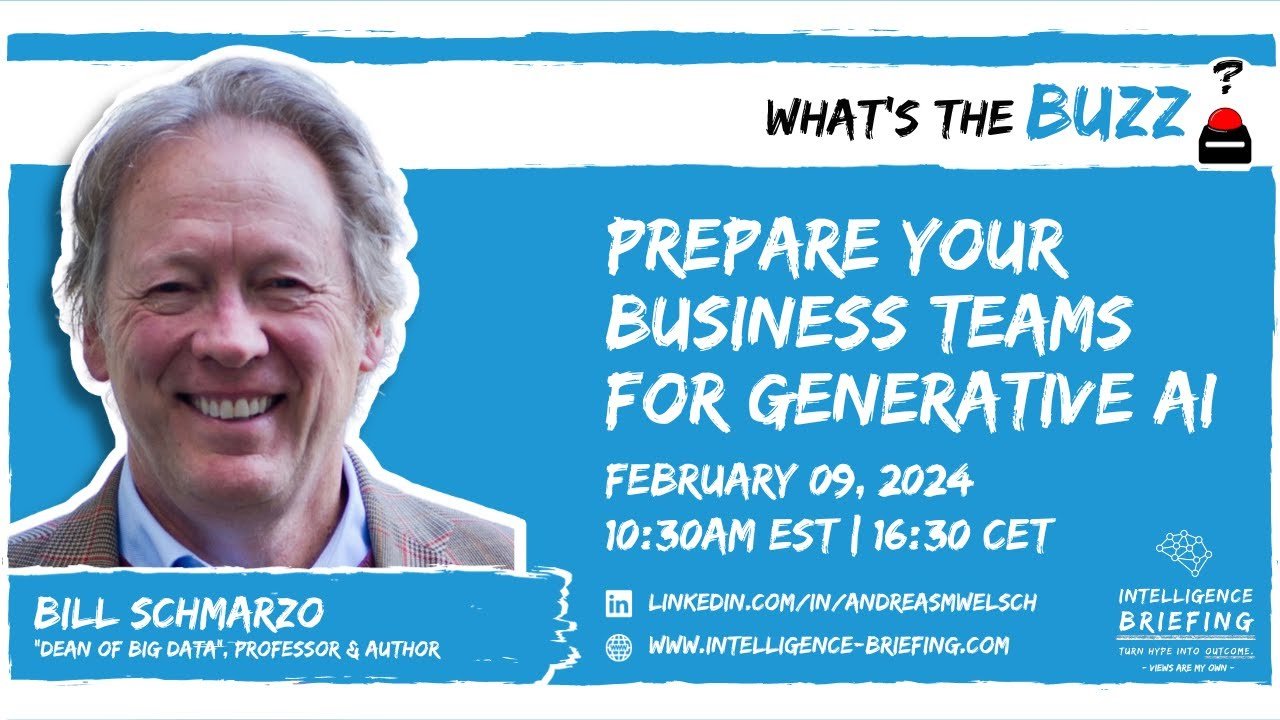
Guest: Bill Schmarzo, Professor & Author, Dean of Big Data
Host: Andreas Welsch
Episode: What’s the BUZZ?, Season 3, Episode 5
Published: February 6, 2024
Episode Summary
Bill Schmarzo, a professor and author known as the Dean of Big Data, joins Andreas Welsch to answer why data and AI literacy still matter when tools like ChatGPT make AI easy to use. Bill describes the components of literacy: how data is captured, how analytics shape behavior, statistics and probability, value creation, ethics and cultural empowerment.
The conversation covers how leaders can help business peers become AI literate, with whom AI Centers of Excellence should partner, how to prepare for unintended consequences, and what business people should know about data privacy. Bill closes with awareness as the first action and a call to demand transparency.
Key Takeaways
- Bill says to use generative AI as a tool and to approach it with a Socratic mindset: ask for the rationale and sources, and validate the answers.
- Bill describes the components of data and AI literacy as data capture, analytics and propensities, statistics, value creation, ethics and cultural empowerment.
- Bill advises embedding business stakeholders with data scientists around a business problem, and expecting results to improve step by step.
- Bill recommends brainstorming unintended consequences with a diverse group of stakeholders, including the second and third order effects of success.
- Bill names awareness as the first action: understand how your data is collected, how it is used to influence you, and demand transparency.
Timestamps
- 0:23 Cold open on preparing your business team for AI
- 0:41 The guest introduces their teaching and industry work
- 2:00 Icebreaker game kicks off the conversation
- 2:17 If AI were a movie what would it be
- 3:39 Why data and AI literacy still matter
- 8:00 How leaders help business peers become AI literate
- 10:41 Building literacy on the data and statistics side
- 14:15 Who AI centers of excellence should partner with
- 16:39 Audience question on unintended consequences of AI
- 20:23 Audience question on data privacy and generative AI
- 24:10 The one action to raise AI literacy
- 27:03 Audience question on transparency into data use
- 28:23 The three key takeaways for the audience
- 28:55 Wrap-up and thanks to the guest
About Bill Schmarzo
Bill Schmarzo is a professor and author, known as the Dean of Big Data. In the episode, Bill describes working primarily as a teacher with students and organizations on data and analytics, and working at Dell Technologies as Customer AI and Data Innovation Strategist. Bill is the author of the book AI and Data Literacy: Empowering Citizens of Data Science, published by Packt.
Full Transcript
Read the full transcript
Andreas Welsch: Today we’ll talk about how you can prepare your business team with AI, and who better to talk about it than someone who’s recently written a book about just that. Bill Schmarzo. Hey Bill, thank you so much for joining.
Bill Schmarzo: Thanks, Andreas, for having me. I’m looking forward to this conversation.
Andreas Welsch: Wonderful. Same here. Why don’t you tell our audience a little bit about yourself, who you are and what you do?
Bill Schmarzo: Primarily I’m a teacher. I love the opportunity to work with students and with different corporations and organizations to help them understand more about data and analytics and how they can use those to drive value. I also work at Dell Technologies, where I’m their Customer AI and Data Innovation Strategist, and I get a chance to work with customers of various sizes on that same mission: how do I unleash the economic value of our data?
Andreas Welsch: Thank you so much for sharing. It sounds like you have a good mix of industry and real-life expertise, where you’re getting in front of many leaders trying to do the same thing, and then being able to bring that over to academia as well. For those of you in the audience, if you’re just joining the stream, drop a comment in the chat where you’re joining us from today. I’m always curious to see how global our audience is. Now, Bill, should we play a little game to kick things off?
Bill Schmarzo: Yeah, I love games. Let’s do it.
Andreas Welsch: All right. What if AI were a movie? What would it be? 60 seconds on the clock to make it a little more interesting.
Bill Schmarzo: Oh my gosh. It’d be Gladiator. Now you’re going to think, why the heck would you pick Gladiator? But there are some lines in that movie, and the one that sticks out to me is that what you do in life echoes in eternity. I think that is such a powerful statement, because what we are doing today around helping others deliver more relevant, meaningful, responsible, ethical outcomes using AI and data will resonate for years, even after we are gone. So to me, if AI were a movie, it’d be Gladiator, and it’d be holding AI itself accountable for driving those kinds of impacts, even after we ourselves are gone.
Andreas Welsch: That’s a really interesting take. I’ve heard a number of different guests mention other movies, but Gladiator stands the test of time, and it’s something for the history books. Look, last week we had Conor Grennan from NYU, and he was talking about ChatGPT and how easy ChatGPT makes it for anyone to use AI these days. But I also keep hearing that the business needs to become more data and AI literate, beyond just playing around with generative AI. So I’m wondering, why is data and AI literacy still important when tools like ChatGPT make it so easy for anyone to use AI?
Bill Schmarzo: ChatGPT can be dangerous. Now I’ll tell you right off the bat, I use ChatGPT frequently, and I call it my Yoda, your own digital assistant. It helps me expand my research. It helps me accelerate exploring things. Even in my class, I mandate the use of GenAI as part of my thinking-like-a-data-scientist methodology, because I think it helps students explore more freely. But it doesn’t replace the need for AI and data literacy. First off, we need to understand how organizations are capturing data about us and about other people, and all the ways that data is being captured, even as we converse here and a transcript is being created, capturing information about us. Number two, we need to understand how analytics are used to uncover our individualized predicted behavioral and performance propensities, because those propensities are being used to influence us, sometimes in a positive manner, sometimes to manipulate us. Number three, we need to understand some very basics about statistics and probabilities. Not in a big sense, but we need to understand that life is about improving the odds of survival, and nothing in the world is a hundred percent, except for the love of a daughter. So we need to make certain that we understand some basics around making decisions with the goal of improving the probability of making a better decision, which is the fourth component. How do I make better decisions? Statistics, analytics and data are all about making better decisions. The next component is value creation. How are we using GenAI, analytics and AI to help create value? That’s a really hard conversation. It’s an economics conversation, because it requires you to think very holistically about how you as an individual create value, or how the organization you’re in creates value, and how it defines and measures that value creation effectiveness. The beating heart of literacy, by the way, is ethics. We need to think holistically about how we are working ethics into our data. How do we get unbiased data sets, and how are we working ethics into the models that are generating recommendations and decisions that impact people? So ethics is the beating heart, but the last component, the thing that enables everything else and wraps around all of this, is cultural empowerment. Everybody needs to feel like they have a voice in how AI and data are being used on them. Everybody needs to understand their role, their responsibilities and their rights when it comes to how AI is being deployed and used.
Andreas Welsch: I like especially the last part about making it personal and developing that understanding of how AI is being used, how it influences you, and also what you can do with it. For those of you in the audience, if you have questions for Bill, please put them in the chat and we’ll take a look in a couple of minutes and pick some of those up. A couple of days ago I saw a news article where leaders said, this generative AI thing is great and we love seeing that, so many companies jump on that bandwagon, so many software providers. But we need certainty. It has to be a hundred percent. Right now it might occasionally go off the rails. So to me, that’s a clear need and a use case for creating more data literacy. It’s not always a hundred percent, and it most likely will never be a hundred percent, whether it’s statistics, machine learning, AI, generative AI, whatever you call it. That’s fundamental, at the core of it. So thank you for sharing that as well, that there is a need to create more of that literacy. Connected to the example I just shared, what is your recommendation? How can leaders help their business peers, who might not be as deep in tech and in data, to get more AI literate and more data literate on the business side?
Bill Schmarzo: On the generative AI front, the best way to learn is to do it. Just get involved. If you’re not using one of the generative AI products today, then you’re already behind the curve. It’s a very powerful tool. Now, let’s make really clear, it is only a tool. It is only a means to an end. So as a user, I still need to understand what my end point is, what am I trying to accomplish, and get involved with it. When you start interfacing with this thing, there are two faces of this generative AI stuff. I think it’s a marvelous assistant in helping me do more research and accelerate my learning. But I approach it with Socrates in mind and the Socratic method in how I ask questions. I’m always seeking to validate. I’m always drilling into more detail. I’m asking, what’s the rationale for what you’re telling me? Cite me the sources. So I come in a bit dubious. I am still responsible as a human for the critical thinking that goes into saying, do I believe what it is telling me? Have I done enough validation, as a detective, to make certain that what I’m hearing back from my favorite GenAI tool is something I can actually believe in? So ChatGPT, start using it. But understand it’s more of a conversation that you’re going to have. It’s not a one-point thing. You’re not going to say, tell me this, and then be done with it and say, oh, that sounds great. It’s like walking down the street and asking some random person, tell me the facts about this, and they’ll make up some crap. You’ve got to validate exactly what it is you want, and you as the human are in the conversation. It’s only your assistant. It’s not making decisions. It’s sitting on your shoulder like a little Yoda, your own digital assistant, whispering in your ear, but it’s not making the decisions for you. You still own making those decisions. So think about embracing the Socratic method. Think about critical thinking as you drive this innovation, and it will come up with great stuff. You will be more productive and you will think more broadly about things. It’s going to give you the chance to do that, but you still own it.
Andreas Welsch: I love how you connect that. We have to be aware. We have to have some critical thinking and knowledge of our own, whether we already have the knowledge and seek to validate or expand it, or after getting the response go and do the fact-checking and validation. Now, on the more traditional data, AI and statistics side, how can leaders help their business peers there, where it’s maybe not as immediate and as tangible as an app on your phone that you can ask questions?
Bill Schmarzo: What I see work is the integration, or embedding, of the business stakeholders with the data scientists, trying to solve a particular business challenge. I find that the best, most successful organizations always start by trying to figure out what it is we’re trying to do. How do we create value? What is important to our organization over the next 12 to 16 months? Then they drive a process that drives collaboration between the business stakeholders, who are the ones trying to define and measure the value creation effectiveness, and the data science and data engineering organizations, who are trying to create the data and build the models to optimize the decisions we’re making. There’s a natural collaborative process. I don’t think you’re going to see business executives writing their own AI models. Maybe GenAI gets us there in 3, 4, 10 years, who knows. But today I’m providing the desired outcomes, concerns, risks, KPIs and the metrics around which I’m going to measure effectiveness. The data science team is building the models, trying to optimize that, and there’s a collaborative process around feature engineering and understanding the cost of false positives and false negatives, and creating that feedback loop for when the results come out. What you’re going to learn very quickly from the business side is that the data scientist won’t give me absolute answers. You said it really well, Andreas, I’m not going to get a hundred percent. So my first one might be sixty percent, and then I learn, and it becomes sixty-seven percent, and then I learn and it becomes seventy-one percent. These economies of learning, this continuous learning and adapting process, are heavily dependent upon the continued collaboration between the business stakeholders and the data science teams to deliver on the promises of those value creation processes.
Andreas Welsch: I’ve seen this work really well in individual projects where you have data scientists and business stakeholders and experts, and you put them together with joint sponsorship and ownership from both the technology and the business side, and have them work on a problem or a project. What I’ve always found interesting is, when you see them over a couple of weeks, or maybe a month or two, depending on how long the project goes, how the data scientists learn more about the business and what questions we need to ask. What is the finance business function really about in a particular problem? When do we need to send a reminder to our customers? Are you really going to pay us? You’re seven days late. You’re 14 days late. And how can you predict, for example, who has a higher propensity of paying you? Yes, there’s a technology component to it, but it only comes to life through the business context. So having that dialogue, and on the other hand for folks, for example, in the finance function, to learn more about what they can do with AI and how it can help them. But I know that’s not the only way. You don’t only learn about each other and each other’s problems through projects. So I’m wondering, with whom should, say, AI Centers of Excellence or AI teams partner to increase AI literacy in a business? It’s not just projects.
Bill Schmarzo: I think overall that organizations need to have a foundation of understanding about how AI models work and how data is being used. The topics I covered are a base foundation. I would mix in design thinking as a base foundation as well, where the organization is able to understand and empathize with who their key stakeholders and key constituents are. To me the overarching opportunity and challenge is understanding how to create value, and that does require collaboration. Now, if you have an AI Center of Excellence, they should be partnering with universities or other organizations to really learn more about this. For example, the new transformer capabilities and the new technologies are there, which is great. You really want to learn about the new tools, but it always comes back to application. Learning about all these great tools is great, but what matters is knowing where to apply them to create value. If as an AI organization all you’re doing is learning about great new tools and posting research studies, and maybe you’re at a university and you get pats on the back for that, for most organizations that doesn’t matter. It just doesn’t matter. It’s all about application. At the end of the day, if you’re not creating that tight linkage between the business and the data science team, with the expectation that we’re going to build a solution that evolves over time, that embraces the economies of learning and the power of compounding to become more and more effective, then I think all the stuff you do in the AI labs is kind of like monkey tricks. Who really cares?
Andreas Welsch: I love monkey tricks as a term, not so much as the result of the work. Bill, I see a question from Dan in the chat, and he’s asking, how do you prepare organizations to deal with unintended consequences? I think that’s a really good one, because it’s not always easy and straightforward in sunshine. There might be some unintended consequences when you work with data and AI. So how do you prepare them?
Bill Schmarzo: Great question. Number one, there will always be unintended consequences, so we start by understanding that they’re going to happen. It’s unavoidable. What we can do is unleash that collaborative organization to start brainstorming all the things that could happen, on both the positive and the negative side. What are the unintended consequences of this business initiative failing, and what are the ramifications? Employees get laid off, we have to close offices, it impacts communities. There are a range of variables and metrics we can measure against when an initiative fails. But what happens when an initiative is successful? Are there second and third order ramifications if this is successful? How does that impact your employees, your customers, the community you’re in? Are there environmental impacts? Are there ethical impacts? What I’ve found is that when you bring people together and leverage design thinking concepts to start ideation, where all ideas are worthy of consideration, where you’re allowed to put all kinds of things on my blank wall here with Post-it notes, maybe 90% of the stuff you put up on the wall, maybe ninety-five percent of what I put on the wall here, has no relevance. But the 5% might be critical, because if we can imagine all the ways that it can go wrong, we can start to identify the KPIs and metrics to monitor for that. If we can do that, we can put those KPIs and metrics into our models to try to mitigate the unintended consequences. It takes a lot of work, and it scares me because we have leaders who are very quick to make policy decisions without going through the process of thinking of the second, third and fourth order ramifications. As citizens of data science, we cannot allow that to happen. We cannot allow AI models to be built that have a negative impact on people, and we need to think through all the ways this thing can go wrong before we put it into production.
Andreas Welsch: That’s very powerful. That speaks to my engineering mindset as well, really taking it apart and looking at it from all different angles and understanding, like I said, what could go wrong. To me, there’s a strong connection to what you said earlier, ethics being a foundational component, not just an afterthought but there from the beginning. Should we even build this?
Bill Schmarzo: What’s interesting is you can actually use ChatGPT to help explore all the potential unintended consequences. It’ll give you all kinds of answers. Some of them are nonsense. It’s okay, I’m a human, I can throw the nonsense ones out. But if you have this conversation and keep asking, give me more, give me more, think about it from the perspective of customers, think about it from the perspective of the community, think about it from the environmental perspective, it’ll start generating all these things. Great starting point. It still doesn’t replace the fact that I want to bring a diverse set of stakeholders into a room. Stakeholders who may not even like each other. I don’t care. In fact, if they don’t like each other, that’s better. Let them brainstorm all the things and argue and go all crazy here. That’s okay. We want to capture all of that so that we come into this world of AI with our eyes wide open, not Pollyannish.
Andreas Welsch: Perfect. I just want to let that sink in for a second. There’s one question from Naz in the chat, the last one, where she’s asking about data privacy and generative AI. I think that’s an important one that we see come up time and again, and that I also see in conversations with business leaders. What about data privacy? Am I just sending that off to some vendor? Is it really protected? What do I need to do? I think the same is even true for AI and machine learning and other means that all subsume under AI. Thinking about data privacy, what are some of the thoughts or recommendations you have when it comes to data and AI literacy? What do business people need to know about AI and data privacy?
Bill Schmarzo: I think you should always assume bad intentions. Always start off by assuming bad intentions, because the cost of being wrong and assuming good intentions and things going bad can be so expensive. Come in as a doubting Thomas. Come in and say, I’m not convinced in any way that my data is going to be protected. All the terms and agreements you get from websites about how we’re going to protect your data, I don’t believe it. For example, the idea of me giving my DNA information to 23andMe, no way. No way. Because I’m just going to assume bad in all cases, and I am going to do everything in my power to make sure my data is protected. I usually, for example, have a tab over my camera here, because I don’t want anybody watching what I’m doing and collecting that. I usually stub out the speaker on my device so that people can’t hear me talking. I use anonymous browsing. I don’t trust anyone. Even good organizations who have all the right intentions, who are the most ethical and honorable, can get hacked. So your data is going to get out there. Just assume your data is going to get out there. When you think about it from that perspective, that you know your data is going to get out there, apply the mom rule. What would your mom think if you put that data out there? If you said, hey mom, I just told everybody about blah, blah, blah, would your mom say, that was a smart move, or would she say, what are you, an idiot? So we have to be cautious. We have to embrace critical thinking to think about all the ways my personal data can be used against me. And then realize that your data will be used against you. Some organizations use it in a positive sense, or recommend you might want these products, or these are the places for vacation, or whatever you might want to do. Most companies are going to use it with really good intentions. It only takes one or two bad actors to give you a bad experience, where that data gets misused and put out there. Data privacy is a huge issue. I love what GDPR has done. I think it’s a step in the right direction. I think it needs to go 10 more steps.
Andreas Welsch: That’s a statement. Usually we hear the opposite, that GDPR complicates everything and it’s just a big rule book. But I love how you raise awareness to be conscious and data conscious, and conscious of all the breadcrumbs that we all leave. Sumi is saying in the chat, I love the mom rule too, I might incorporate that. That’s awesome. Building off all of that, what we just captured over the last couple of minutes, what’s one action that AI leaders should take to increase the literacy in their organization? What’s the number one thing that they should do?
Bill Schmarzo: Awareness. Awareness is number one. If we want to have an impact, we need to make sure everybody is aware of how their data is being collected, and how that data is being used to influence or manipulate them. That, to me, is step one. When I am presenting in a few weeks to a bunch of juniors and seniors at a local high school, that’s going to be point number one, that awareness. You need to be aware that everything you’re doing, walking down the street, typing on your phone, working on the internet, everything you do is being collected, and that there are people who are going to use that data to try to influence you, manipulate you, what you buy, and even what you believe. So awareness is number one. If you’re not aware, you’ve got no chance. Once you have awareness, now we have a platform to say, okay, what’s the next level? How do I protect myself? How do I protect my customers’ data? How do I ensure that I’m using my customers’ data to deliver more relevant, more meaningful, more responsible and more ethical outcomes? But it all starts with awareness, and reading my book.
Andreas Welsch: What is it called, so people can find it?
Bill Schmarzo: I published it with Packt. You can find it on Amazon, so they can collect all your information about you shopping for my book on Amazon. It’s called AI and Data Literacy: Empowering Citizens of Data Science, and I want you to think about that last phrase. Empowering. It means that you understand that you’re a citizen, and a citizen has a proactive role. You need to be active in it. You can’t sit back and wait for crap to happen. I can’t wait for the EU or the White House to come up with an AI act that’s going to protect me as a citizen. I need to be proactive and I need to understand my roles, my responsibilities and my rights as a citizen. My role is to understand how I ensure my data is being used in an ethical manner. How do I get involved? Number two, my responsibility is to bring others into this process. It can’t just be about me. I have responsibility for my society, for my community, for others around me. And number three, my right to transparency. What I mean by that is my right to know when an AI model has been used to make a decision that impacts me. What were the variables and metrics in that model, the rationale, so to speak, that drove that decision? Roles, responsibilities and rights.
Andreas Welsch: Thank you for capturing that. I see one question in the chat again from Dan, and maybe we can answer that briefly because we’re getting close to the end of the show. Dan is asking, can you really get transparency into everything that’s being done with your data? And where or how can you get that transparency? Is there something that’s more actionable?
Bill Schmarzo: Maybe we can’t get total transparency, but we can certainly start marching down that path. We can put rules in place that say that when a system or an AI model makes a decision about me, it pops up and says, hey, an AI model made this decision, whether it’s on Amazon browsing or on social media. When I get some random thing in my feed, it should say this was put here by an AI model, and I should be able to click on that and see, we made this recommendation to you based on the following variables. How hard can it be?
Andreas Welsch: The question is, do businesses want to be so transparent?
Bill Schmarzo: God no.
Andreas Welsch: And for what reason? Exactly. Right. Now that’s awesome. I didn’t expect our conversation to go more in that direction of data privacy and data awareness. But I think it’s super important. As I said, it’s the first step to data and AI literacy, which is also the name of your book. Now, Bill, can you summarize the three key takeaways for our audience today, because we’re getting close to the end of the show.
Bill Schmarzo: Number one, do not be afraid of AI. It’s only a tool and it will only do what you train it to do. Number two, be involved. Be involved in how those models are being trained so you understand how your data is being used and how it might be used to manipulate you. And number three, understand your rights for transparency. Demand them. Don’t think someone else is going to solve that problem for you. It’s on you. Demand transparency.
Andreas Welsch: Thank you so much for joining us and for sharing your expertise with us. I really appreciate having you on. It was great.
Bill Schmarzo: Thanks, Andreas, a fun conversation. Like I said, I didn’t know it was going to go in this direction, but that’s the way it went, so it’s always more fun that way.
Andreas Welsch: Exactly.
Listen and Subscribe
Related Reading
Frequently Asked Questions
Why does data and AI literacy still matter when ChatGPT makes AI easy to use?
Bill says ChatGPT can be dangerous because ease of use does not replace understanding. People need to know how organizations capture data about them, how analytics predict and influence behavior, the basics of statistics and probability, how value is created, and the role of ethics and cultural empowerment.
How can leaders help business peers become more AI literate?
Bill advises leaders to start using generative AI and to treat it as a tool, applying critical thinking and the Socratic method. On the data and AI side, Bill recommends embedding business stakeholders with data scientists to solve a business problem, with continuous learning in the loop.
How should organizations prepare for unintended consequences of AI?
Bill says unintended consequences are unavoidable. Bill recommends bringing a diverse group of stakeholders together to brainstorm what could go wrong and what could follow from success, then turning those ideas into KPIs and metrics that go into the models.
What should business people know about AI and data privacy?
Bill advises assuming bad intentions, since even well-meaning organizations can be hacked, and applying a simple test: how would your mom react if you shared this data. Bill also supports GDPR and wants it to go further.
What is the first action AI leaders should take to raise AI literacy?
Bill says awareness comes first: everyone should know how their data is collected and used to influence them. From there, people can protect their own data, use customer data responsibly and demand transparency about decisions made by AI models.