

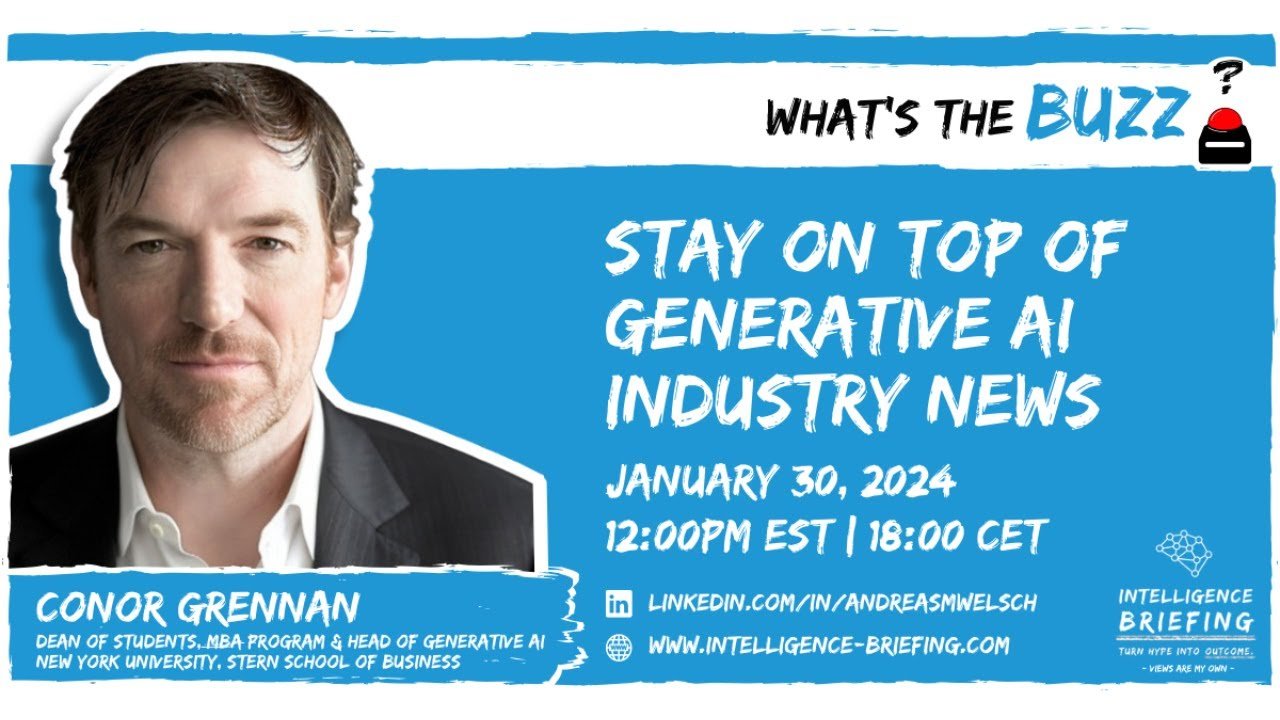
Guest: Conor Grennan, Dean of Students, MBA Program & Head of Generative AI, NYU Stern School of Business
Host: Andreas Welsch
Episode: What’s the BUZZ?, Season 3, Episode 4
Published: January 30, 2024
Episode Summary
Conor Grennan, Dean of Students for the MBA program and Head of Generative AI at NYU Stern School of Business, joins Andreas Welsch to answer how leaders can stay on top of generative AI news. Conor argues that generative AI is a learning and culture topic more than a technology topic, and that a Head of Generative AI belongs closer to HR and talent than to the CTO.
The conversation covers how to upskill a workforce by starting with the C-suite and line managers, how Conor handles pushback on risk and proprietary data, and how to filter the daily flow of AI news by focusing on the tools already in use. Conor closes with three takeaways for the audience.
Key Takeaways
- Conor sees a Head of Generative AI as a learning and culture role that should sit close to HR and talent.
- Conor recommends upskilling from the top: teach the C-suite and line managers first, then the workforce, then look at hiring practices.
- Conor advises leaders to filter AI news by asking what they are trying to do, and to use the AI features already built into the tools they use.
- Conor suggests learning together with a few peers and treating the tool as a thought partner, and not to wait for perfect training.
- Conor says leaders are not behind and should start now.
Timestamps
- 0:22 Cold open on keeping up with AI news
- 0:38 The guest introduces their work at a business school
- 2:14 The guest talks about their new AI podcast
- 3:38 Icebreaker game called In your own words
- 4:26 If AI were a rock band who would it be
- 6:03 Does a business need a head of generative AI
- 12:31 How to upskill your workforce in concrete steps
- 17:14 Audience question on pushback from the C-suite
- 20:13 How leaders stay on top of AI news
- 23:55 Learning AI faster together with peers
- 25:45 The three key takeaways for the audience
- 28:25 Wrap-up and thanks to the guest
About Conor Grennan
Conor Grennan is Dean of Students for the MBA Program and Head of Generative AI at NYU Stern School of Business. In the episode, Conor describes about ten years as Dean of MBA students at NYU Stern, creating and running the Generative AI at Stern program over the last year, and working with companies and boards on how to use generative AI. Conor also co-hosts the AI Applied podcast.
Full Transcript
Read the full transcript
Andreas Welsch: Today we’ll talk about how you can stay on top of the flood of AI news, and who better to talk about it than someone who’s been covering just that. Conor Grennan. Hey Conor, thanks so much for joining.
Conor Grennan: Yeah, thanks for having me. I’ve been looking forward to this, Andreas.
Andreas Welsch: Wonderful. Same here. Why don’t you tell our audience a little bit about yourself, who you are and what you do?
Conor Grennan: Sure. Thanks. It’s great to be here. My name is Conor Grennan. For almost 10 years now, I’ve been Dean of MBA students at NYU Stern School of Business, where I also got my MBA. That place has a special place in my heart. More recently, over the last year, I created and run the Generative AI at Stern program, which teaches students, faculty and administrators how to use generative AI. Also over the last year, I’ve been working a ton with companies and giving a ton of talks to high-level people, working with management boards but also teams, around how to use generative AI, using a very specific framework that I developed. It’s a little different, but I think it works well. I’ve been able to work with companies from OpenAI to McKinsey to PwC, I’ve done some work with ServiceNow, and I get to connect with NASA. Some really fun places.
Andreas Welsch: Cool. That’s wonderful. I’ve been following your content for a while, and it’s amazing to see the following you’re building and how timely your comments and perspective are, and how on point they are to things happening in the industry. I saw you launched a podcast a couple of weeks ago. If you want to say a few words about that as well, I think it’s a great segue into why I wanted to bring you on the show and talk about how you can stay on top of it.
Conor Grennan: Thanks. Anywhere you can get the information out is fun, right? Jaeden Schaefer and I have the AI Applied podcast. Jaeden has a few podcasts on this. He’s huge in the podcasting space. We talk probably three times a week or so about what the latest news is and how we break it down, especially how you apply it to your job. I think generative AI is huge and amazing, but you have to see how it’s applicable, because, Andreas, you talk about this a lot, just knowing it, you can feel really overwhelmed. So what do you actually need to know, and how do you actually apply it to your work? I’m also doing some things on YouTube, and obviously I’m on LinkedIn a lot, as you are. So you and I track along, and there’s so much out there to share with the audience.
Andreas Welsch: I’m really looking forward to our session today and everything that we’ll cover. For those of you in the audience, if you’re just joining the stream, drop a comment in the chat where you’re joining us from, because I’m always curious to see how global our audience is, and I can’t believe from what faraway places you’re tuning in to watch the show. Conor, should we play a little game to kick things off?
Conor Grennan: Yeah, let’s do it.
Andreas Welsch: This one’s called In Your Own Words. When I hit the buzzer, the wheels will start spinning, and I’d like you to answer with the first thing that comes to mind and why, in your own words. To make it a little more interesting, you’ll only have 60 seconds for your answer. For those of you watching us live, also drop your answer in the chat and why. I’m really curious. Now, are you ready for What’s the BUZZ?
Conor Grennan: Yeah, let’s do it.
Andreas Welsch: Okay, here we go. If AI were a rock band, who would it be? Sixty seconds on the clock. Go.
Conor Grennan: Okay, maybe this is recency bias, but over the weekend I saw U2 at the Sphere in Las Vegas, which has a ton of generative AI art coming in at the back. And it made me think. U2 is in their sixties right now. The band has been all things to all people. They’ve been a hard rock band. They’ve been a revolutionary band. They’ve been let’s change the world. Then they went into pop. They’ve been everything, and I feel like that’s generative AI. What we don’t say enough about generative AI is that it’s all things to all people. And I mean that almost literally. In much the same way that U2 has been almost all things across 40 years of the band’s life, I think generative AI can also be anything, no matter your age or where you are in life. That’s generative AI.
Andreas Welsch: Right on time. Thank you so much. This is great. Looking at the chat here, others are saying Daft Punk, for example, or The Who. That would be good. Great examples.
Conor Grennan: Those are good examples.
Andreas Welsch: Now to transition to the questions we’ve prepped and wanted to cover today. You mentioned that one of your titles at NYU is Head of Generative AI. I’m curious, what does it entail, and then, more relevant to our audience here, do businesses need that type of role as well?
Conor Grennan: This is such a good question. I was just talking about this the other day. Look, I think every university should definitely have a Head of Generative AI. At Stern, and I started that role about a year ago, what I was looking to do was think, look, we have to prepare our students for what’s coming next, for the workforce they’re going to be entering and the tools they’re going to be using. But also, faculty has tended to teach the same way for very good reason, because it’s been very successful for years and years. Even now, with schools and things like that, you can’t teach the same way. You can’t just assign a paper and hope that students go back and don’t use generative AI. So we really have to think about new proxies for grading and things like that. That’s in the university and academic setting. It’s critical, because it’s how we are grading and judging. So students have to figure out a new way, and faculty too. But what I spend a ton of time on now is how it’s used in business. We can educate our students, but a lot of that has transitioned into me working with a ton of companies, giving a ton of talks to heads of boards, keynotes and things like that, and to teams, around what it would look like to have somebody running this in their organization. For me, a Head of Generative AI or a Head of AI has a tech layer to it. Of course, you need to understand your tech stack and what you can do. But what generative AI really is, I find, is much more of a learning thing and a culture thing. What I tell companies, and I talk to a lot of them, is that if I were to set up a Head of Generative AI, in the same way we’ve set up a Head of Data or a CTO at different points over the last, let’s say, 30 years, the Head of Generative AI to me should live in the HR and talent space. It should almost be a Head of Learning. I know some CTOs will push back. Of course, we need the tech aspect as well. But because this is so unbelievably accessible to every single knowledge worker in your organization, and it is agnostic to industry, company, department, role, anything, this has to be a new way of doing this. When people ask which companies are doing it well, to be honest, not many. But the companies that are doing it well are the ones that are treating this as a culture issue and a learning issue, starting at the top, understanding what this is going to look like when all of your people are using it and augmenting what they do well. That’s when it gets really powerful, and that’s why I think of it almost as a talent play. Every department and every organization is going to use it differently. And if you’re just treating it like tech, people think, I’m not that good at tech. It’s not really tech. Even when OpenAI puts out their prompting guides and things like that, it’s much more like a guide to how you would be a good leader to a brilliant intern. That’s why I feel it’s much more of a learning thing than a tech thing, a Head of AI role.
Andreas Welsch: That’s awesome. That’s a very interesting and unique perspective. I fully understand and agree with it. It’s a culture change and shift in many good ways, and we need to bring people along. We need to show them what this AI thing can do for them. How do you use it appropriately? How does it work? How do you use it in a way that helps you accomplish new tasks? It’s not there to replace you. These are the types of messages that we need to get across. And I remember a couple of months ago we had a Chief AI Officer on the show, the role reporting directly to the CEO. Now, with what you’re saying, I think that makes a lot of sense too, to bring the culture and the learning and development aspect into the organization. So I love the contrast here, and I’m sure it depends on the company, on the role, on the types of products you’re building. But definitely anchor it in the learning and.
Conor Grennan: Yeah, I think so. And one other word on that. I think you’re exactly right. It needs to roll up to the CEO, because in order to get everybody on board with this, it is about training. It’s in the same way that if you say, we have a culture of collaboration, that’s much closer than saying we have a culture of using ServiceNow or Salesforce or Excel. Those aren’t cultural things. When I’m talking about how people use generative AI, it’s much more akin to exercise than to learning. There’s not really a learning curve, and I get in some trouble for saying that, but there really isn’t. If you know how to talk to a human, you know how to use generative AI. The challenge, Andreas, as you know as well, is that the challenge isn’t learning something. With Excel or French or calculus, you actually have to learn information. You could be in a room of 800 and you’ll have beginners and you’ll have experts. This doesn’t work that way. The way it works is, if you can get your brain around the fact that you have to talk to your laptop or your phone as if it were a human. That’s very difficult for the brain, because the brain automates things to free up your prefrontal cortex, which is why, if you’ve been traveling to work the same way every day for 20 years, you still make that left out of your driveway. Your brain has automated it. So when your brain sees something like ChatGPT, it essentially sees Google. Your neural pathways are like, I know what to do here. I’ll treat it like Google. I’ll give a command and get a response back. When in fact the real way to use it is to ask, what do I do in my role? And what if I had basically cloned my brain, and gave it everything it needed to know in the world to do it? You’d have this incredibly brilliant thought partner that could strategize and help you do your work and help you make better decisions. That’s what it is. But that requires a conversation. It’s not asking a question. And most importantly, everybody is going to be using it differently, which is why, when I work with companies, it’s agnostic to industry. It doesn’t matter what I know about your company. It matters what you know about your company and what your people do well, and that’s the important part.
Andreas Welsch: Building on that, with that opportunity and that potential, how do you then upskill your workforce in more concrete steps, in addition to saying, hey, this is available to you, go try it out? We’ve talked about guardrails before, and certainly there are things you should and shouldn’t do. But more operationally, how do you put that into practice to upskill your workforce?
Conor Grennan: I think you’re saying it exactly right. I even come out and say, listen, I don’t see this as a digital transformation, which means it’s much different from anything we’ve done in the past. A digital transformation is where you implement a new system and basically burn down the old software, and you give everybody training videos and all the help they need. Then you watch your workforce digitally migrate over to the new thing. Some people will do it better, some people will do it worse. That’s not what this is. It’s not that kind of learning thing. Ethan Mollick and Allie Miller are fantastic follows on this front who go into this as well. And again, my co-pilot Jaeden in the AI Applied world talks about this a lot: you have to understand what you need to do in your work to do this. So when we think of upskilling, it’s not really training videos. It’s in the same way that you’d get somebody into shape. It’s a series of things: it’s inspiring, it’s understanding what good shape looks like, it’s having the information. I have a whole training framework. But when I think about the order of events, what I tend to do is first work at the top, with the management committee, whatever that looks like, and the line managers, whatever that looks like, like the Head of HR, Head of Sales, Head of Legal and Learning, and all that kind of stuff. The reason is that if I work with a team first, everybody gets excited and I inspire them and I teach them this framework for how to look at AI in a brand new way. But then they still get to choose who uses it and who doesn’t. That’s great for the employee, and I encourage that. The challenge is that it doesn’t impact the company’s bottom line in the same way, because you’re not systematizing it. Why aren’t you systematizing it? Because at the top, the CEO, the C-suite, the board of directors and the line managers, whoever they are, haven’t yet set new benchmarks. So you have to teach them first and really show them what this framework looks like and what this will look like at scale, if everybody is really using generative AI in their own personal way. And this is how you really differentiate a company: you say, the new benchmarks for, let’s just call it an eight-hour day, should be this and not this. It’s changing what a workday looks like. If everybody is going to be using this at scale, then it will automatically reduce their non-value-add hours from, let’s say, three to one. Even just right there, forget about all the strategic stuff, you’re gaining back time even if you did nothing else. And I hear from salespeople all the time, we just want our time back. And I’m like, we can give you your time back. So you have to start at the top. Once the top understands what that upskilling looks like and what the result of it would be, then you upskill the workforce by not just teaching them what it is, but giving them a brand new paradigm for it, not just here are 10 use cases. That doesn’t work, because everybody’s use cases will be so radically different. It’s like teaching use cases for electricity. There are so many you can’t possibly cover them, so you have to teach people how to look at it in a different way. So you have to inspire them and teach them and train them on how to use it. Then you have to look at hiring practices for your organization. That to me is the third step, because you’re going to be hiring in a very different way, and your organization will start to look different. The organizations that do that well will be going to a place where others can’t follow. If you’re just implementing a tool, that’s a commodity. Everybody will catch up. If you’re implementing a whole new mindset and way of looking at it, you’re going to a place where people can’t really catch up.
Andreas Welsch: I really like how you phrased that, and that it’s a lot more than just another tool or just productivity. Reframing how we look at work, and what a good result looks like, or what a productive and successful workday looks like, is a whole different perspective that I think more people need to take. And when you reframe it, I’m sure you see the outcomes a lot more clearly than with just another tool. Awesome. I see there’s one question from Brent in the chat, and he’s asking, does the C-suite always get it when you present to them about adopting AI, or do they ever push back?
Conor Grennan: Yeah, they do. But I’ve done it so many times that I think I’ve learned where the pushback comes from. That’s why I deal with risks early on in any conversation with a C-suite. They’ll say we can’t, because the risks are this or this. A lot of companies have still just banned it outright, and we understand why, because we can’t risk uploading proprietary data. So I go through what’s actually happening when they upload proprietary data. First of all, don’t upload proprietary data, okay? I’m not advocating for that at all. But I am saying there are differences. If you’re in a regulated industry, there are legal implications to uploading, obviously in healthcare, and obviously if you’re violating third-party agreements. Those are legal issues that you’d have to deal with in any guideline in your ethical and legal framework for your organization. But I think people think that if you upload a spreadsheet of your client list, all of a sudden that’s going to be taken. And then the next person says, hey, give me Samsung’s client list or JP Morgan’s client list, and ChatGPT will be like, sure, this idiot over here just uploaded it. That’s not how the system works at all. You can’t teach it things in that way. So we spend a lot of time on that, because the pushback does come. Also people say, why start with the C-suite when all the information probably comes from the employees? I’m like, that’s why, because the C-suite often doesn’t really understand what it looks like across the organization. So I go into not use cases but a framework that I have called Learn, Execute, Strategize, and it goes through how we work in general, how we make decisions, how we communicate, how we strategize, how we do all these things in our workflow. Then we talk about how generative AI will speed those things up. I haven’t really had a lot of C-suite pushing back after I’m able to actually talk to them. In theory they love pushing back, but then when you say, let’s talk about that, let’s talk about that, and then you show them what it looks like at scale, like imagine doing this and speeding up your process like this, and I take them through a whole set of things, and now imagine everybody in your workforce being able to do that, because as you just saw, it required no new skills other than that you have to be able to talk like a human, not just talk to your phone. Once you show them that, they’re like, yes, please come teach the rest of our workforce, because this is going to be an absolute epic game changer.
Andreas Welsch: Thanks for sharing that. When I talk to leaders, I see there’s also a good amount of confusion, because there’s so much AI news in a given week, in a given day, and it’s getting to the point where it’s really hard to know what I need, what’s just nice to know, or what seems important but really isn’t. If you’re in the tech space and you’re following tech news, I’m sure you’ve seen that in the audience as well. But from a leader’s point of view, where AI is not your only priority or not the only field of interest, how do you stay on top of that information and separate what’s really important from what’s just in there for one or two news cycles?
Conor Grennan: It’s such a good question. This was the idea behind the AI Applied podcast with me and Jaeden Schaefer. We want to show people what they actually need to know, versus, I read eight or nine newsletters a day, and there are some phenomenal ones out there, and you have one as well. These are the things that tell you everything. But then the problem is the FOMO, right? The problem is, should I do that or should I do that? And in actuality, what we talk about a ton is, think about what you do. Forget about all the bells and whistles and everything else. If you are deep in your workday trying to get your work done and you don’t have a lot of time to figure out what all the AI news is, don’t worry. Forget about FOMO for a second, because what we talk about all the time on the podcast and on LinkedIn and everywhere else is that the tools you already use a ton are starting to build in AI. If you’re a designer, Canva has phenomenal AI tools built into it. Obviously Google’s getting a little better, but I would say Perplexity is the one call-out. Perplexity has replaced Google search for me. ChatGPT has replaced a lot of things for me. But you don’t need to know all the tiny things, like this new open-source model from Mistral that’s beating this. I like that, and a lot of people will like that, but if you’re just trying to go about your day-to-day, just think, what am I trying to do? Not just in your work, but in your life. I’m trying to prepare this for my kids. Okay, ask ChatGPT. I have all this work to do and all these meetings and all this research to do. ChatGPT is phenomenal at that. You can cut your research time down by 80%, and then don’t stop at just researching. Keep going and stay in the flow of work. Ask it to put this in the form of this, or put this in a table, or process this for me. The point is that people don’t need to know everything that’s out there, because AI is starting to come to you. Now, if your company is not using it, or you’re not really using it, or you don’t feel like you’re using it well, and again I do a lot of training on this but there are other people doing it too, the reason is that there’s an expression that says don’t let the perfect be the enemy of the good. In this case I would almost reverse it. There’s a challenge where I think a lot of people are using it, but they’re using it in such a fractional way compared to how it could be used. If people start to realize, oh, I can use this to write emails faster, I think of it as giving a marathon runner a really bad bike. That’d be great, and they’d say, I don’t need anything better than this, because I’m still winning the race and outpacing everybody else. But in fact I also have a Tour de France bike. And by the way, I also have a motorcycle. And by the way, I also have a car and I also have a Ferrari. And none of them require any more skills to know how to do. You just have to start working with them. So even if you are using it and you feel like, gosh, I think there’s much more I could be getting out of this, I would seek out training, and again that’s what I do a lot of. Or just find somebody that you trust and go and find training from them.
Andreas Welsch: In terms of strategies, so filtering out what I need to know for what I want to accomplish, are there any other strategies beyond that which you recommend and that you see are most effective?
Conor Grennan: In terms of strategy and generative AI, I never like to say just practice, because that’s like, you want to lose weight, just eat less and exercise. Yeah, man, everybody knows that already. If you just tell people to practice, they’re not really going to get much done. What I’ve found really helpful is to get together with a couple of people who either are interested in knowing it or already know it, and that will upskill you much, much faster. When I run workshops and things like that, I tend to put people together. It’s a little trick I learned totally by accident. I found that when people are working together on this, they get much more creative and they stay more creative. They treat ChatGPT as an additional thought partner rather than working one-on-one. Although, by the way, if you have the stamina, just get in there and start. People say, take whatever you’re doing at work and start throwing it into ChatGPT. That’s a pretty good way of doing it, and testing the boundaries. Why are kids so good at this? Kids are so good at this. My son is phenomenal at it because he’s not afraid to, he’s 14. He’s not afraid to say, I wonder if ChatGPT can do this. I wonder if it can do this. If you can ask that question over and over again, I wonder if ChatGPT can do this, and you put it in and then ask it again, I wonder if it can do that, you’ll be off and running in no time. It may not expand as much as you want. That’s where the training comes in. But I’m telling you, that is a great early step.
Andreas Welsch: Now, Conor, we’re getting close to the end of the show. Can you summarize the three key takeaways for our audience today?
Conor Grennan: First of all, when you’re thinking about generative AI, don’t think of it as some tech thing. If you’re bad at tech, don’t worry about it. If your company doesn’t spend much on tech, don’t worry about it. This is not for techies, it’s also for techies. But what it’s really for is communicators. I talk about this all the time, and in fact I think our most recent podcast was on why English majors are going to basically rule the world. I’m a little biased on that. But if you are a good communicator, if you studied the humanities, if you are good at conversing with people, if you’re good with relationships, you are going to be the ChatGPT expert. You don’t need anything technical. So that’s takeaway number one. Takeaway number two is that you have to get training on this, because if you don’t, you’ll have one or two people in your office that are great at it. Their workday will go from eight hours to six hours. They’ll get the promotions and all that. But it doesn’t help the team around them and it certainly doesn’t help the company as a whole. So please look into training and level everybody up together. It’s going to be incredible for your company. And number three. Again, I don’t like to say just practice, but what I do like to say is get together with other people and track the information, but don’t get FOMO. Get support groups or whatever you need. But don’t feel like you have to read every bit of information. It’s not like learning French verbs here. You just need to go into the tools that you are already using and trust that AI is probably being built into them, because every company I go into is going to do that. If it’s a travel site, if it’s a design site, anything like that, just go in there and see what AI tools they have. Get started there. You’re not behind. We’re okay, but you do have to start now.
Andreas Welsch: I think that part, especially around you’re not behind, resonates with me. If you look at how short a time it has been since these technologies and tools have been available, it’s a couple of months. At most you’re 12 months behind. It’s not like you’re years behind.
Conor Grennan: You talk about this on LinkedIn, I do too, and Andreas and I are both extremely active on LinkedIn. I just want to emphasize what you just said. Don’t worry about being behind. I promise you’re not behind. But do get started now.
Andreas Welsch: Conor, thank you so much for joining us today and for sharing your expertise with us. I really appreciate you making the time to be with us today. It’s a great insight.
Conor Grennan: It was super fun. Thanks for having me. I really appreciate it.
Listen and Subscribe
Related Reading
- AI Leadership for Enterprise Leaders
- AI Literacy Explained: Interactive Guide
- AI Leadership Handbook
Frequently Asked Questions
Does a business need a Head of Generative AI?
Conor says every university should have one and that businesses can benefit too. Conor argues the role is less about technology and more about learning and culture, so it belongs close to HR and talent and should roll up to the CEO.
How do you upskill a workforce on generative AI?
Conor describes three steps. Start at the top with the management committee and line managers so they set new benchmarks for the workday. Then inspire and train the workforce with a new way of looking at the tool, not a list of use cases. Then look at hiring practices.
How can leaders stay on top of AI news without feeling overwhelmed?
Conor advises against chasing fear of missing out. Think about what you are trying to do in your work and life, use the AI built into the tools you already use, and ask the tool to help with research and formatting.
What are Conor Grennan’s three takeaways on generative AI?
Generative AI is for communicators and not only for technical people. Get training so the whole company levels up together. Get together with others, track the information without fear of missing out, and start in the tools already in use, because you are not behind.