

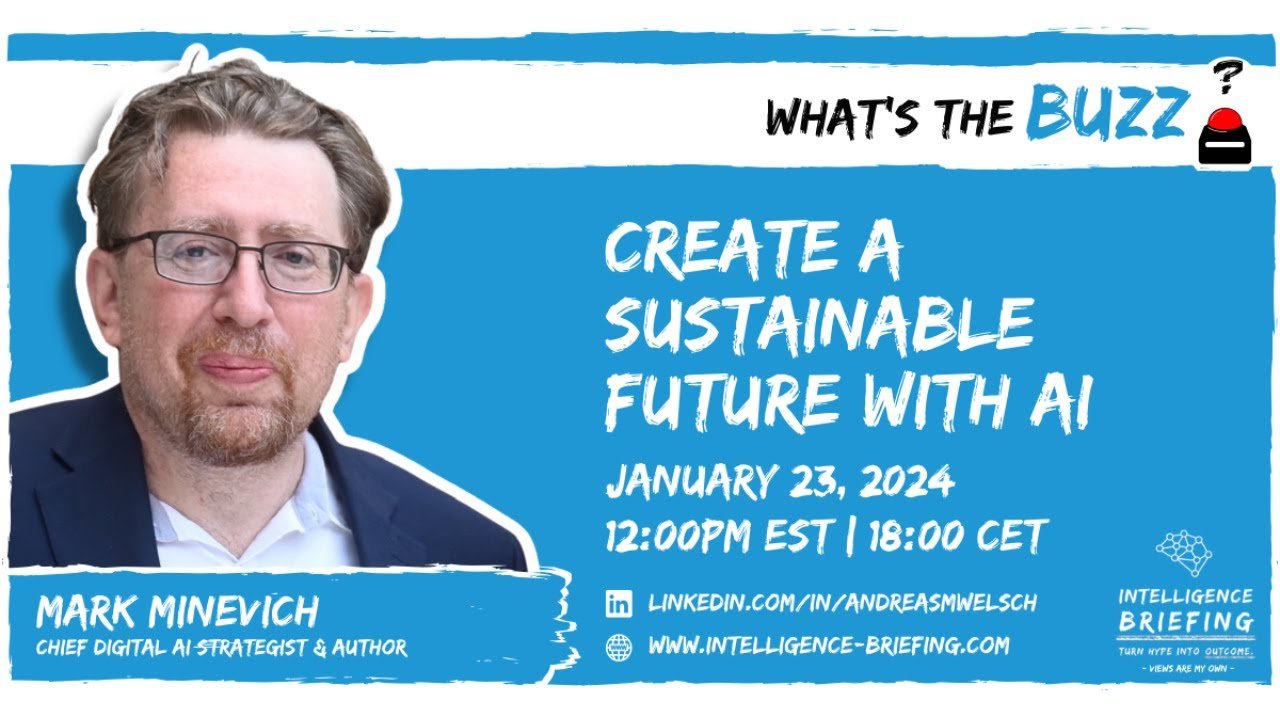
Guest: Mark Minevich, Chief Digital AI Strategist & Author
Host: Andreas Welsch
Episode: What’s the BUZZ?, Season 3, Episode 3
Published: January 23, 2024
Episode Summary
Mark Minevich, Chief Digital AI Strategist and author, joins Andreas Welsch to answer how AI can help build a sustainable future. Mark argues that corporate AI focuses too narrowly on efficiency and productivity, and describes opportunities in energy management, public health, agriculture, disaster prediction and carbon capture.
The conversation also covers how leaders can measure the impact of AI through privacy, bias, energy consumption and alignment with the United Nations Sustainable Development Goals, and how businesses can act on ethics beyond policies. Mark closes with the energy demand of generative AI and the case for renewable power.
Key Takeaways
- Mark argues that sustainability should be a goal beyond productivity gains for individual businesses.
- Mark names four measures of AI impact: privacy, bias, energy consumption and alignment with the United Nations Sustainable Development Goals.
- Mark recommends responsible AI and ethics committees, a Chief AI Officer or Chief AI Ethics Officer, and workforce education to put ethics into practice.
- Mark advises leaders to adopt actionable policies and to engage stakeholders beyond the large technology companies.
- Mark warns that generative AI consumes large amounts of power and calls for renewable energy and smart grids to meet the demand.
Timestamps
- 0:23 Cold open on building a sustainable future with AI
- 0:55 The guest introduces their mission and many roles
- 3:59 Icebreaker game called In your own words
- 4:16 If AI were a color what would it be
- 5:09 Real opportunities when AI powers the planet
- 9:13 AI for energy use and emissions control
- 11:08 AI in agriculture and natural disaster prediction
- 15:57 How leaders can measure ethical and sustainable AI
- 17:00 Privacy, bias, energy and SDG alignment as measures
- 21:55 How businesses can use AI ethically beyond policies
- 27:01 Energy consumption of generative AI and renewable power
- 31:07 Wrap-up and thanks to the guest
About Mark Minevich
Mark Minevich is a Chief Digital AI Strategist and author. In the episode, Mark describes being president of a private advisory boutique that helps governments and enterprises with AI strategy, adoption and governance, and working as an investor and as a Forbes columnist on AI. Mark also chairs and founded the AI for the Planet Alliance and wrote the book Our Planet Powered by AI.
Full Transcript
Read the full transcript
Andreas Welsch: Today we’ll talk about how you can build a sustainable future with AI, and who better to talk about it than someone who’s on a global mission to help people do just that. Mark Minevich. Hey Mark, thank you so much for joining.
Mark Minevich: Thank you so much, Andreas. It’s a pleasure to be here. Just back from Davos, and it’s all been about AI. I just hope it’s going to be AI and sustainability very soon. But I’m excited about 2024.
Andreas Welsch: Why don’t you tell our audience a little bit about yourself, who you are and what you do? You already mentioned Davos, but I know you’re involved in many different projects and organizations. That’s why I’m particularly excited to have you on the show.
Mark Minevich: Andreas, thank you. I’m on a mission to save our planet using artificial intelligence. What else, if not AI? I have several roles. First, I’m the president of a private advisory boutique that is helping governments improve their national AI strategies, and also enterprises in different countries across the world, including here in the United States, some very large Fortune 100 companies, where we focus on improving their adoption and their governance and strategic structure. I’m also an investor in a number of companies, affiliated with a number of funds and also independently looking at opportunities where the next stars will arise. I’m also sitting on a number of foundations and communities. I’m the chair of the AI for the Planet Alliance, the co-chair and the founder of that alliance, focusing on what the United Nations, UNESCO and UNDP could help and could do for a number of different companies across the world, including leveraging some of the most sophisticated technologies that we’ll talk about. I’m also the chairman of the executive committee of the AI for Good Foundation, and I sit on the Working Nation Future of Work executive committee. I’m involved in a number of different groups across the United Nations, digital government and various other governments. I take thought leadership very seriously. I’m a columnist for Forbes magazine on AI, and I recently wrote this interesting book that you can see here in the back, Our Planet Powered by AI, and this new concept of planetary-centric AI. So many things going on in my life. I’m excited to be here.
Andreas Welsch: A lot of my guests typically talk about how you can implement AI in a business and what you should consider. But I already see that this commitment, this mission, runs deep and is deeply personal. So I think we’ll have an exciting conversation.
Mark Minevich: We do. Absolutely personal, and it should be personal for every one of us here. We have this technology. Let’s use it properly.
Andreas Welsch: I like to play a little game and make it a little spontaneous. This game is called In Your Own Words. When I hit the buzzer, and that’s why it’s called What’s the BUZZ, the wheels will start spinning, and when they stop, you see a sentence. I would love for you to answer with the first thing that comes to mind and why, in your own words. To make it a little more interesting, I’ll give you 60 seconds for your answer. For those of you who are watching live, also drop your answer in the chat, and why. So are you ready for What’s the BUZZ?
Mark Minevich: Sure.
Andreas Welsch: Let’s do this. If AI were a color, what would it be and why? 60 seconds on the clock. Go!
Mark Minevich: For me, the answer would be green.
Andreas Welsch: Wonderful. Why green?
Mark Minevich: Because I think AI should be sustainable, and I equate our planet with green.
Andreas Welsch: Great answer. Thanks for being spontaneous and taking that on the fly. Now, there’s been so much doom and gloom about AI last year, to a point where it’s splitting long-term academics on the topic. It’s definitely dividing people to some extent. But on the other hand, we also know that AI is here to stay. So I’m curious, what are the real opportunities if our planet is being powered by AI? What are the opportunities that you are seeing?
Mark Minevich: Yes. Again, thank you for the opportunity to be here. Before answering this question, I wanted to give a premise to the audience on why it is important to discuss this right now. Today, in January 2024, after the massive experience we had at the World Economic Forum in Davos, which I was fortunate to attend, I think what’s happening is that corporate America and big tech are ferociously moving AI toward optimization. Why? Because they care about efficiency. They care about productivity and very little, if anything, else. Corporate leaders want to make the world efficient, and this is what I hear. But we need the world to be much more sustainable. Our planet is suffering. It’s burning. And we need a world where humans get more time to do what they need to do. They have to feel safe, they have to feel loved, and they have to feel that they’re bringing value. So I feel AI could be a tool to solve some of the greatest problems and challenges that the world has to offer, especially in innovation. AI could be used beneficially in areas we just discussed: climate, healthcare, infrastructure, energy. Some corporations do get involved. I want to give them the benefit of the doubt, but not as much as we want. I want corporations to lead this and put it in a priority. 95% of AI is very application driven. Right now, what you’re seeing on your show is very solutions driven and focused on efficiency. I want this to be focused on inclusiveness and sustainability, and that’s why I’ve written this book. When ChatGPT was released in November 2022, we all remember that moment. It sparked so much interest in artificial intelligence. And the world is facing the threats now, floods and fires, and everything that is discussed at the United Nations is just unbelievable. We’re at a very pivotal moment, what I call an inflection point, and it’s crucial for the public to understand our capabilities and limitations. People are fantasizing right now about whether AI will replace human beings. What’s important, what’s not important? What’s the combination of mathematics and software? How do computers actually reason? How do they understand? All of this is important, but there has to be a growing influence toward eco-friendly and sustainable technologies, and a shift toward more customized and tailored solutions in AI. This is the emergence of what many people at the United Nations call planetary AI, which I fully support. I think AI definitely drives efficiency and sustainability, and it helps with humanity’s most significant challenges. It cannot be stopped. It cannot be controlled by any community, by any movement, by any government. It is going to be an essential partner for the foreseeable future. It does cast some dark shadows and raises existential concerns that the world must deal with. Having said all of this, I think it’s important now to discuss the specific things that I am discussing and promoting, and how this is going to bring value to the planet. AI’s role in a sustainable future lies in its ability to look at so much data, trillions and trillions of data points. It’s optimizing processes. It’s able to make predictive insights across all sectors. And this is where energy management, healthcare, agriculture, conservation and disaster management all come in to make our planet healthier, not just human beings. Remember what I said: it’s not just human beings, it’s the planet and our longevity. So let’s talk about optimizing energy use and emissions control. AI algorithms already today are optimizing energy consumption in transportation and in buildings, significantly reducing carbon emissions. Predictive AI models are already forecasting carbon footprints, allowing for better and more efficient carbon management. Then there is energy management. Google, for example, a large company, but it’s set out on a mission using AI technology, specifically DeepMind, to optimize the energy use of cooling systems. We’re going to talk about data centers, with substantial energy savings. We have to improve our public health and safety. This is one of the reasons why I did this. I myself suffered tremendously under COVID. I was almost not coming back to life when I was struck with COVID in Miami in December 2020. So I said to myself, we have to do something better for public health and safety. Disease spread and pollution monitoring: AI has capabilities today to analyze pollution levels and to model disease spread patterns, particularly valuable in densely populated regions. This data comes sometimes from governments, sometimes from technology companies, and it is able to inform public health initiatives and environmental policies to mitigate health risks from pollution and pandemics. We also have to focus on predictive healthcare. I see a lot of it in places like Sloan Kettering in New York. Some of my friends are instituting that. Those are AI models that analyze massive amounts of patient data, offering insights for preemptive healthcare, shifting the focus from treatment to prevention of diseases. Then an area which is so important is agriculture. We need agriculture around the world. We need farmers, sustainable agriculture. AI technology is already used in crop monitoring, yield prediction and pest control. It is optimizing agricultural practices to maximize yields and minimize environmental impact. Very important: natural disaster prediction and management. We had natural disasters in Hawaii, California, New York. This is incredible. It’s going to go on and on. We need a better way to manage them and make predictions. AI has the ability to monitor seismic activity to predict natural disasters like tsunamis and earthquakes, improving prediction capabilities and early warning systems, potentially saving thousands of lives. Our assets, our houses, our way of life. We spoke about climate change. This is the biggest issue of them all, heavily discussed at the WEF. We need to spend more time on mitigation and adaptation, specifically on carbon capture and renewable energy. AI is assisting in discovering new materials today for efficient carbon capture. It is also enabling better integration of renewable energy sources in what we call a smart power grid. Weather forecasts are not so accurate right now. AI could improve the accuracy of weather forecasts, which is very crucial in preparing for extreme weather events, and of course, enhancing education. Education is also part of our health. It’s part of our planetary experience. We can’t remove that. And AI education, especially in remote areas across the world, is very limited. AI could bridge that gap and help us better understand and tackle environmental issues. So the bottom line is that we are able to use AI and climate change data to improve our diversity, our environmental sustainability, our health and societal resilience. I’ve given many illustrations of what is possible, by focusing on greenhouse emissions, disease spread, pollution monitoring, and areas like food security, which I haven’t mentioned but is very important. Optimizing crop yields, agriculture, energy optimization, biodiversity, carbon capture, energy management, flood monitoring, food monitoring. All of those issues are so critically important, and AI has a major role to play, not only in analyzing and predicting, but in 2024 we are moving from insights and information to action. We want to take all of this information from analysis to actual action worldwide and make things happen.
Andreas Welsch: Thank you for sharing all that. There’s so much information there that I want to go back and listen to it again and hear all the different examples that you mentioned. It sounds like this aspect of sustainability, and using AI for the purpose of helping our planet and keeping it sustainable, is the overarching vision and mission, and then it depends on individual companies that play a part in this, in reducing greenhouse gas emissions, improving crop yields, improving energy management and so on. That is something that resonates deeply with me. And I’m also seeing what that means individually for companies, how they contribute to it. Now, obviously a big part of your work is to make sure AI is used ethically and sustainably. I’m wondering, for whom and how can leaders actually measure the impact as they go down that path of using AI for the purpose of increasing sustainability?
Mark Minevich: That’s a very good question. Let’s first define who the leaders are. It’s the United Nations, it’s the CEOs of companies, it’s foundations. Leaders are all of us, the people who are using AI, and we need to measure AI in our homes as well. Don’t think of leaders as just folks in government or in the White House. We are all leaders of our own lives, and we need to understand what impact AI is bringing. For me personally, Andreas, it has to go through key areas, which I defined in my book: privacy, bias, energy consumption, and clear alignment with the United Nations SDGs. Those are the key factors that would create a measure of success for me. Let’s go back to privacy. AI needs to respect privacy by default and by design, and it doesn’t do that right now, especially on the generative AI side. No matter which LLM you’re using, OpenAI or whatever, AI is not respecting privacy by default and by design. We have to change this. We have to make sure that we minimize data collection and usage. We have to implement responsible data handling practices to maintain public trust, and we have to establish clear guidelines. Not only guardrails, not only regulations. Regulations alone do not solve the problem, and this will help privacy protection. That’s how we are going to measure whether we are creating success with privacy and whether we are impacting consumers and companies. Do they feel safe? Bias is another issue that I mentioned. The majority of AI scientists around the world are white males. Not that they purposely do it, but there is bias that comes out in the way they design their data models. This came across vividly when I was in Davos, for example, in a session. It’s very difficult to find women, and I’ve been discussing this with women leaders, saying we have to change this equation. We also need more minorities in data science. But coming back to it, the bias is coming from the training data, and it’s affecting trustworthiness, fairness and reliability, all the things I’ve written about. I did a whole report with my colleagues at the World Economic Forum about this topic. So what do we do about this? How do we measure it, and how do we know that we have impact? We have to detect and measure the extent of bias at every level of our maturity: when the data science is being built, when it is being put into production, when it is being used. At every single stage of the models, we have to detect and measure how extensive the bias is and where it is coming from. We have to use different data sets. I think there’s something now called BBQ. We have to deploy different types of technologies to identify those biases, and we have to implement corrective and mitigative measures. It’s not enough to say, okay, we identified it. How do we mitigate it, how do we remove it, and how do we have a plan to mitigate it? I also want to talk about measurement in everyday life, and not only in enterprises and companies. That is the dual role of AI for energy consumption. AI training is electricity intensive, extremely electricity intensive. We have to figure out mitigation techniques to optimize energy usage in all sectors, not only in data centers for technology companies, but in software, technology and communications, improving efficiency and efficacy by 40%. I think it’s possible. If we hit those numbers, even if we improve less, we could do the job. We should use some tools. I want to mention for your audience software carbon accounting tools available from every cloud provider. Finally, to your question, climate and the SDGs are a big area for me. Not only is the United Nations doing a fantastic job on measurement, but I think AI has a major role in sustainability. We have to monitor the usage of environmental resources and emissions. We have to monitor lower emissions aided by the climate change compact. AI could allow us to do that. And we should evaluate AI’s impact comprehensively, not just at level one. We have to look at emissions, and we have to look at production costs and vendor costs. We have to look at a very comprehensive package here. I think it’s really privacy, bias, energy, and alignment with the SDGs, robust management, robust mitigation, and a commitment to transparency, accountability, explainability and fairness.
Andreas Welsch: Thank you for sharing that. Again, there are multiple opportunities for businesses looking to incorporate AI, but also for those building AI-based products, to make sure that they are sustainable, or even more sustainable than they have been. Now, maybe switching gears a little bit for our last question. You might run into people who say, hey, sustainability is a lofty goal, and sure, whatever we do has to be sustainable or more sustainable. But how can you make it concrete for an individual business? What can a business do? How can business leaders use AI ethically, beyond ethics panels and policies? What are you seeing that makes it really concrete and something to take away?
Mark Minevich: Thank you very much. First of all, I agree with you. We can’t look at everything through regulations alone. I think we need to establish very strong governing bodies across governments that have expertise in AI and that can analyze AI from different angles, not just what they’re comfortable with, like the traditional agencies such as the SEC and the FDA. We have to do better. Companies must continue to promote responsible and ethical AI and focus from their angle. Regulation is already very active in the European Union, but I’m not sure those regulations are producing the results that consumers and everybody are looking for. They are very restrictive. I think what President Biden has done is look at innovation, balancing innovation, and also setting specific standards for the federal government. Having said that, I want to answer your question, what could be done? I think it’s very important to focus on setting up responsible AI and ethics committees, and on mitigating and identifying the risks of AI products developed in-house or by third parties. It’s important to have a Chief AI Officer or Chief AI Ethics Officer involved, and committees as well, to make sure there is balance. That’s number one. Number two is education and training of the workforce. That’s a big area where we really need to spend the time right now. It provides the level of education that is needed for consumers, for companies and for the public in general, educating them in responsible and ethical AI. We spoke about policies, but sometimes you need policies that are actionable, and they should be done at the local, national and international level. I just did a whole Forbes article about incredible work done by a UN agency called UNICRE, headed by Iraqi Barza. They have shown that they are protecting the safety of children using AI, and not only with policies but with real actionable things that they have done with the government of the UAE. So it’s important that we not only come out with policies, we have to adopt those policies, and from a governance perspective that includes a clear understanding of use cases of AI. How are they being used? Ensuring AI has moral values and enables human accountability and understanding. More importantly than anything else, we have to engage the stakeholders. We’re not doing enough on engaging CEOs, not only of technology companies. It’s great to engage Sam Altman and Satya Nadella. They already know what they’re doing and what they’re not doing. But it’s important to engage the rest of the industry stakeholders, making sure they understand what we’re talking about, making sure the language is clear and high-level ethical considerations are on the table. As we discussed in the last question, we have to continuously monitor the impact of how this engagement is working. Is it really producing the impact or is it not? And if we are doing something right, let’s incentivize that good behavior. Let’s give some brownie points to the leaders who are engaged and to the public that is engaged in establishing ethical behaviors within the company. Those are the strategies I pointed out in my book, and I think they point out very clearly how to resolve the issues of potential misuse, bias, privacy, transparency and such.
Andreas Welsch: I think you’ve given us a very broad but also very concrete overview of why we need to think about sustainability more, whether it’s in our development processes or even starting with the ideas up front, and that the responsibility lies not only at the governmental level but also at an industry and individual business level, all the way down to those of us working on AI and working with AI.
Mark Minevich: Andreas, I just want to point out, just for two minutes, something that I think is on our minds today with everything going on with generative AI, and you and I discussed it before. It is consuming a lot of energy and a lot of power. It is concerning, and it should be concerning to all leaders. If I want to give you a statistic, models like ChatGPT consume much more power than Google search, equating to countries like Ireland. Can you imagine this? To put this in perspective, the ChatGPT model from OpenAI is using as much energy as the country of Ireland. By 2027, the servers and data centers that are processing this, the Nvidia machines and the like, are going to be using up to 134 terawatt hours annually. That is the parallel energy usage of entire nations sometimes. This is really challenging for us to observe. Right now we’re even seeing 300 kilowatts per rack in terms of data servers being used. That’s a tremendous amount of power. I’ve seen the reports, I’ve looked at the reports, and this was discussed at the World Economic Forum. 80% of data center power will be consumed by AI over the next 15 years. 80%. There has to be some way that we differentiate. Access to power is a key differentiator, in my opinion. We have to figure out how to lower that consumption, and by what methods. Of course, every company that is developing data centers, we just have to look at Nvidia, they’re skyrocketing in terms of earnings calls. That is fantastic. That’s great news for them. And big money right now is putting an incredible amount into liquid cooling technology. Investors like KKR and Bosch and everybody else are investing very heavily in high-powered, high-heat data centers. They’re driving up demand because you need cooling technologies for all of this, and that’s where sustainability comes in. But more importantly, for long-term strategy, in my opinion, and this was written up by many analysts, from investment bankers to others, in order to cope with this demand we have to focus on renewable energy much more. There has to be an even deeper understanding and a deeper call to action. Renewable energy has to increase at all levels. The growth of generative AI will only accelerate the demand, so we have to focus on accelerating renewable energy. Smart, AI-driven smart grids will provide us this opportunity to provide cooling information, to build a smart renewable energy grid, smart power, to make sure we power those power-hungry generative AI systems. We should also think about, and I’ve seen some reports, we should not dismiss it, the future of sustainable AI operations will heavily depend on nuclear energy. I know we sometimes want to be dismissive, but there is already research going on by fusion tech companies that are building some new type of nuclear approach to manage this type of energy consumption. And who do you think invested in many of them? Sam Altman, because he realizes what the direction is. I wanted to bring this to the attention of your audience, that we have to be very mindful, and we have to support environmental, social and governance initiatives right now. Generative AI, as much as it is bringing potential, is taking a lot of power, and we have to really think about mitigation and how we’re going to use it so we can lower this consumption, hopefully in the next few years by 20 to 25%.
Andreas Welsch: Thanks for adding that. Following some of the news on these topics, my understanding is that as models are getting smaller and more tailored, that might be setting us up on that path. But Mark, we’re getting close to the end of the show today, and I really want to thank you so much for joining us and for sharing your expertise with us. It was a pleasure having you on the show, and thanks to those of you in the audience for learning with us. Mark, thanks again.
Mark Minevich: Thank you so much. Really a pleasure to be here.
Listen and Subscribe
Related Reading
Frequently Asked Questions
What are the real opportunities if AI powers the planet?
Mark names energy management and emissions control, public health and pollution monitoring, predictive healthcare, agriculture, natural disaster prediction, carbon capture and weather forecasting. Mark expects 2024 to move from insights and information to action.
How can leaders measure ethical and sustainable AI?
Mark measures success through privacy, bias, energy consumption and clear alignment with the United Nations Sustainable Development Goals. Mark adds that leaders include everyone using AI, and that regulation alone does not solve the problem.
How can businesses use AI ethically beyond policies?
Mark recommends responsible AI and ethics committees, a Chief AI Officer or Chief AI Ethics Officer, education and training for the workforce, actionable policies, stakeholder engagement beyond technology companies, and incentives for good behavior.
Why does the energy use of generative AI matter?
Mark says generative AI consumes much more power than search and cites a comparison with the energy use of Ireland. Mark argues that leaders should push for renewable energy, smart grids and lower consumption, and does not dismiss nuclear energy for the longer term.