

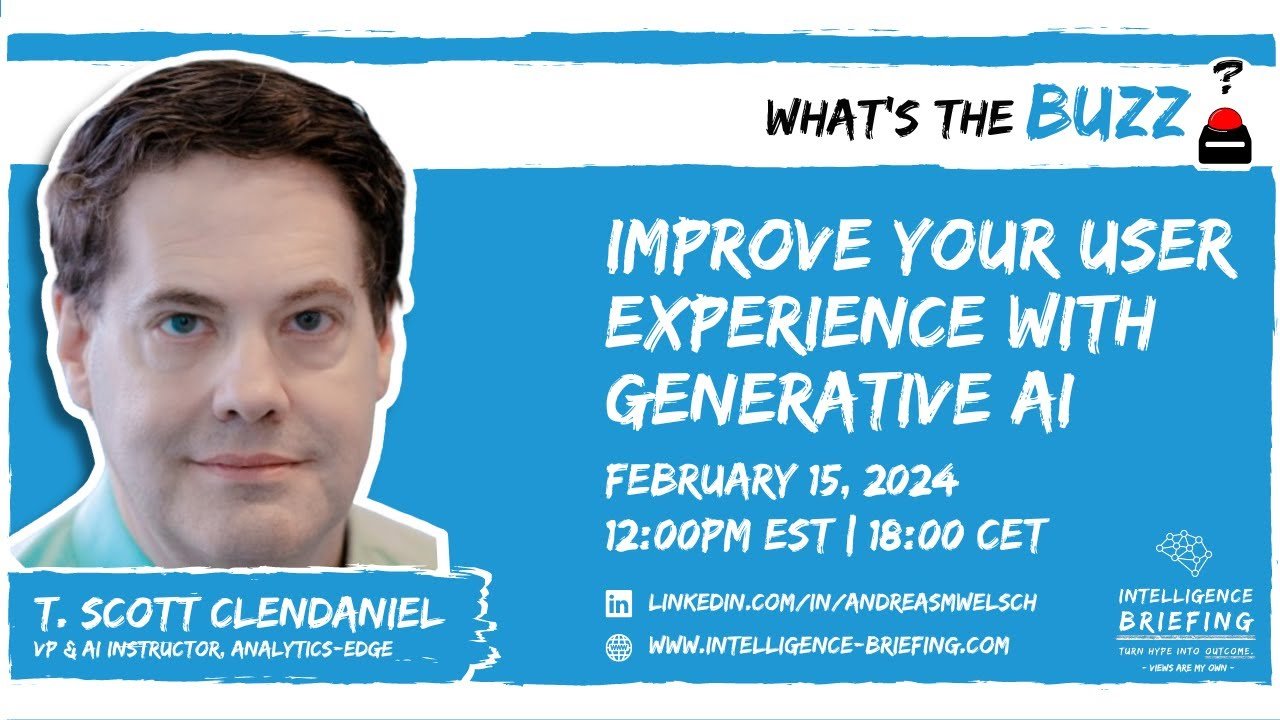
Guest: T. Scott Clendaniel, VP & AI Instructor, Analytics-Edge
Host: Andreas Welsch
Episode: What’s the BUZZ?, Season 3, Episode 6
Published: February 13, 2024
Episode Summary
T. Scott Clendaniel, VP and AI Instructor at Analytics-Edge, joins Andreas Welsch to answer how generative AI can improve user experience. Scott argues that generative AI is popular now not because AI improved but because the interface became simple: a text box that anyone can use without coding.
The conversation covers unexpected ways language models help business users, why text-based interfaces differ from the chatbots of before, copyright and generated designs, using customer prompts as research, and what leaders should know before introducing language models. Scott closes with three takeaways for the audience.
Key Takeaways
- Scott says the simple, text-based interface is what makes generative AI accessible to people who never coded.
- Scott recommends using generative AI as a testing ground for brainstorming and prototypes, not for final results, and avoiding generated output where copyright matters.
- Scott suggests capturing the first prompts users enter in internal tools as customer research that improves the user experience.
- Scott warns leaders against adopting AI to look current and notes that simple algorithms such as logistic regression often deliver higher return on investment.
- Scott advises against banning generative AI, since employees will use it anyway, and prefers some level of control and understanding.
Timestamps
- 0:23 Cold open on generative AI for user experience
- 0:39 The guest introduces their long career in analytics
- 1:42 Icebreaker game called In your own words
- 2:30 If AI were a song what would it be
- 3:22 What makes generative AI remarkable for user experience
- 8:28 Unexpected ways language models help business users
- 11:28 A tip on asking AI tools for help
- 12:31 What is different from the chatbots of before
- 14:57 Audience question on copyright and AI generated designs
- 16:37 Using generative AI tools for interface design
- 17:25 Capturing user prompts as customer research
- 20:10 What AI leaders need to know before adopting models
- 23:15 Audience question on shopping inside chat interfaces
- 26:43 The three key takeaways for the audience
- 27:32 Wrap-up and thanks to the guest
About T. Scott Clendaniel
T. Scott Clendaniel is VP and AI Instructor at Analytics-Edge. In the episode, Scott describes starting in the field in March 1986, helping people learn artificial intelligence, machine learning and data science, and consulting for clients that include Audi, Biogen, Mercedes and the Los Angeles Times.
Full Transcript
Read the full transcript
Andreas Welsch: Today we’ll talk about how you can use generative AI to improve the user experience in your applications. And who better to talk to about it than someone who’s been teaching hundreds of teams on AI and analytics over the years? Scott Clendaniel. Hey Scott, thank you so much for joining.
T. Scott Clendaniel: Yeah, I am so excited to be here. I can hardly contain myself. Thank you for inviting me.
Andreas Welsch: Awesome. Why don’t you tell us a little bit about yourself, who you are and what you do?
T. Scott Clendaniel: Sure. First of all, I am older than dirt. I actually started in the field in March of 1986, so I’ve been doing this for quite a while. I absolutely love helping people learn all about artificial intelligence, machine learning, data science, all those fields. I’ve done a heck of a lot of consulting, and I’ve had clients you may have heard of: Audi, Biogen, Mercedes, the Los Angeles Times, folks like that. Now I’m trying to transfer that knowledge to others and bring more people into the field.
Andreas Welsch: Scott, should we play a little game to kick things off?
T. Scott Clendaniel: Okay.
Andreas Welsch: Alright, wonderful.
T. Scott Clendaniel: Do I win a free car?
Andreas Welsch: Probably not.
T. Scott Clendaniel: Okay. Alright, we’ll do it anyway.
Andreas Welsch: But how about reputation and reputational points? Excellent. All right. Look, this game is called In Your Own Words, and when I hit the buzzer, the wheels will start spinning. When they stop, you’ll see a sentence. I’d like you to answer with the first thing that comes to mind and why, in your own words. To make it a little more interesting, you’ll only have 60 seconds for the answer. Now, are you ready for What’s the BUZZ?
T. Scott Clendaniel: As ready as I’m going to get. I am.
Andreas Welsch: Okay, perfect. Here we go. If AI were a song, what would it be? 60 seconds on the clock, go.
T. Scott Clendaniel: If AI were a song, what would it be? I’ll tell you what it would be: Help! by the Beatles, because that’s where we’re going with this. Help. I need some info. Help, not just any info. How would that be?
Andreas Welsch: That would be awesome, right? We all can use a little more help. Fantastic. And well within time. I’ve seen a lot of creative answers, but Help is perfect. Why don’t we talk about the actual topic of the show, around user experience. Look, I think we’ve all obviously seen generative AI in the news last year, still in the news this year. Good thing. I think this year it’s more about where the rubber meets the road: implement AI, get your pilots out of your lab and into production. But I also see that it democratizes access to AI-powered applications and those insights. Whether you’re a senior executive or a first-year student, English is the new programming language, which makes it so universally applicable and accessible. But I wonder, from your perspective, what’s so remarkable about generative AI when it comes to user experience?
T. Scott Clendaniel: All right, so let me throw a question out to you and the audience at large: when you go to send an email, Andreas, we’re going to start with you. What programming language do you use?
Andreas Welsch: Good question. I don’t know what’s under the hood, but
T. Scott Clendaniel: So when you go to the web, which programming language do you use? You probably just use a browser, right? When you go to create a presentation, you use some type of app. The whole point of creating software was to put things into apps so that people didn’t have to reinvent the wheel over and over again. But somehow that memo seems to have been skipped by our friends in the artificial intelligence community, where it’s, no, you have to be a ninja in Python to do anything. No, you have to be able to code. You need to know IDEs. So not only am I going to teach you all the statistics, but I’m also going to teach you computer science and all these obscure languages and all this kind of stuff. Really, we don’t require on your driving test that you understand compression ratios on a gas-powered engine, right? Or at least mine didn’t. The whole process of applications is to simplify things and make things easier. It’s also about user experience. But programmers, a small group of folks, not programmers but bro-grammers, thank you to Nicole for giving me that phrase, say no, you have to be able to do everything I can do before you can touch your information. Then consider the screen that you see when you go to ChatGPT, as an example. It’s largely a blank screen with a place to type. You don’t need to code anything. You don’t need to know how to do it. Even with GUI interfaces, it’s basically you type your answer and hit enter. So the beauty is that people who have been scared off from our field for a long time now have access to things that they never would have had before. And I think it’s remarkable. A lot of the stuff that AI does now, it did before. It did search before. You could generate text before. So what’s the difference? Why is it so popular now? I’m going to be really controversial here and say it is not so much that artificial intelligence has improved, it’s that we’ve simplified the user interface.
Andreas Welsch: I love that. I remember working with customers a couple of years ago on AI pilot projects. We didn’t call it AI then, we called it machine learning, because we wanted to be very precise and accurate. And accuracy, for example, was one of the variables, one of the pieces of information that we wanted to display to business users. They saw 80% accuracy and I thought, that’s awesome. They tried it out and the results were garbage. I said, actually, if it’s 95 or 97%, that’s when it gets really good, and 99%, that’s where you want to be. They couldn’t believe that 80% was garbage. To your point, you need to expose that, and if you make it simpler to begin with to interact with these systems, that’s a huge opportunity.
T. Scott Clendaniel: That’s well, and it’s funny, because you even talk about the labels. We now call it artificial intelligence. Back when I started, it was data mining, and no one uses that phrase anymore. Then it was KDD, knowledge discovery in databases, and then it was predictive analytics. No, that’s not good enough. No, it’s going to be machine learning. No, it’s going to be data science. Lots of the stuff has been the same the whole way through, but we keep changing the name just to make things harder for people. And that’s a great example. If you type in any of those things, you’re going to get similar results back, because we have removed that complexity.
Andreas Welsch: I really love that. Again, for business users, I think it makes it so much easier to finally get useful results without the complexity of having to understand the technical details in the background. By the way, for you in the audience, if you have any questions for Scott, feel free to pop them in the chat and we’ll take a look in a couple of minutes and take some of those as well. Speaking of business users, what do you think there is the potential for them? What’s an unexpected aspect of large language models that you’ve seen for improving the user experience there?
T. Scott Clendaniel: I think a lot of it is that it opens doors. What I mean by that is, I myself am probably the worst graphic designer in the history of the universe. I may have the heart of a da Vinci, but I have the skill set of a one-armed troll with a really bad hangover. So I can have ideas, like, I’d like to have this image to convey this message to others, an actual business use case, and it’s very complicated, and I’m trying to think of how to do it. There is no way in hell you could give me all the tools in the world and that was going to be helpful. But now I can go into one of the generative AI tools and say, okay, I’m looking for something that looks sort of like this. I can prototype all kinds of different things, and I’m not even saying that’s going to be the final result, but with the amount of time savings, I wouldn’t have even ventured into that realm before. Now I play around. I get a little more self-confidence. I’ll try refining my prompts over time. I never would have done that. I love Adobe Photoshop and all those products, they’re lovely, but that was not going to help. This removes that fear, and removing that fear allows business users to do all types of tasks that they would have been afraid to approach before.
Andreas Welsch: Yeah. I like how you also broaden the definition, or the variety, of generative AI. In business, a lot of the use cases that we see today are still focused on text and text generation, summarization. What are the key points out of this meeting, out of the meeting minutes, or even things like Bard or now Gemini: summarize this YouTube video for me, if you can access it.
T. Scott Clendaniel: Absolutely. Let’s just take a simple example. It is very hard for most people to sit in a series of meetings back to back. There’s been all kinds of research that even a fifteen-minute separation between meetings does wonders for the human brain to be able to recover just a bit. Even having something as simple as an AI assistant in a meeting to take the notes, I have to worry less that I’m typing and writing and summarizing the point and listening and coming up with my response all at the same time. It seems simple because we have to do it all the time, but it does get complex. Instead, I can really listen to what’s happening and form my response and not be obsessed with note-taking. It frees up that cognitive load for me to do the things I hope I’m better at.
Andreas Welsch: I’m really excited to see where this is going. Maybe even get some coaching: what are the questions that I should be asking, following the conversation, and having context about me. Yeah.
T. Scott Clendaniel: Can I share a magic trick with you?
Andreas Welsch: Oh, only by exception, yes.
T. Scott Clendaniel: Okay, perfect. Actually, one of the things, if you are new to generative AI, one of the beautiful things is that if you get stuck, you can ask your question about generative AI in ChatGPT or Gemini or whatever your weapon of choice is. If you are stuck, or you get an instruction that you don’t fully understand, you can clarify and say, what do you mean by that? A lot of times students won’t do that in a full classroom setting because they don’t want to feel embarrassed. They don’t want to feel like, oh, my boss is going to think I’m an idiot if I didn’t catch that last thing. But if you’re in something like Gemini, you can use Gemini for some tips on how to create better Gemini products. That is one of the things that I think just opens up all kinds of possibilities.
Andreas Welsch: I love the power that is now at our fingertips. It’s not the first time that we hear it’s all about language. A couple of years ago we talked about chatbots as the new thing, the new interface for voice commands in the enterprise and what have you. I think it hasn’t quite happened yet, whether it’s in an office where you have an open space and everybody is talking to their assistant. It gets a little loud and annoying, maybe, let alone in field service.
T. Scott Clendaniel: I’ve been in those environments. Yes, I understand.
Andreas Welsch: All of a sudden you trigger your desk neighbor’s assistant to do something, or whatever. Maybe we’ve seen that with Google Assistant, with Alexa in our homes when they suddenly go off. Or now even let alone field service, or on an oil rig, where it’s just impractical for somebody to speak to that system, given all the environmental conditions and noise and everything. So what do you think is different this time when it comes to language, and voice, and large language models? What’s different this time compared to chatbots from a couple of years ago?
T. Scott Clendaniel: I’m so glad you asked that question, because fortunately I was prepared with a response, because that is this guy, your cell phone. Why? Because most people in the past 10 years have given up, to a large extent, on calls back and forth within the office. They’ve just surrendered. But what do we use all the time? Text messages. Text messages are the primary means of communication, especially for folks younger than I am, which is most everybody. That is an interface we’re really comfortable with and we use it all the time. One of the other things that helped us is that with the rise of search engines over the past 20 years, people are used to typing in questions. So I don’t have to fool about with the timbre of my voice. I can take as long as I want. It’s basically texting to a really smart. For the moment, we’re going to keep the hallucinations and the accuracy issues off to the side. But in general, we have this whole means of access using an interface that we’re so familiar with, which is that you’re basically using a giant text message system when you’re using one of these LLMs.
Andreas Welsch: So that’s your answer?
T. Scott Clendaniel: That’s my answer.
Andreas Welsch: Oh, okay. Good.
T. Scott Clendaniel: Even remember the question, because that happens to me.
Andreas Welsch: Yeah. All good. I see Anil here is asking in the chat if you have any tips on how to deal with or handle copyright issues when using UX generated from GenAI tools.
T. Scott Clendaniel: Yes, I do. Think of all of the generative AI tools in one of two realms. One is brainstorming. Help to come up with some different ideas, developing prototypes, that type of thing. Number two is being able to come up with different ideas that you couldn’t have thought of on your own. So you’re brainstorming, and the system is brainstorming back to you. That’s like a good first draft. In terms of the copyright issues, do not use anything that comes out of generative AI. It’s already been pretty well established that you can’t copyright stuff that comes out of generative AI. And I don’t know if anyone else noticed, but in the past month the patent office has now said that any patent that’s written by or comes out of AI will not be recognized. So this is your first step field, this is your brainstorming field. This is the area where I’m going to come up with new ideas and test some things out. In terms of copyright, avoid it like the plague. Think of it as coming up with the different ideas. If you’re going to have an image, take the image that you created as a good example, and then send it to whoever your internal artist is, or do it on your own. Wonderful. Thank you. And yeah, to be really careful. Yeah.
Andreas Welsch: Yeah. When it comes to UX, one of the tools that I was really surprised by was one that Tobias Zwingmann mentioned a couple of months ago when he was on the show, and that was Vercel AI. You can give it a prompt and say, hey, create a layout for our website to do lead capture, for example, or as a landing page, or a sign-up for a newsletter or something else, or even more complex things. Using generative AI, it comes up with the design and shows that to you, and you can make modifications and transfer that over to an actual programming language. That’s where I got excited, because it’s not just text generation, not just image generation or synthetic voice or video, but there are other really powerful and useful applications where you can use
T. Scott Clendaniel: Let me tell you about an opportunity that’s missed a lot by organizations that I think generative AI can also help with. For decades, when I worked in marketing, I was desperate to understand what exactly customers were thinking. I either had to sit down with the customer service department, listen to phone calls, or look at messages from email requests or whatever else. One of the things you want to look into is the ability to capture what the first prompts were that someone used for an internal tool, for several reasons. One, it helps you improve the UX of the product overall, even when it’s not a generative AI interface. But number two, what was their starting point? We in business have a nasty tendency to talk to ourselves. We come in and we can’t erase what we think we know, so we just assume that everybody else knows it, and that they want this new benefit or this new feature or whatever else. You have a non-stop collection of user-generated research information. Take some time to read some of it, for heaven’s sake. I’m not saying read all of it, but you can also ask your generative AI tool to review the different questions or comments that have come through. What are the most common aspects? Because you want to learn about your customer, you want to hit the customer needs, and a great way to understand why people don’t like your particular UX approach is to ask them the question. If you’ve only got buttons on a website, you can’t do that. But if you can capture what people are entering through the actual text to your customer service team, you will have amazing insights that you didn’t have before.
Andreas Welsch: So in a way, even use generative AI to summarize the raw data that you’re getting and draw some conclusions from it.
T. Scott Clendaniel: Absolutely. And that’s where RAG comes into play, and I think that’s going to become more and more important. There was some research released by Wharton at the University of Pennsylvania, I guess two weeks ago, three weeks ago, or that’s where I found it. I don’t know that they generated the research, but that’s where I found the articles, from a Wharton professor, and the point was that if you have a solely isolated resource to create your own generative AI interface, it does not tend to do well at all, because it loses all the language cues. So we’ve got the specialized information. I fixed that problem, but now I’ve still got the interface problem. That’s why I think RAG is going to help, because it’s going to allow the best of both worlds.
Andreas Welsch: Yeah. And make it tangible and preserve that context. Now I’m wondering, if you’re an AI leader, or you want to become an AI leader in a business, what do you need to be aware of when you want to introduce large language models, be it for improving the user experience or for other reasons?
T. Scott Clendaniel: One of the things that I’m a little worried about is that we now want to call everything artificial intelligence, like everything in the world. And this is a funny but true story. Five years ago I was like, gosh, AI on this, AI on that, our product has AI, AI everywhere. And I was like, wouldn’t it be funny if someone said that they used artificial intelligence in a toaster? I will be darned if in 2017 I didn’t find an old ad for a toaster with artificial intelligence. Alright, stop using that phrase for everything. Just because it’s an interface with a computer does not make it artificial intelligence. I think as a leader, there are a lot of folks out there, bless their hearts, executives who come back from the golf course, our lady CEO is playing with other lady CEOs and our guy CEO is playing with his guy CEOs, and they’re all playing golf and they come back and say, okay, we’ve got to do AI. Why? Because everybody else on the golf course is doing AI, and I can’t go out on the golf course and say we’re not doing AI. I don’t want to be embarrassed. That’s terrible. So when you’re talking about this field, don’t do AI because you want to be able to say you are doing AI. You need to find an appropriate problem where this is going to be a good fit. Throwing around the terms all over the place is not going to help you. Also, everyone is now using that phrase, so whatever type of market advantage you thought you had 18 months ago by using the phrase artificial intelligence is gone now, because everyone else is saying it and you’re not differentiating yourself. That’s the first problem area. The second problem area is plain old statistics and machine learning. Our old friend logistic regression. Decision trees, random forests, anybody remember those? Algorithms that we use for problem solving. You’re a lot more likely to get a higher ROI from solving problems like fraud detection, response analysis, email open rates, all those simple, binary outcomes, with a simple algorithm than you are to go full out and buy all these platforms for artificial intelligence. Crawl, walk, run. You don’t have to be full speed at the moment to make this stuff work. Take it easy.
Andreas Welsch: That really brings it back to the basics, and also a bit of that misconception that generative AI now renders everything else obsolete, all of the logistic regression and statistical methods and so on, and it does not. ChatGPT does not generate your demand forecast. It probably does, but not very accurately. There is that. Now one other question here in the chat that I think is really interesting: how soon will we see commerce where users can purchase goods or services within the chat interface versus using a specific app? What do you think? Is it a multi-year journey? Is it just connecting another API, like a plugin, like Kayak or something else that you can already connect in ChatGPT? What do you think?
T. Scott Clendaniel: I think you could probably jury-rig it today. I wouldn’t necessarily recommend it, but with enough blood, sweat and tears you can actually use a generative AI interface today to purchase goods. I don’t recommend it because it’s still very buggy, but I absolutely think that in 2024 there are going to be a bunch of products that offer that. Remember that the purpose of Amazon creating the product that shall not be mentioned, hint, hint, it rhymes with Marexa, was not for people to be able to play music. They thought this amazing device was going to be in every room in the house and people were going to be making purchases with it all the time. At one point they had 10,000 folks working on hardware, software, all that. That’s a lot of folks, and they completely missed the boat, in my humble opinion, on the interface and the power of things like ChatGPT. They thought e-commerce was going to be solved by this. I’m not sure that people particularly want to go into that type of interface or trust it enough. So I don’t think the issue is that we can’t do the technology or when it’s going to happen. It’s when our customers are really going to prefer that.
Andreas Welsch: What I think is really interesting about that point, and obviously I’m using some of those devices myself and have been for a while, is that at least personally I want to see the item. I want to see what it looks like. Is it large? Is it small? Is it white? Is it black? Is it a shade of white or a shade of blue? So in the absence of visual cues and information, just relying on language, and then also trusting that the device accurately understands what I mean or gives me the options. And then if it’s reciting the options, what was option number one again, out of those three or out of those five? And are these even the three that I want to see?
T. Scott Clendaniel: If you went into a store today with a live salesperson, 70% of all communication is nonverbal. It’s tone of voice, it’s body language. You lose all that when you have a text interface. You’re not going to have any of those components. And we still have a hard time getting sales professionals to understand what we want, and this is what they specialize in. So if we’re expecting to get that type of clarion communication, let alone your excellent point that this doesn’t help me see it. This doesn’t help me hold it. Can I hold it up to my couch and make sure it matches, or whatever.
Andreas Welsch: Yeah. I love the VR, by the way, to see what this looks like in your room. Yes, for some things that’s really helpful. For a bunch of batteries or your dish soap, not so much. But definitely. Hey, we’re getting close to the end of the show, and I was wondering if you could summarize the key three takeaways for our audience today when it comes to generative AI and improving user experience with it.
T. Scott Clendaniel: Sure. Number one, encourage employees to use it as a testing ground for brainstorming, not for final results. Two, trying to ban it is a terrible idea, because they’re going to use it anyway, and you would rather have some level of control and understanding of what they’re doing. Three, use it as a way of researching what people are really interested in and understanding customer needs. Just don’t think of it as a band-aid. Think of it as a fantastic way to improve the overall customer experience. Those would be my top three.
Andreas Welsch: Wonderful. Thank you so much, Scott, it was a pleasure. Thank you. I love being here. Thank you for sharing your expertise with us, and thanks to those of you in the audience for learning with us. I think it was a very insightful session. I really appreciate you giving us that broad overview and bringing it back to business and what really matters.
T. Scott Clendaniel: You bet. I hope I can come back one day. Take care.
Andreas Welsch: Awesome. Thank you so much.
Listen and Subscribe
Related Reading
Frequently Asked Questions
What makes generative AI remarkable for user experience?
Scott says much of what AI does now it did before, including search and text generation. What changed is the user interface: a blank screen with a place to type, which removes the need to code and brings people who were scared off from the field into AI.
What is different about large language models compared with earlier chatbots?
Scott points to the text message: people already communicate by text and are used to typing questions into search engines. Using a language model feels like texting a very smart assistant, without needing to adjust the voice or speak aloud in an office.
How should businesses handle copyright for content made with generative AI?
Scott advises treating generative AI as a brainstorming and prototyping tool. Scott says output from generative AI cannot be copyrighted and that the patent office has said AI-written patents will not be recognized, so a human artist should create the final version.
What should AI leaders know before introducing large language models?
Scott warns against doing AI only to say so, since everyone now uses the phrase, and against overlooking simple methods such as logistic regression and decision trees. Scott says these often return more for problems like fraud detection and email open rates.