

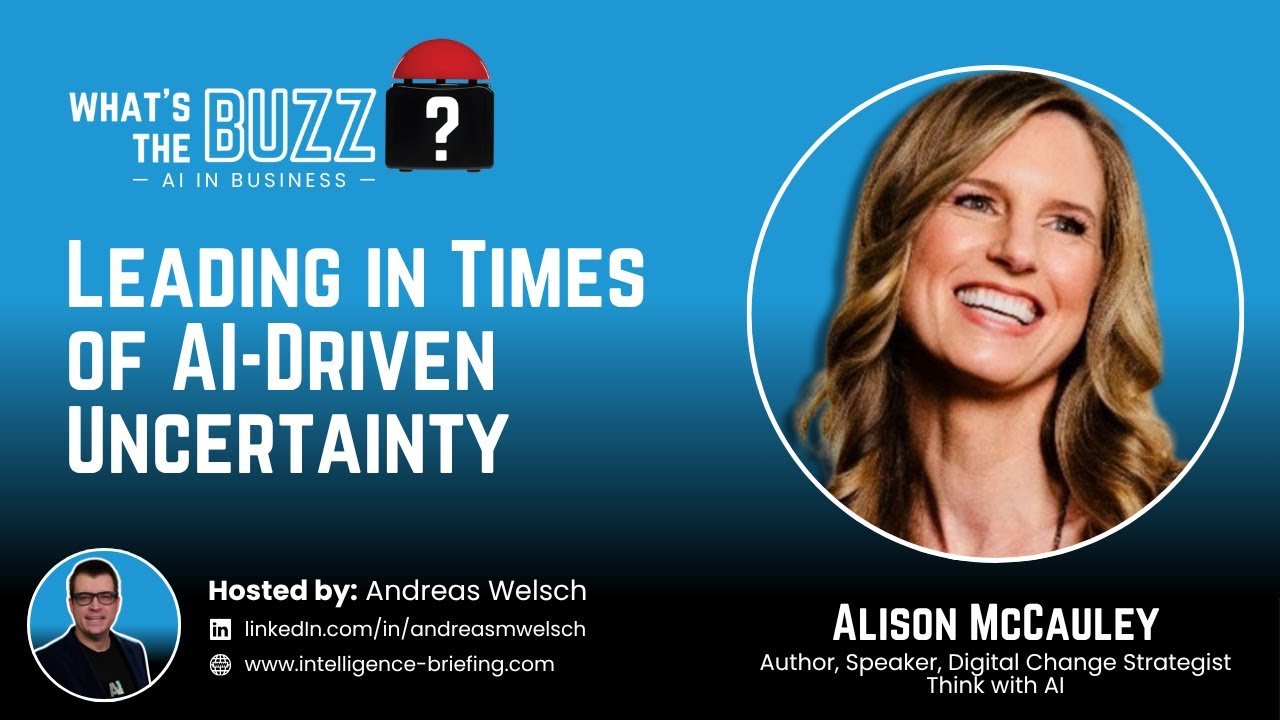
Guest: Alison McCauley, helps companies develop digital strategies and lead innovation around AI
Host: Andreas Welsch
Episode: What’s the BUZZ?, Season 4, Episode 22
Published: September 9, 2025
Episode Summary
Alison McCauley, who helps companies develop digital strategies and lead innovation around AI, joins Andreas Welsch to answer how leaders can lead when AI creates uncertainty in the workplace. Alison says every job will change, that no one has figured this out yet, and that the best way to see the change is to get hands-on. She advises leaders to meet people where they are, start from the business need, equip their experts and use AI as a thought partner. Her three takeaways are to jump in, to lean into expertise, and to imagine what is now possible beyond automation.
Key Takeaways
- Alison says every job is going to change, from CEO to middle management to entry level, and that nobody yet knows exactly how.
- Alison says the people who see change best are those with their hands in it, so leaders should get hands-on with AI.
- Alison advises mapping who in the organization already uses AI, because those people can become change agents, and starting the AI conversation from the business need instead of the technology.
- Alison says expertise matters more in this moment, because only experts can identify AI garbage for what it is, so equipping experts with AI is how organizations capture the opportunity.
- Alison describes a real deficit of imagination: AI allows organizations to do things in a different way, not only to automate what they already do.
Timestamps
- 00:01:11 Guest background: change management and AI
- 00:04:54 Entry-level jobs and uncertainty
- 00:05:43 Every job is going to change
- 00:10:59 How leaders support teams: meet people where they are
- 00:12:44 Start from the business need, not the technology
- 00:14:05 Why expertise matters in the AI era
- 00:15:59 The deficit of imagination
- 00:17:00 Teaching students to judge AI output
- 00:20:31 AI as a thought partner
- 00:24:29 Leaders worried about their own roles
- 00:27:13 A custom-quote example
- 00:29:37 Three takeaways
About Alison McCauley
Alison McCauley has spent her career at the intersection of emerging technology and human behavior. She began her career when the field of change management was forming and started working in AI in 2010.
Alison travels around the world giving talks and workshops.
Full Transcript
Read the full transcript
Andreas Welsch: Today we’ll talk about how to lead when AI creates uncertainty in the workplace, and who better to talk about it than someone who’s helping companies develop digital strategies and lead innovation around AI. Alison McCauley. Hey Alison. Thank you so much for joining.
Alison McCauley: I’ve been looking forward to this conversation.
Andreas Welsch: Awesome. That makes two of us. And I hope for those of you in the audience, you’re just as excited as we are. But Alison, maybe not everybody in the audience knows you yet. Why don’t you tell us a little bit about yourself, who you are and what you do?
Alison McCauley: Sure. I have spent my entire career at this really exciting intersection of emerging technology and human behavior. How emerging technology affects us as people, as individuals, and as organizations, as teams, as culture and society. And I have to say it’s never been more interesting than it is right now. I began my career when the field of change management was just forming. It’s been fascinating to see how some things have stayed the same since those early days when we were literally writing the playbook for change management, and some things are brand new. I started working in AI in 2010. Very different times, very different kind of space. It’s been fascinating how things have changed over these last couple of years, and it is truly a whole new area that needs to be navigated. That’s why the topic we’re talking about today is the topic of the era.
Andreas Welsch: Wonderful. I couldn’t agree more. There’s so much talk about tech and bringing it to the business, but at the end of the day, there are still people there that need to adopt it, that need to get comfortable with it, that also need to help other people manage the change and lead through it, when probably very few of us have the answer to what it means and where we are going. So I’m looking forward to digging a little deeper there and learning from your insights.
Alison McCauley: Wonderful.
Andreas Welsch: Why don’t we play a little game to kick things off. What do you say?
Alison McCauley: A little improv maybe.
Andreas Welsch: A little improv. Exactly. When I hit the buzzer, the wheels will start spinning and you’ll see a sentence. I’d like for you to answer with the first thing that comes to mind and why, in your own words. To make it a little more interesting, you only have 60 seconds for your answer. For those of you watching us live, please drop your answer and why in the chat as well. Alison, are you ready for What’s the BUZZ?
Alison McCauley: Let’s do it.
Andreas Welsch: Okay. Let’s see. Here we go. If AI were a color, what would it be and why?
Alison McCauley: Wow. Okay. There are some colors that are yet to be discovered, and we hear about these occasionally. I have a feeling that AI is a color that we haven’t quite seen yet. It’s forming. I think we can’t turn to what we already know. I think it’s going to be something that is new that we all discover.
Andreas Welsch: Oh, love it. I like that. When I ask my children what their favorite color is, the answer I’ve recently been getting is rainbow. All the colors of the rainbow. I love rainbow color. So definitely there’s a lot to be discovered, and I feel like the colors can change very quickly as well, as things evolve and adapt.
Alison McCauley: Yeah. And these analogies actually are really apt, because AI is adapting and changing so quickly and there’s so much to be discovered that we’re all discovering together, because this new acceleration is so new.
Andreas Welsch: This newness factor also creates a lot of uncertainty and a lot of change. In the last couple of weeks we’ve seen a lot of coverage about how recruiting for entry-level jobs is slowing down because of AI-driven automation. Companies are looking to do more with AI on entry-level tasks, things that are a little more complex than “if this happens, then do that.” Great, yes, AI can do that. AI can also help professionals and senior experts with more complex tasks. So we’ll likely see this trend going up the hierarchy, if you will, or the seniority levels, of what AI can do. That also creates a good amount of uncertainty and fear about jobs, not just “I just graduated, where do I find a job?” Those are some of the conversations that I’m having with students where I teach as an adjunct, but also with more senior professionals. What are you seeing when you talk to leaders in organizations about these topics, what AI means for jobs, for organizations? What are people seeing?
Alison McCauley: There’s a big disconnect between what is possible, what has been newly unlocked with AI, and where organizations are right now. When I talk to different organizations, I travel around the world giving talks and workshops, there’s a range of where people are. If I may, Andreas, be very direct, if your viewers are okay with that, I just want to be really direct: every job is going to change. CEO jobs are going to change. Middle management jobs are going to change. Entry-level jobs are going to change, and we haven’t quite taken that in, and we certainly don’t know yet exactly how they will change. Some people will adjust to this. Some organizations will adjust to this. Some teams will adjust to this, and some just won’t. Some jobs will disappear and new jobs will be created, and we just don’t know exactly how. We’ve seen shifts like this before. Before the Industrial Revolution, we were a largely agrarian economy. That shifted, and every single role, every single job, every single industry changed. Now we’re at the beginning of this cognitive revolution, but we don’t know where it’s headed. When you look back at the Industrial Revolution, it’s almost like it unfolded with a choreography that was so well orchestrated, but it happened over 80 years. Now we’re seeing it in the matter of just a few years, or even in some cases a few quarters. It’s changing fast, and that throws people for a loop. What I see when I talk to organizations is that no one’s figured this out yet. We’re all figuring this out together. Those that are better equipped to see what’s happening at that front edge of change are those that have their hands in it and are leaping into the unknown. I really advocate for that, because you need to see change as it happens. The best way is to get your hands in it and really work to understand it.
Andreas Welsch: I love that call to action. A lot of times it’s really about seeing and feeling, so that on one hand you can believe, and you can also understand what it actually means, what it does, what the opportunities are, and maybe some of the challenges, where it sounds like a big promise but I know there could be some holes that we might run into. It’s also been a couple of decades since we changed how switchboards work, and switchboard operators, right, were superseded by technology, or people pressing the button for you in the elevator. I must say I was in New York City the other day for a tech event and there was actually a person pressing the right button in the elevator so we got off on the right floor. But we know that these are more the exceptions these days than the norm. I also feel that from the Industrial Revolution, some of the robotics in the seventies, and many other evolutions, it feels like it’s never been that fast, or it’s also been so far and so long ago that very few of us actually relate to this. So for our generation now in the workforce and those going into the workforce, this is really new. It’s the first time that there is such a big, monumental change that’s happening with us and to us.
Alison McCauley: It’s fascinating. Every single time there’s a transformative technology, we forget how much it changes us, and also how every single change of that magnitude comes with a combination of fear and excitement. You mentioned elevator buttons. When electricity first came to us, it was met with fear and excitement. The president of the United States, when electricity was first installed in the White House, would not switch the lights on. He had his staff do it because he was scared of it. It’s that combination. It’s hurtling towards us so fast, and that’s also because it’s changing so quickly. That’s why it’s important to be in it, because things change, sometimes week to week, but definitely quarter to quarter. If you’re not in it, you don’t see it. Someone else, your competitor, might.
Andreas Welsch: We’re seeing that a lot, and even competitors that are not even born yet are jumping on this and will at some point go into spaces that are underserved. But I’m curious, what do you recommend, in addition to getting hands-on, for how leaders can support their teams and organizations on this journey? And maybe right from a team to an org unit to the company level, there are many different layers of that complexity, if you will. How can leaders support their organizations?
Alison McCauley: That’s such a huge question. I have several different methodologies to get at different angles of that, so I’ll give some hints on some of those, or an overview of some of those, but then I also want to talk about the bigger picture, because there’s a lot of opportunity to step back and think about it. As I mentioned earlier, I have been working in change management and digital change since the very beginning of that profession, when it was first codified into a formal profession. A lot of the lessons that we developed in some of our first playbooks are still valid. What’s really critical is to meet people where they are. People all across your organization are at different levels of understanding of what’s happening, so you need to understand where they are. You’ve got people in your organization who are maybe even using this in their personal lives to do all kinds of exciting things. That’s incredible expertise that you can tap into. These are passionistas that could be nurtured into change agents. So mapping who in your organization is using what, where the passion is, where the understanding is, is one way to start to build the AI muscle of your organization. Another piece that we could talk about a lot more is how you connect to value. We tend to talk about AI as technology. Of course it’s a technology, but the real opportunity, where the unlocks really happen in an organization, is when we start talking about the real business need that you have in your organization and focus there. Put aside the technology. Focus on where the business needs are. What could we do without constraints? What would we do if we could remove the blocks and barriers that we have today? What would we be able to achieve? Then start the AI conversation from that focal point. That’s about really showing people how to get to value, and that changes everything. The other piece is about patiently showing people the way. This always takes longer than people think. Once you understand AI, you think, oh, everybody gets this, it’s so obvious, because you get bombarded in your echo chamber around AI. But truly, people need a long time to understand how to move in that direction. So I emphasize a whole arsenal of change management techniques around being able to create learning circles and sharing networks, storytelling, feedback loops. There’s a whole bunch of organizational mechanisms that we can put in place that have a huge impact. Those are a little summary of some tips and tricks. But just to bump it up a level, when I give talks, one of the big surprises that a lot of leaders tell me about afterwards, in the Q&A and the discussions, is how important expertise is in this moment. We’re in a world where AI generates a lot of stuff, it mixes things up, it still hallucinates, and only the experts in your organization can really identify AI garbage for what it is, because it presents it in a way that feels really great. You were talking earlier about entry level and some of the challenges for entry level. People without the experience can’t identify AI slop and AI junk for what it is. It’s your experts that can. So your experts are the ones who can understand how to leverage this technology, and you have experts all over your organization at every single level, in every functional area, in every department. Equipping your experts with the knowledge to use AI is what unlocks the opportunity. They’re able to navigate the systems, and no matter what organization, at this point in time you probably could use more expertise. If your experts understand how to use AI to amplify the knowledge they have, if they’re able to truly orchestrate these systems to make it work in that way, you amplify your expertise, and that’s so much of the opportunity here. The other thing that I would really encourage leaders to do, and this takes some time, is this. There’s an opportunity in this moment not just to automate. Today’s AI is not just about automation. We have 30 years of experience, more than 30 years, with automation that works in a certain way. This new AI allows us to do things in a completely different way, so we need to dig into our imagination and reimagine what we can accomplish and what we can achieve as humans in an organization, because we now have these capabilities. Right now there’s a real deficit of imagination. We’re not tapping into that. We’re in reactive mode. We’re not in the space where we’re really understanding how we could go next level. What new products and services can we introduce? What new industries can we create, because we now have these tools? That’s the other piece: to really tap into what we can make out of this. What can we do when we no longer have the cognitive limitations that organizations have been governed by forever?
Andreas Welsch: That’s such a great overview. I’ve brought generative AI into the classroom where I teach undergrads in business, how do we actually use these tools. Last fall, we talked about prompting techniques, and we talked about ChatGPT and Anthropic, and probably half of the class, maybe a little less than half, said yes, I’ve used these tools before, but I would love to learn more about how to use them properly. This spring, 95% of students in the class raised their hand when I asked who’s used it before, and they said, can we move on and not talk so much about prompting techniques? What else can I do with it? So on one hand, right there, there’s this incredible trajectory that even students and younger people are on to incorporate that into their daily work, and we need to talk a lot about responsible use. There are some good studies about your brain on ChatGPT, what you actually retain and learn. The interesting part for me was when I said, can you create, for example, sample questions that a recruiter might ask you about a certain job that you might apply for as an intern? Then I asked them, what do you think about the response? How was ChatGPT’s response, or Claude’s response? My students said it was good. I said, what do you mean, it was good? Oh yeah, it gave me what I asked. I got a list of questions. Okay, are the questions specific? Are they helpful? Do you think they will ask you these? And they said, I don’t know. Yeah, I think they’re good. So what I realized, similar to what you shared, is that it depends on your expertise. I’m seeing this in corporate trainings a lot, where professionals are able to discern, is this good quality? Is this okay? Or is it really bad? Unless you have a rubric or some kind of reference frame of what good actually looks like, it’s really hard to discern whether this is actually valuable, useful, good, or just fine or total garbage. So the value of expertise and experience that you mentioned is incredibly important. To me that’s a stark contrast with this push that we’re seeing from some companies and some leaders as well: we want to be AI first, we want to lead with AI, we will do everything with AI, and if AI cannot do it, only then we hire people or we hire people back. And you already have people in your company and they’re very knowledgeable. They know a lot about your business. They have a lot of tacit knowledge. So to your point, how can you augment them with the right tools and leverage their expertise? I think that’s critically important. I also feel a lot of times we talk so much about leadership, but sometimes it, on one hand, loses its meaning. Or sometimes we also know that there are great leaders, and there are leaders who are not as good as they could be. So specifically looking for team members that might need a little more help, or that are on the leading edge of things, how do you bring them in? I feel from a leadership point of view that changes the game for you in how you need to assess and decide who you should nurture a little more and give a little more guidance. How can team members collaborate with each other? Who’s more leading, who can bring some information back to the team? A lot of the soft skills and interpersonal factors, I feel, play a lot bigger role as you grow.
Alison McCauley: You know what? The pro move here that’s so easy that anyone can do, and you mentioned it with the students, is learning how to use AI as a thought partner. It’s the use case that can help anybody with any challenge that they have. Even the one that you outlined for leaders: where do I start? How do I understand how to activate different members of my team around it? If you learn how to use AI as a thought partner, and you’re really interacting with AI as if it is an incredible peer or expert in different areas, and you’re using it to push your thinking and continuing to evolve that, you can unlock all kinds of new levels of your own brain and expertise. You mentioned the studies that we’re seeing where AI, in some studies, has been shown to basically dumb you down. But there’s a juncture here. AI can make you dumber or it can make you smarter. It’s all about how you use it. I had an interesting example with students. What I tell them to do when they’re interviewing for jobs is to go out and upload some information, the job description, your resume. Upload to AI, and ask it to develop a bunch of hard questions to ask you. Then record yourself giving the answers using AI, and have AI evaluate that. Do that three times now, and see what happens. It’s that thought partnership, and anyone can apply that to anything, and you build AI muscle in the process.
Andreas Welsch: I see we’re thinking a lot alike. One of the exercises that I gave to my students as well was to use it as a sparring partner, as a coach, as an interview coach, so you develop confidence and you see where some areas are that you can improve upon. And by the way, what applies to students and early-career individuals also applies to professionals and leaders alike, looking to stand out in this crowded job market.
Alison McCauley: Yeah. And frankly all the way up to the CEO.
Andreas Welsch: To use this as a thought partner.
Alison McCauley: I have clients that use it to pregame their board presentations. It’s a fantastic use. And this one anyone can do today.
Andreas Welsch: I think that’s one of the beautiful things about it, right? It’s right at your fingertips, where you don’t have to be a trained mathematician or statistician. You don’t need to have a PhD to use these tools anymore. They’re on your phone. Go ahead, use them. Obviously, use them safely and responsibly. Don’t put confidential data in there. All the guardrails and boundaries that we need to set, but it’s there. You can use it. You can use it at the dinner table if you want.
Alison McCauley: Please do. You know, there’s a flip side to this. When we are confronted with too many choices, we tend to freeze. Have you ever had that happen?
Andreas Welsch: Oh yeah.
Alison McCauley: Yeah. This is called the paradox of choice. We have this with AI, because we are used to technology doing what’s dictated by the technologist, right? It’s dictated by the app. All of a sudden you sit in front of AI, and what happens is people freeze. They have no idea where to start. That’s part of the challenge: how do we know what to engage with? How do we know where to start? One of the first things to do is to really focus in on where it’s going to make a difference for you.
Andreas Welsch: I love how practical your suggestions have been so far throughout our conversation. I want to take us into a negative rabbit hole, but I’m looking for some additional practical thoughts from you as well, because I know a lot of leaders are also concerned about what AI or agentic AI means for their jobs, right? Will I eventually have a smaller span of control? Are we not going to backfill roles with humans? Am I going to have a lower personnel budget but a larger technology budget, an OPEX budget to spend on technology? Again, what does it mean? A lot of times I feel, especially in large organizations, influence and status depend so much on how many people you manage and lead. Do you have 5, 50, 500, 5,000? How do you feel leaders can prepare themselves? You already gave some good examples, but what would you say to leaders who are concerned about what all that AI change means for them and for their role, whether I’m at first-level leadership, mid-level, or even senior leadership?
Alison McCauley: I’ve heard that concern from several different areas: how do we measure leaders when it’s no longer about the number of people they manage? That’s what our structures have long done. So that is a fear that’s out there. That is a concern. What I have noticed is that people often go into the conversation about AI, even at an executive level, with a lot of fear about what it truly means to them. The emphasis on the importance of expertise is a bit of an unlock, because all of a sudden people understand that we need our expertise, the expertise across my teams. The other piece is when you get hands-on. I have a workshop methodology that I’ve used that has worked really well to help leaders go from skepticism to a path forward, to a perspective on the use cases that are really going to make a difference in their business, and how to make those first steps, in just a few hours. When you get to the point where you’re thinking about your business problems and how to solve them with AI, and you can collaborate with AI as a thought partner to do that, that’s where you see the shift, and all of a sudden it’s, wait a minute, I can solve these perennial problems because of it. I can help my team. I can reimagine what a role is about and how I can better serve my customers or build better products and services because of this. I’ll give an example. I was working with a team where the organization wasn’t aware of the kind of change that was happening in the middle level of their organization with AI. They had decentralized innovation. I recommended a combination of decentralized and centralized innovation around AI. They’d done the decentralization work, so people were equipped with tools. One thing we were doing was mapping out where the people are who are using it in ways that are effective, because a lot of organizations don’t even know how it’s being used. I found a woman who had worked with it. They had a service that was a very costly custom quote process that took weeks of back and forth. She created a tool using Claude that enabled that work to be done in a matter of hours. Then I dug into it with her: how did the team feel? Because all of a sudden this team that had been doing the custom quotes, spending weeks of time, now it’s just hours. Their job could disappear. But of course they were excited about it in this situation, because now all of a sudden they could spend all their time on developing more strategic relationships. That’s where we can start to see these kinds of differences.
Andreas Welsch: I love it. I love the positive that is in these transformations as well. Thinking about the client that you mentioned, if you previously spent weeks creating these custom quotes and now it’s a matter of hours, how many more quotes can you create in that same amount of time? Meaning, how many customers in addition can you serve, or serve more quickly?
Alison McCauley: How much deeper can you serve those customers?
Andreas Welsch: Yes, that too, right? It’s not just about how we can now reduce the number of people that we have, because we still plan for that same volume of custom quotes. But what else can we do for businesses and for leaders? What can we deliver in terms of value and customer satisfaction? Now, Alison, we’re getting close to the end of the show and I was wondering if you could summarize the key three takeaways for our audience today.
Alison McCauley: I would say very clearly, jump in if you haven’t already. That’s number one. Get hands-on. Really get hands-on. The other thing is to really lean into the expertise in your organization. Equip your experts with AI, enable them, and help them chart a path to how they’re going to amplify their value through AI. It’s a huge opportunity. And the next thing is that leaders should really lean into imagining and dreaming what is now possible with these tools. It’s not just about automating what we’re already doing, it’s about rediscovering and reimagining what’s possible because of these tools.
Andreas Welsch: I love that. It’s all about dreaming big, getting hands-on, experiencing for yourself what it can do, and helping those around you have the same enlightening experience as well.
Alison McCauley: There’s a lot here. There’s a huge opportunity here for those that are ready to jump in.
Andreas Welsch: Perfect. Alison, thank you so much for joining us and for sharing your experience with us. I’ve really enjoyed our conversation.
Alison McCauley: I love talking to you. It’s so great.
Listen and Subscribe
- Listen to this episode on Buzzsprout
- Watch this episode on YouTube
- All episodes of What’s the BUZZ? on Buzzsprout
Related Reading
- AI Leadership for Enterprise Leaders
- AI Readiness for Enterprise Leaders
- The HUMAN Agentic AI Edge by Andreas Welsch
- How Does Agentic AI Change Executive Leadership? Elise Neel on Leading with Agents
- How to Build an AI Learning Culture With AI Champions
- Don’t Outsource Your Thinking to AI: A Leader’s Guide
Frequently Asked Questions
Will AI change every job?
Alison McCauley says yes. She expects CEO jobs, middle management jobs and entry-level jobs to change, and says some jobs will disappear while new ones are created, without anyone knowing exactly how. She compares it to the shift from an agrarian economy in the Industrial Revolution.
How can leaders support teams through AI change?
Alison recommends meeting people where they are, mapping who is already using AI and nurturing those people into change agents. She also suggests starting from the business need, patiently showing people the way, and using learning circles, sharing networks, storytelling and feedback loops.
Why does expertise matter more when AI generates content?
Alison says AI still hallucinates and presents its output in a way that feels great, so only experts can identify AI garbage. People without experience cannot tell AI slop from good work, which is why she wants experts equipped with AI.
How can people use AI as a thought partner?
Alison says to interact with AI as if it were a credible peer or expert and use it to push your thinking. Her example for job seekers is to upload a job description and resume, have AI generate hard questions, record your answers and have AI evaluate them, three times.
What is the paradox of choice with AI?
Alison explains that when people face too many choices they freeze. With AI, people used to technology dictated by an app sit down in front of an open prompt and do not know where to start, so she advises focusing on where AI will make a difference for you.