

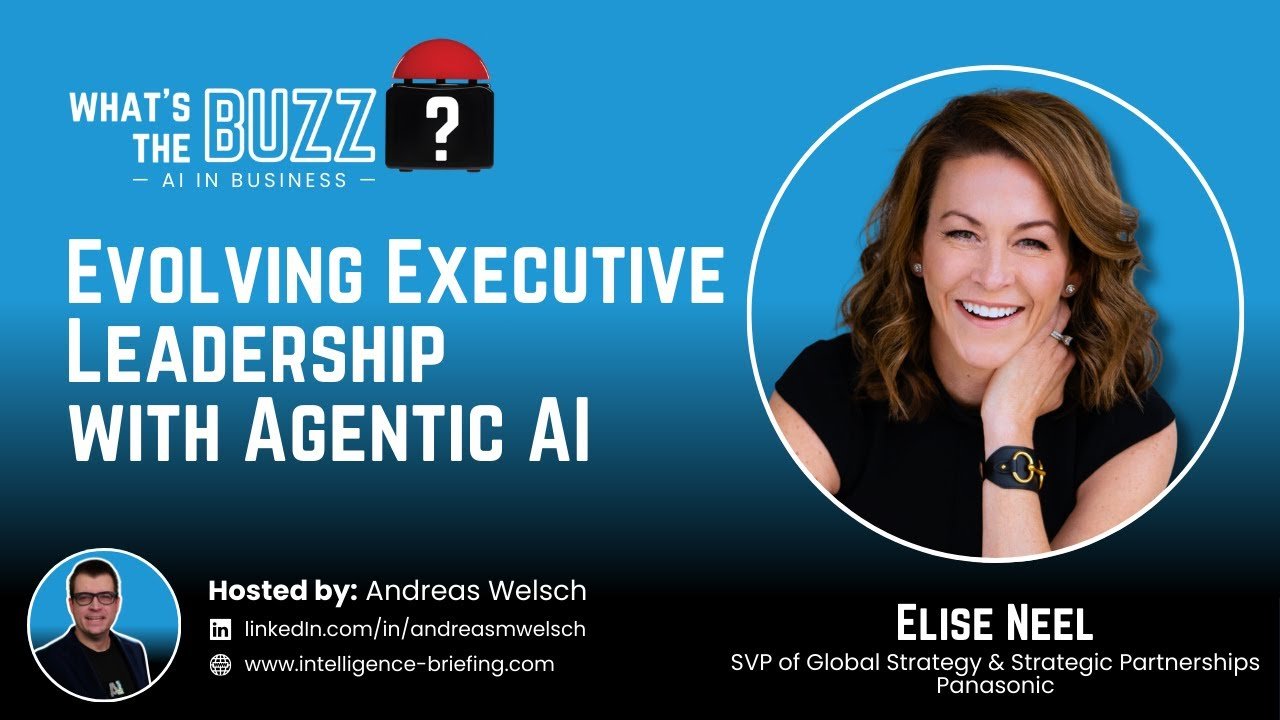
Guest: Elise Neel, SVP of Global Strategy and Strategic Partnerships at Panasonic
Host: Andreas Welsch
Episode: What’s the BUZZ?, Season 5, Episode 7
Published: April 1, 2026
Episode Summary
Agentic AI is usually discussed as a tool for automating work, less often as a change to how executives lead. Elise Neel, SVP of Global Strategy and Strategic Partnerships at Panasonic, joins host Andreas Welsch to explain how agentic AI changes executive leadership and what leaders should do about it now.
Neel said Panasonic is not only asking where AI can automate existing processes. It is asking where humans are the bottleneck. She described four ways organizations will operate: human over human, humans over AI, AI to AI, and AI orchestrating humans.
Neel named three shifts for leaders: egos lose and collaborators win, orchestration becomes a distinguishing capability, and leaders have to co-create by building with the technology themselves. She said leadership confidence in agentic AI is high, while confidence in executing with it is low.
Neel also described a sparring agent for Panasonic’s C-suite. It is built from recorded executive meetings and shareable strategy documents, so downline teams can test decks and proposals before they reach the executive. Neel said the work is still in progress, with the CTO first, and the aim is to shorten executive decision-making by 50% or so.
Key Takeaways
- Look for where humans are the bottleneck. Neel said Panasonic is repositioning AI away from automating existing processes. The question is what happens with an abundance of intelligence, parallel execution and probabilistic decisions instead of human approval chains.
- Egos lose, collaborators win. Neel said leaders who believe they are the smartest person in the room see the gains from generative AI fall apart. The value shifts to being the best orchestrator, organizer and question asker.
- Orchestration is a leadership capability. Neel used the Hollywood analogy: a team assembles for one movie, then disperses. She expects leaders to assemble the right people and the right intelligence for a task, then dissolve the team afterwards.
- Leaders have to build it themselves. Neel said leaders cannot learn agentic AI from slides or articles. Her suggestion: ask an LLM where you should use it better, or ask it for a 360 review of yourself.
- A sparring agent can speed up executive decisions. Neel said the agent learns from an executive’s meetings and documents, and feedback from the downline flows back into it. The aim is to shorten executive decision-making by 50% or so.
Timestamps
- 00:00:13 Why agentic AI for executives matters
- 00:00:44 Welcome and Elise Neel joins
- 00:01:39 Neel on Panasonic GO and her role
- 00:02:47 Agentic AI as a leadership reckoning
- 00:03:58 Finding where humans are the bottleneck
- 00:05:08 Four ways organizations will operate
- 00:06:16 What leaders need to embrace
- 00:06:38 First shift: egos lose, collaborators win
- 00:08:53 Second shift: orchestration and the Hollywood analogy
- 00:10:23 Third shift: co-creation and getting hands on the keyboard
- 00:11:22 Ask an LLM where to use it better
- 00:13:34 What is a leader’s true value?
- 00:16:32 Why leaders should model it themselves
- 00:18:23 A sparring agent for the C-suite
- 00:18:45 Consensus-based decision-making and Nemawashi
- 00:19:48 How the sparring agent is built from executive meetings
- 00:22:14 Aim, status and what the agent teaches the organization
- 00:23:17 Closing thoughts
About Elise Neel
Elise Neel is SVP of Global Strategy and Strategic Partnerships at Panasonic. In the episode, Neel said she leads strategy and strategic partnerships for the Panasonic GO initiative, Panasonic’s strategic transformation initiative on how AI and software can change customer touchpoints, new growth pathways and the company’s operating model.
Neel described Panasonic as a 106-year-old company with roots in hardware excellence and manufacturing, and said she works on the initiative from a global perspective.
Full Transcript
This is a lightly edited transcript.
Read the full transcript
Andreas Welsch: Everybody talks about agentic AI, but very few talk about how you actually use it with executives and for executives. Today we’re going to change that. So let’s jump right in.
Andreas Welsch: All right, welcome back for another episode of What’s the Buzz, where leaders share how they have turned hype into business outcomes. Today we’ll talk about how you can evolve executive leadership with the help of agentic AI, and who better to talk to about it than someone who’s actively doing that. Elise Neel, thank you so much for joining.
Elise Neel: Hi, thanks for having me. Hi, everybody.
Andreas Welsch: Awesome. I saw your session at the AI Summit in New York at the end of last year, and I saw so many great points that you shared there that resonated with me, and that’s why I reached out and asked if you’d be open to sharing them with the audience here today. But maybe not everybody is familiar with you yet. Could you share a little bit about yourself, who you are, and what you do?
Elise Neel: Sure. Well, again, thank you so much for having me. Through our discussion today, recognizing that we’re all learning, we’re all growing, we’re all navigating this new world collectively together and figuring out the bumps along the way, I’m coming as a humble person trying to figure out what we’re doing at Panasonic, and then how to share that with the community of other innovators, both your listeners as well as other leaders. At Panasonic, I have the privilege of leading our strategy and strategic partnerships for the Panasonic GO initiative. Panasonic is a 106-year-old company with a lot of incredible roots in hardware excellence in manufacturing. And Panasonic GO is our strategic transformation initiative that aims to look at the ways that AI and software can revolutionize our customer touchpoints, our new growth pathways, and fundamentally change our operating model inside the company. I have the pleasure of doing that from a global perspective, which has provided a lot of incredible stories and challenges and a few successes along the way.
Andreas Welsch: Wonderful. Looking forward to hearing more about the successes and also the learnings that you’ve made personally and as part of the organization. Like I said, everybody’s talking about agentic AI. There are very few people talking about the impact and the opportunity that it has for executive leaders, but I heard you share something really impactful about how you’re thinking about this at Panasonic and how you’re going about it. So I’m curious, what are your findings in that journey?
Elise Neel: Sure. I think that agentic AI provides a leadership reckoning as we think about an opportunity to redefine operating models from a leadership perspective. In past transformations, as we’ve looked at leveraging technology, whether that be mobile device technology, big data services and analytics, cloud compute, 5G technology, or robotics, agentic AI in particular, which to me is defined very differently from basic bot interactions, one-dimensional question and response, into actual AI that has agency, provides a much larger opportunity beyond a classic technology upgrade. What we learned quickly is that this has an opportunity to fundamentally change our leadership operating model. As we set out on our transformation journey at Panasonic, instead of looking simply at where we can apply AI to automate existing processes, we’re trying to reposition it to say: where are the places where humans are the bottleneck? Where are we the problem, as we think about processes and services that have been designed to fit neatly into the way our human brains operate, and how do we move that to the side to say, “What would happen if we didn’t have scarcity of intelligence and instead we had abundance? What would happen if we didn’t have to do linear decision-making from point A to point B, but instead could have parallel execution? Or what would happen if we moved from human-specific approval chains to different kinds of probabilistic decision outcomes and decision-making?” What we have started to discover is that some of the greatest gains that a lot of people are focusing on, which are real and tangible today and great low-hanging fruit with agentic AI to derive productivity, are not just about the efficiency of implementing those solutions, but about what happens when you can add massive streams of optionality into the decision framework, and how that changes the value that we add as leaders, and how we apply that to transforming our culture and perhaps building the leaders of the future. We’ve introduced, which I spoke about a little bit at the AI Summit, four different ways that we believe organizations will operate in the future. Today we operate in a human over human, or human to human, construct. We are now seeing humans over AI, as humans are beginning to direct AI and look to it as an additional source of intelligence or productivity. We then quickly move into AI to AI, so machine to machine orchestration, and we believe that we’re not that far away from AI orchestrating humans. As we think about how we push to that third and fourth dyad in this trajectory, it really does rock the world when you think about how it changes leadership for the future.
Andreas Welsch: Yeah, absolutely. I think for many leaders that’s a new challenge on top of everything else that you’re expected to do on a daily basis, managing the uncertainty of how things are progressing and where they are going. It seems very few people have answers to those questions right now. We’re all writing the playbook as we go along. But how do you feel leadership needs to evolve, and what do leaders need to embrace, given those uncertainties but knowing roughly what the direction is?
Elise Neel: Yeah. I think there are three takeaways that I’m on the personal journey for, and we’re also seeing patterns not just at Panasonic, but inside our customers, inside our partners, and frankly inside our competitors as well. The first big leadership change is around our own egos. What we see is that egos are losing and collaborators are winning. It’s not just about our human ego, in terms of “As a leader, I am paid what I am paid and hired to do a role because somebody, or a system of people, believed that I was really smart or adept at this particular set of capabilities.” Oftentimes, particularly at the mid-manager and lower levels, there’s extreme specialty that comes with those specific roles. We are positioned as “let’s ask Elise or let’s ask Andreas or let’s ask somebody else into the room as the expert” to speak on this particular topic. What we’re now seeing through agentic AI is that the people who rely on human intelligence, who believe that they are the smartest person in the room, that all roads lead to the human and particularly to them, break down very easily, and the efficiencies and opportunities with generative AI fall apart or don’t get realized. Instead, as we think about collaboration, these machines and LLMs by their inherent nature take this swarm, complex approach and think about connections that we can’t make from a human mind perspective. As they think about machine-to-machine collaboration, they are designed well to collaborate not only among themselves, but also to help connect dots between humans. So the shift is from “I am the smartest person in the room” to “I am the best orchestrator of all of the minds and all of the intelligence, regardless of where it comes from.” Maybe I’m not the smartest person, but I’m the smartest organizer, the smartest articulator, the smartest question asker. That kind of problem-frame articulation is a really valuable tool. The second piece is: if you know that, how do you put it into action? We see the power of orchestration from a leadership perspective as a very distinguishing capability that leaders will need in the future. I heard one of our partners at Microsoft talk about the way Hollywood organizes a movie, so maybe from an analogy perspective this is easier to understand. When someone sets out to make a movie in Hollywood, they assemble the best group of individuals, producers, writers, talent, boom mic handlers, sourcers, and they all come together with a collection of skills that the director or producer felt were correct. They make the movie with excellence, and as soon as it’s done, they all dissipate and go back to other jobs, where they’re available for the next task. This orchestrating and radial organization making, as we think about assembling a team or a set of intelligence for a particular task, project, or execution, will create a lot of dynamism in the org, where today we have very structured hierarchies. Not only are you orchestrating how work gets done between humans and machines and machine to machine, providing oversight, risk tolerance, privacy considerations, all the things humans do really well, but you’re also thinking about how to get the best group of people and the best group of intelligence together for a particular task, and then maybe dissipating that over time. The third big learning that will be really important for leaders in the future is co-creation. I would challenge all of your listeners: there is something very different between talking about agentic AI and actually putting your hand on a keyboard and figuring out how to build it for yourself. The best way that you can lead is to know about it. This is not a technology where you can just receive PowerPoint docs, read Wall Street Journal articles, or hear other people talk about it. You have to figure it out on your own, and the best leaders will differentiate themselves because they will know how to do that. They will not just push it into their downline. What we found across the industry, in lots of research with our customer sets and our partners, is that leadership confidence is very high. “I know about agentic AI, I know about the opportunities.” But their confidence in execution is extremely low, because they haven’t spent the time putting those things together themselves. So figure out the high-value tasks that you’re doing that are creating constraint. And here’s an idea: if you use an LLM every day, just ask it, “Where should I be using you better?” It’s fascinating. Ask an LLM for a 360 review of yourself, and brace yourself, because I did this not that long ago and it was sobering, which is great. This is how we get better. Those are the three big pillars that we’re navigating through, and I’m doing it as a leader myself, trying to fumble my way through to make myself a better leader, more efficient for the future.
Andreas Welsch: Great to hear those three examples. I think the last one isn’t always easy to incorporate into your daily work if you have a busy schedule, back-to-back meetings, calls, what have you. Carving out the time to sit down and actually get your hands on the keyboard and try to figure this out. Not everything is a linear process or a success, so going back to it, iterating, revising, improving, but I think that’s part of the mindset we need to build, to be more informed than just reading about it. It’s also become easier than ever to do this yourself, whether you use LLMs like I said or some other products, Copilot, or what have you. The big shift for me is also how you take away some of the fear that some of your team members might have: this AI, this intelligence, this nebulous thing, nobody really knows where it is going. But if it does parts of the work that I’ve been doing, what is my value? What do I bring? I think a lot of that has to do with shifting how we define work. It’s not just about being here for 40 hours and filling a role, like you said. It’s about what the outcome is and who the outcome is for. It’s not just about accomplishments, but how we got there. And I think reframing that around the things that make us unique as humans, that we add to that mix, adds a lot of value and brings a lot of reassurance that yes, we need your expertise. We want your expertise. That’s why you’re here.
Elise Neel: Yeah, I think it has been a really honest journey and a sobering journey as we think about exactly the question you’re asking, which is: what is my true value? As I look at myself, a lot of it was around “I’m great, I manage up really well, I’m helping to orchestrate workflows against the team, I’m packaging together stories, I’m thinking differently from a strategic perspective, and I’m able to take the lessons of leadership over my tenured career and apply them there. My lived experiences add a lot of value.” The challenge that I’ve been experiencing personally is: what happens when every case study of every transformation is now available from a global perspective, not just to me, but to every other competitor? What now sets me apart? I’m now building and deploying agents that are assisting me and significantly augmenting me as a leader. What is my differentiation and value? Why should I command the salary that I command? What happens when my agents are more promotable than me because they’re learning and adapting faster than I am as a human? How do I stay sharp, and how do I continue to offer my expertise to my company and to my network of colleagues, and how do we learn those pieces together? Now, as someone who spends a lot of time in innovation and frontier technology, on more of a three-to-five-year journey, I don’t know that this is going to be a problem for everybody today. But what I do know is that if I’m not preparing today for what will happen tomorrow, I’m going to have some challenges articulating my value. How would I put together my resume if I were looking for a new role five years from now, and how is that different from what I do today? We’re seeing incredible powerhouse individuals early in their career, brand new people who have never worked in business before, begin to outperform and outshine in their thinking and their application of AI agents, because they’re learning with a new paradigm. Some of the things that made me so valuable today, like my lived experience, like the fact that I’ve worked for 20 years and done transformative work, create a bias that is not necessarily great. Because I’ve done it and figured out the ways that work, those have all been structured elements that aren’t necessarily ready to be thrown away, but maybe all need to be reevaluated. So is my experience an inhibitor versus an enabler? My brain is going in so many directions. Anyway, all to say, there’s a lot here for us to sift through, and I think if we rely on our HR leaders, our resource leaders, our technologists, and so on to figure out how these things are going to work in the future, versus us as leaders modeling it and helping to show and shepherd the way, I think we might be disappointed. We have an opportunity to craft and shape it ourselves.
Andreas Welsch: I think that’s such an important point on a couple of different dimensions. One is that your future value as a leader, as a professional, as an individual is determined by the strategic decisions you make today, such as getting hands-on, figuring out how this works, how I can augment myself and do more and better things, with access to insights like case studies at my fingertips. And then think about how I can apply this, and how I can model this so that my team doesn’t just think, “Hey, this is a top-down thing.” It’s one of those change initiatives. Everybody says we’re doing it, but the reality is that on the ground floor nobody’s really doing it, or my manager doesn’t embrace this, so why should I? You have a responsibility to model that as well, and it sounds like you’re doing this personally at Panasonic, but others in the organization are doing that too.
Elise Neel: We’re trying.
Andreas Welsch: Yeah. I think that’s very honest and very candid, and a lot of times that’s the best you can do. There was one example that you shared at the AI Summit that I thought was so interesting. I’ve been a leader myself and I know time is of the essence. You’re in lots of meetings, with lots of competing priorities, lots of feedback, alignments before the alignment, before the alignment. If you take your proposal to your next-level leader, you very likely get feedback, maybe different feedback every time, but after a couple of iterations, a couple of projects, you figure out what he or she usually looks for. It sounds like you’ve got an interesting way to approach this, to save some of the executives’ time but also give actionable feedback to the teams working on projects. Can you share a little bit about that?
Elise Neel: Sure. You’re referring to some of the work that we’re doing for our C-suite around the deployment of a sparring agent. Our C-suite has repeatedly talked about how we increase the speed of decision-making across Panasonic. If you are unfamiliar, Panasonic is a Japanese company and one that embodies the principles of consensus-based decision-making. What this does is it takes a really long time for decisions to get made, but when decisions get made and consensus is gained, then execution is typically incredibly swift and very accurate. It’s part of the principles around Kaizen, and we have a name for this in the Japanese language called Nemawashi, which is exactly what you’re talking about. It is all of the meetings before the meetings, and the meetings after the meetings, and the prep to do the prep to prep the prep. This takes an inordinate amount of time, but the reality is exactly as you said, oftentimes the feedback is similar. You have new people, we have a rotational system inside Panasonic, and so it takes a little bit of time. And the pace of change that we are undergoing as a company, along with everybody else in the industry, is much more rapid. If we continue to take the same amount of time to make decisions, we will continue to fall behind. What we have built is a structure where first we identified a C-suite individual who has allowed us to record their meetings. All of this is standard, as many of you do today already for note-taking and summarization, but it captures tone, language, intent, and begins to capture the essence of the feedback that is provided to the downline as they prepare presentations to move them forward. We took those meeting notes and minutes, the tonal components, strategic documents and things like that, things that can be readily shared and used for training for the downstream teams, and assembled them from an agentic perspective. Now we have a living, breathing, dynamic agent that the downline teams can interact with on behalf of the executive. Whether that is a deck review, a one-on-one preparatory situation, feedback as they think about performance reviews, or how to think about what the boss would say when collaborating with the CMO or the CEO, our sparring agents on behalf of the C-suite have allowed the downline teams to learn at a faster pace and improve the speed of decision-making, so that when the deck or the deliverable goes to that particular individual, a lot of that feedback is already in place. The other piece is that the downline also provides feedback into the agent: “Well, that’s different than what I heard in the meeting. How should I really think about this? That’s not going to work, boss man, because you’re missing all of this other stuff, here’s what’s really happening on the line.” There’s a lot that leaders don’t have insight into, and that also gets built into the agent, so it becomes bidirectional. The agent isn’t just for the benefit of the downline, it’s also for the benefit of the leader, who can think, “Okay, Suzy has given me this piece of material that they’re asking for a decision on. Let me ask the agent what I need to know about this process, what am I missing in my analysis.” What we see is a constantly evolving, learning, adapting, and healing agent. Our aim is that over time, this reduces executive decision-making speed by 50% or so, and increases their ability to make decisions. This is a really interesting work in progress. It took quite a bit of time to convince our C-suite that this is a viable and really strong opportunity. And going back to our previous conversation, it challenges that some of these things can be automated. When you think about the decisions you’re asked to make every day as a leader, most of them could be automated, and potentially you would make a different decision if you had exposure to options that may not have been present before in our human thinking. This is an active project that we have first with our CTO, and we’ve got a couple of other C-suite members lined up. Maybe the line isn’t wrapped around the block, but we’re hoping to demonstrate some of these pieces. It also teaches the organization, sets a precedent for what leadership will look like in the future, and helps us learn and adapt along the way.
Andreas Welsch: Now that sounds like a real, tangible example of top-level leadership sponsorship, embracing and encouraging this and showing it in action, while also looking for tangible and realistic time savings and picking up additional speed. Elise, thank you so much for sharing this. We’re getting close to the end of the show, so I’m very appreciative of you spending time with us today and sharing what you’re doing at Panasonic around agentic AI to help executive leadership scale better and also promote the notion of more AI in the business, for business benefit and individual benefit. Elise, thank you so much for joining us.
Elise Neel: Thank you so much for having me, and be brave, everyone. We can do it together.
Andreas Welsch: Wonderful. All right, folks in the audience, see you next time for another episode of What’s the Buzz. Bye-bye.
Listen and Subscribe
- Watch on YouTube
- Listen on Buzzsprout (show page)
- Listen on Apple Podcasts (show page)
- Listen on Spotify (show page)
Related Reading
- Agentic AI for Enterprise Leaders
- AI Leadership for Enterprise Leaders
- Agentic AI Operating Model: What Leaders Need
- Agentic AI for the Workforce: AI Leadership Lessons
- Responsibility for AI Output: Why Leaders Stay on the Hook
- The HUMAN Agentic AI Edge by Andreas Welsch
Frequently Asked Questions
How does agentic AI change executive leadership?
Neel called it a leadership reckoning. She said agentic AI is more than a classic technology upgrade because it is AI with agency, and it can change the leadership operating model. Panasonic looks for where humans are the bottleneck, not only for processes to automate.
What are the four ways organizations will operate with AI?
Neel described human over human, humans over AI, AI to AI (machine-to-machine orchestration), and AI orchestrating humans. She said organizations operate in the first today, are beginning to move into the second, and are not far from the third and fourth.
What do leaders need to do differently with agentic AI?
Neel named three shifts. Egos lose and collaborators win, orchestration becomes a distinguishing leadership capability, and leaders have to co-create by building with the technology themselves instead of pushing it to their downline.
What is a sparring agent for executives?
Neel said it is an agent built from an executive’s recorded meetings, tone, language and shareable strategy documents. Downline teams use it for deck reviews, one-on-one preparation and feedback before a proposal reaches the executive. Downline feedback flows back into the agent, and executives can ask it what they are missing.
Why does Panasonic need faster executive decisions?
Neel said Panasonic’s consensus-based decision-making, including Nemawashi (the meetings before and after the meetings), takes a long time, even though execution is swift once consensus is reached. She said the pace of change means that taking the same amount of time to decide would let the company fall behind.