

Agentic AI for Process Excellence: Scale Automation Without Losing Accountability
Original source: All Access: AI in PEX
Agentic AI is rapidly moving from experimentation to real work across systems and workflows. For process excellence leaders focused on predictable outcomes, the promise is compelling: faster analysis, orchestrated tasks, and fewer manual handoffs.
But Andreas Welsch, an AI leadership expert, emphasizes that agents do not automatically improve processes. Without operating discipline, agents can amplify inconsistency, rework, and unclear ownership—the very problems process excellence teams work to eliminate.
This article distills Welsch’s process-first perspective and frames it for executive decision-makers responsible for AI governance, AI strategy, and workforce transformation. It also reflects themes he explores in his book, The HUMAN Agentic AI Edge—Shape the Next Generation of AI-Ready Teams, and in the Process Excellence Network context connected to “All Access: AI in PEX.”
Executive Summary
- Agentic AI can boost task speed while degrading end-to-end process performance.
- Agents introduce variability, exceptions, and blurred accountability without clear standards.
- Process-first design clarifies where agents add value and where humans must decide.
- The HUMAN Agentic AI Edge Operating Model™ aligns roles, rules, and ownership for scale.
- Responsible scaling requires governance, standard work, and workforce enablement—not shortcuts.
Key Takeaways
- Traditional automation follows predefined steps; agents interpret goals and adapt to context.
- Agent outputs can look “finished” while still requiring human judgment.
- Early deployments often create task-level efficiency but process-level degradation.
- Common symptoms include uneven quality, downstream review queues, and shifted cycle time.
- Well-designed agents can reduce handoffs, improve flow, and standardize execution.
- Local optimization is a major risk when an agent improves one step but harms the whole.
- Welsch’s HUMAN Agentic AI Edge Operating Model™ maps familiar process controls to an agentic world.
What is Agentic AI?
Agentic AI refers to AI agents that can interpret goals, adapt to context, and act across systems and workflows rather than simply executing fixed, predefined automation steps. Unlike traditional automation, agents can orchestrate tasks, generate outputs that appear complete, and adjust their actions based on conditions. This power makes agents disruptive to established process controls, because it can increase variability, multiply exceptions, and blur accountability when decisions are partially automated.
How Agentic AI Changes Process Behavior
Process excellence teams have long optimized for reduced variation, lower waste, and predictable outcomes. Welsch notes that AI agents behave differently than traditional automation because they interpret goals and adapt to context rather than executing a fixed script.
That difference matters at scale. Agent-generated work can look polished enough to pass downstream—until review reveals missing judgment, incomplete context, or misaligned decisions that force rework.
Key Insight: AI agents increase the need for explicit process controls because they adapt in real time. Without clear standards and ownership, they can introduce variability, expand exceptions, and make accountability unclear when outcomes are only partially automated.
Why “More Automation” Can Reduce Process Excellence
Welsch highlights a pattern many organizations are encountering: adding agents to processes does not automatically improve them. In some early deployments, output increases at the task level, but the overall process degrades.
From a process excellence perspective, the warning signs are operational and measurable: review effort rises, cycle time shifts downstream, and quality becomes uneven. The organization may feel faster in the moment, but the system absorbs the cost later.
- Variability increases instead of decreasing.
- Exceptions multiply rather than shrink.
- Accountability blurs when decisions are partially automated.
Key Insight: Task-level efficiency can mask process-level failure. Agents can create “draft debt,” where seemingly complete outputs push quality checks downstream, increasing queues and rework. Process excellence requires optimizing the end-to-end flow, not just one step.
Where Agents Strengthen Process Excellence (When Designed Deliberately)
Welsch outlines where agents can reinforce core process goals when embedded with discipline. Used intentionally, they can coordinate steps across systems, flag bottlenecks earlier, and reduce manual handoffs.
Agents can also standardize execution while still adapting to context—provided teams define where adaptation is acceptable and where it must be constrained. The result is not “hands-off” work, but better allocation of human attention toward judgment and exceptions.
- Reduce manual handoffs by coordinating steps across systems.
- Improve flow by flagging bottlenecks and exceptions earlier.
- Standardize execution while still adapting to context.
- Free human capacity for judgment, improvement, and exception handling.
Key Insight: Agents should be treated as participants in the process system, not isolated tools. Process excellence benefits emerge when agents operate under the same clarity, controls, and ownership expected in mature processes.
The HUMAN Agentic AI Edge Operating Model™ (A Process-First Governance Layer)
To prevent agent deployments from breaking accountability, Welsch introduces the HUMAN Agentic AI Edge Operating Model™. The model is positioned as an operating discipline that ensures “all bases are covered”—not only the technical ones—when agents are embedded into workflows.
Welsch’s model aligns six dimensions that process leaders already manage, updated for an agentic world:
- Roles: What the agent is responsible for and where human ownership remains.
- Knowledge: Which data and rules the agent is allowed to use.
- Rules: Guardrails that prevent overreach and enforce standards.
- Rewards: What the agent optimizes for (speed, accuracy, compliance, cost).
- Collaboration: How agents and people hand work back and forth.
- Organization: Where ownership sits when outcomes are delivered.
For process excellence teams, Welsch links this to familiar concepts such as SIPOC clarity, RACI discipline, standard work, and governance—reframed for AI agents acting across systems.
Preventing Local Optimization: The Hidden Risk in Agentic AI
One of the biggest risks Welsch calls out is local optimization. A single step becomes faster, but the end-to-end process suffers. Symptoms include growing review queues, accumulated draft debt, and rising exceptions.
The operating model is designed to force upfront design decisions so failures are not “discovered” after rollout. Instead, stability is engineered before scale.
- Where does the agent add value in the flow?
- Where must humans intervene?
- What quality threshold triggers escalation?
Key Insight: Local optimization is an enterprise governance problem, not a tooling problem. Faster steps can create slower processes if human review and exception handling are not explicitly designed into the workflow with clear escalation thresholds.
A Process-First Path to Scaling Agentic AI
Organizations serious about process excellence should avoid using agents as shortcuts around established operating discipline. Welsch argues that agents must be designed as part of the process system, with clear roles, standards, and measurable outcomes.
He also connects scale to enablement. When paired with hands-on training that aligns leaders and frontline teams on shared standards, the operating model supports repeatable performance rather than one-off wins.
What “Repeatable Performance” Looks Like
In Welsch’s framing, repeatable performance means the organization can reduce friction, improve outcomes, and maintain quality without sacrificing trust. Agents help when they are governed and integrated—not when they are bolted onto broken workflows.
The Next Evolution of Process Excellence in an Agentic AI World
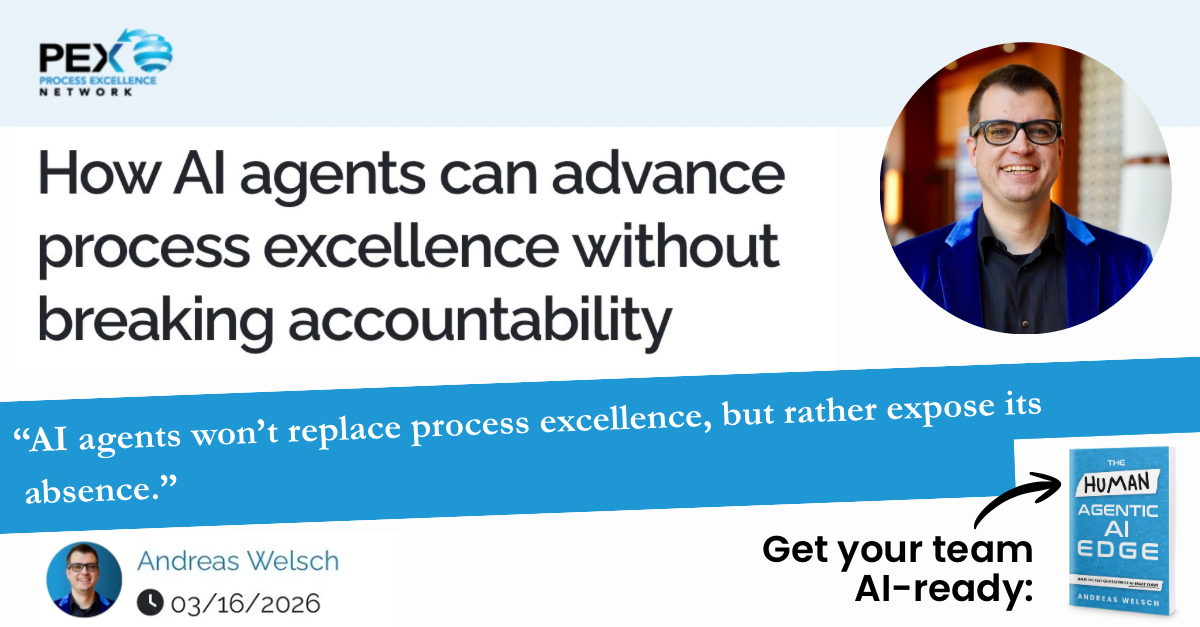
Welsch’s conclusion is direct: AI agents will not replace process excellence, but they will expose its absence. Organizations that succeed apply the same rigor to agents that they apply to processes: defined standards, measurable outcomes, and explicit ownership.
In this view, the HUMAN Agentic AI Edge Operating Model™ provides a practical way to scale AI while keeping human judgment ahead of AI capabilities. That stance supports responsible adoption without trading away trust or quality.
Leadership Implications
- Design governance into the workflow: Define escalation thresholds and where human intervention is mandatory.
- Clarify accountability: Establish explicit ownership for outcomes, even when steps are partially automated.
- Control knowledge boundaries: Specify what data and rules agents can use to prevent overreach.
- Align incentives: Decide what agents should optimize for—speed, accuracy, compliance, or cost—before deployment.
- Enable the workforce: Pair agent rollout with hands-on training so leaders and frontline teams share standards.
Why This Media Coverage Matters
This perspective appears in the Process Excellence Network ecosystem and is tied to “All Access: AI in PEX,” where Welsch is listed as a speaker. The audience context matters: process excellence leaders, transformation teams, and executives responsible for operational performance.
For AI leadership and workforce transformation, the relevance is clear. Agents expand what automation can do, but they also expand what must be governed. Welsch’s framing connects AI adoption to familiar process disciplines—roles, rules, standard work, and ownership—so organizations can scale without breaking accountability.
The same themes are explored in Welsch’s book based on lessons drawn from more than 50 interviews with AI leaders, reinforcing the leadership requirement: keep human judgment ahead of AI capabilities while building repeatable operating discipline.
Conclusion
Agentic AI can accelerate process excellence, but only when it is governed as part of the process system. Welsch’s message is that speed without ownership creates downstream cost—review effort, rework, and uneven quality.
By applying a process-first operating discipline—clarifying roles, constraining knowledge, enforcing rules, aligning rewards, designing collaboration, and assigning organizational ownership—leaders can scale Agentic AI while preserving accountability and trust.
About the Author
FAQ
1) What is the biggest process risk when deploying Agentic AI?
The biggest risk is improving individual tasks while damaging end-to-end performance through variability, exceptions, and unclear ownership. Agentic AI can push review effort downstream, shift cycle time, and create uneven quality unless escalation and accountability are designed upfront.
2) How do AI agents differ from traditional automation in workflows?
Traditional automation executes predefined steps, while AI agents interpret goals, adapt to context, and act across systems. This flexibility can create outputs that look complete but still require judgment, which changes how process controls and governance must be applied.
3) Why can Agentic AI increase rework and review queues?
Agent outputs can appear finished and move work forward, but hidden gaps often surface during review. That shifts quality checks downstream, increasing queues and rework. Process excellence teams should set standards, thresholds, and human intervention points before scale.
4) Where does Agentic AI genuinely improve process excellence?
Agentic AI improves process excellence when it reduces manual handoffs, coordinates steps across systems, flags bottlenecks earlier, and standardizes execution while still adapting to context. These gains require treating agents as governed participants in the process system.
5) What does Andreas Welsch’s HUMAN Agentic AI Edge Operating Model™ cover?
The model aligns six dimensions needed to embed agents safely into workflows: roles, knowledge, rules, rewards, collaboration, and organization. It helps leaders clarify what agents do, what they are allowed to use, and who remains accountable for outcomes.
6) What is “local optimization” in an Agentic AI deployment?
Local optimization happens when an AI agent makes one step faster but harms the overall process through draft debt, larger review queues, and more exceptions. Executives should assess value in the full flow and require defined escalation triggers for quality.
7) How should leadership set guardrails for AI agents across systems?
Leadership should define the rules and knowledge boundaries agents can use, specify what they optimize for (speed, accuracy, compliance, cost), and set collaboration handoffs with humans. This strengthens AI governance and keeps accountability clear across workflows.
8) What does “process-first” AI adoption mean for executives?
Process-first AI adoption means embedding agents into the process system with clear roles, standards, measurable outcomes, and explicit ownership. It avoids shortcuts around governance and ensures improvements are repeatable, not isolated wins that create downstream operational cost.
9) Will AI agents replace process excellence teams?
AI agents will not replace process excellence, but they will expose its absence. Without discipline, agents amplify inconsistency and rework. With governance and standard work, agents can support predictable outcomes and free people for judgment and exception handling.