

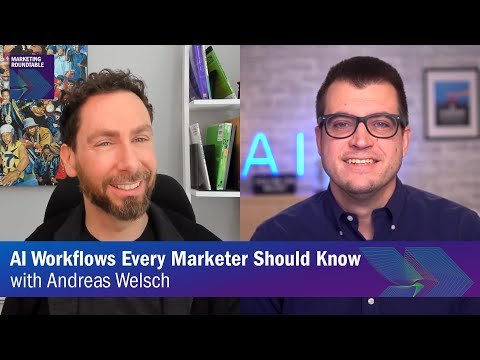
AI leadership is increasingly defined by a widening gap: AI tools are advancing quickly, while enterprise adoption moves slowly due to governance, data protection, and cultural friction.
How do leaders turn fast-moving AI innovation into real AI adoption in marketing? Set practical guardrails instead of bans: approve tools and keep confidential and personal data out of public ones. Normalize transparent use so employees share prompts and lessons, and start with repeatable work such as content repurposing, budgeting time for the upfront learning curve.
In a conversation on the Marketing Roundtable podcast (produced by BrainDo), AI leadership expert Andreas Welsch described what it looks like when AI enablement works in practice: clear guardrails, managers who encourage responsible experimentation, and workflows that reclaim time for higher-value work.
The discussion is especially relevant for marketing and communications teams caught between compliance concerns (“don’t use AI”) and executive mandates (“bring AI into everything”). Welsch’s perspective emphasizes adoption discipline: focus on business outcomes, not hype.
Original source: Marketing Roundtable Podcast (BrainDo)
Executive Summary
- AI innovation is outpacing enterprise AI adoption and creating opportunity cost.
- Governance must balance data protection with practical access and guardrails.
- Managers should normalize AI use to avoid hidden, unmanaged “shadow AI.”
- AI can compress content repurposing from hours to minutes, after an upfront learning curve.
- Authentic thought leadership still requires real expertise, not automated volume.
Key Takeaways
- Welsch describes a “two-speed” reality: fast AI lab innovation vs. slower corporate adoption, creating a widening delta.
- Blocking AI at work can backfire; employees may shift to personal devices, taking corporate data with them.
- Guardrails matter: confidential and personal data should not be placed into public tools.
- Licensed-data approaches (for example, Adobe Firefly’s training on licensed data) can reduce legal exposure.
- Cultural signals matter: a Slack study cited by Welsch found 46% of respondents avoid telling managers they use generative AI.
- Teams should test multiple models (ChatGPT, Claude, Gemini, Copilot, Perplexity, Deepseek) because outputs differ by tool.
- AI should free time for higher-value work; repurposing is a strong initial use case because it does not change the underlying substance.
What is AI leadership?
AI leadership is the ability to guide responsible AI adoption by combining governance, culture, and workflow redesign. In Welsch’s view, effective leaders set clear guardrails (for privacy and confidential data), make practical tools available, and encourage teams to share prompts, learnings, and failures. AI leadership also means focusing on business outcomes (time saved, faster production, better decisions) rather than “AI for AI’s sake.” The goal is measurable productivity and higher-value work, not unmanaged experimentation or generic, automated content.
AI Leadership and the Two-Speed Reality: Innovation vs. Adoption
Welsch explains AI adoption through a simple visualization: AI labs are shipping innovation on a steep curve, while corporate adoption is flatter. The difference between those curves becomes opportunity cost.
For executives, the implication is clear: the organization can have “theoretical access” to powerful capabilities in the market, while day-to-day teams remain blocked by policy ambiguity, tooling constraints, and fear of missteps.
Key Insight: Welsch frames the gap between fast-moving AI innovation and slow enterprise AI adoption as an opportunity cost. The longer access, governance, and skills lag behind available capability, the more value is left on the table.
This “two-speed” problem is amplified in marketing, where teams face immediate pressure to produce content, run experiments, and respond to market shifts.
AI Governance Without Paralysis: Which Guardrails Enable Action?
Marketing teams often receive conflicting messages: legal and compliance warns against AI tools because of data risks, while leaders and consultants push for broad AI rollout. Welsch argues for balance.
He notes that organizations must protect data, including avoiding placing confidential information or personal data into public tools. At the same time, banning AI outright can be counterproductive, because employees can access the same tools on personal devices, potentially moving corporate data outside managed environments.
Welsch points to approaches that can reduce risk. For example, he highlights Adobe Firefly as a way to generate images with greater legal confidence because it is trained on licensed data.
Key Insight: Welsch emphasizes governance that enables responsible AI use. Overly restrictive policies can push employees to personal devices, creating unmanaged “shadow AI” behavior. Practical guardrails (what data not to use, what tools are approved) can improve both safety and adoption.
Executive pattern: “approved tools + explicit exclusions”
The conversation suggests a pragmatic governance posture: approve tools that fit risk tolerance, explicitly exclude sensitive data from prompts, and keep employees inside guardrails rather than outside them.
Why Is Culture the Hidden Bottleneck in AI Adoption in Marketing?
Welsch cites a Slack study showing that 46% of respondents avoid telling their manager they use generative AI. Reasons include fear of being perceived as lazy or incompetent, and fear of being assigned more work.
This is less a tooling problem than a leadership and culture problem. When employees hide AI usage, organizations lose visibility into quality, risk, and learning opportunities.
Welsch describes an alternative: managers who invite responsible use and ask early adopters to share prompts and lessons. In his SAP leadership experience, a team member asked permission to use ChatGPT for copy drafting, and the response was to allow it with guardrails and encourage knowledge-sharing.
Key Insight: Welsch links AI adoption to psychological safety. If employees fear judgment or workload penalties, they will conceal AI use, reducing governance visibility and slowing organizational learning. Leaders can reverse this by normalizing responsible AI and rewarding transparent experimentation.
Boundaries still matter
Welsch also acknowledges limits. Teams can be encouraged to experiment while maintaining accountability for outcomes. He uses an analogy: health and well-being may support lunch walks, but boundaries prevent “walking from 9 to 5.” The same applies to AI experimentation unrelated to work.
Which AI Tools Should Marketing Teams Start With? Start Where Work Already Happens
When asked for “top technologies,” Welsch does not begin with a universal stack. Instead, he recommends starting with existing applications and asking whether vendors already added AI capabilities.
The operational questions follow: Is AI included in current licenses, a higher-tier subscription, or an add-on? Who needs access: everyone or only specialists? What would it change in cost, speed, or creative throughput?
Welsch also recommends experimenting across multiple tools because outputs and interpretation differ. The conversation mentions widely used assistants and search tools (ChatGPT, Claude, Copilot, Gemini, Perplexity, Deepseek) as well as role-specific tools for copy and content.
Examples mentioned in the conversation
- Copy generation: Copy.ai, Jasper
- Editing and repurposing: Descript (edit audio/video like a document), Opus Clip (identify viral moments)
- Automation and integration: make.com (low-code/no-code workflow chaining)
- Image generation: Midjourney; Adobe Firefly referenced for licensed-data safety
The throughline remains outcome-driven adoption: AI should be introduced where it reduces time, increases throughput, or improves decision quality.
How Can AI Speed Up Content Repurposing? From 4 Hours to 30 Minutes
Welsch offers a concrete example from his own content operations. He hosts a livestream and podcast called “What’s the BUZZ?,” where he interviews AI leaders and practitioners.
He describes how post-production used to take three to five hours: turning a podcast into a newsletter, repurposing into social posts, and producing creative assets. Over time, he assembled an AI-enabled workflow that reduced repurposing to roughly 30 minutes of review, with automation execution described as taking around a minute and twenty seconds.
Key details matter for executive expectations: the time savings did not appear instantly. Welsch notes that it took days to build and optimize the workflow, including setting up API calls to his podcast hosting site and using OpenAI APIs.
Why this example is scalable inside enterprises
Welsch’s point is not that every employee must become a developer. The point is that organizations can identify repeatable, high-friction tasks, like repurposing, and invest once to unlock ongoing efficiency.
Thought Leadership vs. AI “Workslop”: Authenticity Still Wins
The conversation addresses a growing executive concern: an increasing flood of AI-generated content that mimics expertise without demonstrating it. Welsch describes the tension between keeping up with automated content pipelines and building an audience that trusts real expertise.
He provides a practical test: if a CEO or client references an article in an elevator when “the lights go out,” the author must be able to discuss it without relying on the tool. If AI-generated content was posted without deep understanding, credibility collapses.
Welsch explains how he maintains authenticity while using AI: he uses AI heavily for repurposing content that already exists (for example, transcript-driven rewrites for different formats). He also alternates that with original analysis where he deliberately thinks and writes without outsourcing the core perspective.
Implication for executive communication
AI can accelerate distribution, but credibility still depends on informed judgment. High-volume automated posting may increase activity metrics, but it does not guarantee authority.
Using AI as a “Sparring Partner” for Better Work Before Production
Welsch positions generative AI as useful earlier in the workflow, not only for production, but also for preparation and decision support.
He shares an example from teaching management information systems: students can role-play interviews by pasting a job description into an AI tool, instructing it to act as a recruiter, and requesting feedback on answers.
He connects the same method to marketing: teams can generate an ideal customer profile (ICP) or persona, then role-play how that persona might respond to a piece of copy. While personas remain simplified representations, Welsch suggests AI can provide useful iterative feedback on resonance, missing elements, and potential creative directions.
What’s Next: Agentic AI and Smaller Teams
Looking forward, Welsch points to agentic AI: systems that can be given a goal and then research, propose options, and execute tasks on a user’s behalf. He also describes a potential future where new companies operate with fewer humans because AI becomes more capable across business domains.
He stresses that organizations will still need internal capability: it is not enough to bring in external consultants while employees continue to work “as if nothing happened.” Teams must be upskilled so AI knowledge and organizational context stay inside the company.
Welsch also shares an adoption snapshot from audiobook production. He created an audiobook version of “AI Leadership Handbook” using an AI voice clone, and observed how quickly platforms adopted similar capabilities, from a single option to major distribution platforms adding AI narration pathways in a short window.
Leadership Implications
- Design governance for enablement: approve tools and define strict exclusions for confidential and personal data.
- Reduce “shadow AI” risk: provide sanctioned options so employees do not default to personal-device usage.
- Normalize transparent AI use: encourage teams to share prompts, wins, and failures; reward learning, not secrecy.
- Budget for the learning curve: recognize that workflow gains arrive after setup and iteration, not immediately.
- Prioritize business outcomes: introduce AI where it saves time, improves throughput, or elevates quality.
Why this conversation matters
This Marketing Roundtable discussion targets working marketers who want to participate in industry conversation but struggle with time barriers. Welsch’s examples show how AI can compress repurposing and editing work so professionals can publish consistently without sacrificing day jobs.
The themes also map directly to workforce transformation. Welsch links adoption success to leadership behaviors, governance guardrails, and upskilling, rather than any single tool. The conversation reinforces that AI leadership is not a “vendor project,” but an operating model shift.
These points align with Welsch’s broader positioning as an AI leadership expert focused on adoption, governance, strategy, and workforce enablement.
Conclusion
AI leadership is increasingly the differentiator between organizations that experiment endlessly and organizations that operationalize AI adoption with measurable outcomes. Welsch’s guidance is practical: enable tools with guardrails, build a culture of transparent learning, and redesign workflows where AI removes friction.
Used well, AI can shift marketing effort away from repetitive production and toward higher-value thinking, while protecting credibility through authentic expertise.
Frequently Asked Questions
What is the biggest barrier to AI adoption in marketing teams?
The biggest barrier is often culture and governance, not technology, because employees may hide AI use, leaders may be unsure how to set guardrails, and compliance fears can block access even when tools could improve productivity.
Welsch cites a Slack study where 46% avoided telling managers about generative AI use, signaling a trust and incentives issue.
How should executives balance AI governance with employee productivity?
Executives should balance AI governance by approving practical tools, explicitly prohibiting confidential and personal data in prompts, and keeping teams inside managed guardrails, because bans can push employees to personal devices and create higher unmanaged risk.
Welsch emphasizes enabling access with constraints rather than freezing adoption.
How can leaders reduce “shadow AI” behavior?
Leaders can reduce shadow AI behavior by offering sanctioned AI options, setting clear rules for sensitive data, and normalizing transparent use, because blocking AI on corporate devices can lead employees to use personal phones and move corporate data outside governance.
Welsch argues the “genie is out of the bottle,” so managed enablement is safer than denial.
How can AI help create authentic thought leadership without becoming generic?
AI can support authentic thought leadership when it repurposes real conversations, transcripts, and researched viewpoints, because the substance remains human-driven while AI accelerates formatting and distribution across channels without replacing expertise.
Welsch contrasts repurposing with mass-generating posts detached from real knowledge, using an “elevator test” for credibility.
What does “AI upskilling” look like for managers who are not AI experts?
AI upskilling can be led by managers who empower tech-savvy team members to experiment, then share prompts and lessons with the group, because leaders do not need to know everything to create a learning culture and responsible adoption.
Welsch describes encouraging employees to report what worked, where it failed, and how prompts evolved.
How should teams account for the AI learning curve without hurting performance accountability?
Teams should account for the AI learning curve by setting boundaries for experimentation while still measuring outcomes, because productivity gains typically come after iterative practice and workflow setup rather than on day one of tool usage.
Welsch notes that his automation gains required upfront time for setup, including APIs and workflow optimization.
How can AI improve pre-production work like research and messaging?
AI can improve pre-production by acting as a sparring partner for brainstorming, persona-based role-play, and message testing, because teams can iterate on ICPs and draft copy, then ask the model to critique resonance and missing elements.
Welsch describes using AI to role-play personas and evaluate how copy might land with an intended audience.
What is agentic AI and why does it matter to workforce transformation?
Agentic AI refers to systems that can be given a goal and then research, propose options, and perform tasks on a user’s behalf, because this capability could reshape work design and enable smaller teams to operate effectively.
Welsch notes this trend alongside the need to build internal capability rather than outsourcing AI competence.