

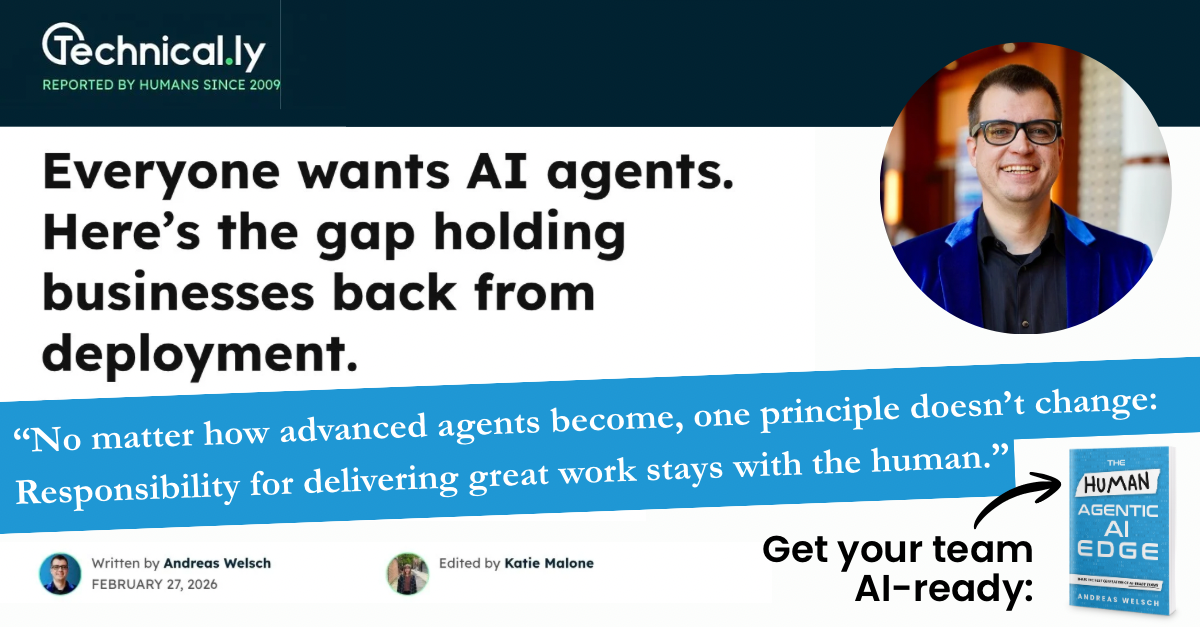
AI agents are becoming a frequent topic in boardrooms and technology roadmaps. However, many organizations expect agents to work like fully autonomous staff before basic readiness is in place. This article explains where to start with deploying AI agents and how to scale. It focuses on practical steps for business leaders, CIOs, CHROs, and operations teams.
Deploying AI agents works best when organizations start small and scale deliberately. Classify each use case as personal productivity, a team-delegated task, or a business-critical workflow. Write a role description for every agent, keep a named human owner and reviewer accountable for outputs, pilot vendor-provided agents first, and add governance as agents move into shared and critical work.
Recommendations here reflect guidance originally shared on Technical.ly and center on three practical patterns for agents. These patterns make it easier to test, govern, and measure impact. Consequently, they reduce risk while unlocking productivity.
Original source: Everyone wants AI agents. Here’s the gap holding businesses back from deployment.
Key Takeaways
- Classify agentic AI into three risk tiers: personal productivity, team-delegated tasks, and business-critical workflows.
- Apply a Dual-Lens Principle: treat agents as both software and as role-based contributors to work.
- Keep humans responsible for judgment, quality, and final decisions to avoid “Draft Debt.”
- Start with vendor-provided agents where possible to reduce technical complexity and speed time to value.
- Design role descriptions for agents, define data access, and codify review and escalation paths.
- Scale deliberately: increase governance and testing as agents move into shared and critical workflows.
- Make readiness investments (training, processes, and monitoring) match agent capability growth.
What are AI agents?
AI agents are software systems that perform tasks on behalf of people or teams, often by interacting with multiple tools and data sources. They use language models, automation, and rules to complete repetitive or ambiguous steps. In business settings, agents augment human work by handling routine actions, preparing drafts, checking data, or coordinating across systems. Consequently, they can speed up work and change how accountability is assigned.
What are the three categories of agentic AI?
Classifying agent scenarios helps choose the right controls. Therefore, begin by mapping potential use cases into three clear categories.
1. Personal productivity
This tier covers individual use. For example, drafting messages, summarizing research, or brainstorming ideas. Risks are limited because accountability stays with the user. However, standards for accuracy and bias checks remain important.
2. Team-delegated tasks
Teams delegate recurring activities to agents for efficiency. Examples include preparing weekly reports, checking pipeline data, or coordinating calendar events. In this tier, outputs influence shared decisions. Therefore, versioning, review workflows, and test cases become essential.
3. Business-critical workflows
At this level, agents interact with core processes such as procurement, customer routing, and financial analysis. These agents scale impact and also scale risk. As a result, stronger governance, audit logs, and escalation rules are required before wide deployment.
What is the Dual-Lens Principle for designing AI agents?
Design teams should hold two perspectives at once. First, view agents as employees with roles, handoffs, and quality expectations. Second, view them as software components with ownership, permissions, and testability. Together, these lenses clarify where responsibility sits and what technical controls are needed.
Role-design for agents
Create a short job description for each agent. Specify the tasks, inputs, allowed systems, and expected outputs. This reduces ambiguity, aligns stakeholders, and supports approvals. In addition, define what success looks like in measurable terms.
Software controls and permissions
Define which systems and data an agent can access. Next, set API credentials, least-privilege permissions, and logging. Consequently, traceability improves, and audits become simpler.
What is an agent role description?
The agent role description lists responsibilities, data access limits, input formats, and expected outputs. It also names the human owner and the review cadence. This short spec clarifies accountability and supports rapid validation during pilot phases.
What is Draft Debt, and why does review matter?
Organizations often accelerate AI use faster than they build standards. As a result, the AI output looks finished but still needs human clean-up. This creates hidden rework and undermines productivity. Therefore, institute mandatory review steps and sample audits before outputs are published or acted on.
What are review guardrails?
Set clear review rules: every agent output requires a named human reviewer for factual checks and bias assessment. Use checklists for common errors, and require confirmation before external release. Consequently, quality improves, and invisible rework drops significantly.
Where should you start when deploying AI agents?
Most companies do not need fully autonomous agents initially. Instead, choose low-risk, high-frequency tasks to pilot agents. For example, sales prospect identification or proposal drafting. Vendor-supplied agents can be customized to your needs. This reduces complexity, shortens feedback loops, and provides measurable wins.
For practical resources and templates, see internal guidance pages: Agent playbook templates, AI upskilling, and Organizational readiness assessment.
Why should you start with vendor-provided AI agents?
Using vendor agents lets teams test use cases with lower engineering cost. Vendors often provide templates, connectors, and update paths. Thus, early pilots show value quickly. However, contract terms and data handling must be reviewed before roll-out.
Who is accountable for AI agent outputs?
Humans remain responsible for final decisions. Therefore, maintain clear ownership for every agent and every output. This includes checks for bias, factual accuracy and relevance. Moreover, train users to spot common failure modes and to escalate when uncertain.
How should governance scale as AI agents take on more work?
Governance should enable safe scaling. Begin with pragmatic policies for access, testing and monitoring. Then, increase rigor as agents move from personal to team to critical tiers. Consequently, governance helps preserve trust while unlocking impact.
What operational readiness and training do AI agents require?
Readiness covers people, processes, and platforms. Train users on agent limits and review expectations. Next, set up monitoring dashboards, error logging, and incident response for agent failures. Finally, align change management with the rollout cadence to keep adoption sustainable.
How do you measure the impact of AI agents?
Track both productivity and quality metrics. For example, measure time saved, post-review error rates, and rework reduction. In addition, monitor user satisfaction and trust. As a result, decisions about scaling or pausing deployments are based on data rather than intuition.
Checklist for deploying your first AI agent
- Define the agent role and expected output format.
- Limit data access to what is strictly necessary.
- Choose a vendor or internal prototype for a pilot.
- Assign a human owner and reviewer for outputs.
- Design test cases and monitoring dashboards.
- Run a time-boxed pilot and collect metrics.
Conclusion
AI agents can increase productivity and change work design. However, practical value depends on appropriate use cases, well-defined roles, and a match in readiness. Leaders should start where accountability is clear, use vendor tools to shorten time to value, and add governance as agents take on shared or critical work. Ultimately, human judgment remains the linchpin for safe and effective deployments.
Related Reading
Frequently Asked Questions
What are AI agents, and how do they differ from simple automation?
AI agents are systems that perform tasks by using language models, data, and integrations across tools. Unlike simple automation, agents handle ambiguity, make contextual decisions, and can coordinate multi-step workflows across systems, which requires clearer governance.
Where should organizations start when adopting AI agents?
Begin with low-risk, high-frequency tasks such as personal productivity or report drafting. Use vendor agents to pilot quickly. Then assign a human owner and a measurement plan to validate impact before scaling to the team or critical workflows.
What should companies deploy to employees first when creating AI agents?
Most companies should start with vendor-supplied agents for low-risk, high-frequency tasks, not fully autonomous agents. Vendor agents come with templates, connectors, and update paths and can be customized, so early pilots such as sales prospect identification or proposal drafting show measurable wins with lower engineering cost.
What is the Dual-Lens Principle for agent design?
The Dual-Lens Principle means treating agents both as role-based contributors and as software components. This approach clarifies responsibilities, permissions, and quality standards while ensuring technical controls and testing are in place.
How can organizations avoid Draft Debt?
Prevent Draft Debt by requiring human review of agent outputs, using checklists for common errors, and auditing samples routinely. This reduces hidden rework and keeps productivity gains intact.
When do agents require stronger governance?
Stronger governance is required when agents move from personal use to team-delegated tasks or business-critical workflows. At those stages, add audit logs, escalation paths, and stricter access controls.
What metrics should measure agent impact?
Track time saved, error rates after review, rework reduction, and user satisfaction. Also, measure trust indicators and incidents to ensure quality while scaling.
Can vendors’ prebuilt agents reduce implementation risk?
Yes. Vendor agents often include connectors, templates, and managed updates. Therefore, they reduce upfront engineering. However, contracts and data handling must be reviewed to ensure they align with organizational policies.