

Upskill Your Organization to Use (Agentic) AI
….without Creating Rework
Increase leadership and employee readiness for successful use of AI tools in your business. Access best practices and how to overcome common challenges while leading with human centric AI – for better results.
Learn from one of the premier AI leaders, Andreas Welsch, who is a globally recognized AI leader, advisor, and speaker. Andreas is an Adjunct Professor at West Chester University of Pennsylvania and serves on the Editorial Board of the Journal of AI, Robotics and Workplace Automation.
Andreas has spent over two decades in global leadership at SAP and has advised Fortune 500 leaders on realizing business value from AI. Andreas is an established thought leader in Agentic AI, a LinkedIn Top Voice, and has created several popular LinkedIn Learning courses.
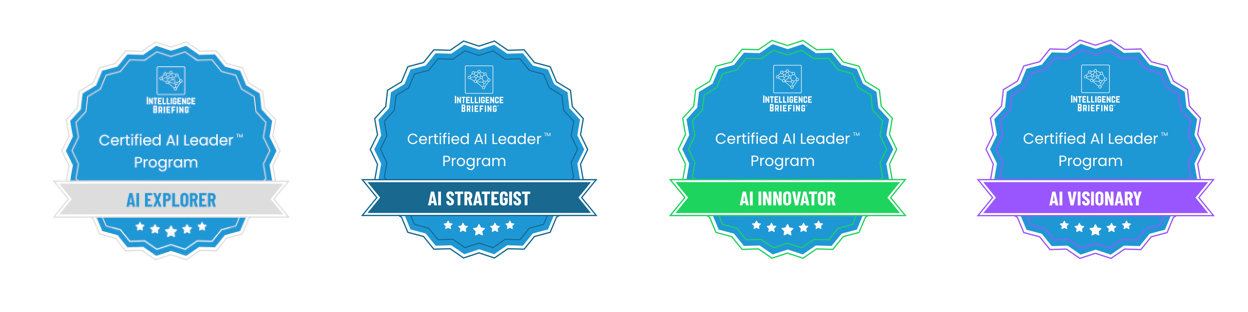
Multiple upskilling programs are available, from foundational programs that introduce the practical use of AI in everyday work to advanced, hands-on coursework that prepares you to become an AI strategist.
Our Clients Include




Become a Certified AI Leader™
Structured and engaging training coursework grounded in real-world experience and focused on the needs of your business.
Foundations:
AI Explorer
Introduces professionals to the practical use of AI in everyday work. Learn how AI is reshaping business, how to collaborate effectively with AI tools, and how to structure tasks for clearer, more consistent outputs.
More details
Advanced:
AI Strategist
Provides advanced, hands-on training for professionals who want to use AI as a strategic partner in their work. Apply advanced prompting techniques and learn to collaborate with AI assistants.
More details
Expert:
AI Innovator
Offers practical, expert-level training for professionals looking to integrate agentic AI into everyday work. Design agentic workflows and collaborate effectively with AI.
More details
Leadership:
AI Visionary
Equips leaders with practical guidance to adopt AI agents responsibly, strengthen decision-making, automate complex work, and align team usage with organizational goals.
More detailsFlexible Format
Available as four, 2-hr long sessions or two, half-day sessions.
Interactive Elements
Ensure active engagement via polls and word clouds.
Reinforce Learnings
Homework and microlearnings between modules reinforce learning and repetition.
Digital Badge & Certificate
Learners can show their proficiency upon program completion.
AI Explorer
This foundational program introduces professionals to the practical use of AI in everyday work. Participants learn how AI is reshaping business, how to collaborate effectively with AI tools, and how to structure tasks for clearer, more consistent outputs using ChatGPT.
Learners develop core prompting skills, apply AI to common workflows across functions, and explore simple no-code automations that reduce manual effort. This course also discusses and builds awareness of ethical use, bias, and responsible adoption.
Complete the program with a capstone project in which participants design their first AI-enhanced workflow tailored to their role. By the end of the course, participants can use AI confidently, productively, and responsibly across their day-to-day work.
Key Topics & Learning Objectives
Understand how AI enhances everyday work
>> Explain core AI concepts, recognize where AI can support common tasks, and identify opportunities to improve productivity.
Use AI tools effectively and responsibly
>> Apply clear prompting strategies, collaborate with AI systems to refine outputs, and follow responsible-use guidelines.
Create simple AI-driven workflows that improve efficiency
>> Design practical, repeatable workflows using AI assistants that address the needs of your job and organization.
Week 1
- Module 1: Understanding the Foundations of AI in Business.
- Understand the Foundations of AI in Business. Learn how AI is changing business and what it means for your role. Explore the differences between traditional and generative AI, understand key terminology, and identify opportunities within your business context.
- Module 2: Shifting Behaviors to Work with AI.
- Shift Behaviors to Work with AI Adjust habits, communication, and workflows to collaborate with AI. Develop the mindset necessary to work effectively alongside AI tools, including how to structure problems, provide context, and iterate efficiently.
Week 2
- Module 3: Discovering High-Value Opportunities for AI Agents.
- Prompting Like A Pro: Practice effective prompts and tool interaction strategies. Learn advanced prompting techniques, understand how to provide clear instructions, and develop strategies for consistent, high-quality AI output.
- Module 4: Applying Agentic AI Responsibly Across Business Functions.
- Learn how AI in your role applies to HR, marketing, finance, or operations tasks. Implement AI tools for common workflows in your role to enhance productivity and address department-specific challenges.
Week 3
- Module 5: Automating with Agentic AI.
- Automate with Agentic AI and explore no-code automations and multi-step agents. Learn how to create automated workflows that combine multiple AI tools, set up recurring processes, and implement time-saving systems.
- Module 6: Leading AI-Augmented Teams.
- Lead AI-Augmented teams and understand new responsibilities, risks, and best practices. Guide teams through AI adoption, establish governance frameworks, and create policies that maximize benefits while minimizing risks.
Week 4
- Module 7: Building Inclusive Governance Frameworks.
- Ethics, Bias & Responsible Use. Build awareness of bias, hallucinations, and misuse. Develop frameworks for the ethical use of AI, learn to identify and mitigate biases, and establish responsible use guidelines for your organization.
- Module 8: Capstone Project: Creating an AI-generated Explainer Video.
- Capstone Project: Automating Your First Workflow with AI. Design one AI-enhanced workflow from your job. Apply everything you’ve learned to create a practical, immediately applicable solution tailored to your role and organization.
AI Strategist
This program provides advanced, hands-on training for professionals who want to use AI as a strategic partner in their work. Participants apply advanced prompting techniques, learn to collaborate with AI assistants, and identify opportunities to streamline workflows using AI-generated insights with ChatGPT.
This course covers selecting the right tools for each task, integrating reliable research methods, and designing repeatable workflows using custom GPTs in ChatGPT. Learners practice multi-step prompting, structured reasoning, and turning insights into slide-ready content with Gamma, while applying responsible data and privacy practices.
Complete the program with a capstone project in which participants design and deliver a custom GPT tailored to a real process in their organization. By the end, participants can apply AI strategically, create reliable workflows, and produce clear, high-quality outputs that support better decisions and stronger communication.
Key Topics & Learning Objectives
Identify high-impact opportunities for AI in processes
>> Assess processes, pain points, and performance gaps across business functions, and identify AI’s potential for improvements.
Analyze how to use AI effectively in business functions
>> Distinguish which tasks benefit from AI and select appropriate tools based on the task, context, and business value.
Apply advanced prompting and workflow techniques
>> Design prompt chains, integrate generative AI into existing workflows, and adapt outputs to meet stakeholder requirements.
Week 1
- Module 1: Strengthening Prompting Skills.
- Create clear and effective prompts that support common business tasks. Explore advanced prompting patterns, including roles, constraints, structured formats, and multi-step prompts that enable more reliable output.
- Module 2: Working with AI as a Thought Partner.
- Build work habits that enable effective AI collaboration. Break tasks into manageable steps, provide helpful context, and iteratively refine outputs. Review, adapt, and version work in ChatGPT Canvas.
Week 2
- Module 3: Discovering AI Opportunities in Workflows.
- Analyze workflows and identify where AI can reduce effort or increase impact. Evaluate performance gaps, pain points, and how to discover additional opportunities by using AI assistants.
- Module 4: Selecting AI Tools and Researching Information.
- Examine how different AI tools can support your business tasks. Select the most appropriate tool for each task based on value, complexity, and responsibility, including ChatGPT web search.
Week 3
- Module 5: Accelerating Workflows with Repeatable Assistants.
- Design repeatable and reliable AI workflows. Build custom GPTs with clear instructions, reference materials, and reusable templates. Understand data privacy and security within and across teams.
- Module 6: Elevating Prompting and Presenting Information.
- Strengthen multi-step prompting and structured reasoning techniques. Integrate ChatGPT deep research to generate insights and translate structured outputs into presentation-ready content with Gamma.
Week 4
- Module 7: Ensuring Quality, Reliability, and Accuracy in AI Results.
- Apply review and validation techniques to ensure AI-generated content is accurate, complete, and aligned with organizational standards. Apply structured quality checks and cross-referencing methods.
- Module 8: Capstone Project: Automate a Common Task or Process.
- Apply the skills developed throughout the program by designing and delivering a custom GPT for a real process in your organization.
AI Innovator
This expert-level program provides practical, advanced training for professionals looking to integrate agentic AI into everyday work. Participants learn how to design agentic workflows, collaborate effectively with AI systems, and identify high-value automation opportunities across business functions.
The program covers advanced patterns for multi-agent coordination in Relay, cross-system orchestration, and multimodal communication using tools such as HeyGen, Suno, and Runway. Participants also explore responsible adoption practices, including governance, data ethics, and operational oversight.
The program concludes with a hands-on capstone project in which learners design and deliver an AI-generated explainer video showcasing a real process from their organization. By the end of the course, participants can safely and confidently use agentic AI in their work.
Key Topics & Learning Objectives
Build an agentic AI workflow to automate knowledge work
>> Identify tasks for agentic AI, configure agentic workflows, and monitor performance to ensure outcomes align with objectives.
Explore multimodal AI tools to generate video, audio, and text
>> Apply visual creation tools to enhance communication and clarity.
>> Evaluate when and how to create multimodal results responsibly.
Promote responsible AI use and peer learning at scale
>> Establish team practices that encourage experimentation, create feedback loops for learning, and model responsible use.
Week 1
- Module 1: Designing Agentic AI Workflows.
- Identify knowledge-work tasks suited for agentic AI and translate them into workflows. Explore how AI agents interpret goals, coordinate tools, and execute tasks autonomously.
- Module 2: Developing Effective Practices for Human–Agent Work.
- Build collaborative habits that help teams integrate agentic AI safely and confidently. Define goals, guardrails, constraints, and review points that ensure human oversight remains effective.
Week 2
- Module 3: Discovering High-Value Opportunities for AI Agents.
- Analyze complex processes to identify tasks that benefit from agentic autonomy. Evaluate feasibility, operational risks, and expected outcomes. Identify opportunities to combine agentic automation & human expertise.
- Module 4: Applying Agentic AI Responsibly Across Business Functions.
- Examine how agentic AI supports operations, HR, procurement, finance, customer engagement, and strategy. Learn to assess when agent-led processes add meaningful value and when human-led work remains key.
Week 3
- Module 5: Expanding Agentic Workflows Across Business Systems.
- Create advanced patterns for agentic AI, including multi-agent collaboration in Relay, tool orchestration, and decision pathways. Learn how agents coordinate across systems, handle exceptions, and adapt.
- Module 6: Working with Multimodal AI Tools for Richer Communication.
- Explore how professionals can use images to kick-start workflows and expand the communication of insights through multimodal content with AI tools such as HeyGen, Suno, and Runway.
Week 4
- Module 7: Building Inclusive Governance Frameworks.
- Design governance structures that help your organization implement agentic AI safely and responsibly. Address privacy, security, data ethics, operational oversight, and transparency.
- Module 8: Capstone Project: Creating an AI-generated Explainer Video.
- Apply the skills developed throughout the program by designing and delivering a multimodal explainer video about a real process in your organization.
AI Visionary
This course prepares leaders to empower and encourage their teams to use while maintaining high accountability and high-quality results. Participants learn how AI agents accelerate analysis, automate complex tasks, and enhance decision-making across business functions. Participants gain a structured view of AI’s capabilities, the strategic impact for their organizations, and the foundational steps to adopt AI responsibly.
Designed for business leaders navigating digital transformation, this training provides a grounded, forward-looking roadmap to use AI and AI agents to improve performance, enhance adaptability, and sustain competitive advantage without creating AI slop. Understand how proper project identification minimizes rework.
Complete this course with a capstone project in which participants develop their Team AI Charter as a framework for clear, responsible AI use. By the end, participants can encourage their teams to use AI in alignment with their company’s goals and objectives.
Key Topics & Learning Objectives
Recognize how leadership roles evolve with Agentic AI
Week 1
- Module 1: Understanding How AI Changes Leadership.
- Introduce the Dual-Lens Principle as a leadership model for balancing speed and scale with human accountability and quality when teams use AI and AI agents.
- Module 2: Defining Quality and Preventing the Slop Spiral.
- Define what high-quality AI-supported work looks like using the HUMAN Agentic AI Edge Operating Model and learn how unclear standards lead to the Slop Spiral and declining outcomes.
Week 2
- Module 3: Encouraging Responsible AI Use without Creating Rework.
- Learn how to promote transparent, responsible AI use that builds trust, avoids shadow AI practices, and reinforces clear expectations for disclosure, review, and accountability across teams.
- Module 4: Choosing the Right Work for AI Agents to Avoid Draft Debt
- Apply the HUMAN Agentic AI Edge Operating Model to decide which tasks suit AI support and how poor task selection creates Draft Debt and downstream rework.
Week 3
- Module 5: Designing Accountability with the HUMAN Agentic AI Edge Operating Model
- Use the HUMAN Agentic AI Edge Operating Model to define ownership, review points, escalation paths, and leadership responsibilities for AI-supported work at the team and organizational levels.
- Module 6: Assessing Readiness and Interrupting the Slop Spiral.
- Assess organizational readiness across skills, culture, incentives, and governance, and identify early warning signs of Slop Spiral behavior before AI use scales and quality erodes across teams.
Week 4
- Module 7: Scaling AI Use While Controlling Draft Debt and Slop.
- Learn how leaders scale AI adoption while maintaining quality, controlling Draft Debt, and reinforcing consistent standards through governance, feedback loops, and leadership behaviors.
- Module 8: Capstone Project: Creating a Team AI Charter.
- Create a Team AI Charter grounded in the Dual-Lens Principle and Operating Model that clearly defines purpose, guardrails, accountability, and quality expectations for responsible AI use.