

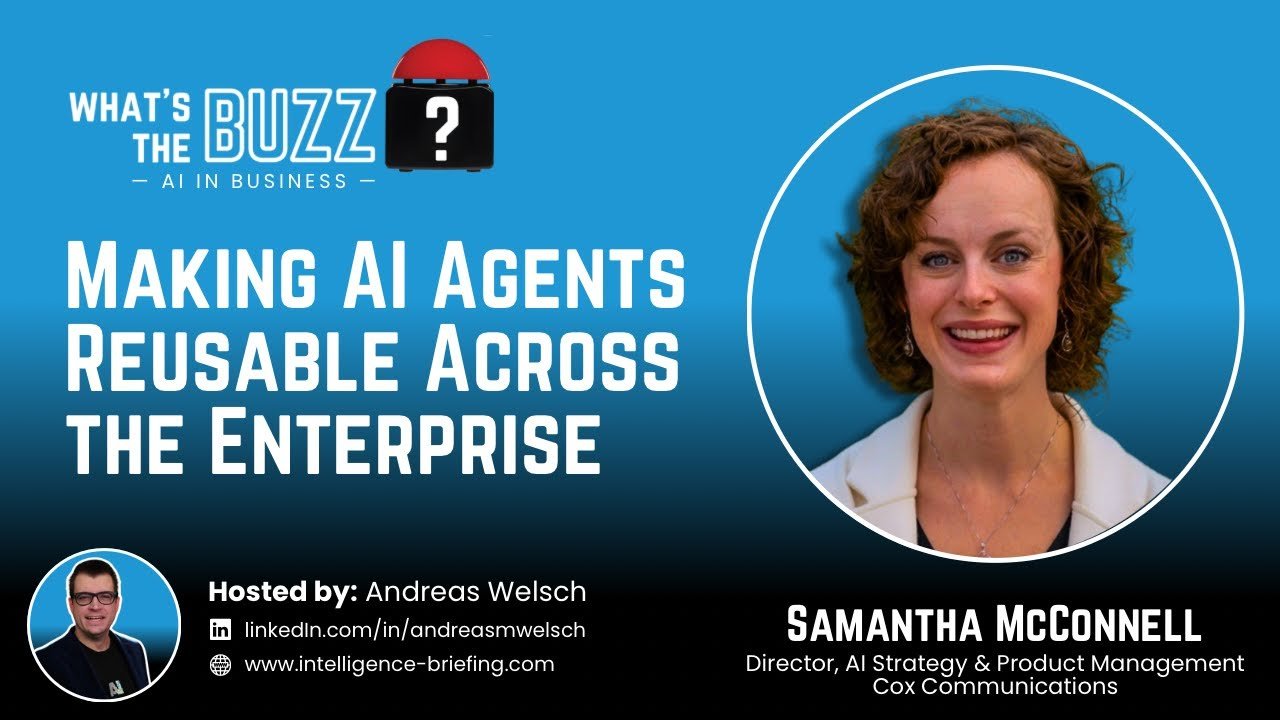
Guest: Samantha McConnell, Director of AI Strategy and Product Management at Cox Communications
Host: Andreas Welsch
Episode: What’s the BUZZ?, Season 5, Episode 2
Published: January 28, 2026
Episode Summary
How do you keep teams from rebuilding the same AI agent? Samantha McConnell, Director of AI Strategy and Product Management at Cox Communications, joins host Andreas Welsch to explain how a central registry, a cross-functional AI council and clear adoption metrics keep enterprise agents reusable.
McConnell said she thinks about agents in two buckets. Individual productivity agents benefit one person or a few, and Cox points those builders to an AI hub, an AI registry and a list of approved AI tools. Enterprise-scale agents go to an AI council that includes security, data governance and supply chain.
McConnell said the pace of agentic work changes the planning. Something can be in place in days to weeks, and her team’s assumption is that most AI agents will not see their first birthday. Leaders have to be ready to revisit what they build, and to weigh whether an off-the-shelf tool is about to arrive.
McConnell also stressed adoption and metrics. Two AI products she worked on performed as expected technically but reached only about 50% adoption at first. She advised setting appropriate success metrics before starting, and noted that if the problem is a policy or org structure problem, AI is probably not the right solution.
Key Takeaways
- Balance control and empowerment. McConnell said overly controlling the use of AI means the need goes unmet. Cox pairs a governance process for enterprise-scale agents with an approved list of tools for individual use.
- Use a registry to avoid reinventing the wheel. McConnell described an AI hub and an AI registry where people can see what peers have built. She said the registry is primarily homegrown, still in its early stages and very helpful. Enterprise-scale tools go through a strict compliance process and are logged there.
- Expect agents to be short-lived. McConnell said: “our assumption is that most AI agents will not see their first birthday.” Getting to market is faster, but teams must be comfortable revisiting what they build.
- Adoption matters as much as the technology. McConnell said two AI products performed as expected technically but were at about 50% adoption. Her team looked at users who use a product routinely, and at how often they use it versus legacy tools.
- Match success metrics to the technology. McConnell said to set appropriate success metrics before digging in. Department-specific benefits have been easy to measure, while general enterprise productivity tools are more diffuse and harder to quantify.
Timestamps
- 00:00:12 Welcome and the topic: building reusable agents
- 00:01:31 Samantha McConnell introduces herself and her role at Cox Communications
- 00:02:35 The What’s the BUZZ game begins
- 00:03:00 If AI were a plant: bamboo
- 00:03:55 How to keep developers and citizen developers from reinventing the wheel
- 00:04:46 Individual productivity agents, the AI hub and the AI registry
- 00:05:37 Governing enterprise-scale agents through an AI council
- 00:06:25 Is the agent registry built in house or bought?
- 00:08:57 Centralized, federated or decentralized: choosing an operating model
- 00:11:05 How quickly the innovation cycle for agents is moving
- 00:12:53 Build now or wait for an off-the-shelf tool
- 00:14:41 Adoption: two AI products at about 50% of the planned business case
- 00:17:00 Setting success metrics before you start, and when AI is the wrong tool
- 00:18:09 A favorite agentic AI use case and how its impact is measured
- 00:19:01 Land and expand: starting with personalized content creation
- 00:22:24 Bringing team members on board as agents do more work
- 00:24:00 Samantha McConnell’s three key takeaways
- 00:25:38 Closing thoughts on governance and the registry
About Samantha McConnell
Samantha McConnell is Director of AI Strategy and Product Management at Cox Communications, a telecommunications company. McConnell said she is part of the company’s centralized AI organization, the AI and innovation squad.
McConnell said she has been in the AI space for about a decade and launched Cox’s enterprise virtual assistant eight years ago. She now works on agentic AI, including a B2B marketing and sales effort.
Full Transcript
This is a lightly edited transcript.
Read the full transcript
Andreas Welsch: Everybody talks about agents, but very few talk about how you actually build them at scale, deploy them at scale and manage them at scale. So today we’ll talk about how to build reusable agents that you can use in your enterprise and make available to your developers and your citizen developers as well. So let’s jump right in.
Andreas Welsch: All right, welcome back for another episode of What’s the Buzz, where leaders share how they have turned AI hype into outcome. Today we’ll talk about how to build reusable AI agents that you can leverage in your enterprise. And who better to talk about it than someone who’s actually working on that, Samantha McConnell. Hey Samantha, thank you so much for joining.
Samantha McConnell: Of course, thank you for having me.
Andreas Welsch: We met in Austin at Generative AI Week in November, and we were on a panel together and had a chance to talk a little bit about what you’re doing. So I’m super excited to have you on the show today. But maybe for our guests in the audience who might not be as familiar with you yet, can you share a little bit about yourself, who you are and what you do?
Samantha McConnell: Absolutely. So, I’m Samantha McConnell. I am a director of AI strategy and product management. I am part of our centralized AI organization, the AI and innovation squad here at Cox Communications, which is a telco.
Andreas Welsch: Wonderful. Now I know you chaired Generative AI Week last year, and you’ve been in the industry for a long time. You’ve seen many things happening when it comes to data, when it comes to AI. So I’m really looking forward to our conversation today. Folks, for those of you in the audience, if you’re just joining the stream, put a comment in the chat where you’re joining us from. I’m always curious to see how global our audience is. And don’t forget, I have a new book coming up called The HUMAN Agentic AI Edge that’ll be out at the end of February. So get ready to check that out when it launches on Amazon. It’s all about how you can build and shape your next generation of AI-ready teams, when everybody says we need to do AI but there’s little guidance on how to do it well. How do you get your teams to actually use it without creating AI slop, low-quality stuff that ends up in our inboxes and clogs them? And how do you encourage your team members to do that? But all right, without talking about that too much, Samantha, should we play a little game to kick things off?
Samantha McConnell: Let’s do it.
Andreas Welsch: Okay, so in good old fashion, what’s the buzz? When I press the buzzer, the wheels will start spinning and you’ll see a sentence. I’d love for you to complete the sentence with the first thing that comes to mind, and why, in your own words. Are you ready for What’s the Buzz?
Samantha McConnell: All right. I think so.
Andreas Welsch: Okay. Here we go. So, if AI were a plant, what would it be? 60 seconds on the clock. Go.
Samantha McConnell: All right, I’m going to go with bamboo, because it is highly useful and has many different uses. It’s also really fast growing. For both of those reasons, with the rate of AI growth, the rate of AI innovation and also the many different ways AI can be used and provide value, I feel like AI is bamboo, if it were.
Andreas Welsch: Okay, I love that. Great answer.
Samantha McConnell: Lots of pandas chewing on it, too.
Andreas Welsch: So fantastic. Great segue into our topic, too. Like I said, I see so many vendors say we have AI agents you should use, here’s what we make available, you can build on our platform to your heart’s content. But I’m wondering, as more and more organizations are building agents, as more and more people in the organization are building agents, how do you even ensure that your developers and your citizen developers don’t reinvent the wheel for things that are common tasks that you can encapsulate, like you’ve been doing with modular services or with APIs?
Samantha McConnell: Yeah. So to me it’s a combination of making folks aware of what we have and also effective governance, to ensure that we’re not reinventing the wheel where it’s really important that we don’t. I tend to think about this in terms of two buckets. The first is what we call individual productivity agents. These are agents that benefit one person or maybe a couple of people. I build something for myself and maybe I share it with a friend. We have an AI hub and an AI registry, which are centralized resources for AI agents, for logging them and sharing information about them. So if I need an individual productivity tool or agent, I can go there and look at it, but it is a little bit more of an incentive-based approach in terms of not reinventing the wheel. I can go see what my peers have created. When it comes to enterprise tools, or AI agents that are going to be serving more of a production, enterprise-scale need, serving whole departments or larger user groups, there is that same making folks aware. We’re still sharing with folks what we have available, but we also have a governance process in place. Anytime a stakeholder here at Cox Communications needs a new enterprise-scale AI solution, they bring that to our AI council, which is a cross-functional governance body. My team, the AI squad, is a significant portion of it, but not all of it. It includes folks like security and data governance and supply chain and all those good folks. We get together to review those. So in that situation, there’s the incentive of we use what we already have, and then we also have a governance process in place to ensure that we’re not having a proliferation of duplicative solutions.
Andreas Welsch: That sounds interesting, especially the part about the registry and having a central piece of information, something available to know what has already been built. I haven’t seen a lot of vendors cover this specific part. To the extent that you’re able to share, is that something that you’ve built in house? Are you using a vendor solution for that? Because if we compare agents and humans, and sometimes that’s good, sometimes that’s bad, but for the sake of saying, in a business I know who’s there. I have an address book. I can call up Jane, I can call up John, and I know where in the org chart they are and what their roles are. I haven’t seen a lot of that with AI agents. So I’m curious, did you build that? Did you buy that?
Samantha McConnell: Yeah, ours is primarily homegrown to serve our particular need. It’s still in its early stages, but it’s proven very helpful.
Andreas Welsch: And how do you ensure that the list is as complete as possible, as part of the governance? Do you say you have to go through this process, and then we approve it and then your agent gets access to the network? Is it that strict or stringent, or is it like anybody can build an agent but please register them there?
Samantha McConnell: So again, it depends on the kind of agent. For the individual productivity agents, there are looser restrictions. We aspire to automatically register those on the back end, but for now those are a little bit less tracked. What is very tracked is anything that is of a bigger scale. Any of those more enterprise or production-level tools that are getting used by larger groups of people, we do have a strict compliance process, and all of those are getting logged to our registry. But I’ll also add, for the individual productivity agents, we have a list of approved AI tools. So if you’re going to innovate and build something for yourself, in those situations you have to use our approved AI tools, to ensure that we’re being compliant, secure and all those good things.
Andreas Welsch: No, that makes a lot of sense. In many of the smaller and midsize businesses that I work with, IT leaders said, we’ve opened the floodgates. We said, okay, no more wait and see, let’s now do AI. And all of a sudden, we’re getting all these requests, and I need a tool to do this, I need a tool to do that. And how do we make sure we’re not spending money in five different places for something, or on five different tools that do kind of the same thing?
Samantha McConnell: Right.
Andreas Welsch: So, something like that, right?
Samantha McConnell: And it’s a middle ground, right? When we first created my centralized AI org, which is about a year old, it was created officially at the beginning of this year. We were in the planning stages of it in Q4 last year. We considered several different operating models, from highly centralized to more federated, all the way down to a very decentralized model for AI. And we said our aspirational model is we would love to work towards decentralized, but as we learn through this, and as we get all of our best practices and appropriate guardrails in place, it’s something a little bit more in the middle. For the larger-scale implementations we are taking more of a highly governed, more centralized approach, not entirely but more so. But then also, to your point, because everybody’s got a good use case for AI, we can’t honor those thousands of perhaps smaller-scale but still worthy use cases. In those situations, we’ve decided to say, here’s our approved list, also available on our AI hub: here’s an agent builder, here’s where you go for this, here’s where you go for that. And as long as you’re using those tools within the appropriate guardrails, for those things that are geared towards a person or a couple of people, we’ve said, we’re empowering you.
Andreas Welsch: Awesome. That sounds great. It sounds like really striking the balance between innovation on one hand but also the governance and the rigor and risk management on the other side, right?
Samantha McConnell: Yes, that’s the goal.
Andreas Welsch: When we were in Austin, and also when I attend other events, I see so many vendors talk about how it’s super easy to build an agent, we’ve built a ton of them for you, we have a platform, you can build your own ones or you can extend what we’ve shipped. But I don’t really see a lot of those companies actually talk about what it means, what it takes to take the agent and put it in a business. What is the life cycle around them? How do you get people to use it? What were maybe, in your examples, some of the surprises that you ran into as you were going through that process?
Samantha McConnell: Yeah. So I think there are a number of things I can talk about here. One that always comes to mind first, when I think about AI agents that can be surprising, is just how quickly the innovation cycle is moving, even relative to other AI technologies. As you mentioned, Andreas, I’ve been in the AI space for about a decade, but it’s very different than it used to be. Even very different than it was a couple of years ago. The rate of innovation, the speed to market, the time to value is shortening. It’s getting shorter, right? Eight years ago, I launched our enterprise virtual assistant here at Cox, and it’s still in place. It probably took a couple of years to get it launched, but it’s still here in service eight years later. I launched a couple of generative AI solutions a couple of years ago with the GenAI boom, including AI-backed knowledge search, content creation and things like that. Those had a shorter development time, maybe six months or so, and they’re still in service a couple of years later, but we’re starting to look at them and say, I think we could build this better. And then with the agentic work that we’re doing now, you could have something in place in days to weeks, and get to a V1 even quicker than we’ve ever seen before. But also, our assumption is that most AI agents will not see their first birthday. So while you’re getting to market much faster and seeing return on that investment much quicker, you also have to be comfortable with overhauling, and be prepared that it’s not going to sit in service for eight years. It’s going to need to be revisited.
Andreas Welsch: Now, does it mean that you totally scrap the agent, and that there is some better tool or
Samantha McConnell: Depends.
Andreas Welsch: Off-the-shelf tool? Yeah.
Samantha McConnell: Yeah, that is something we have run into. We envision, we prioritize, we build a solution knowing that there will be an off-the-shelf thing coming, but it’s not here quite yet. And we have to take a strategic guess on when the off-the-shelf thing will be coming. You’re not going to get it right 100% of the time. Sometimes it does happen that you build the thing and then it seems like five minutes later there is an off-the-shelf solution. So that’s some mental math we’re constantly doing.
Andreas Welsch: No, I’m sure that’s not easy. That’s not easy for you as a leader. It’s probably challenging for the team. And it’s probably not easy to convey that and sell that to your leadership, that hey, we’re investing something, it takes a couple of weeks or a couple of months to build this, but by the time or shortly after we’ve shipped it, maybe there’s something else coming. But still, in that period of time, it was good for what it is. Right.
Samantha McConnell: Right. And it took maybe days or weeks to build it, not years. And that is the trade-off. So we are learning to innovate at that pace, and it’s requiring additional organizational and cultural shifts to become comfortable with that kind of approach.
Andreas Welsch: I can imagine, especially in larger organizations, where there are more processes, more red tape, more enablement and education, not just in the AI function or the IT function but in governance, risk, legal and other business functions that you work with. I’m sure there’s a lot more that goes into that.
Samantha McConnell: There’s tons. I don’t want to lose sight, though, that you also mentioned adoption. I think that’s another important thing to talk about here, and that has been really key. I have worked on two different AI products. One was AI-assisted coding, the other was that generative knowledge search. In both of those situations we launched the product, and then we did a look back at it and we said, this product is performing as expected technically. However, we’re only at about 50% adoption. So the business case that we had planned right before we created this AI product, right now we’re only on track to get about half of that. Fortunately we noticed that, we took the appropriate steps, and now we’re fully on track, and more so. But adoption is just as important as ever, if not more so, given these accelerated timelines, and that’s something really to keep in sight from the beginning.
Andreas Welsch: How do you measure adoption, if you don’t mind me asking? I know there are many different ways, from looking at users to looking at tokens and consumption and transactions. What’s working for you, or what did you decide on?
Samantha McConnell: It depends on the product. In the examples I gave you, we started looking at users initially, and users with a significant threshold of usage, not folks who had tried it once or twice but the folks who were using it routinely. That was the first one. And then we looked at how often they were using these tools versus legacy tools. We also looked at that balance to say, are they fully adopting them, or are they going back to legacy tools which they may be comfortable with but we know aren’t quite as effective.
Andreas Welsch: Right. I see. Now many organizations, many leaders are jumping on this agentic bandwagon. It seems so promising. I was talking to a CIO the other day and he said, look, all the consultancies, all the vendors whisper in my ear, whisper in my C-suite’s ear and say it’s super easy, we should build agents, and hear all the productivity gains that you’ll achieve. We see it in the news. Last year in the news, specifically, there was lots of talk about the slowdown in entry-level hiring. What are you seeing? What do organizations, what do leaders miss as they jump on the agentic AI bandwagon?
Samantha McConnell: Yeah. So I think one thing that can often be missed is establishing appropriate success metrics for your AI initiative before you dig in. And it’s not just success metrics. AI can be something really exciting and appealing that folks want to use, but if the problem you’re trying to solve is a policy problem, AI is probably not the right solution. Or if it’s really an org structure problem, AI is probably not the solution. So ensuring that the “we want to use AI” imperative doesn’t lead you to a mismatch between the technology and the result you’re expecting to get, I think that’s a really key thing to keep in mind as you’re starting your agentic AI endeavor.
Andreas Welsch: So, connect your AI strategy, connect your AI portfolio to your business strategy. What is it that we’re actually trying to drive? How do we measure if we achieve that? Right.
Samantha McConnell: Yeah. And I think at a macro level, and then also at a more granular level too, right? As you’re tackling particular processes or particular use cases, are your AI products connected to the right metrics?
Andreas Welsch: Yeah. Question for you. You’ve obviously, like I said, been working on AI products for over a decade. You’ve been actively working on agentic AI scenarios and use cases, bringing those into the enterprise. What’s your favorite agentic AI use case, and why, and how do you measure the impact of that agent?
Samantha McConnell: So I might be biased by the thing I’m currently working on, which I do love very much.
Andreas Welsch: Good.
Samantha McConnell: We are working on reimagining our B2B marketing and sales organization with agentic AI, and we have some wonderful partners in that space who came to us and said, we’re ready. We’re ready to embrace AI. We’re ready for change. What does this look like? Referring to what we talked about before in terms of rate of innovation, we said, that’s great. We love this vision, and we also need to ensure that we are tackling that scope in an appropriate way. So we’re using a land-and-expand approach. We started with personalized content creation as part of the overall marketing and sales process, worked towards our beta and V1, and then we are moving outward and moving in depth from that initial work. Because if we try to tackle everything in one big-bang approach, then we’re going to run into that issue where we get 20% done and then the world’s changed and we’re going to say, I want to build it differently now, right? So we’re taking manageable bites out of the overall scope while keeping the overall goal in mind. I mentioned content creation. That one is about increasing our efficiency in producing personalized marketing content and also making it much more personalized. Whereas previously it was much more one-size-fits-all with our B2B audience, now we’re able to use AI to make it scalable, customizing it by segment, by industry and by all kinds of different criteria, and making it much more relevant to the audience. And then from that tool, we’ve moved on towards things like brief creation and also towards selling. We’re looking at seller preparedness: what information do we give them ahead of attempting a sale? There we’re looking at seller effectiveness, seller efficiency, some of those different things. But really, we have not had challenges in terms of measuring impact or identifying impact. I think that’s generally been true for us where the AI benefit is more specific and tied to a particular department. The business case is not particularly difficult. Where it can be a little bit more challenging sometimes is with the very general enterprise productivity tools. While they’re valuable, those are the ones where I’ve sometimes had a bit more of a struggle quantifying that impact, because it’s more diffuse, you know.
Andreas Welsch: Yes.
Samantha McConnell: That’s something we’re still thinking through.
Andreas Welsch: That’s something I’m seeing too, right? Yes, it’s fine to write emails faster, or get a little coaching here or there, summarize your meeting minutes. But how do you quantify this into something you can take to your business stakeholders and say, here’s what we’re spending, here’s what we’re saving? And how much are people really saving at the end of the day? Does it really move the needle? Or, to your point, is it the departmental use cases? Is it about operational efficiency at a larger scale? Is it about engaging with your customers differently? I remember talking to the CTO of a media company in 2024. They operate a few theme parks, and he said, with the help of generative AI, we’re looking at personalizing the guest experience. You’re going to the Harry Potter theme park, all your email communication will be in that language. You’re going to the Minion park, everything will be in Minion. And obviously what’s true for consumers certainly applies to B2B as well. So great to see how you’re thinking about that. How do you bring team members on board there? When agents can do more work, more sophisticated work, now we’re able to scale, like I said, personalize by industry and by many other parameters, things that we as humans haven’t been able to do in the same amount of time or maybe with the same cost. How do you navigate some of those conversations? And maybe it’s not you personally, it’s more across the organization.
Samantha McConnell: I think where we’ve used it well, AI can be really fulfilling. Our marketing team absolutely wants to create the most personalized, customized communication possible, and it just wasn’t doable before, but they aspired to that. Using that as an example, it allows them to achieve more of their vision than they were previously able to. I think that’s fulfilling. And for many folks, even with some of the more generally used tools, it gives them the chance to take some of the administrative work off their plates, so now they’re able to focus more on whatever they were passionate about in their job. Certainly folks can have some understandable apprehensions, but generally, once folks get hands-on with the tool, if we’re launching the right AI products, they say, thank goodness that we have this now. I wish we’d had it 10 years ago, right?
Andreas Welsch: That’s awesome. That’s the kind of feedback and the kind of support that you want to drive adoption. For sure. Yeah.
Samantha McConnell: Yeah.
Andreas Welsch: Wonderful. So, maybe before we get closer to the end of the show, can I ask you what your key three takeaways are for our audience today?
Samantha McConnell: Okay, let me think through this. I think first, probably from what we talked about around not recreating the wheel, is finding the right balance between control and governance, ensuring you’re being responsible, but also empowering folks, because overly controlling use of AI means you won’t be meeting all the need. So I think finding that balance is maybe my first takeaway.
Andreas Welsch: Yeah.
Samantha McConnell: All right. I think maybe second is this idea of the increased rate of innovation. We all have these muscle memories of how we move through these kinds of technology products and projects. But in the world of agentic AI, the wheel of innovation moves more quickly than that. We can take advantage of faster time to value, but we also need to be prepared to revisit those solutions, and many won’t last as long as we’re used to.
Andreas Welsch: Yeah.
Samantha McConnell: And then I think the third thing I’ll call out is ensuring that you connect your AI products to appropriate success metrics. Not just a success metric, but ensuring that it’s something that is appropriate to the technology. So I think between those three things that covers a lot of ground.
Andreas Welsch: Cool. I love it. Very tangible. Samantha, I really appreciate the depth with which you’ve shared how you are approaching that at Cox Communications, how you’ve evolved the program, what the key initiatives are. Really, the part about governance stands out to me: on one hand fostering innovation where it’s about personal productivity, on the other hand, while still fostering it, also making sure that it is compliant and standardized. That’s great. And the learnings about building reusable components in the registry are pretty exciting too. So yeah, Samantha, thank you so much for taking the time to be with us today and share your expertise and your experience with us. Really appreciate it.
Samantha McConnell: Of course. Thank you so much for having me.
Andreas Welsch: Wonderful. Folks in the audience, thank you so much for joining, and see you next time for another episode of What’s the Buzz. Bye-bye.
Listen and Subscribe
- Watch on YouTube
- Listen on Buzzsprout (show page)
- Listen on Apple Podcasts (show page)
- Listen on Spotify (show page)
Related Reading
- Agentic AI: Scaling, Governance and Workforce Adoption
- Deploying AI Agents: A Practical Guide for Business
- Why AI Strategy Should Start With Business Goals
- Agentic AI for Enterprise Leaders
- AI Governance for Enterprise Leaders
- The HUMAN Agentic AI Edge by Andreas Welsch
Frequently Asked Questions
How do you stop teams from rebuilding the same AI agent?
McConnell said it takes a combination of making people aware of what exists and effective governance. Cox keeps an AI hub and an AI registry where people can see what peers have built. Requests for new enterprise-scale solutions go to an AI council, a cross-functional governance body, to avoid a proliferation of duplicative solutions.
How should governance differ for individual and enterprise AI agents?
McConnell said individual productivity agents have looser restrictions, though builders must use an approved list of AI tools to stay compliant and secure. Enterprise or production-level tools used by larger groups go through a strict compliance process and are all logged to the registry.
How long will an enterprise AI agent stay in service?
McConnell said the cycle is shortening. Cox’s enterprise virtual assistant has been in service for eight years, and generative AI solutions built a couple of years ago are still running. For agentic work, her team’s assumption is that most AI agents will not see their first birthday, so teams should expect to revisit them.
How do you measure AI agent adoption?
McConnell said her team looked at users who use a product routinely, not people who tried it once or twice. It also looked at how often people use the new tools compared with legacy tools, to see whether they fully adopt them or go back.
What do leaders miss when they jump on the agentic AI bandwagon?
McConnell said leaders often miss establishing appropriate success metrics before they dig in. She added that if the problem is a policy problem or an org structure problem, AI is probably not the right solution.