

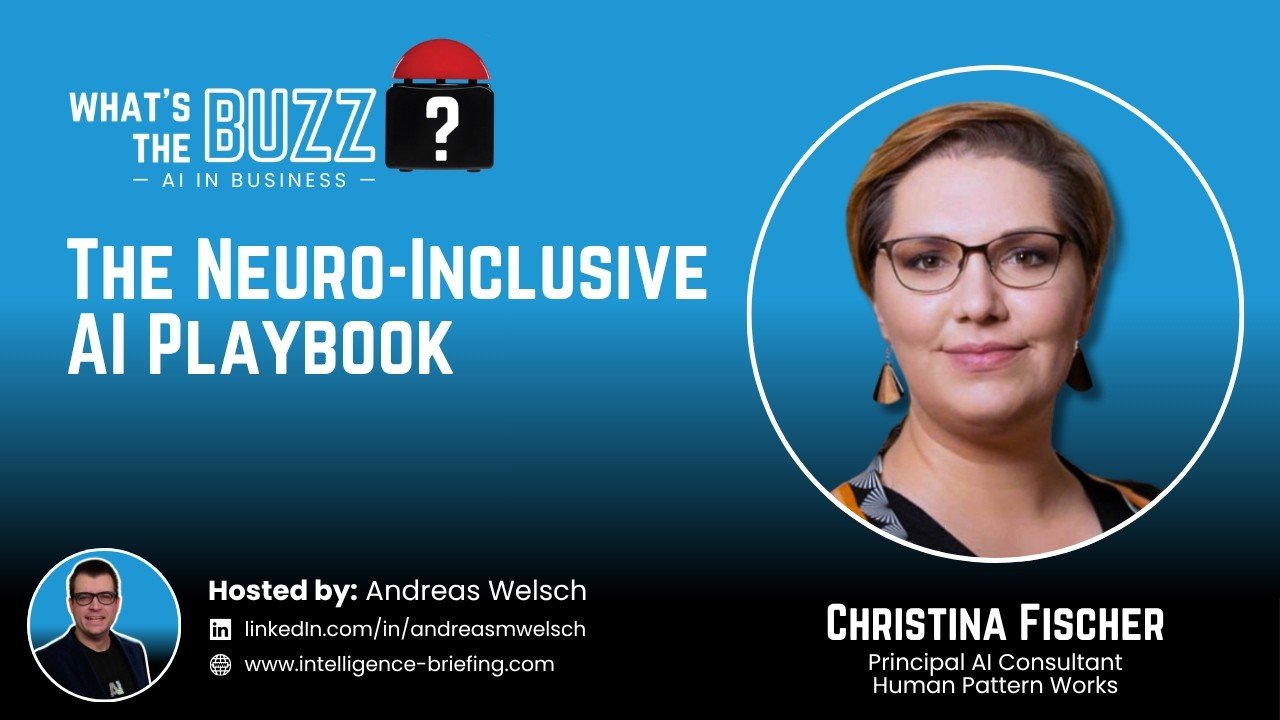
Guest: Christina Fischer, Principal AI Consultant at Human Pattern Works
Host: Andreas Welsch
Episode: What’s the BUZZ?, Season 5, Episode 18
Published: September 2, 2026
Episode Summary
AI transformation is not a technology discussion, says Christina Fischer, Principal AI Consultant at Human Pattern Works. Fischer joins host Andreas Welsch to answer what leaders miss when they push AI into their organizations.
AI touches processes, work culture, compliance and technology at the same time, Fischer argues. Fischer said large language models work toward the average, while humans are strongest at edge cases. Neurodivergent employees are often the canary in the coal mine for an organization’s working culture.
Fischer closes with a playbook. First, audit AI maturity across process, work culture, compliance and technology. Then use a bronze, silver and gold scale to decide the next step.
Key Takeaways
- AI transformation is not a technology discussion. Fischer said around 70% of AI initiatives fail worldwide because leaders do not think about them in a systemic way. Humans need to be part of the conversation, not only through top-down decisions.
- Listen to the edges. Fischer said an estimated 15 to 20% of people are neurodivergent. In Fischer’s view, the person who breaks first or speaks up first is an early-warning signal for the organization. Fischer calls that person a canary in the coal mine.
- Design feedback loops that go beyond OKRs. Fischer recommends conversations where people say how things are going and where the company is heading. They also say which ideas they can bring. Then act on what comes back.
- Trust comes before psychological safety. Fischer said logging keystrokes or hours at work measures an easy metric, not the quality of the work. Fischer expects the time of more flexibility to come back, because it helps companies retain and attract talent.
- Support middle leaders. Fischer said expectations from above and from below meet at one pressure point in the hierarchy. In Fischer’s experience, the support systems for these leaders are often weak or uneven across an organization.
- Audit before you transform. Fischer’s approach starts with an AI maturity audit across process, work culture, compliance and technology. Companies score from bronze to silver to gold across five working pillars. Fischer said gold is not always the goal. Sometimes the next step is enough.
Timestamps
- 00:00:45 Welcome and the neuroinclusive AI playbook
- 00:01:24 Christina Fischer introduces herself
- 00:02:19 Why neurodivergence gets too little attention in AI leadership
- 00:03:55 Why AI initiatives fail: it is not purely a technology issue
- 00:05:19 The human premium: creativity, empathy and critical decision making
- 00:06:12 AI works toward averages, humans handle edge cases
- 00:07:34 The faster horses quote and human innovation
- 00:09:21 Top-down leadership and why it fails
- 00:11:31 Neurodivergent employees as the canary in the coal mine
- 00:12:54 Edge cases on the bell curve and listening to them
- 00:14:16 Return to office, empathy and psychological safety
- 00:16:27 Trust, flexibility and what the pandemic showed
- 00:21:01 The transformation playbook for leaders
- 00:23:36 Support for middle and senior leaders
- 00:25:33 Step one: audit AI maturity across four dimensions
- 00:27:52 The bronze, silver and gold maturity scale
- 00:28:20 Key takeaways
About Christina Fischer
Christina Fischer is Principal AI Consultant and founder of Human Pattern Works. Fischer guides small and medium-sized companies and scale-ups through complex AI transformations. The clients are mainly in Switzerland, the DACH region and across Europe. Fischer also described more than 10 years at Siemens and earlier work in other enterprise contexts.
Full Transcript
This is a lightly edited transcript. Filler sounds, repeated words and short acknowledgements such as “yeah” and “mhm” are removed, and the wording is otherwise as spoken. Statements about companies and people in the news are reproduced as spoken and have not been independently verified.
Read the full transcript
Andreas Welsch: We’re in the second half of the year, and we keep hearing all about agentic AI and leaders pushing AI down into their organizations. Today, we’ll talk about what the number one thing is that they actually miss and how to fix that. So stick around for this one.
Andreas Welsch: Alright. Welcome back for another episode of What’s the Buzz? Where leaders share how they have turned AI hype into business outcomes. Today, we’ll talk about creating a neuroinclusive AI playbook, and we’ll talk a bit more about what that means. And who better to talk about it than someone who’s been actively working on that for quite some time, Christina Fischer. Hey, Christina. Thanks so much for joining.
Christina Fischer: Thanks for having me, Andreas. Happy to be here.
Andreas Welsch: Awesome. Hey, Christina. Maybe not everybody knows you just yet, but I hope they do know you a lot better after this episode. So for those of you that don’t know Christina yet, maybe you can share a little bit about yourself, who you are, and what you do.
Christina Fischer: Absolutely. So hi, everybody. I’m Christina Fischer. I’m a principal AI consultant at Human Pattern Works. Human Pattern Works is my own company. I founded it this year. I am a neurodivergent, female founder based in Switzerland. So neurodivergency, that’s something like, for example, autism could also be ADHD, which both of those are actually the case in my case. So what do I do as a principal AI consultant? I guide small to medium sized companies or also scale ups and other such organizations, usually in Switzerland, but can also be the DACH regions or Germany or Austria, but also across Europe. And I guide them through complex AI transformations. Because AI transformation is very often a very multilayered issue, with different challenges across very many dimensions. Like, for example, processes, work culture, compliance, or technology. So AI is not purely a technology discussion, and I think that is what I want everybody to take away from today, at the core.
Andreas Welsch: Wonderful. I’m so excited to have you on the show because I feel this topic of lived experience and especially neurodivergence is one that is not receiving enough coverage, that’s not as top of mind from any leaders, I feel. And especially when I see stories like, a couple weeks ago, Mark Zuckerberg was in the news, and he said, hey, our agentic AI initiative is behind schedule. We’ve restructured heavily because my executives and directors told me that, yes, we’re on a good path. AI can do all the work. We’ve shown 10% of the company the door because we need to restructure. We need to save cost. We’ve reallocated resources to AI topics. We’ve mandated that clicks and keystrokes be monitored so we can train AI until employees push back. Ford brought back 350 engineers over the last several months and years after they realized, hey, actually, AI isn’t able to do everything that we were promised that it could. So guess what? We still need people. What a surprise. What’s up with that? So I think that’s why it’s so important we have this conversation, and I hope that we can raise more awareness for this aspect with this episode. So, Christina, I’m curious. I mean, in your work with leaders across business, different sizes and industries, what are you seeing? Why are the Zuckerbergs and the Fords failing in these regards? And what do organizations, what do leaders do that are actually succeeding?
Christina Fischer: Well, so first of all, I think the most important aspect that we need to keep in mind when we are talking about AI, again, as I mentioned at the beginning, is it’s not purely a technology challenge. So it is quite a multifaceted issue, because it touches so many aspects of an organization. And I think that is maybe why such examples as you have named them kind of fail. And actually, around 70% of AI initiatives fail worldwide because the mindset going into such a challenge, building out how AI can enhance an organization and actually increase value, profit, productivity, whatever metric you take as a success, it kind of fails because it is not thought about in a systemic way. So you mentioned, Andreas, humans, obviously. I think the core of the issue is AI just uncovers or triggers questions around how do we work with technology as humans, what is the premium of humans in the age of AI, which, by the way, to say that loud and clear, is still there. Even, I would go so far as to say, now is more important than ever. So humans need to be part of the conversation. And I don’t just mean top-down decisions about the strategic direction in which a company should be going, but it must be a much more collaborative and inclusive conversation. And that’s also, I do believe, I mean, what are the strengths of humans in the age of AI? So we are talking here about really characteristics like creativity, empathy, critical decision making, ethical and sustainable decisions around governance, which are all very much needed for an AI conversation as well. So we are talking here about really core human traits, which we are really good at, and AI, unfortunately, isn’t. Also, AI works very much towards averages. Right? So it’s a mathematical baseline that AI is. When we are, for example, talking about large language models, they are trained on sets of data that, in essence, the more data you get as well, the more averaged out it gets. Now, of course, you have weird corners of the internet where maybe the LLM has learned some weird information. But usually the company offering LLM models wants the most generic, the most accurate information also being used by their models. Now, we humans are very good at edge cases. And I mentioned it before, being a neurodivergent person and professional myself, we are very good at thinking out of the box and also considering nuances that aren’t necessarily there from the beginning. We are good at seeing patterns, not just neurodivergent persons, people in general, humans in general. We are able to discover corners of challenges that haven’t been considered yet. And that’s exactly kind of where AI isn’t so great at, because it needs steering in that direction. Right? It also obviously needs limits. That’s a different conversation around compliance, but just this human spirit of kind of innovating new ideas and thinking about new ways to do things. Coming back to Ford, you mentioned Ford before. I think one of the nicest quotes from Ford is around, if I asked people, back before I created the first car, what they would need, they would tell me faster horses, or more horses. And they would never come up with a concept like the car. Now, however, the car is a human invention. So in this scenario, the AI system is maybe that big mass of people asking for faster horses, and the human spirit and the innovation and the motivation to improve society, the economy, and our collaboration is kind of the person that invented that car.
Andreas Welsch: That’s a good point. Right? And, I mean, when I think about AI transformation, it feels like leaders, even without any malintent, say, yes, the good ones realize we have people, we need people, and we need to manage the change. But I think then there’s another step up to say, and we actually need to recognize that not everyone is the same. If you go through leadership training, it’s one of the things that’s instilled. You have different personality types. You have different preferences of communication. Like you said, there are different abilities, or neurodivergent people as well. So how do we deal with that whole construct of individual preferences, individual needs, and so on? How are you seeing that, and how do you influence that such that AI leaders recognize, hey, yes, that’s actually something we need to think of as well? Not just the tech, not just that we need people in general, but that people are very different. They’re not this homogeneous entity.
Christina Fischer: Yes. So let me start with a really, maybe provocative sentence. So very often still, many organizations, even if they are modern and forward thinking and innovative, have some kind of leadership at the top, more or less conservative, that obviously has big responsibility and oversight for many employees and, obviously, the business’s success. So very often, the strategic decisions are made: what to invest, how to invest, what to measure. And then, even though often they say it’s in collaboration with everybody, it’s usually not. It’s top down. So it’s kind of my way or the highway. And I want to say that’s a very, very good way to fail fast and basically throw money out the window. So I propose, in the age of AI, as a general rule, to start thinking about work, about collaboration with each other, in a different way, in a much more distributed way. Right? So there are pockets of expertise and pockets of knowledge all over an organization. And I do believe this needs to be leveraged in order to make better decisions for the company, not just within those teams, but really to leverage that innovation power and human creativity across the whole organization. So that’s kind of a given. Now you mentioned, right, so everybody is kind of different, of course. And, of course, a company, especially starting at a certain size, cannot really adhere to every single person individually. That’s also clear. However, I want to propose kind of a view where neurodivergent persons often are a bit like the canary in the coal mine. So the person that has, for example, certain sensory needs or certain requirements around work adjustments or flexibility or also clarity on objectives, that will be the person who, in the worst case scenario, breaks first, in the best case scenario, speaks up first. Right? So that can be a very powerful signal and trigger for that organization to start understanding what’s going wrong. So when I say canary in the coal mine, what I mean is these voices need to be taken seriously. And obviously that doesn’t happen of its own, but one can design feedback loops or certain conversations within your organization that go beyond, let’s say, OKRs and the next fiscal year profits, but actually come together where human people can exchange how it is, are things going, where’s the direction of my company or my department going, what ideas can I bring up and bring in. And it is a mind shift change first and foremost. It doesn’t have anything to do with AI transformation at first glance, but it’s about fostering a better working culture for everybody. And the idea is these edge cases, I call them edge cases, but in essence, if you’re thinking kind of of the bell curve, right, of normalization, everybody is somewhere on that bell curve. And many of us, well, actually, 15 to 20% is the estimate, are neurodivergent edge cases on both sides of the spectrum, and everybody else is kind of distributed across the middle, more or less. So listening to those edge cases can be a powerful way to spot challenges, especially around change fatigue, around people also being just frustrated with the way that they are or are not included in conversations where the company is going, where the department is going. So that’s why I propose: listen, honestly, have an actual interest in what your organization is saying. Try to foster a conversation there and feedback loops. Don’t close your ears to what the employees are saying, but make an effort to listen in and to have honest conversations with people that are from the business. And don’t push top down all your decisions, but try to kind of validate them with your baseline. And that’s not just your clients. That’s your human premium in the organization. That’s your employees.
Andreas Welsch: Now there’s so many great points in what you just shared. Let me see. For me, it comes back to doing the opposite of what we’re seeing in the news and what captures the headlines and what keeps capturing mind share, at least amongst leaders, from what I can see. We have a lot of leaders, and let’s go back to the end of the pandemic or maybe even during the pandemic, that said, hey, you can work from anywhere. It doesn’t matter where you are. As long as you can log in, you do your work, I’m perfectly fine. The pandemic ended. We said, well, now we have all this real estate sitting there, and we actually don’t really know what our people are doing when they’re at home. Are they watching Netflix? Are they babysitting? Are they working on a second or a third job? We need people back in the office. And not just occasionally, but at least three or four days a week. Guess what? Now we have AI, so you better adapt or you leave. And it seems to get a much, much tenser climate and a lot more top down, my way or the highway, like you said. So for me, it comes back to actually, especially middle and first level leaders, they are the ones that need to lead with a lot more empathy. They are the ones that need to pay a lot more attention and listen a lot more closely, and that’s where a lot of the psychological safety happens that’s being created. So people feel welcome, feel included, feel able to speak up and voice their concerns or bring in their ideas, because guess what? I do have a manager that truly cares. And, yes, there are some corporate objectives that we need to achieve, and we need to achieve them together. But between here are the objectives and pushing it down and contextualizing what does it mean, that’s, I think, part of this harder task of leadership that we still need to do and that we’ve had to do for a long time, but we’re seeing not always the best examples out there.
Christina Fischer: Yeah. That’s true. I mean, ultimately, you mentioned a few hard facts. Right? We paid for certain buildings. Now they have to be filled to be able to write them off with taxes. But besides that, I mean, that’s, of course, a valid point for a business. But what I sketched out before, right, it comes down to trust. And I think we need to start trusting people again to be self-motivated, to be interested in bringing either their own company or the company that they’re working for forward. And psychological safety comes from that place of trust. Right? It comes with the trust that you, as an employee, are able to structure your day. It comes down to not logging your keystrokes, or not, I mean, quite honestly, not even logging your hours spent at work, because, let’s be honest, the productivity metric of how many hours you spend at work isn’t really about the quality of the work. It’s simply a very, well, easy metric to gather. But that’s kind of my point. Right? Coming back to, or not coming back, but the pandemic showed us it is possible. However, companies had to invest in good digital tool sets that allow their companies to collaborate in a virtual environment. And I think a lot of people also learned that in actual fact, some of the work is best done if they have the quiet, for example, of their home office. Or, I don’t know, some people, for example, prefer to work in a library or in a cafe. More power to them. I never could, because it would completely derail me, all the sensory input that’s going on. So I definitely need the quiet of my own home office for it. But, you know, that’s the point. Everybody works best in different ways. And the pandemic showed that it is quite possible to allow that, to allow a certain flexibility and still actually to foster a certain company culture. And I think, as always, right, these waves usually come in waves. There was a time of more flexibility. Now it’s more restrictive. I honestly believe that the time of more flexibility will come back, because that’s also the way that you retain and attract talent. And, again, coming back to human premium, it will become more and more important, especially in the age of AI and agentic AI. You need domain experts. You need architecture experts. You need people who understand the context and can sketch out what the big picture looks like, sketch out those compliance rules and governance systems. Right? So you will need people more and more for very highly specialized roles. And you, as a company, I don’t think it will work for much longer to only look at the fiscal side of the AI equation and the technical side of the AI equation. I think long term, companies that want to be successful need to also additionally look at those more qualitative aspects of work culture, of trust in their employees, of fostering digital conversations that work with different types of people, different personality types, and allowing, again, more flexibility. Because, ultimately, our work as humans will become more complex, much more like a network of different roles and different activities. And that does mean a lot of effort needs to be put into managing that. It cannot succeed if we, as humans, are constantly pulled down by bureaucracy, mistrust, or a lack of freedom in how we work. I think that’s the easiest thing to allow your employees to control themselves.
Andreas Welsch: Absolutely. And, I mean, it goes onto my long list of things you should be doing but that are a lot harder to actually do day to day than they sound. You mentioned some at the beginning of this episode as well. We have leadership leading by example, creating psychological safety, creating the spaces for the conversations. But, you know, it’s not just a long list of things. It sounds like there’s a whole playbook, obviously a whole transformation playbook, that the leaders should be following if they want to succeed with their transformation and make sure that they bring their people along as individuals as they are. What does that look like, and what are you seeing there?
Christina Fischer: So first and foremost, maybe, you know, what I said so far, it sounded like there’s kind of us and them, in a sense. Hopefully not. Us, the employees, or us, the humans, and then those executives and leaders and company heads that have no idea and that don’t trust their employees. Ultimately, that narrative is completely wrong. Right? So we, as humans, are all in common systems. The system could be an organization that you work for, that could be your sport club, that could be your private friend group. We are all living in systems, and I think the very first thing to recognize is we are all humans. So fostering that empathy towards each other, and also understanding that systems work according to certain rules. Even the most complex issue can be broken down into understandable chunks. And if you tackle those chunks or blocks one by one, or parallelize them as well, but once you describe it, a challenge can be understood, can be sliced, can be tackled. It can be in a modular way or iterative way. So agile kind of type of working, of course, lends itself to the new world a lot. But it is doable, as long as we have trust and empathy and the psychological safety to go for it. And in that group of humans, I do include leaders as well, because what I often saw in an enterprise context, to be quite honest, is that on a micro level, within teams, that kind of collaboration and also conversation usually works quite well. But at some point, up the hierarchy, it breaks, because somewhere you have that pressure point where most of the expectations from even higher up and the expectations from the bottom aggregate and usually break the system. And especially these leaders, you mentioned middle management, maybe even senior management, depending on the size of a company, you have even more layers. These are humans as well, first and foremost, that need support. So the playbook that I worked out, because of my experience, 20, no, sorry, 10 years working at Siemens and before also in other enterprise contexts, I saw that especially those people, especially those leaders that are those breaking points, they need support in how to manage being an employee in essence themselves and having to deliver value on the one side, and at the same time also be people managers. Right? People leaders, that are responsible for groups of people, are responsible for how they work and what the communication looks like and how the communication flows as well from one end of the company to the other. So often, in the last few years, I saw that the support systems for especially these leaders is not very good, or not quite the same quality across the organization. So it’s very much up to, again, who’s the manager of those leaders. Is that a person who’s empathic or not? So what I propose is, no leader can go it on their own. Support is needed. Everybody needs support. And especially now that the challenges and solutions become more and more complex, and much more also unclear, let’s say. We don’t necessarily have any more yes and no answers. We have yes, no, maybe, in that case this, in that case that. And with AI, all of this is just accelerated. So now that we are living in more and more complex times, my neurodivergent playbook really helps steer the as-is situation of any company to a much more clear, structured approach to transformation. So coming back to my initial issue, or to my company’s core value, to bring other companies up to speed, in a sense, in their maturity across those different dimensions, my first step is to evaluate. So we need to understand where is a company at. Could be a company or a business unit, or it could be a small to medium company, scale up. In essence, the context is not that important. It’s okay. What is the scope of what we are looking at? Let’s say it’s a small company. So let’s start with that. Evaluate and audit their AI maturity first across the four categories of my rating system, as I’ve built it up, which is process, work culture, compliance, and technology. Look at where they are. An organization could basically have full points in one of those but not in the others. Or it’s much more balanced across all four. Or maybe three or two are great, but then the other ones are kind of a blind spot. So it’s also extremely individual, not just for people, how we work best, but also organizations. Right? And that’s the first step: audit that, see where we are at, and then together, I can define with them basically where do they want to get to. Right? So let’s say they are full of unmined potential. So potentially that means they have great talent but don’t really support them. They might have maybe some patterns or product ideas that are just lying around but haven’t been named or externalized. They are maybe in the heads of people, or they are within data that’s lying around and not used. That type of unmined potential needs to be made visible through understanding where a company is already at. And then, of course, the idea is I have the scale kind of from bronze, silver to gold across those four dimensions, where you can then see, okay, what types of activities are needed per category on five different working pillars to reach, for example, gold. Or, I mean, gold doesn’t always have to be the goal. Sometimes it’s just about going to that next step or improving your compliance, or it might be completely different depending on what organization I’m working with.
Andreas Welsch: Wonderful. Now, Christina, we’re getting close to the end of the show, and the key topics that I heard, and the key themes that I hope you and the audience take away from our conversation today, are this. If you’re a leader, this is the time to lead, to really show up for your people. It’s not just about pushing down whatever your senior leaders and executives are giving you. You need to step up. You need to be a lot more involved in managing, not just managing, but in actually leading your teams, your organizations. Pay close attention. Listen to what your team members are saying. And the hardest part is creating that space and psychological safety so your team members feel comfortable speaking up, and you will be surprised what you hear. It will not always be something that you want to hear, but you learn a lot. And you are now in a position as a leader to bring this forward and make sure that you create this inclusive culture, especially around AI and transformation when things are so uncertain. We’re all humans was the other part that I heard. So understanding that, yes, it’s a normal distribution, and some are in the middle, some are on the edges, is important to inform those decisions as well. And there’s a playbook out there. So connect with Christina to learn more about that, for sure. Christina, it was a pleasure having you on today. I learned so much, and again, I hope for those of you in the audience, you did too, and I’m looking forward to seeing everyone for the next episode of What’s the Buzz? Thanks, Christina.
Christina Fischer: Thanks, Andreas, for having me. It was lovely to talk.
Andreas Welsch: Thanks. Bye-bye.
Christina Fischer: Bye.
Listen and Subscribe
- Watch on YouTube
- Listen on Buzzsprout (show page)
- Listen on Apple Podcasts (show page)
- Listen on Spotify (show page)
Related Reading
- AI Leadership for Enterprise Leaders
- How Executives Boost Human Potential With AI
- How Leaders Prevent AI Workslop and Protect Quality
- Agentic AI for Enterprise Leaders
- The HUMAN Agentic AI Edge by Andreas Welsch
Frequently Asked Questions
Why do AI initiatives fail, according to Christina Fischer?
Fischer said around 70% of AI initiatives fail worldwide because the mindset going in is not systemic. AI touches processes, work culture, compliance and technology at the same time. Leaders cannot treat it as a purely technology discussion. Humans need to be part of the conversation.
What does canary in the coal mine mean for neurodivergent employees?
It names the person who breaks first or speaks up first. Fischer used the term for an employee with, for example, sensory needs. It also covers needs around work adjustments, flexibility or clarity on objectives. In the worst case, that person breaks first. In the best case, that person speaks up first, which can be a powerful signal for the organization. Fischer cited an estimate that 15 to 20% of people are neurodivergent.
How can leaders support middle and first-level managers during AI transformation?
Give these managers support, because no leader can go it alone. Fischer said expectations from higher up and from the bottom meet at these managers. Host Andreas Welsch added that middle and first-level leaders need to lead with more empathy and listen more closely. That is where psychological safety is created.
What does Fischer’s neuro-inclusive playbook involve?
The playbook starts with an audit of AI maturity across four categories: process, work culture, compliance and technology. Fischer then defines with the company where it wants to get to. The scale runs from bronze to silver to gold across five working pillars. Gold does not always have to be the goal.
Why does Fischer say AI works toward averages?
Fischer says large language models are trained on sets of data, and more data makes the output more averaged out. In Fischer’s view, humans are good at edge cases, nuances and patterns nobody has considered yet. AI needs steering in that direction and needs limits.