

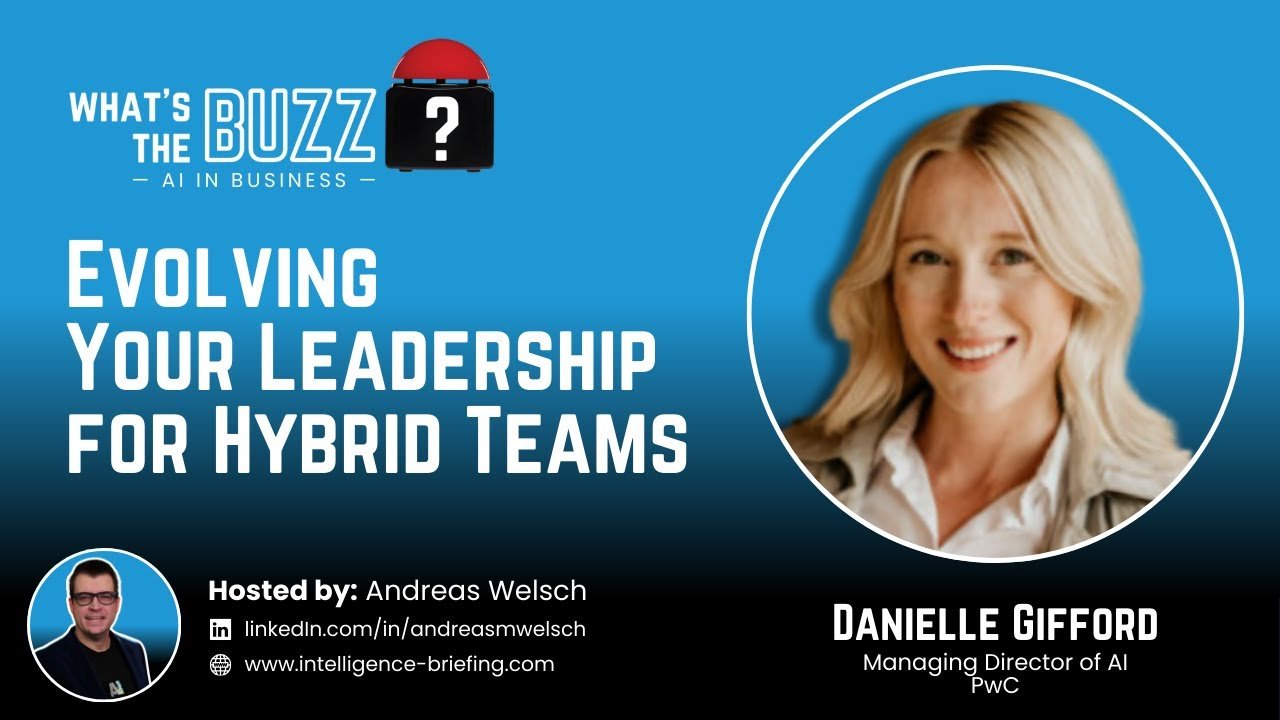
Guest: Danielle Gifford, Managing Director of AI at PwC
Host: Andreas Welsch
Episode: What’s the BUZZ?, Season 4, Episode 24
Published: October 7, 2025
Episode Summary
Danielle Gifford, Managing Director of AI at PwC, joins Andreas Welsch to answer how leaders should evolve their leadership for hybrid teams of people and AI agents. She describes how Canadian enterprises are moving from interest in agents to pilots, with little full deployment so far. Danielle and Andreas discuss why delegating to an agent calls for the same clarity on goals, context, tools and evaluation that a leader owes a human colleague, and why agents are more than another form of automation. She closes with what she teaches MBA students about AI and her three takeaways for leaders.
Key Takeaways
- Danielle says leaders should start with the business problem and treat technology second, because the visible issue is not always the root cause.
- She describes agents as goal-based and context-aware, working within boundaries and with some autonomy, which sets them apart from rule-based automation that follows a predefined script.
- Danielle expects agents to force teams to define role boundaries, objectives, tasks and how work is evaluated, which she says will lead to business redesign.
- Andreas notes that delegating to an agent needs the same four things as delegating to a person: the goal, the context, the tools and data, and a way to judge whether the outcome is good.
- Danielle says Canadian enterprises are risk aware, and she encourages them to move from piloting to implementing AI and agents in their businesses.
Timestamps
- 00:24 Cold open on leadership with agentic AI
- 00:40 Welcome and episode theme
- 01:11 Danielle on her PwC and teaching roles
- 03:03 Icebreaker game: What’s the BUZZ?
- 03:34 If AI were a color: Danielle’s answer
- 05:30 State of AI hype and adoption in Canada
- 08:11 Where agentic AI stands on the hype cycle
- 11:58 How leaders should think about agents
- 13:19 Digital coworkers and human plus agent teams
- 19:22 Are agents just another form of automation?
- 21:49 Multi-agent collaboration and critical evaluation
- 23:42 Teaching MBA students about AI
- 27:13 Canadian AI regulation and literacy signals
- 29:06 Key takeaways
- 30:45 Thanks and wrap-up
About Danielle Gifford
Danielle Gifford is Managing Director of AI at PwC. In the episode she describes her role as covering PwC’s AI solutions and products, from strategy and governance to literacy and building and deploying models, and co-leading its emerging solutions. She also teaches an applied AI and business course in the MBA program at the University of Calgary.
Full Transcript
Read the full transcript
Andreas Welsch: Today we’ll talk about how to evolve your leadership with agentic AI, and who better to talk about it than someone who’s actively working on that: Danielle Gifford. Hey, Danielle. Thank you so much for joining.
Danielle Gifford: Awesome. Thank you so much for having me here this morning.
Andreas Welsch: Great. Why don’t you tell us a little bit about yourself, who you are and what you do.
Danielle Gifford: Okay, sounds good. My name is Danielle Gifford. I am currently a Managing Director at PwC of AI, and I would say my role really focuses on two different things.
Danielle Gifford: One is our solutions and our products and what we’re actually offering in markets. So everything from strategy to governance, to literacy, to actually building and deploying models, from traditional AI (it still feels funny to say traditional AI) to generative AI to agents. And then the other part of it is co-leading our emerging solutions.
Danielle Gifford: As I’m sure you’re well aware of the way that we do work, there’s just a better way for cloud migrations, application migrations, data migrations, their traditional line by line code transformation. There’s tools that can support us in that. Those are the two hats that I wear at PwC.
Danielle Gifford: I also teach on the side at the University of Calgary, so I am a professor in their MBA course teaching an applied AI and business course. So helping business students actually understand what is and what isn’t AI, how to critically evaluate it, and then how to actually look at scoping a use case.
Andreas Welsch: That’s awesome. We talked a little bit about that before going live, so let’s make sure we talk about that here on the air as well, because I think it’s incredibly important to also prepare the next generation of leaders for this transformational time that we’re in, and have an idea for what’s ahead and how we can lead that successfully.
Andreas Welsch: Absolutely. So awesome, folks. If you’re just joining the stream, drop a comment in the chat where you’re joining us from. I’m always curious to see how global our audience is. And also don’t forget to get your copy of the AI Leadership Handbook so you can learn how to turn technology hype into business outcomes. And what do you say? Should we play a little game to kick things off in good fashion?
Danielle Gifford: Yes. I love a little game.
Andreas Welsch: All right, so you’ll see the sentence here when I hit the buzzer. You’ll also see the surprise word, and I would love for you to answer with the first thing that comes to mind. You’ll have 60 seconds for your answer. And for those of you watching us live, drop your answer in the chat and why as well. Are you ready for What’s the BUZZ?
Danielle Gifford: Yeah, I’m a little nervous and anxious, but I’m ready.
Andreas Welsch: I’m sure you’ll do just fine. So let’s do this. If AI were a color, what would it be? 60 seconds on the clock. Go.
Danielle Gifford: Okay. Interesting. There’s green, there’s the primary colors. I feel like my mind immediately goes to yellow just because that is my favorite color. The reason I would say yellow is it’s energetic. It brings light to things, I would say, and being able to actually search and find and summarize, and it has, most of the time, a very good outcome.
Danielle Gifford: But then the other thing with yellow, if you think about stoplights, is it’s a little bit of a sign of caution. Although it has this enthusiasm and lightness and energy, there’s also a bit of caution towards how you’re using it, when you’re using it and what the actual application is. So final answer is yellow.
Andreas Welsch: That’s awesome. I love it. I was a little concerned you might say. It’s the association. But let’s hope we don’t get to that part. So really good to see the positivity and the optimism, and the sun is yellow, so it gives us some warmth and energy like you said. I’m trying to figure out how to make a good transition to our topics, because it seems a little abrupt with all that energy that we see in the market and all that yellowness.
Andreas Welsch: What do you see from where you are? You’re working in Canada, you’re working with a lot of large companies and brands across different industries. You have a front row seat at what’s happening, what people are actually doing. What are you seeing as the state of AI hype and adoption, and where are companies on their path?
Danielle Gifford: Absolutely. I feel like it’s a really good question in terms of what are we hearing, the actual noise that’s in the system, versus what’s actually happening. I would say from a practical perspective, what we’re seeing in Canada is companies starting to really push forward into the adoption of not only AI and generative AI but also agents, which is something that’s really exciting.
Danielle Gifford: For anyone that’s listening, Canadians are good, they’re kind, they’re humble, but they’re often a little bit risk aware. So when it comes to the adoption of new technologies, we’re not always the first to hop on the bandwagon. What I’m starting to see in companies is not just the original approach of let’s make sure that we have our data properly in the right systems and it’s cleansed and we can do the analytics on it. That’s obviously one key part of the conversation, but it’s actually where are the opportunities for us to leverage and look at agentic AI or generative AI within our offices, both from a back office perspective and from a front office perspective.
Danielle Gifford: This is the first time that I’ve started to see that real shift, especially having been in the AI space for the last six to seven years. We had the hype of AI and then we went through the AI winter, and then ChatGPT launched on the scene in November of 2022. Now all of a sudden it’s not just something that’s a buzzword, or people are looking at it and just being like, oh, I’ll get to it. It’s actually something that’s serious that’s on the agenda, that executives have put budget towards. And they’re putting the guardrails around it to start to pilot and then move into deployment with the opportunities that make the most sense for their organizations.
Danielle Gifford: A very long-winded way to say, from a Canadian perspective, we’re starting to see a lot of movement, not just from the top level but throughout the organization, and then the actual adoption of it into some of the systems and processes.
Andreas Welsch: That makes me curious. First of all, I fully empathize with risk aware, coming from Germany. A lot of times it’s even risk averse, the next step up on that scale. From my perception, generative AI has become a lot more mature, whether you read the reports and it’s the trough of disillusionment, or the realization that things aren’t as easy and aren’t as simple as we initially thought. We’ve gone through this before in other hype cycles. It seems that agentic AI is now coming up that slope, and organizations are trying to figure out what to do with this.
Andreas Welsch: How are you seeing this play out in Canada? Are there proofs of concept being spun up? Is it piloting, is it putting things into production? Are there specific areas of business where you see companies looking at this more seriously than others?
Danielle Gifford: One of the things I would say on that topic is you mentioned generative AI is a little bit more commonplace now. I remember reading a report from Gartner, as of May of 2025, that about a thousand different vendors or platforms, like the Workdays, the Salesforces, the SAPs, have introduced some form of generative AI into their products. That means it’s going to be here regardless of if you want it or not, because the applications are getting turned on in the systems that you’re using every day.
Danielle Gifford: Now we’re starting to see the same sort of trend with agents, where a lot of companies and platforms are starting to look at building out the correct systems and infrastructure to actually support agents. One of the unique things, and I think we’ll get to this a little bit later, is everyone thinks that it’s just easy to drop in an agent. They’re like, oh, I have an agent, I’m going to give it a goal, and it’s going to get me to that goal in simple form, and I’m going to save money, I’m going to save time, and I’m going to save manpower. But it’s not as easy as it seems. It’s not that simple.
Danielle Gifford: When you’re thinking about agents, very much like you think of self-driving cars, you still need the infrastructure and the rules and the logic and the guardrails around it. If we think about Waymo, the way that it works today, you have all of the roads and the streets, and you have the logic around stop signs or stop lights in terms of what to do. So you know and understand what’s there. With agents, you still have to set up some of that infrastructure in order for them to be effective, in order for them to work well, and in order for you to have the right guardrails, controls and processes around them within your systems.
Danielle Gifford: I know that Microsoft has started to see, and they’ve posted this, some early gains within their business, specifically within Copilot. I think they were saying that agents have supported something like 9.4, 9.5% higher revenue per seller, and the ability to customize some of the products and what they’re actually doing. So we are starting to see some of that from an agent side.
Danielle Gifford: I will say, at least from a Canadian perspective, we do see companies that are pushing towards agents and that want to do proofs of concept and pilot them, but we haven’t seen as much in terms of that actual full deployment, unless you’re looking at a company like Cohere, which is a really famous company here in Canada that builds foundation models. Enterprises, both public and private, are playing around with it, but they’re still getting to crossing the chasm, I would say, of actually bringing them into deployment. So it’s good momentum and it’s good trajectory, but it’s really about when you make that leap to actually seeing the impact in your systems.
Andreas Welsch: That makes perfect sense, given where the industry is and where the technology is. What you mentioned, building the guardrails, building the infrastructure around it in your organization, maybe between organizations, it seems that we’re really at this early moment where we’re seeing this potential and we’re able to prove it in certain scenarios, but there’s so much more to be done to really capitalize on it.
Andreas Welsch: I’m wondering how you see leaders viewing this topic. What’s the right way to think about it, knowing that there is so much hype and so much push, but also so much more to do?
Danielle Gifford: I don’t know if there ever is a right or wrong way to think about agents, to think about technology, but I always do think that it goes back to what is the problem that you are trying to solve for. Similar to what we were talking about before, not all leaders, but leaders that maybe aren’t as technical think that it’s as simple as just dropping an agent in and then it will do what you need it to do.
Danielle Gifford: What it means for businesses is that you need to take a look at your processes, the people that you have, the systems that you’re working with, and almost do process mapping to understand all of the intricacies within that. Where are the high value areas where a single agent, or an orchestration of agents working together, could provide the most impact? That’s where I’m seeing leaders see a little bit of a miss between the hype and where the power of agents can be.
Danielle Gifford: The other thing, which is unique, and I’m sure that you’ve heard it a lot and I’d love to get your take on it, is this whole notion of now we’re going to have digital coworkers. What does that actually mean? Even if we think about workforce transformation, learning and development, human resources. When you’re working side by side with an agent, what does that mean for you? How do you have that collaboration or cooperation between what a human is doing and what an agent is doing, and where do you come together as human plus agent? I’m curious if you’ve had conversations around that digital coworker, and how do you actually manage that?
Andreas Welsch: Great point. I actually created two courses with LinkedIn Learning on that topic, of how you bring AI into your organization when it becomes a coworker. So a little plug and a recommendation to take a look at those. But we see a lot of times people and vendors comparing AI to humans. I’ve seen this term, AI employee, come up lately. To me, that’s such a misnomer and a mislabeling and miscategorizing of what these tools are at the end of the day. They are tools. They have access to information. They’re built into software you use every day, but they’re not a replacement for or equivalent to your human colleague at the next desk over in the office, across from you. So I think we need to be careful how we refer to them in general, to raise the right expectations.
Andreas Welsch: On the other hand, and that’s where I’m a little conflicted myself, if you look at how work is done in a business, we see many parallels that we can now apply to agents as well. There are guidelines, there are codes of conduct, there are standard operating procedures. How do we divide work, and what couldn’t we apply to agents? Especially the part of the collaboration is so important: when do you hand something over, what do you ask, what information do you need to give?
Andreas Welsch: As a leader yourself, I’m sure you’ve gone through some kind of leadership training. I was fortunate to do that earlier in my career. There are some basics about how we delegate tasks to another person that we want to work with, or that’s part of our team. It’s usually about what is the goal that I want you to achieve? What is the context in which you work? Are there tools? Is there additional data to work with, other people or other resources to use? And the last one, which is the most important one for me, is how do you evaluate if the outcome is actually good?
Andreas Welsch: A lot of times you say, that isn’t good enough. Or if you’re an employee and you manage this, that isn’t good enough. You say why is it not good enough? Oh, I don’t know, but do it again. I feel we’re seeing a lot of that now with AI, with us as individual users almost becoming leaders. So we need to be clear on those things. But it’s really this division of labor, to come back to that point: where can I delegate something safely, where I know that I won’t be compromising quality?
Danielle Gifford: Absolutely.
Andreas Welsch: And I won’t be compromising accountability, which is still emerging.
Danielle Gifford: On that point, it almost goes back to the basics of workforce design. What are the role boundaries, like you were saying, what are the objectives, what are the tasks? And if we are going to have these hybrid human and AI teams, what does that really mean? I’ll go out on a little bit of a ledge here, but a lot of companies don’t have great processes in place. Everything that you named in terms of context, structure, what tools, what are the boundaries, how are you evaluated: that’s not cut and clear in a lot of places. I think what agents are doing is actually forcing teams and leadership to focus on what those boundaries are and what that looks like.
Danielle Gifford: As companies and organizations start to implement agents or look at agentic AI, whether it be a solo agent or an orchestration, I think they’ll see a lot of business redesign. That will allow them to have a lot more value in what they’re doing, because the way that things are done today isn’t always necessarily the best way, but no one can point to what it is or how it’s evaluated or who does what. It’s always kind of living in people’s heads. So how do you get that information out of people’s heads or out of systems to support those hybrid workers?
Andreas Welsch: I think that’s an excellent point, because a lot of these processes and systems, especially the ones that your business runs on, were designed 20, 25 years ago, maybe 15 if you’re a little more modern, or if you first moved to the cloud or something like that, if you are more on the leading edge. But it’s not the case that you can reconfigure these things so easily.
Andreas Welsch: One thing that comes to mind is workforce design. Depending on the size of the company and the industry that you’re in, you might be going through this process every 18 to 24 months. Reorganization, change: the world has changed outside, we need to change too, we need to adapt. I’m not seeing a lot of conversation about how your agents need to adapt. Yes, there are still finance tasks and HR tasks, but once you get more towards go to market, more towards sales, more towards the consulting side, how are things going to change in the business on the customer-facing side, and how will you be able to adapt that? I think that’s probably the next frontier that we’ll talk about soon, once agents have become the norm in business.
Danielle Gifford: Yeah, absolutely.
Andreas Welsch: Which also reminds me, a couple of months ago I was having a conversation with a former colleague of mine, and we were talking about this concept of agents. I said, I think business is really changing fundamentally, and leadership is changing, and leaders need to work differently with their teams. And my former colleague said, no, I don’t think so. It’s just another kind of automation. You’re just automating a process. You used to do it with rules, you used to do it with robotic process automation, maybe a little bit of machine learning. Now you do it with agents. What’s the big deal? I’m wondering where you stand on that.
Danielle Gifford: It’s an interesting conversation and I can see the different points of it, especially if you are a technologist. My fiancé has been in software engineering for a number of years and now works at another company where they’re leveraging generative AI and agents for cybersecurity. At a very simple level, maybe it is automation. But if we go back to what is automation, it’s rule-based. It’s logic. It’s a predefined script. If X happens, do Y. If the temperature drops (in Calgary, it’s very cold) below X degrees, turn on the heat.
Danielle Gifford: Agents are different. They’re goal-based, they have context, they have objects that they interact with, they have boundaries. And just because they come up against a hurdle doesn’t mean that they can’t go around it. That’s where the intelligence comes into play as an agent. Very similar to reasoning models, to an extent, it’s thinking through what is the best way to solve this problem, what information do I need, what do I have access to, and what is my level of autonomy or authority to act on that action?
Danielle Gifford: That’s where I would say there is a big discrepancy between what automation is and what agents are. You have that flexibility, and then you have almost not a lack of supervision, but for models that are a little bit more advanced, you don’t have the same supervision you would over automation, where if the script breaks you figure out a way to fix it. There’s a very different set of instructions, boundaries, guardrails and access that you would give an agent versus automation.
Danielle Gifford: And that’s just one agent. Now, what if you paired a couple of agents together? How do they work together? If they come up with an idea, how do they critically evaluate it and not just all agree that it’s the best idea? There are different layers of intelligence to this that make it so much more than just automation in my mind.
Andreas Welsch: I love that. So the two points that I heard: there’s more autonomy in the decision making, in addition to the level of automation that you have. And then on the other side, with multi-agent, how do you make sure you really get the best outcome and the best output if you pair them and have them review and critique each other’s results?
Danielle Gifford: Yeah. There have been examples of agents within scientific research, where you have one that goes out and does the research, one that acts as the peer reviewer, one that sorts for something else, all these different types of agents. But how do you put in the right boundaries and confines so they don’t all just agree on the first answer that is given to them? What does that look like? To me, that level of complexity puts it on another level of how you need to be thinking about them and how you might need to be governing them.
Danielle Gifford: Not every company or every area is at that specific state. But as we make this evolution, as we are saying generative AI is now more commonplace and classic prediction models are now traditional AI, which is hilarious, and as it becomes more commonplace and people get more comfortable with it, what does that look like? I still think we’re in very early days of understanding how to set that up and have it in the right confines.
Andreas Welsch: Agents agreeing with each other sounds like we’re converging towards the mean, like we’re doing in so many other areas when many people use generative AI. I’m curious: you mentioned you’re a professor at the university and you teach MBA students. How do you balance that, and what do you teach students? What do they need to know, especially as they move into leadership roles and higher levels of accountability?
Danielle Gifford: There’s so much that you can cover when it comes to AI. One of the big things that we try to teach in the class and focus on is what is and what isn’t AI. What is the problem that you’re trying to solve, first and foremost, and then how do you critically evaluate the different models or tools that are out there? You have tools like NotebookLM, you have Synthesia, you have Rep. How are you looking at what the model was trained on? Who are the main creators of this? What is the actual price for this? Where does your data go? What level of access or control do you have over that?
Danielle Gifford: It’s almost the critical thinking around how you use and leverage AI, and then how you think about the guardrails that need to be around it from a business perspective. Traditionally in business schools, there really was always just a focus on theory, which is great. I think theory is important for a lot of things. But what I’m seeing now, more than ever, and this is myself included, so maybe I am biased, is that people want to be hands on. They already know and understand prompt engineering, so they say, teach me how to build an agent, or show me how I can vibe code something on Lovable or Cursor.
Danielle Gifford: I think they’re really surprised, especially the people that are non-technical or don’t have that technical training, at what they can build in a short amount of time. I remember even in my startup days, when we were building a website, if you’re using Wix or you have to outsource and find a developer, you’re asking: do I get a full stack developer? Do I get a front end? Do I get a back end? What does that look like? It’s weeks and tens of thousands of dollars, and then you might not always get what you want. Now you have these tools. So as business students think about not just their corporate lives but also entrepreneurship, what does that mean to them?
Andreas Welsch: I think that’s a really great way to frame it: make it hands-on, go beyond prompt engineering and, most of all, teach the critical thinking. That’s really what matters when we have so much choice. For me, just because you can generate a lot more information doesn’t mean that the quality is better, and you end up with decision fatigue and need to figure out which of these 10, 12, 30 different versions you really want. So it’s about the critical thinking skills: what is real, what makes sense, what is logical, what is plausible, and how do you check some of the facts? Great to hear how you’re approaching that.
Danielle Gifford: Just before we leave that, one of the things, and I’m sure you’re seeing this in your conversations or with some of your clients, is that there is starting to be a little bit more signal, at least from the Canadian government, around what rules and regulations are going to come for corporations when they’re thinking about leveraging AI. If we go back to the EU AI Act, there’s literacy in place for anyone that is accessing, developing, using or deploying AI. These are the types of things that are going to start to become commonplace, at least in Canadian companies and in Canadian society, as we have a new Minister of Artificial Intelligence, Evan Solomon, which is fantastic.
Danielle Gifford: Business students, or anyone in general, need to see these signals and understand how they’re going to affect businesses down the line. When you are building, make sure that you have, and I feel like the word guardrails is so overused, the right guardrails, controls and processes in place to support the technology that is in fact solving a problem.
Andreas Welsch: To me, that sounds like a very responsible approach to take. It’s not just survival of the fittest. If you’re cutting edge and leading edge, great, we want to work with you. If you need a little more guidance, or you’re in different sectors where it’s not all about tech and software, then sorry, you’re on your own. I think it makes sense to take people along on the journey so that everybody in the country as a whole, and citizens as a whole, benefit.
Andreas Welsch: We’ve touched on a lot of different topics, starting with the hype and where adoption is. You said companies are looking at generative AI, a little more established, and agentic AI, we’re getting there. Leaders should be aware of what’s happening and what’s real and what’s not. We need to teach our MBA students. We’ve covered a lot of ground, but I’m curious, in your own words, what would you say are the key three takeaways from our show today for our audience?
Danielle Gifford: Key three takeaways. That’s a good question. I would say, one, focus on business problems over technology. Business first, technology second. That very much applies to any type of AI or technology, because sometimes when you’re looking at a problem, it’s almost like a flower: you realize that the petal isn’t the problem. It might be the root.
Danielle Gifford: The second thing, for Canadian enterprises and Canadian leaders: not just playing around and piloting, but really taking the next steps of implementing different forms of AI, whether it be traditional AI, generative AI or agents, into their businesses. I know that we’re risk aware and I know that we have different rules and obligations and processes that we like to go against, which is important in order to be compliant. But if we think about competition, and if we think about how we can build a better community and a safer business for all, that’s something that’s really important.
Danielle Gifford: And the final part of it is that agents are not just automation. Agents actually have autonomy. They have goals, they have purpose. They’re going to work in certain confines. They’re going to take different actions. So when you’re looking at problems and figuring out what technology to use to get 60, 70% of the way in the solution for a problem, it’s really important that you understand what type of technology it is and how it should be built and deployed.
Andreas Welsch: Wonderful. Thank you so much for summarizing what you as listeners and viewers should keep in mind. Danielle, it’s been great having you on the show. Thank you so much for joining us and for sharing your experience with us.
Danielle Gifford: Thank you so much for having me. I’m looking forward to reading the book, and it’s been a pleasure.
Listen and Subscribe
- Listen to this episode on Buzzsprout
- Watch this episode on YouTube
- All episodes of What’s the BUZZ? on Buzzsprout
Related Reading
- AI Leadership for Enterprise Leaders
- Agentic AI for Enterprise Leaders
- AI Leadership Handbook by Andreas Welsch
- AI Team Integration: Practical Rules for Leaders
- AI Agents in the Workplace: What a Benchmark Shows
Frequently Asked Questions
Are AI agents just another form of automation?
Danielle Gifford says no. In her view automation is rule-based: it follows a predefined script, such as turning on the heat when the temperature drops below a set point. Agents are goal-based, work with context and objects, and operate within boundaries. When an agent meets a hurdle, it can find a way around it. She adds that pairing several agents raises further questions about how they critically evaluate each other’s ideas instead of agreeing on the first answer.
What should leaders define before they delegate work to an AI agent?
Andreas Welsch lists the same basics a leader applies when delegating to a person: the goal, the context in which the work happens, the tools and data available, and how to evaluate whether the outcome is good. Danielle adds that agents push teams to settle role boundaries, objectives and tasks, which she expects will lead to business redesign.
Where do Canadian enterprises stand on agentic AI?
Danielle Gifford describes strong interest and growing movement across organizations. Companies want to run proofs of concept and pilots, but she has seen little full deployment so far. She describes Canadian companies as risk aware and encourages them to move from piloting to implementing AI in their businesses.
What should MBA students learn about AI?
Danielle Gifford teaches students what is and what is not AI, how to define the problem first, and how to critically evaluate tools by asking what a model was trained on, what it costs and where the data goes. She also sees students asking for hands-on work, such as building an agent, and adds that students should watch regulatory signals, including AI literacy requirements.