

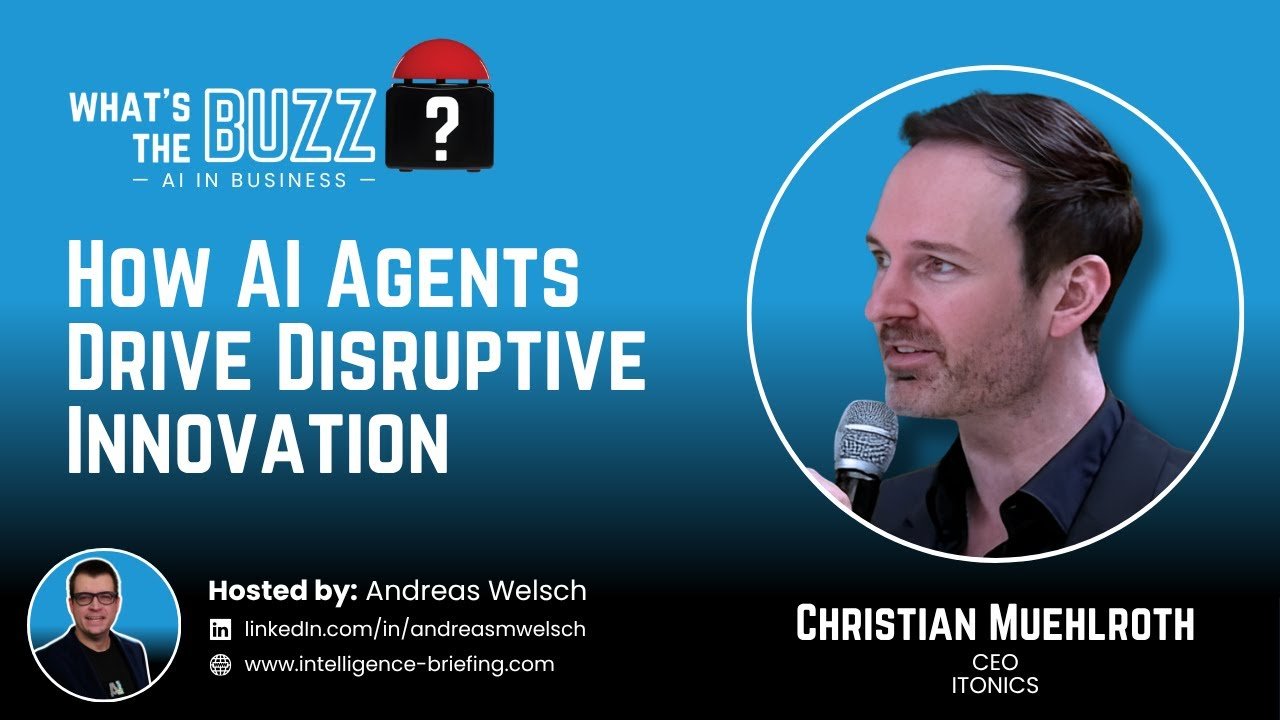
Guest: Christian Muehlroth, CEO of ITONICS
Host: Andreas Welsch
Episode: What’s the BUZZ?, Season 4, Episode 25
Published: October 21, 2025
Episode Summary
Christian Muehlroth, CEO of ITONICS, joins Andreas Welsch to answer how AI agents drive disruptive innovation. ITONICS builds software for enterprise innovation and technology management. Christian separates invention from innovation, explains Kondratiev waves and says technology waves are getting shorter because each wave builds on the one before. He describes why large organizations slow down as they grow and why that makes the risk of disruption real. He argues that agents move companies toward an abundance of labor and amplify people who want change, and he names clean enterprise data as the foundation leaders overlook.
Key Takeaways
- Christian says leaders should treat AI as amplified intelligence and give the best tools to the people who want change, because rolling AI out to everyone leads to what he calls AI tourism.
- He says the risk of disruption is real: technology accelerates while large organizations slow down under processes, politics and policies.
- Christian sees organizations failing to redesign legacy processes before they add AI, and he warns that automating an inefficient process only produces an automated inefficient process.
- He advises senior decision makers to go with an 80% solution: bring along everyone who wants to come, and find ways to help the others.
- Christian names clean enterprise data and a platform foundation as the step leaders overlook, and he notes that public language models lean on open web sources.
Timestamps
- 00:12 Cold open on disrupting or being disrupted
- 01:27 Christian introduces himself and ITONICS
- 02:31 Icebreaker game: What’s the BUZZ?
- 03:03 If AI were a color: Christian’s answer
- 04:26 How innovation typically occurs
- 06:02 Kondratiev waves and the innovation cycle
- 09:19 Why companies fear disruption from agents
- 11:08 Lessons from Kodak, Blockbuster and Nokia
- 13:37 Is agentic AI really a big disruption?
- 16:26 Cutting headcount versus amplifying people with agents
- 18:05 Where organizations fall short in AI adoption
- 21:52 Bringing change seekers and resisters together
- 25:03 The one thing leaders must do now
- 27:29 Key takeaways
- 29:54 Thanks and wrap-up
About Christian Muehlroth
Christian Muehlroth is CEO of ITONICS. In the episode he describes ITONICS as a software-as-a-service provider whose platform for enterprise innovation and technology management helps companies make use of new technologies, create inventions and innovations, and bring them to market.
Full Transcript
Read the full transcript
Andreas Welsch: Today we’ll talk about how agents are disrupting business, and who better to talk about it than someone who’s actively working on innovation management and disruptive innovation: Christian Muehlroth. Christian, thank you so much for joining.
Christian Muehlroth: Thanks. It’s a pleasure. After seeing you in person a couple of weeks ago, also being on this digital format, thanks for having me. It’s great.
Andreas Welsch: Wonderful. It’s been a while since we’ve crossed paths digitally. I think it’s almost two years ago that you invited me to your show. So it was great seeing you in person a couple of weeks ago and now having you here. Not everybody might know you already, and if you don’t know Christian yet, you should definitely give him a follow on LinkedIn. Why don’t you tell us a little bit about yourself, who you are and what you do.
Christian Muehlroth: Yeah, sure. I’ll keep it short. I’m Chris. I’m the CEO of ITONICS. We are a software as a service provider. We build software, basically. What we build is a platform for enterprise innovation and technology management, which means we help companies actually make use of new technologies and create inventions and innovations and bring them to market, to accelerate growth and to be more resilient in times of disruption. We do that with a software-first approach, and that’s why we also talk about agents today.
Andreas Welsch: Exactly right. There’s so much talk about innovation in general, but very few are doing it well. So I’m sure you’re getting a front row seat at what’s working and what’s not working, and I’m really excited to have this conversation with you. In good old fashion, why don’t we play a little game to kick things off?
Christian Muehlroth: Sure.
Andreas Welsch: Fantastic. When I hit the buzzer, the wheels will start spinning, and when they stop, you’ll see a question. I would love for you to answer with the first thing that comes to mind and why, in your own words. Are you ready for What’s the BUZZ?
Christian Muehlroth: Let’s do it.
Andreas Welsch: Okay, here we go. If AI were a color, what would it be? 60 seconds on the clock to make it a little interesting. Here you go.
Christian Muehlroth: I’d say if AI were a color, it would probably be white. The reason is that white contains all colors, so I think that resonates well with AI, which is, in my opinion, a general purpose technology. It can probably take on any task in the digital realm, but also maybe soon in the physical realm. But it also needs something to channel through, like a prism. It needs a prism to be useful: data, ontology, policies, agency, tasks, intention, ideas, whatever. Unfocused, it’s white. But then focused through a laser, it becomes a color and then also useful in practice.
Andreas Welsch: I love it. What an awesome answer, and what a great segue to talk about innovation too. You really need to channel it through something, almost like a catalyst. Otherwise it’s just there, but it doesn’t do anything meaningful for you. Beautiful. Innovation also isn’t something that just magically happens, and it doesn’t happen momentarily. How does innovation typically occur, and what comes together now in this wave of AI agents?
Christian Muehlroth: It’s so interesting. If you think of the major innovations, first of all, it’s probably great to distinguish between invention and innovation. I know it’s been done in the literature and everywhere else, but I think it’s interesting and important to do it specifically in the age of AI, because AI was not invented in the recent months or years. The foundation, specifically the physics, but also the machine learning algorithms, the mathematics and the statistics they’re based on, was groundwork done decades ago. That was the invention.
Christian Muehlroth: The innovation came in recent years, which made things much more useful. That’s because of the processing power for sure, but also because of the electricity needs of the data centers, the scale, the user interface and so on. These innovations, sure, also in algorithms, but also in the delivery of the AI, made it much more useful in recent years. Sometimes the difference between invention and innovation is still confused in practice, and I think right now, specifically with AI, we see very clearly what’s an invention and what is an actual innovation that’s useful to the market.
Andreas Welsch: When we met a couple of weeks ago, it was part of a panel discussion, and you mentioned some parts of innovation management. In innovation theory, we started talking about these waves, these innovation waves or Kondratiev waves, based on the Soviet economist. I don’t hear a lot of people talking about this, by the way. It’s also in the book, because when I took innovation management at university, I was quite excited to learn about it. Maybe you can share a little bit about what’s up with Kondratiev waves and how they now fit into this innovation cycle.
Christian Muehlroth: I think it’s so interesting, and I love that you have it in your book. I’ll totally recommend the book, by the way. It’s really great, and the pure fact that you already have Kondratiev waves in there makes it a great book. The theory is that everything, really everything in life, not only technology, goes in waves. Things go up, things go down, then they go sideways for some time, but ultimately they go in waves. If you look back in history, at the history of technology and also society, that actually has been the case. You always know in retrospect what these waves are: for example the steam economy, electricity, then the internet. These are all considered big technological waves of change.
Christian Muehlroth: After technology, typically big societal, work and business transformation follows, but of course it takes some time. By the way, many of these stem from military and defense applications, like the internet, so it’s pretty interesting to see what those folks are up to. That’s the theory, and the interesting thing about it is that time is getting compressed right now. Back in the 1800s, a wave was recognized to be about 60 or 70 years. These waves are getting shorter, and the reason is pretty obvious: you can stack the technologies on top of each other. The previous waves support the next one. We need electricity for the internet, we need the internet now for scaling AI, and so on. They build upon each other, and that’s why we feel that everything is accelerating these days.
Andreas Welsch: To me that is fascinating, especially the layering of things. If you’ve been in the industry for a while, you have seen this, whether it was your dial-up modem, then cable, now on your phone, and all the services that enables. Now, to your point, add data, add AI on top, and whatever is next. It feels like things are indeed moving faster. We’ve been talking about this for a long time, and you observe this probably in your own lives too, but it’s sometimes getting to the point where it’s not only overwhelming, but where you feel disrupted and maybe where your business feels disrupted.
Andreas Welsch: What are you seeing when you work with companies who are looking at innovation management and, for example, at software to manage that process? Why do companies fear this kind of disruption, and what do you think agents now drive in this disruption?
Christian Muehlroth: It’s very interesting, because you can consider this on two axes. You have the accelerating technological change. That’s very true, and as you say, I 100% agree, everybody feels it and can observe it right now. But there is a second aspect to it, which is that large enterprises and big corporations know very well that the larger they get, the slower they actually get, and that’s a problem. You have a gap between the accelerating technological change, where things get faster and faster, and over the years we’ve specifically seen the foundation models improving over and over again at an impressive rate, and organizations always running behind.
Christian Muehlroth: They have processes, they have politics, they have policies, which basically leads them to be slower in the adoption rate. The bigger they get, the more processes, politics and policies they have, which means ultimately that they slow down. So you have an exponential acceleration in tech, and you have an algorithmic rate of change in those large organizations. They’re getting slower and slower. That means the risk of disruption is pretty real, because it’s more than an exponential rate of change when they get slower, and that’s where the risk is.
Andreas Welsch: We’ve seen these examples time and again. Kodak, who dismissed digital cameras, and we believed people still wanted to take pictures in analog and film. Blockbuster, who didn’t see Netflix coming. Nokia, who didn’t see the iPhone coming. Are those the kind of examples we should be looking for in our own organizations, or are there other examples? For me it’s not quite that obvious. And by the way, it’s only obvious in hindsight.
Christian Muehlroth: That’s the main point. Unfortunately, it’s always obvious in hindsight. On the other hand, I’m surprised that we, as the collective of organizations on the market, don’t learn too much from history, because there are tools and methodologies and ways, for example corporate foresight. I’m not saying that organizations should engage in year-long scenario creation techniques, because that’s probably an outdated way, except for a public agency. But specifically private companies can rarely look forward three, five, seven years right now. There are systems, algorithms and ways to understand signals of change: how you capture them, how you interpret them, how you bring them into the organization, and how you also use them for decision making.
Christian Muehlroth: I’m always surprised because, specifically in turbulent economic times, which we might have in 2025 right now, depending on the region we’re in, companies divest from those capabilities and go back and focus on the core business. They should do the exact opposite. I know it’s hard in these times, but specifically in those times you should watch out for the next thing, for the next move, and have very rigid strategic intelligence. That’s not what they do. They divest in stages where uncertainty is the highest, where in those stages they should invest a lot in exploring potential future pathways.
Andreas Welsch: How does that then play out with agentic AI? I feel we’re still early, by the way. I saw Gartner’s generative AI hype cycle, and generative AI is moving into the trough of disillusionment. Great. That means relief is near. People are figuring out what this can really do beyond shiny objects and throwaway proofs of concept. But with agentic AI, do you think this is really going to be that big of a disruption, as some of the industry players and marketing departments are hyping it up to be?
Christian Muehlroth: I think there are two things. One is that agentic AI is going to move us closer to an abundance economy because of the collapsing cost behind it. Right now agents are like interns that never sleep. They can be super smart, PhD level in certain domains, but in general we consider them interns because they need oversight. But because the labor cost trends towards zero, or whatever you pay to these AIs, specifically for some bridged tasks or some mundane tasks, you don’t have a headcount constraint anymore. You have a throughput constraint, and sometimes maybe even a lack of ideas. Okay, what should we do next?
Christian Muehlroth: Very practically, you can do market scan preparations much faster, and even coding, of course. These models are so great at producing software code. They might not know all your code base yet, but it’s brilliant. That’s in the digital space, and also in the physical space. When we have fewer boundaries on land, you can create maybe even cheaper physical production, higher buildings, faster production of facilities or whatsoever, if you now do this with robots or machines. So that’s the first thing. It moves us towards abundance, specifically for labor.
Christian Muehlroth: That is in combination with something that we call amplified intelligence, or AI is amplified intelligence, because humans still set the intent. We still have the agency. But the AI agents expand your capacity, sometimes even your capability, to execute: speed, precision and maybe even latency. Two things are interesting, because they amplify human intention, and if you’re really good at something, you can use AI to really 10x or 100x what you’re doing. At the same time, for mundane tasks it gives us basically abundance in labor. That’s really disruptive.
Andreas Welsch: I’ve been thinking about this quite a bit, and that’s a lot of the conversation right now, also if you look at media and what CEOs are publicly saying, especially those that are leading or want to be perceived as leading. A lot of this conversation is about how we are reducing the number of people and not hiring people because of AI. Is this the right and the only way to look at it? Why is nobody saying we’re giving you agents so you can 10x or 100x what you’re doing? What’s your perspective there?
Christian Muehlroth: I think you’re spot on, because the truth is probably both. On one hand, if you consider AI and agents as a way to automate specific labor or specific tasks, then yes, there will be people being laid off. We already see it, specifically for the tasks where text-based AI applies. We currently just think about LLMs. There are different ways of artificial intelligence, but right now we focus a lot on text-based AI, so large language models and the like, and there is just so much you can automate with this sort of intelligence. So that’s the truth.
Christian Muehlroth: At the same time, everything that requires human agency, human creativity and human ingenuity will remain. Probably the people who already are pretty creative and have a great level of ingenuity and agency now have a tremendous opportunity to make a career, to make a business and to bring this to life. So it’s both sides.
Andreas Welsch: Then where do organizations fall short? We know they should embrace this. Sooner or later they will eventually look at this, even if it takes a couple of years like we’ve seen with cloud or with mobile and other trends. But where are they failing in adopting AI right now, and what’s your recommendation? What are you seeing?
Christian Muehlroth: First of all, we are seeing that there is no redesign of legacy processes. You just take inefficient processes and put AI on top of them. If you automate a shitty process, you get an automated shitty process, basically. So you need to design your processes to work in this new era, and if they really don’t make sense, then you shouldn’t be automating them. For example, in Germany we are digitizing our public processes to a large extent, trying for a couple of years. We had all these forms that you have to hand in to some public agency to get some stuff, and you have to physically write on those forms. When we digitized this process, we just put the forms on the screen. We never thought about whether it actually makes sense to have a form.
Christian Muehlroth: For example, if you have a newborn child, you still have to hand in a specific document to request some things from the government. But the government already knows anyway that you have a child, because there are other processes registering your child. So why should you have to fill in the form? Why couldn’t the government just do this automatically, as they know you have a child? We just took the same process, digitized it and made it a form on the screen. If organizations do the same now with AI, have legacy processes and just try to automate them, it’s probably not a good idea. It’s very expensive if you do this. So that’s one of the things: reconsider what actually makes sense. It’s a great opportunity right now to do it, and the leading organizations do it.
Andreas Welsch: But it costs money and it takes time, and we don’t know if it works. And I still want a paycheck and a bonus and a raise. Yes, innovation, but please not too much, and not too much at the same time. Is that something you encounter or perceive?
Christian Muehlroth: Yeah, it’s the truth, 100%, because it’s comfortable. Specifically, if you’re in an organization maybe for 10, 15, 20 years, you have a comfortable job. Why change, if there isn’t pressure? There can be positive and negative pressure for sure, so it goes both ways. There is a tendency and an aversion to change, and we see people in big corporations who say, ah, go away with this stuff, maybe I can sit it out or wait it out, or just see what happens. We see this a lot. But to be honest, we also see the opposite. We see great people who have agency, who have ideas, who want to push forward, who also want to make a career. For them it’s a perfect time to grab these opportunities and really deliver impact in those organizations.
Andreas Welsch: So you have super progressive, excited and tech-savvy folks on your team or in your organization. They want to try this out. They say, yes, I want change, we need to do this differently. And then you have the other side of the spectrum, who say, please leave me alone, I just want to collect the paycheck and be here nine to five and then have a life outside of work. And by the way, I’m retiring soon. How do you bring these two together? Is that maybe even the solution to making progress but still taking everybody along on this journey?
Christian Muehlroth: It’s a great question, and I think to some extent the decision makers who actually decide which way to go need to be honest with themselves and with the organization. I think it is a very noble goal to say, let’s get as many people as we can on board, and it’s probably the right way to do it. But that’s theory, and then there is practice, and you always have people who just do not want it for specific reasons. Maybe some can, some don’t, it doesn’t really matter. That’s just normal.
Christian Muehlroth: While this is maybe a ground truth, senior executives and decision makers should rather go with an 80% solution and say, we need to move on, this is the path. Everybody who wants gets on board, and for the others we need to see what we can do for them and how we can help them get along. As much inclusion as is needed, perfect, do it. But you also need to think in terms of the enterprise, and as we discussed in the beginning, we have this disruption risk and it’s imminent. It’s really here. So maybe go with the 80% solution and do whatever it takes.
Andreas Welsch: I’m wondering if some of that is also more culturally relevant. I know Germany has a very democratic process in companies, where we should talk to many people and make sure everybody’s heard and included. To your earlier point, I think that can a lot of times slow your business down as well. Over here in the US, it might not be that long of a deliberation. We see the opportunity, we see the potential, and we also see the pressure: what happens if we don’t adopt this? I get the sense businesses are moving relatively fast on many of these topics, certainly not all. Maybe culture plays into that too, I don’t know.
Christian Muehlroth: For sure. There are times when a more democratic approach might work a little bit better, and there are times when a more straightforward approach might work better. It’s like a pendulum that swings, and it depends on the situation of the industry or the company, the enterprise. Both have a reason to exist. You just need to know when to deploy which approach and at which time.
Andreas Welsch: Good point. Your leadership skills are definitely what figure out when to invite a dialogue and when this is a decision to move forward with, or, to your point, an 80% solution that helps us move forward. Before we wrap up, I’m curious: in addition to being sensible about the approach they follow, what should leaders do as they want to ride this wave of disruption instead of being disrupted? What’s the one thing they need to do right now?
Christian Muehlroth: The one thing that is often overlooked, and that leads to AI tourism typically, is, as boring as it may sound, laying the platform and the data foundation for it. Most of the AI applications we’ve seen are based on dirty data, which means wrong data sources. Just as an example, we’ve seen many companies try and experiment with public large language models for any sort of innovation or research and development tasks. There are a couple of problems with that. Public LLMs currently lean a lot towards open web sources like Wikipedia and Reddit. There are some statistics that try to prove it.
Christian Muehlroth: A concise R&D strategy or a new product development strategy needs clean enterprise data. That’s customer insights, that’s patents, your own patents, to see where you have technological capability, but also competitor information. You need to take your current R&D pipeline into account, your current product and services offerings, and so on. Otherwise you lean too much on public LLM data. So we need a very clean enterprise pool to make this usable, maybe even a shared taxonomy, which is, for example, what we enable in ITONICS.
Christian Muehlroth: We don’t use public LLMs. We have a different approach. We didn’t train our own, but we deploy one specifically in our infrastructure. Data never leaves ITONICS. It doesn’t go to OpenAI, it doesn’t go to Anthropic, it doesn’t go to Perplexity. It’s all within the existing data privacy contract you already have with ITONICS, in that case. So it’s much more safe and secure, and we can prove that. That’s the thing: the foundations, specifically with the data. Otherwise you have journey data and you have just open web source data, which is not really useful in the specific R&D and innovation context.
Andreas Welsch: Wonderful. Thank you for sharing. Chris, we’re getting close to the end of the show, and I was wondering if you can summarize the key three takeaways for our audience today.
Christian Muehlroth: Sure. Let’s go to the beginning. The first one is the abundance economy. Because AI means amplified intelligence, I would look specifically towards use cases and empowering people who want the change and amplify their human intelligence with AI, amplify their creativity. Give them the most expensive tools. I understand the approach of rolling out AI to everybody because you want to leverage everybody and raise the bar for everyone. But that’s a lot of experimentation and leads to AI tourism, because everybody tries out some things, and that’s actually wasted potential and wasted time and money. So my first recommendation would be to think of AI as amplified intelligence and provide the tools to the people who really want the change. Give them the best tools, the most expensive ones, because that’s 10x-ing, 100x-ing sometimes their capabilities. I think this is one key takeaway.
Christian Muehlroth: The second thing is to take disruption seriously, because we’ve seen it a lot. You’ve mentioned so many examples. We’re tired of the Kodak and Nokia examples because they were decades ago, but I’m pretty sure we’ll see many of those examples in the future. Don’t undervalue and don’t overstate it. The disruption is really imminent right now.
Andreas Welsch: And make sure that your company doesn’t become the next Kodak or Blockbuster that people will tell stories about for generations.
Christian Muehlroth: You don’t want to be on that list, really. And then the third thing is to get the foundations and the data right. It takes some time, but it’s not a hard thing to do, and it’s an important thing to do. If you are doing it, and you have really clean data, specifically for everything R&D and innovation, and over time you stack more and more technology use cases on top of it and add AI and agents to it, this is maybe one of the most competitive advantages you can get to make the most out of your data in the years to come.
Andreas Welsch: Chris, thank you so much for joining and for sharing your expertise with us. It’s always a pleasure talking to you, and thanks so much for the invitation.
Listen and Subscribe
- Listen to this episode on Buzzsprout
- Watch this episode on YouTube
- All episodes of What’s the BUZZ? on Buzzsprout
Related Reading
- Agentic AI for Enterprise Leaders
- AI Leadership for Enterprise Leaders
- AI Leadership Handbook by Andreas Welsch
- Crossing the GenAI Divide: Use Cases to Business Impact
- Agentic AI: Scaling, Governance and Workforce Adoption
Frequently Asked Questions
What is the difference between invention and innovation in AI?
Christian Muehlroth says AI was not invented in recent years: the physics, mathematics, statistics and machine learning algorithms behind it were groundwork done decades ago, and that was the invention. The innovation came in recent years, when processing power, data center scale and the user interface made AI useful to the market.
Why do large companies face a real risk of disruption?
Christian says technology change is accelerating, while large organizations get slower as they grow because they add processes, politics and policies. In his view that widening gap makes the risk of disruption real. He adds that in turbulent times companies often divest from foresight capabilities when they should invest in exploring future pathways.
Will AI agents reduce headcount or amplify people?
Christian Muehlroth says the truth is probably both. Where AI automates specific labor or tasks, particularly text-based work, people will be laid off. Work that needs human agency, creativity and ingenuity remains, and he sees people who already have those qualities gaining a tremendous opportunity to build a career or a business.
What should leaders put in place before they scale AI for innovation?
Christian names the platform and data foundation as the step leaders overlook. He says R&D and product strategy need clean enterprise data, such as customer insights, the company’s own patents, competitor information and the current R&D pipeline, because public language models lean on open web sources. He also advises giving the best tools to people who want change instead of rolling AI out to everyone.