

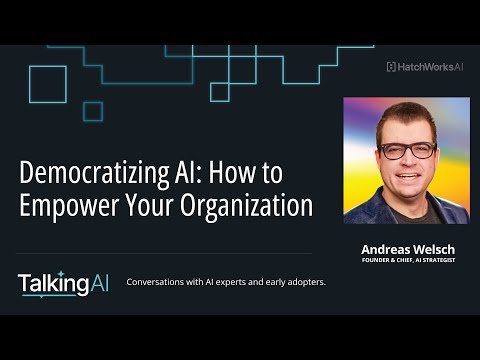
AI leadership is quickly becoming the deciding factor between organizations that translate AI hype into measurable outcomes and those that stall in experimentation. In a wide-ranging discussion on the Talking AI Podcast, AI leadership expert Andreas Welsch explains why organizations do not “need more AI”: they need stronger leadership, clearer governance, and a practical plan to bring people along.
Empowering an organization to embrace AI starts with AI literacy, not tool rollout. Welsch recommends pairing tool access with hands-on training through social blended learning, treating prompt quality as a communication skill, giving AI leadership cross-functional authority, and governing AI agents with shared values and HR involvement, because agents change how work is defined.
Welsch’s perspective is grounded in enterprise realities: tool sprawl, uneven AI literacy, emerging agentic AI capabilities, and the organizational ambiguity of who should own AI transformation. He also connects agent deployment to workforce transformation decisions that technology teams cannot make alone.
This article distills Welsch’s core points into executive-ready guidance on AI adoption, AI upskilling, agent governance, and the evolving role of the chief AI officer.
Original source: Talking AI Podcast
Why this conversation matters
The podcast format surfaces the real questions executives and AI leaders are wrestling with: how to operationalize AI literacy, how to decide which tools are acceptable, and how agentic AI changes workflows, pricing, and governance. Welsch frames these as leadership and organizational design challenges, not simply technical deployment tasks.
For CIOs, CTOs, CHROs, and business leaders, the discussion is especially relevant because it ties AI adoption to workforce transformation, values alignment, and cross-functional accountability. These themes also reflect Welsch’s broader focus as the author of AI Leadership Handbook.
Executive Summary
- AI adoption succeeds when people are trained, not just given tools.
- “Social blended learning” accelerates AI literacy and practical usage.
- The chief AI officer role is useful but likely transitional.
- Agentic AI requires governance for persona, values, and guardrails.
- Outcome-based “service as software” can disrupt SaaS pricing models.
Key Takeaways
- Welsch emphasizes organizations need better outcomes with AI, not simply “more AI.”
- Training must be hands-on and shared: microlearning plus cohort-based learning improves adoption.
- Tool accessibility was rising, making AI literacy both easier and more urgent.
- Prompt quality matters because AI output reflects the clarity of human instruction.
- AI agents should be grounded in company values and codes of conduct, similar to employees.
- HR should be involved because agent deployment changes how work is defined and organized.
- Agent orchestration will evolve from single agents to departmental, then cross-company agent interactions.
What is AI leadership?
AI leadership is the ability to steer an organization toward measurable business outcomes using AI while managing risk, enabling people, and aligning AI behavior with organizational values. In Welsch’s view, it includes educating the workforce, filtering market hype into relevance, and coordinating adoption across functions. It also requires setting guardrails, especially as agentic AI becomes capable of taking goals, breaking them into subtasks, and executing work with increasing autonomy.
Why does AI adoption start with AI literacy, not tool rollout?
Welsch argues that organizations have a responsibility to train people to use AI tools effectively and differently than traditional software. Simply provisioning “enterprise copilots” or assistants and expecting immediate productivity gains leaves adoption to chance and increases uneven outcomes.
He points to organizations that pair access with training and upskilling, and see returns measured in “several hours of time saving per employee” because employees learn how to get useful output consistently.
Key Insight: AI literacy is a leadership obligation, not a self-service perk. Welsch highlights that companies see real time savings when they invest in training alongside tool access, because employees learn the new interaction model required to get reliable, job-relevant results from AI.
What “social blended learning” looks like in practice
Welsch recommends “social blended learning,” combining multiple learning modes: short microlearning snippets (for targeted topics), cohort-based learning sessions (virtual or in-person), and structured sharing of individual experimentation. The emphasis is hands-on: trying tools, learning pros and cons, and understanding what improves output quality.
This approach matches how AI work actually happens: iterative, collaborative, and grounded in real tasks rather than abstract theory.
How does democratized building change AI adoption inside enterprises?
As the host notes, organizations increasingly incorporate “build as part of training,” where employees move from use cases to prototyping simple AI solutions. Welsch reinforces the significance: AI no longer requires advanced degrees in statistics or optimization to become useful.
This accessibility shifts the internal conversation. Leaders are asking how AI fits business strategy not only because of headlines, but because people use these tools daily on phones and browsers. That creates urgency for governance: employees will use tools with or without formal approval.
Key Insight: Wider access to AI tools increases both opportunity and governance pressure. Welsch noted that leaders asked strategic questions because AI had become “a lot more accessible,” which drove experimentation across the workforce, often ahead of official policy.
Why prompt engineering is really about communication
Welsch frames prompt quality as a mirror of human clarity. Poorly structured prompts lead to generic, non-specific outputs. Better results require more upfront thinking about goals, relevant context, and constraints, similar to briefing a capable colleague.
He also expects more low-code and no-code tooling to make AI easier for average users. But deeper customization, especially when defining agent behavior, will still require explicit instructions for the foreseeable future.
Key Insight: “Prompt engineering” is not merely a technical skill; it is an organizational communication capability. Welsch emphasizes that when prompts are unclear, AI outputs reflect that ambiguity, making structured instructions and well-defined goals essential for dependable results.
What does a chief AI officer do, and is the role transitional?
Welsch describes the chief AI officer (CAIO) as a multifaceted role emerging to coordinate AI across the enterprise. Responsibilities include monitoring fast-moving market developments, determining relevance for the organization, enabling people with education and guidance, and coordinating implementation across technology and business functions.
He argues the CAIO is most effective when positioned senior enough to work across functions, ideally reporting to a divisional president or equivalent, rather than being constrained as a VP reporting into a narrower technology remit.
Longer-term, Welsch expects the CAIO to be transitional. As organizations build the “muscle” of AI adoption and collaboration, AI becomes embedded across leadership roles, reducing the need for a dedicated C-suite position.
Why does agentic AI governance need values, personas, and HR at the table?
Welsch supports the idea that organizations will need HR involvement in agent programs, echoing the broader notion that companies may eventually manage “agent resources.” His reasoning is practical: technology teams are redefining how work is done, and that has implications for roles, responsibilities, compensation structures, and expected outputs.
He gives concrete examples of why persona and values matter. A customer service agent should be friendly and helpful, but not so accommodating that it over-discounts and erodes margin. A finance agent must comply with strict rules and guidelines, including accounting standards such as IFRS, plus company code-of-conduct expectations.
Welsch also warns that if multiple teams build agents independently, the organization can end up with inconsistent interpretations of values and policies, or omit them entirely. HR has experience institutionalizing how employees are expected to behave; that knowledge becomes relevant for agent design.
Key Insight: Agent behavior must be governed like employee behavior. Welsch argues that without shared guardrails (values, code of conduct, and domain rules), different teams will create inconsistent agents. This is why HR expertise belongs in agentic AI projects that reshape work.
What is “service as software”? The SaaS pricing disruption ahead
Welsch points to a shift from “software as a service” toward “service as software,” where companies price around outcomes delivered rather than access to software features. Agentic AI enables systems that research, analyze, draft outputs, and present recommendations, sometimes with human sign-off, and potentially more autonomous over time.
He also notes the pricing challenge: the transactional cost of running agents may be small, but the value created can be significantly higher. Startups may have an advantage in developing outcome-based pricing because they often solve a narrow, well-defined problem for a specific buyer, making value quantification easier than in broad product portfolios.
Welsch brings direct experience to this topic, having worked on SAP’s generative AI pricing model across multiple lines of business including finance, sales, procurement, and HR.
How AI agents work: model, tools, and orchestration
In the conversation, a practical framing is introduced: agents combine a model (the LLM), tools (the systems the agent can use), and orchestration (the loop that governs reasoning and next actions until the goal is reached). Welsch agrees that model capabilities increasingly look commoditized, while tool access and orchestration determine real-world usefulness.
He highlights the trust dimension: reading and synthesizing information is one thing; writing back into systems, committing code, or executing transactions demands higher confidence and clearer governance. The trajectory, in his view, moves from individual agents to departmental agent teams and eventually to cross-department and cross-company agent interactions (for example, procurement agents requesting quotes from sales agents).
Human-centered design in an agent-driven world
Welsch points to marketing’s debate on search engine optimization (SEO) as an early signal of how design and discovery may change. As AI-enabled search becomes more common, organizations may need to consider “optimization for agents” so AI systems can find company content and information.
At the same time, he suggests human-centered design remains critical because agents are tools used by humans. Design will shift toward how people interact with agents, evaluate results, and establish trust, such as understanding why a response is credible and which sources are most important.
Leadership Implications
- Institutionalize AI literacy: Pair enterprise tool access with structured training and hands-on experimentation.
- Standardize agent guardrails: Define values, personas, and code-of-conduct constraints before scaling agentic AI.
- Bring HR into agent programs: Treat agents as part of workforce transformation and operating model redesign.
- Position AI leadership for cross-functional impact: Ensure AI leadership has authority beyond IT constraints.
- Prepare for pricing and value-model change: Explore outcome-based pricing as “service as software” matures.
Why this matters for AI leadership and workforce transformation
The conversation links emerging technology to organizational realities: AI adoption depends on enablement, governance, and clarity about what “good” looks like, especially as agents gain more autonomy. Welsch repeatedly reframes AI as a leadership topic: guiding people, filtering noise, setting guardrails, and organizing work.
It also connects directly to Welsch’s broader work on AI leadership, including AI Leadership Handbook and his focus on translating AI trends into enterprise outcomes. His emphasis on HR involvement signals that workforce transformation is not a downstream effect: it is part of the design brief.
Conclusion
AI leadership increasingly determines whether organizations capture value from AI tools and agentic AI, or simply accumulate pilots and inconsistent behaviors. Welsch’s guidance is clear: invest in AI literacy, treat prompt quality as communication discipline, establish shared guardrails for agents, and involve HR because agents change how work is defined.
As “service as software” reshapes SaaS pricing and operating models, executives who treat AI adoption as a coordinated leadership agenda, rather than a technology rollout, will be best positioned for sustainable workforce transformation.
Related Reading
- How Leading Organizations Build a Winning AI Learning Culture
- Now We Need People For AI Adoption And Change
Frequently Asked Questions
What is the biggest AI adoption mistake enterprises make?
The biggest AI adoption mistake is rolling out tools without workforce enablement, then expecting instant productivity gains. Andreas Welsch stresses that organizations must train people on how to work with AI differently than traditional software to get measurable outcomes.
He highlights that pairing access with training drives practical use and time savings.
How should leaders build AI literacy across the enterprise?
Leaders should build AI literacy using “social blended learning,” combining microlearning, cohort sessions, and shared hands-on experimentation. Welsch explains that this mix helps employees understand pros and cons, practice real tasks, and consistently produce better AI outputs.
This approach scales learning while keeping it practical and job-relevant.
Is the chief AI officer role permanent or temporary?
The chief AI officer role is likely transitional as AI becomes embedded across executive responsibilities. Welsch compares it to other “trend-driven” roles and expects demand to decrease over time as organizations build AI adoption muscle and cross-functional collaboration improves.
In the near term, it can centralize enablement, relevance filtering, and coordination.
Where should a chief AI officer sit in the org chart?
A chief AI officer should sit high enough to work across business functions, ideally reporting to a divisional president or equivalent. Welsch notes that if the role reports into narrower technology structures, it can become constrained to IT goals rather than enterprise value creation.
Positioning influences scope, authority, and the ability to partner with finance, HR, and revenue leaders.
Why does prompt engineering still matter for executives?
Prompt engineering matters because it reflects the organization’s ability to communicate goals and constraints clearly. Welsch explains that poorly structured prompts produce generic results, while thoughtful instructions yield more relevant outputs, especially when defining agent behavior, personas, and acceptable actions.
Even with easier tools, clear instruction remains a competitive capability.
What governance is needed for agentic AI in customer service?
Agentic AI in customer service needs governance for persona, values, and boundaries around discounts and profitability. Welsch warns that an agent can be “too helpful” by over-optimizing for customer satisfaction and eroding margin, so guardrails must be explicit.
These constraints should be standardized so multiple teams do not implement inconsistent policies.
Why should HR be involved in AI agent programs?
HR should be involved because agent deployment changes how work is defined, organized, and governed. Welsch argues that technology teams are effectively redesigning roles and responsibilities, and HR has long-standing methods for institutionalizing codes of conduct and expected behaviors across a company.
This becomes critical when many teams build agents with different interpretations of “how the company behaves.”
How do agents evolve from single tasks to enterprise workflows?
Agents evolve from individual use cases to departmental agent teams, then cross-functional and cross-company workflows. Welsch describes a progression where agents collaborate within a function (e.g., marketing) and later interact across departments (marketing-to-finance) and even between companies (procurement-to-sales).
This evolution increases the importance of orchestration, trust, and shared governance.