

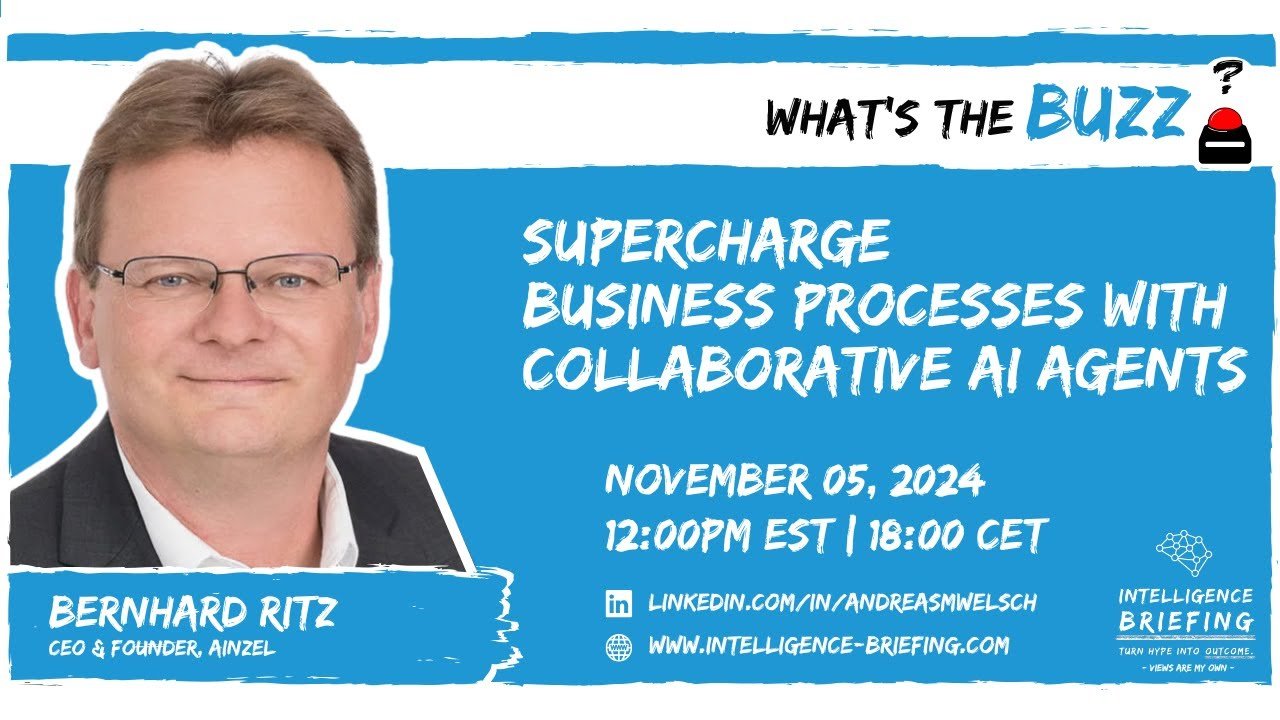
Guest: Bernhard Ritz, CEO & Founder, Ainzel
Host: Andreas Welsch
Episode: What’s the BUZZ?, Season 3, Episode 27
Published: November 5, 2024
Episode Summary
Bernhard Ritz, CEO & Founder of Ainzel, joins Andreas Welsch to answer what it means to bring collaborative AI agents into business processes. Bernhard compares AI agents to virtual employees and explains how a team of agents trained in different business roles can hold a discussion that works like a chain of thought.
The conversation covers the oversight, compliance and bias risks that come with more autonomy, why HR belongs in the discussion, and what remains for humans to decide. Bernhard also discusses interoperability between vendors’ agents and advises leaders to treat AI as a business capability and to look at existing agent frameworks.
Key Takeaways
- Bernhard advises leaders to step back from the technology and look at what AI agents do for the business, and he compares them with virtual employees.
- Bernhard says a multi-agent system replaces a single prompt with a discussion between agents trained in roles such as compliance, finance and industry specialist, which lets teams put more effort into each task.
- Bernhard suggests applying the standards used for human employees, such as a code of business conduct, as a starting point for AI agents, with additional oversight measures on top.
- Bernhard notes that following the conversation between agents gives more transparency into how a decision was made than a single answer does.
- Bernhard recommends learning to work with AI agent frameworks and deciding how far to go with autonomy in a responsible and ethical way.
Timestamps
- 0:43 The guest introduces himself and his company
- 2:06 Icebreaker game called In Your Own Words
- 2:42 If AI were a movie, what would it be
- 3:32 What it means to bring AI agents into a business process
- 6:28 Language flexibility and the oversight AI agents need
- 8:38 Why HR belongs in the discussion about AI agents
- 9:45 How agents collaborate through a chain of thought
- 14:03 Managing two workforces, humans and AI agents
- 14:52 Transparency into how multi-agent systems reach a decision
- 17:17 What is left for humans to decide
- 19:25 Agents from different companies working together
- 21:03 Vendor agent strategies, lock-in and interoperability
- 25:23 Recommendations for leaders starting out with AI agents
- 27:34 The three key takeaways
- 28:56 Wrap-up and thanks to the guest
About Bernhard Ritz
Bernhard Ritz is the CEO & Founder of Ainzel. In the episode, Bernhard describes Ainzel as an enterprise AI platform that adds virtual employees, AI agents, to businesses, and says he worked for 22 years at SAP before joining an SAP partner to build up its North America business and starting Ainzel around 18 months earlier.
Full Transcript
Read the full transcript
Andreas Welsch: Today, we’ll talk about supercharging your business processes with collaborative AI agents. And who better to talk about it than someone who’s actively working on that? Bernhard Ritz. Hey Bernhard, thank you so much for joining.
Bernhard Ritz: Hello Andreas, thanks for having me on the show.
Andreas Welsch: Awesome. Why don’t you tell our audience a little bit about yourself, who you are and what you do?
Bernhard Ritz: Sure. I’m the CEO and founder of Ainzel, an enterprise AI platform that adds virtual employees, AI agents, to businesses. I worked for 22 years for SAP, a couple of years in Germany and later here in the US. Then I joined an SAP partner to build up their North America business. Around 18 months ago, I started Ainzel, so I started my own company.
Andreas Welsch: That’s awesome. I’m really looking forward to our conversation today. You showed me Ainzel a couple of weeks ago, and I was so excited to see these collaborative agents and what that actually means. Also, don’t forget to pick up the AI Leadership Handbook on AILeadershipHandbook.com, so you can learn how to successfully implement AI in your business, because it’s not just about tech. With all of that out of the way, what do you say, should we play a little game to kick things off?
Bernhard Ritz: Okay.
Andreas Welsch: Wonderful. This one is called In Your Own Words. When I hit the buzzer, the wheels will start spinning. When they stop, you’ll see a sentence, and I’d like you to answer with the first thing that comes to mind and why, in your own words. To make it a little more interesting, you only have 60 seconds for your answer. For those of you watching us live, drop your answer in the chat, and why, too. So, are you ready for What’s the BUZZ?
Bernhard Ritz: Let’s go.
Andreas Welsch: Okay, here we go. If AI were a movie, what would it be? 60 seconds on the clock.
Bernhard Ritz: Movie, that’s an easy one. It’s Inside Out. You probably know the Disney movie, where these little figures are thinking about you, your different emotions and so on. That’s a great parallel to AI agents, if we get to the point where we have them reasoning and thinking, all these little different aspects of your life together, collaborating. A perfect comparison to AI agents.
Andreas Welsch: I love that. That’s wonderful. Definitely on message and on theme for the show. Let’s jump right into it. You already mentioned agents working together, but before we talk about them collaborating, what does it even mean to bring agents into a business process? I think agents have been the hot topic this summer. What does it actually mean in concrete terms when you do that?
Bernhard Ritz: The way I look at this, and a lot of people ask me about AI agents and the technology involved, is that I tell them to step back. Don’t look at the technology, look at what these AI agents do for the business. I always compare them with virtual employees, which is scary for some people. Some people say, oh no, they’re just augmenting, they’re not real employees. But step by step, AI agents are working towards being part of the team, being a member. These are virtual helpers built on generative AI. They started with very simple tasks: can you improve this email? Then it went to, can you write this email? Can you run this email campaign? Can you manage my email inbox for me? Step by step these helpers got better, and step by step we’re integrating them deeper into our business processes. As I just described, we use them to augment what we are doing, and now they are starting to take over single activities, single steps. They’re very knowledgeable and trained in certain domains at an expert level. They are fast, and they respond with information in seconds that would take us minutes or hours to compile. So they are very helpful, affordable, knowledgeable, trained little helpers. That is actually how the name Ainzel came about. I thought about how to name these little helpers. In Germany there is a TV show with Mainzelmaennchen, and I tried to find a domain name that fits Mainzelmaennchen, these little helpers, and I came up with Ainzel. Later I recognized, oh, there is AI at the beginning of it.
Andreas Welsch: I love that analogy. I’ve been wondering, too: when you introduce more autonomy into your business process, I’m sure you introduce some challenges as well. In business, it’s already tough enough with a team of human workers and employees to get them to communicate, collaborate and agree on terminology and the goal and how to break it down, while still benefiting from everybody’s individual experience and background. How do you see this evolving in business when we now introduce AI agents as a software component that can do some of the more complex tasks than just if-then-else?
Bernhard Ritz: You brought up an interesting point, and that is language. I think the beauty of large language models and the underlying vector databases is that they bring a lot of flexibility to what AI agents can react to. In traditional applications, you have databases with strict fields, and you need to provide the information in the exact format required so that it can be handled. With AI there are ontologies and vector databases that do similarity searches, so you can have a very flexible way of entering information and the AI agent is still able to handle it. I think that’s a great advantage. You said autonomy, and obviously that’s the big point. The more AI agents take over functionality and parts of the business processes, the more autonomy they will get to do things independently. This is also where the risk is and where oversight needs to kick in: hallucinations, bias, privacy, security, compliance. I said they are virtual employees. If you play that model, virtual employees have an NDA and an employee contract, and they need to follow the code of business conduct. For AI agents, we need to design them the same way. I think this is also the difference with an enterprise AI platform, which takes that very seriously, compared to feeding information into a large language model that works with you, where the oversight component you expect in an enterprise platform is probably not there. Information goes out there, and information is shared that shouldn’t be. So an enterprise platform that handles these AI agents and the collaboration between them is the go-to solution in this case.
Andreas Welsch: I’m glad you mentioned this, because I think that part is a lot of times underestimated or not even covered. I was thinking about it a little more the other week after our conversation, and I realized that in a lot of organizations HR is actually absent from these discussions. Technologists are defining what these new agents, these new digital workers, should look like, how they should behave, and what policies they need to abide by. So I think there’s another opportunity for technology leaders to bring in HR experts and ask what we need our AI agents to abide by. How do we ground them, and in what documents? Is there a single source of truth, ideally, like there is for employees, or is it okay if every department defines it somewhat similarly but has the autonomy? I think there’s a lot more to cover there, also on the human-to-human collaboration with your HR team as you’re defining that. But what are you seeing? What do these agents actually bring to processes? How does it work if they work in a collaborative setting? How can I envision that?
Bernhard Ritz: I think the simplest comparison in AI terms is that these agents generate something like a chain of thought. In a traditional home environment where you have ChatGPT, you ask something and you get a response, and it has a memory that follows what you’re doing. Here it’s multi-agent systems. You have a bunch of agents trained in different business roles, somebody who’s a compliance agent, a finance analyst, an industry specialist, you name it, and they figure out certain topics and answer questions. Instead of one prompt that gives you an answer, you run a full conversation, a discussion between these agents. They contribute to the conversation and react to each other’s answers. This one said this, the finance analyst said this, hey, entrepreneur, what do you think about this? You run a discussion, a very complex chain of thought from different perspectives, designed based on the role. Some of these agents are trained with internal information or external information. If you have somebody who is trained on your own information, they bring the perspective of the company. Say you’re a pharmaceutical company and you have 20 years of information from clinical trials. You convert this into a chatbot, you bring it into the conversation, and suddenly you’re bringing that knowledge into a broader conversation with a compliance officer, an entrepreneur and a financial specialist. That’s my philosophy. People often ask, is AI here to make things cheaper? I say it’s a mix. It’s definitely more affordable, but you can also put more effort into each task, and that is exactly this chain of thought. Imagine that for every question you answer and every step you take, you do a little workshop around it. Let’s figure this out. Let’s have a one-hour conversation as a group about how we solve this and how we can customize it for this specific customer so it makes a lot of sense to them. Let’s run this chain of thought and have a conversation from different perspectives. I think you get the picture I’m drawing. It’s a little Mainzelmaennchen, these little ainzels figuring things out. A lot of people also ask whether AI can reason. Single-prompt reasoning is getting much better, no question about that. But if you run this chain of thought and they have some guardrails around which direction they are going, what the key questions are that they should answer, and instructions they are following, including reasoning why they do a specific task, that gives them a lot of guidance for how the team of agents generates responses.
Andreas Welsch: I think the part you mentioned about accomplishing more in the same amount of time, or having a more in-depth discussion and evaluation of options, is a key aspect that I haven’t seen a lot of people talk about in that sense. It’s not just about how you can become more efficient and reduce the mundane things, but what you can accomplish in the same amount of time now that we can scale it and have all of these virtual experts come together and have that discussion, which would take us an hour, two hours, half a day. Great. I go back to what I said before about this model of virtual employees: I developed a strategy framework for AI together with William Faye, and we asked how things would change. How would your business processes change if you could put 10x the effort into what you’re doing? Imagine you have 10 times the resources to do something. How would it change?
Bernhard Ritz: And this goes to some of what I’ve also seen from you. You have to reimagine your business processes. If you can customize things much more than today, and you can put much more effort into it, the result is different.
Andreas Welsch: Yeah, absolutely. And I see Josh has put a comment in the chat: we’re going to see a need for leaders to manage two different workforces, humans and AI agents. I think that’s spot on. In many cases, as leaders, we need to be prepared to guide agents and give them feedback. We also need to think more critically when we’re presented with a proposal, about whether our team members used AI to generate it. We don’t know how they prompted it or what the instructions were for the agents to create something. But if it’s on us to make a decision and say, should we go left or right, with these options, we need to think a lot more critically about that, which I believe is getting more important. I’m curious what you’re seeing.
Bernhard Ritz: That’s an interesting aspect you brought up, the oversight of what goes into a problem. Do we understand why the system is answering the way it’s answering? I think multi-agent systems have an interesting advantage. You’re not just seeing the result, here’s the answer, it’s 42. You can follow the conversation between the agents. This is what they argued about, this is what one agent asked the other agent. And if you run some monitoring on top of this and ask, is this compliant, can I see some bias in these questions and answers, then you have much better transparency into how a decision is made and how we came to a certain point, instead of just responding with the 42.
Andreas Welsch: That’s a great point. And compared to spending an hour or two in a room behind closed doors and coming out with an answer, where you also don’t know the exact conversation flow, here you can actually audit it or take a look.
Bernhard Ritz: It’s a good point. Looking at Josh’s question, we need to manage two workforces. I think a good start is to apply the same standards we have for humans to the AI agents, as I said. If we have a code of business conduct, we don’t want to see anything in these conversations that doesn’t comply with it. Human standards are a good starting point, and then we need additional measures for oversight on top.
Andreas Welsch: Great point. I think that will only become more important as more businesses explore AI agents and how to deploy them in a compliant way. We’ve seen that before with machine learning, where algorithms have a different optimization function and optimize for that one outcome, but it can have adversarial effects and negative side effects on what you actually want to do. So to your point, ground them in the binding document that they need to abide by, and then set your guardrails. I think that is only getting more important. Now, I’m curious: when you use systems with multiple agents collaborating, you can see the conversation flow, what one said, what the other said, how they arrived at the decision. What’s really left for humans to do in terms of decisions, and where do we still need people in that process?
Bernhard Ritz: There’s probably a short-term answer and a long-term answer. Twelve months ago, people said humans are the creatives and AI agents are not. I guess we are now over that point, where we see a lot of creativity in AI agents and how they bring together topics that are typically not together, and the new outcome is quite creative. I see functions or job roles that are easier for AI agents to handle. You’re probably not a software developer anymore, but a software architect orchestrating. At the same time, we see these AI agents climbing up the ladder to more complex tasks and roles. Yesterday they coded, now they’re architecting solutions. Tomorrow, who knows? Do I see a limit where I say AI will never be able to do X, Y, Z? Actually, no, I don’t see it. It’s more a question of how we deal with these capabilities. Going back a little to AI strategy, this gives you new capabilities, and you have to rethink the way you do business and reimagine your business processes, as we saw with this HR question. You have to rethink what skills are required in your company in this new way. And you have to rethink the market as well, because it’s not just you who has these new capabilities. All the other participants in the market, your competitors, your customers, your suppliers, you name it, have the same capabilities. Could they suddenly substitute your products or services? We can do this in-house with AI. The same goes for you. You are probably asking the same question: can I do things in-house that I haven’t done before? That goes to the strategic idea. We see that the technology has evolved significantly over the last two years, and now more and more the business aspect shines.
Andreas Welsch: That makes me wonder, if you have your multi-agent systems in your own company, and your customers, partners and vendors do the same thing, where is this going? Do you envision a future where agents of different companies collaborate, much like we collaborate with our suppliers, partners and customers? What products do you need? When can we build or ship them? What material do we need to source, in collaboration with the partner or supplier? Where is this going, and where does it stop, or does it?
Bernhard Ritz: You’re already drawing the next generation, Andreas. Quite interesting. So it’s a marketplace where agents from different companies start to collaborate. You have a little workshop going on with your customers and suppliers. Interesting thought. I haven’t thought about it, but why not? We’re not there yet. We’re still in the process of company-internal agents collaborating. But what you can do today is put agents into the role of customers and test certain things. You could put an AI agent in the role of a competitor and see how it reacts to certain activities that you’re doing. It’s crazy how fast the whole thing develops. I like the idea of intercompany agent collaboration. I haven’t seen it. Here’s a business opportunity for somebody on the call.
Andreas Welsch: That’s true. Obviously, and you’re most likely seeing this too, all of the large vendors in the market have announced some sort of agent strategy or agent features, whether it’s Salesforce, Oracle, SAP, Microsoft and many others. But I also see them building these capabilities very tightly into their applications. It’s about creating, on one hand, more value, and on the other hand, more lock-in. What I haven’t seen a lot of is interoperability between these different solutions. In a business process and in a company, you most likely don’t just have one vendor, as much as vendors would love that to be true. So I think there’s another opportunity when it comes to integration. If you have an HR workflow and there are some budget questions, you can see the difference between, say, Workday to SAP. What does that integration look like? But I think there are also advantages if you’re not locked into any of these verticals and you have an open platform. What are you seeing there?
Bernhard Ritz: I think a lot of companies are trying to find out a good starting point with AI. How do we get started? When you look at your business systems, your Salesforce, ServiceNow, SAP, Oracle, you name it, these vendors are adding agent capabilities to their solutions, so they will handle part of the processes, or the processes within those systems. What I also saw is that they are now open to connecting to other systems, a Salesforce agent connecting to an SAP system and vice versa. So there’s some level of openness, but probably not to the point of how a third party could do it. When I look at Ainzel, I say yes, we connect to multiple systems, and as a third party we can independently orchestrate the capabilities that I see from the different vendors. Everybody goes in the same direction with agents, and with what we discussed about how they have evolved and will evolve. It’s just a question of what the orchestration framework for all of these agents is, and how flexible and open it is to the different vendors. Again, it will be an evolution. The current vendors have a big advantage because their processes and solutions are already implemented in companies. Why wouldn’t you start by adding the AI capabilities that these vendors offer? But when it comes to interoperability between the systems, it will be interesting to see how that works.
Andreas Welsch: Let’s bring this back to one of the earlier points you made, that ideally we start by viewing agents like human workers when it comes to policies and guidelines. Now imagine your HR department, your finance department and your sales department all saying, here’s the scope of what I do. If you want to talk to me, you need to fill out a form or use some kind of orchestration or integration, so I know what to do with the information you give me. Or even worse, all I can do is this little box, don’t come to me for anything else. To your point, I think that’s the next evolution that we will need to see. It’s fine to have silos when it comes to business systems, but for a business process that goes horizontal, it doesn’t matter if it’s vendor one, two or three from a business point of view. So I think there’s another big opportunity. Like Milind is posting in the chat, perhaps we need to develop standards or open systems that allow intercompany agent collaboration, and even interdepartmental collaboration, I would say. We’ve covered a lot of ground in the last 25 minutes. I’m curious where you see things going. What’s your recommendation for leaders looking to learn more about AI agents and starting on this journey?
Bernhard Ritz: I think we touched on some of these points. Step back and look at this as a business capability and ask what it does to your business. Most companies have experience with little pet projects from the IT department or other departments on how to use AI. I haven’t seen a lot of companies who really stepped back and asked how we reimagine our business and how this influences our position in the market. There’s a bigger picture to this. Especially when you have this picture of virtual employees, you can reimagine, and that’s a good metaphor to do that. When it comes to the technology, a lot of companies have started with internal chatbots, where they have trained agents on their own proprietary data. That’s the starting point, probably the pre-version of an agent. Look at existing AI agent frameworks and see if there’s something that helps you orchestrate this agent communication. Other than that, we’re still at an early stage, where we are adding AI to the business processes. Companies need to look at how they handle oversight and compliance. I think topics like hallucinations are starting to go away, because more and more is being done, such as asking for sources and validating against them. In my opinion hallucination is something that goes away in the next 12 months, with chains of thought and all kinds of processes that help us overcome it. But topics like bias, and giving more autonomy to AI agents and letting them take over bigger parts of the business processes, will be some of the challenges we have to look at as we go step by step into this AI-ready, AI-enabled world.
Andreas Welsch: That sounds exciting. I can’t wait for hallucinations to go away, because if we start to put LLMs and GenAI into so many critical places, having the certainty that it does what it says and says what it does is really important. We’re getting close to the end of the show, and I was wondering if you can summarize the key three takeaways for our audience today.
Bernhard Ritz: Take a business look at AI. Think about reimagining your business and your market situation; that’s one thing. Second, learn to work with AI agent frameworks, because they’re the evolution of large language models. It’s not about individual prompting anymore, but about agents trained in certain domains who are world-class experts in what they do, and a whole bunch of them collaborating to figure things out. Companies have to get their feedback and learn this new way of doing business. I take an individual contributor and put a virtual team around them, and now they’re a manager of a virtual team with suddenly all this capability available. The third one: all of these changes raise the question of autonomy. How far do I go? How do I step by step unleash AI, and do I even want to unleash it? How does a company want to proceed with these capabilities in a responsible and ethical way? I think these are other topics that should be considered.
Andreas Welsch: Awesome, thank you for sharing and for summarizing our discussion today. Folks, for those of you in the audience, if you would like to learn more about AI agents, I recently released two courses on LinkedIn Learning that help you get started with AI agents and cover the basics of what it is all about and where the opportunities and challenges are. And I thank you so much for joining us and for sharing your expertise with us. It’s been great having this conversation with you and learning from you, and hearing where you see things today and in the future.
Bernhard Ritz: Thanks for having me on the show.
Listen and Subscribe
Related Reading
- Agentic AI for Enterprise Leaders
- AI Governance for Enterprise Leaders
- Always-On Agents, forthcoming in Early 2027
- How Can Business and AI Teams Work Together?
- What Is the State of AI Agents in the Enterprise?
- What Are the Top Criteria for Multi-Agent Systems in HR? Kris Saling on Where Agents Fit
Frequently Asked Questions
What does it mean to bring AI agents into a business process?
Bernhard advises looking at what AI agents do for the business instead of at the technology, and compares them with virtual employees. In his description, agents started with simple tasks such as improving an email, and step by step took over single activities and steps in business processes.
How do collaborative AI agents differ from a single prompt?
Bernhard explains that a multi-agent system runs a conversation between agents trained in different business roles, such as a compliance agent, a finance analyst and an industry specialist, instead of returning one answer to one prompt. The agents react to each other’s answers, which he describes as a complex chain of thought from different perspectives.
What oversight do AI agents need?
Bernhard names hallucinations, bias, privacy, security and compliance as the risks that come with more autonomy. He suggests applying the standards used for human employees, such as a code of business conduct, as a starting point, with additional oversight measures on top. He adds that following the conversation between agents gives more transparency into how a decision was made.
Where do humans still fit when AI agents collaborate?
Bernhard gives a short-term and a long-term answer. He sees agents moving up to more complex roles, so a software developer becomes a software architect who orchestrates, and he does not see a limit to what AI will be able to do. In his view the question is how businesses deal with these capabilities, which means rethinking processes, skills and the market.
What should leaders do to start with AI agents?
Bernhard recommends looking at AI as a business capability and reimagining the business, rather than running isolated pet projects. He advises looking at existing AI agent frameworks, handling oversight and compliance, and deciding how far to go with autonomy in a responsible and ethical way.