

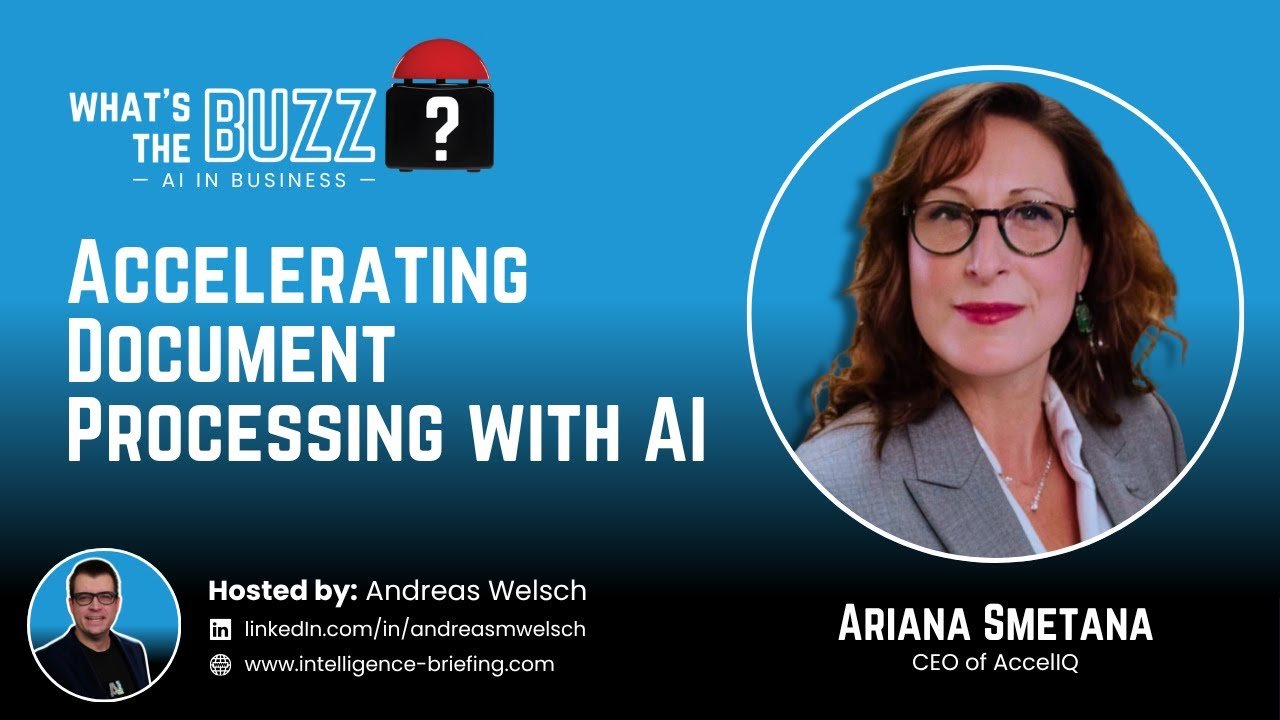
Guest: Ariana Smetana, CEO of AccelIQ Digital
Host: Andreas Welsch
Episode: What’s the BUZZ?, Season 5, Episode 8
Published: April 15, 2026
Episode Summary
How do you make AI accurate enough for the office of the CFO? Ariana Smetana, CEO of AccelIQ Digital, joins host Andreas Welsch to answer that question for finance document processing.
Smetana said she launched her AI strategy company about five years ago and, about a year and a half ago, launched her own product for finance and the office of the CFO. She said the repeated problem she saw, even in companies of a quarter billion dollars, is that data from ERP and CRM systems is still pulled into Excel spreadsheets, assembled by hand and turned into reports in a slow, error-prone process.
Welsch asked how that works when finance numbers must be correct but AI is probabilistic. Smetana described a layered approach: the user decides what data is ingested, the data is validated, discrepancies are shown and corrected before analysis, and the calculations are deterministic instead of being guessed by a language model. The model is used for reporting and summarizing, with the human in control throughout.
Smetana said her team did not use vibe coding. It started from the problem, built with finance professionals, and piloted as it went, because trust, accuracy and data security matter to the office of the CFO. She also said that, as a small company, it put emphasis on getting SOC 2 approval.
Smetana said she sees more finance interest this year in moving from talking about AI to using it. She advised leaders to get hands-on, to choose products built for their specific problems, and to work with trusted vendors.
Key Takeaways
- Build for the problem, not the technology. Smetana said the product started from a repeated problem in the office of the CFO and was built with users through interviews, testing and pilots, rather than built first and matched to a problem later.
- Keep calculations deterministic. Smetana said the calculations in her product are deterministic and do not go to a language model to guess. The probabilistic part is limited to reporting and summarizing, and she said current generative AI cannot be accurate enough for CFOs and operations on its own.
- Keep the human in control. Smetana said the user, who is the domain expert, decides what data is ingested, sees discrepancies and errors before analysis, and can correct them. In her words, the goal is not to eliminate the human but to let them do the work faster and stay in control of the output.
- Treat trust and security as part of the product. Smetana said finance and operations professionals need to feel trust, have accuracy and know their data is safe. She said her company put emphasis on SOC 2 approval even as a small organization.
- Get hands-on, with products built for the purpose. Smetana recommended that leaders experiment, be curious and look for products that target their specific problems and segments, and work with trusted vendors. She said agents can come at a later stage, once people understand how the process works and that it is accurate every time.
Timestamps
- 00:00:12 Why finance document processing is the question worth building for
- 00:00:57 Welcome and Ariana Smetana joins
- 00:01:40 Smetana introduces herself and her AI strategy work
- 00:02:06 Launching a product for finance and the office of the CFO
- 00:04:02 If AI were a band: Queen and orchestration
- 00:05:25 Finding the sweet spot between small productivity gains and endless use-case lists
- 00:05:46 The repeated problem in the office of the CFO: data pulled manually into Excel
- 00:07:47 Numbers must be right: deterministic versus probabilistic AI
- 00:08:09 A layered approach with the human in control
- 00:10:49 Why the product was not built with vibe coding
- 00:13:02 Security, data leaks and getting SOC 2 early
- 00:14:11 Validating the product with customers and pilots
- 00:15:43 How much users need to know about the technology
- 00:16:53 How finance professionals work with the tool
- 00:18:43 The product name and why it starts from Excel
- 00:20:36 What finance professionals think about AI and agents
- 00:22:52 What excites Smetana about the last five years
- 00:24:43 Smetana’s key takeaways
About Ariana Smetana
Ariana Smetana is CEO of AccelIQ Digital. Smetana said she launched her AI strategy company about five years ago, focused on mid-market and smaller organizations, and has built products for companies since. About a year and a half ago she launched her own product for finance and the office of the CFO, which she said helps finance professionals ingest data, validate it and generate reports such as board and compliance reports.
Full Transcript
This is a lightly edited transcript.
Read the full transcript
Andreas Welsch: So there’s so much talk about what you can do with AI, how you can build new applications, but the most important question is what should we even build and how can you make a meaningful impact to someone in their work? So today we’ll talk about how to do that in finance, specifically for document processing, with one of the founders of a company doing just that. I’m really excited to get started with this. So let’s jump right in.
Andreas Welsch: All right, welcome back for another episode of What’s the Buzz, where leaders share how they have turned hype into outcome. Today we’re talking about how to help finance professionals optimize their work with the help of document processing with AI, and I could not be more excited to welcome Ariana Smetana to the show. Ariana, thank you so much for joining.
Ariana Smetana: Well, thank you, Andreas. I’m so happy to see you again. We did it about five years ago when you launched it, and I did as well. This is exciting.
Andreas Welsch: Yes, absolutely. So I’m so excited to have you back on the show and hear what’s new. But maybe not everybody is familiar with you yet. Can you share a little bit about yourself, who you are, and what you do?
Ariana Smetana: Absolutely. So, as I mentioned, about five years ago I launched into the AI sphere. I launched my AccelIQ company and started developing AI strategy for the company, specifically in the mid-market and smaller organizations. This was on the brink of when AI was really unknown. It was more about digital transformation and understanding what these new possibilities of digitization can do when implemented in organizations. Then slowly I started developing more into AI and making sure that companies understand what to do with their data and how it can be processed with new technology such as AI. Over the years I have been building products for companies, and about a year and a half ago I decided to launch my own product in the sphere of finance and the office of the CFO, helping to solve those problems with technology.
Andreas Welsch: Super. That’s really exciting, and you already shared a little glimpse with me beforehand of what it looks like. So we’ll talk a little bit more about that, and what specific problems you’ve seen and how you’ve addressed them. Folks, for those of you in the audience, if you’re just joining the stream, I’m always curious where you’re joining us from and to see how global our audience is today. So feel free to put in the chat where you’re joining us from. And if you’re looking to learn more about how you can actually get your employees to use AI, and use AI well, without creating slop or low-quality results, I have a new book out. It’s called The HUMAN Agentic AI Edge. It’s already a best-seller on Amazon. So consider picking that up, and I hope it helps your organization become more AI ready. But enough with that. Ariana, should we play a little game to kick things off?
Ariana Smetana: Sure.
Andreas Welsch: Okay. So, let’s see. In good fashion, what’s the buzz? I’ll show you a clip, and I would like for you to answer with the first thing that comes to mind and why, in your own words. To make it a little more interesting, you have 60 seconds for your answer. Are you ready for What’s the Buzz?
Ariana Smetana: Yes.
Andreas Welsch: Okay. So here we go. If AI were a band, a music band, a rock band, something, what would it be? 60 seconds on the clock.
Ariana Smetana: Well, one of my favorite bands is definitely Queen. With AI, what I see is that AI can hit some amazing high notes, like Freddie Mercury with his singing. And it can also be a flop. I’m sure there were some bad songs created by Queen as well. So AI is really something where you need to have a team, you need orchestration, to execute it well. So I think a band would be quite a good synergy with AI in my mind.
Andreas Welsch: Awesome. Wonderful. Thank you so much. Great answer. I mainly got to watch the music videos of Queen, and I remember them filling stadiums. So it kind of feels like AI is doing that too. Awesome. But obviously that’s not the main topic of our show. We actually want to talk more about how you can help finance professionals accelerate their processes with document processing, for example. And I know there are so many organizations that are either leaving a lot of potential on the table when it comes to AI, doing little things, a bit of productivity, everybody gets an AI assistant and we’re done with our AI strategy. But on the other side, they’re boiling the ocean. Here are all the things that we could be doing, a long list of use cases and ideas that I collected up and down the hierarchy and prioritized, and they still die on the vine. So do you find that sweet spot of making an impact and being relevant with the solution that you’re building? What was one of the approaches that you’ve pursued?
Ariana Smetana: You’re so spot on. Like I said, in strategy we did exactly that. We tried to document all the use cases, potential applications and where the problems lie. And over the years there was a repetitive problem, especially in the office of the CFO. Even in mid-size companies, quarter-billion-dollar companies, these are not necessarily small anymore, but their back office has a bottleneck in the processing and getting financial data in place, so they can be on the proactive side instead of reactive and historical. When we talked to customers, specifically users, they were still stuck in a very old-fashioned way. There are sophisticated systems, no matter which one you want to name, ERP or CRM and all the others, but the data was always pulled into Excel spreadsheets, manually assembled, and then reports were created and presented. That was a really tedious, error-prone process in many organizations. So that led me to start developing, because, knowing as much as we know about AI and developing products, we saw this as a potential area where ingesting this kind of data can help professionals be far more accurate, generate these reports on demand, and make decisions, actually growing faster and deciding when things are happening instead of looking backwards. That was the aha moment for the companies I work with, and it led me to develop many different use cases in the sphere of the CFO and now also the COO, with operational data.
Andreas Welsch: One of the questions I have, and I’ve previously worked with finance organizations too, is that numbers have to be correct. There’s no margin for error. There’s no, oops, we got the decimal point wrong, or we booked it on the wrong account. How are you approaching that with finance, when we know we do not have a deterministic system but rather a probabilistic system now with AI, with approximations, with confidence scores, where we’re somewhat certain that this is right, but it’s not 100%. It’s never 100%. How do you navigate the tension between it has to be absolutely right and, hey, this is how the technology works, and it’s more probabilistic than deterministic?
Ariana Smetana: Andreas, very good question, because what we build is really not a wrapper on the AI LLMs that most people typically use, or the public access to LLMs. We built a layered approach. We really want the human to be in control. So the user, who is the domain expert, decides what data needs to be ingested. When the data is ingested, it is validated for accuracy. That’s the first layer. In the next layer, the user sees exactly where problems are happening. There are discrepancies and errors, and those can be corrected before you start analyzing. Then we also built a deterministic layer. The calculations are deterministic. They are not going to LLMs to guess what the calculation for a specific problem would be. The layer afterwards is built for sending the data you want to have to the probabilistic area, and that is reporting and summarizing. So there are multiple layers, and multiple touch points for the human to be in control. They can also generate their own questions, meaning, this is my calculation, this is how I want to do it, and you can lead that. They are the main expert, not the machine dictating the output. That was our approach, because we know that current AI, generative AI specifically, has no ability to be accurate to the point of what is needed for CFOs and operations.
Andreas Welsch: So what I’m hearing is using the strength of each actor in this process, from doing the calculations with more traditional statistical methods or certain mathematical models, to generative AI when it’s probably more about giving context, or longer-form output, to the human making the final decisions.
Ariana Smetana: Absolutely. From the beginning to the end, we’re not eliminating the human, we enable them to do it faster and still be in control of the output.
Andreas Welsch: Right. Now, you said you’ve been working on this for the past 18 months, and when I talk to founders in the technology space, I hear so many great stories of, hey, we were able to prototype this super quickly, we were able to go from idea to prototype to final product within a matter of weeks, within a matter of months. AI is definitely shortening that time frame to take something to market. How have you approached that in your case?
Ariana Smetana: Interestingly enough, yes, there is the latest vibe coding, no coding, low coding, and I don’t know what the names even are these days anymore. We didn’t take that approach. We really wanted to start with a problem and understand where the problems lie for users and professionals, interview them, discuss with them, and build the solution with them. That was the main approach for us, and that’s the reason it took so much longer. We put a lot more emphasis on keeping the human in the loop, actively testing it, and piloting as we go along. We didn’t want to do what many companies do, which is give it away for free, run with it as fast as possible, and then end up with a lot of slop and errors and deteriorating trust. We believe that professionals in the office of the CFO and operations need to feel the trust, have the accuracy, and know that the data is safe and is not leaking in many different directions.
Andreas Welsch: I think that’s so important. While I get excited about vibe coding too, and the opportunity to spin up something real quickly, you still need to do your due diligence. You still need to know what data, first of all, do I need? How do I secure it? How do I make sure the outputs are correct, so that professionals, to your point, can take action on it and can trust that the recommendations and the information are correct, complete and accurate? And maybe you need to figure out if it is correct but incomplete.
Ariana Smetana: Correct. So that is our approach. Of course, there are many other ways to do it as well.
Andreas Welsch: Sure. But I also wouldn’t be surprised if those are some of the ways that we’ll read about in the news when things go sideways because security was neglected, or data is leaking, or somebody got unauthorized access. It happens to some of the best organizations. I think McKinsey was in the news a couple of days ago about their internal AI agent being hacked by white hat hackers and so on. So, long story short, you definitely want to do your due diligence, especially when there is legal, financial or reputational risk involved.
Ariana Smetana: Yes, absolutely. That’s our approach, for sure. And just to mention, even as a small organization, we put emphasis on getting SOC 2 approval and following all of these policies, because we know that data, security and the policies around them are very important to have.
Andreas Welsch: That’s another important point, right? The second you want to take that to an organization, they’ll ask you for compliance and for reporting and adhering to these standards. It’s good to think about that early on and from the beginning, rather than having these conversations and then needing to fix it afterwards. Now, you’ve taken the new product to market, and you said you did a lot of iteration and work together with prospects and customers. You got a lot of input and feedback. You really deeply understood what the problem is that organizations have and how we can solve it. How did you go about validating it? You mentioned a few things already, like asking organizations to test it or pilot it. What were some of the other strategies that you employed?
Ariana Smetana: Predominantly, we approached it in two different ways. We go directly to the organizations that bring those problems to us, and then we test with their specific use case and the data they have, whether it’s compliance, reporting on variances, or producing 13-week cash flow projections. There are many different use cases that we worked on. The beauty is that our plan for the product is to build it based on what the users really need. It’s not that we build it and see who is going to use it, going backwards and searching for the problem. No, we start with the problem and make sure it’s addressed in the best way possible. We also work with fractional CFOs, making sure they can serve their pool of customers through this tool and do that even better and more accurately, at the scale they need to work at. These are different approaches, maybe not a traditional way, but I think we are not living in a traditional kind of software development at the moment. I think AI is a very unique type of business. And the beautiful thing is that the users, who are the main experts and non-technical, now have a technology that can help them directly, in natural language, with their business and their work.
Andreas Welsch: How much do they actually need to know about the technology underneath to be able to use it?
Ariana Smetana: For our tool, we purposely wanted to work with non-technical people. We made it extremely light on IT. There are no heavy integrations and no heavy lift from the company. It is mainly driven by the user, and through natural language processing it enables them to ask the questions they would ask a colleague. They can see how this is going to process. We try to demystify the black box as much as possible, showing them how it works, giving them control of the deterministic calculations and the output they want to generate. So it’s a fully different approach. It’s not just, press a button and then something comes out, as most systems are built at the moment.
Andreas Welsch: What do your customers, the professionals in finance, use it for and how does it work? When you say natural language, you already mentioned they work with different documents, and there are some more traditional calculations for accuracy happening. How do professionals work with the tool or the system?
Ariana Smetana: What we built has a simple UI, meaning the user interface is very simple and intuitive. We didn’t want to have extensive implementation and integrations. So we ingest the data they need to work with, and they determine what the data is for the output they need to generate. So they have full control, being the human on the input side, and then generating this data validation as a first step. Following that, you can see a preview of what was generated. Even if you’re not an expert in prompting, we built a specific tool on our back end to enable them to be more accurate and get the output that they need. And, like I said, with additional tools in the platform you can make corrections and make sure it’s really understood and produces what you have in mind. The speed is still there, absolutely, you are able to do the work much faster, but you’re still in control and you can get the output exactly the way you need it, whether it’s board reporting or compliance reporting to the bank. Any of these reports can be generated with this tool, and customers are telling us additional use cases they see as valuable, and then we put them on the road map to develop.
Andreas Welsch: That’s awesome. Sounds like if they’re using it, they also get ideas for new ways to use it, or new use cases, if you will, where it can be helpful. Now, we’ve actually talked quite a bit about the approach you’ve taken and how you’ve identified that there’s a need or a gap in the market. What’s the product called, for anyone listening or watching who would love to learn more about it?
Ariana Smetana: We wanted to stay with the common language that most companies know. It’s called Excel Insight. We know that most professionals in this area still work extensively in Excel spreadsheets, or other spreadsheet tools they may have. We are not going to enable them to do anything better in Excel, but we want to extrapolate this data and give them capabilities beyond Excel. We touch on Excel because that is where they live and how they work, but we give them much more capability in extracting this data, so they can do it better, more accurately, with a trustworthy output, versus the copy-and-paste errors that can often happen.
Andreas Welsch: That makes a lot of sense. And I’m sure you lived and breathed that early in your career. If I’m not mistaken, you were in finance for a long time, right?
Ariana Smetana: Correct. Yes, I did. Like I said, no matter how sophisticated a company is, and some of them are Fortune 10 companies, they have all the beautiful systems and you still end up doing a lot of preparation and analysis in Excel, in spreadsheets, and then preparing reports, and that can be very tedious and error-prone as well.
Andreas Welsch: So I’m curious. When you work with finance professionals and finance leaders, obviously there’s a lot of talk about AI, there’s a lot of talk about agents, what they can do, what they will be able to do, what they might do that you don’t want them to do. What are you seeing when you talk to finance professionals when it comes to AI? How open, how concerned are they? What are some of the big things that get them excited, but other things that they need to have in view as well?
Ariana Smetana: This year I definitely see much more interest in moving from talking about AI to, let’s use it and do it. And that is a beautiful thing, because the only way somebody can really understand AI is by doing it and experimenting. Even on a small scale, that is very valuable to get hands-on and start testing it. The beauty of our approach was that we wanted to meet them where they are. So we didn’t build all the bells and whistles of an agentic system, especially an autonomous one, because that can be a rather scary proposition. We still want them to be in control and decide the input and output and how the process works. Agents can come at a later stage, especially if anything needs to be automated, and that can easily be done. But they need to understand how it works and that it is done accurately every time. And then they can remove themselves from the daily tedious tasks and move to something even more strategic: reviewing, thinking critically about what the output is and how this data can impact the company.
Andreas Welsch: Awesome. I think that’s so important, to show this as a progressive roadmap of steps, especially when it comes to trust. As we’ve been saying all along in this episode, you really need to understand: is this accurate? Is this correct? Can I act upon this information? So the more trust you build, the easier it will be to increase the level of automation and the level of autonomy.
Ariana Smetana: Yes, absolutely.
Andreas Welsch: Now, for my last question, we’ve obviously known each other for five years or something like that, before bots were swarming LinkedIn, and people put their own thought leadership out. What is it that you’ve seen over the last five years that gets you excited about working on big problems, complex problems like the ones you’re working on in your company right now? What gets you excited about this?
Ariana Smetana: On one hand, I believe that the more people learn about it, the more our approach and understanding will improve overall, because that will give us confidence that we can all use it in the right way. Like anything, when we started riding a bicycle we were all falling down and didn’t quite know what to do, but the more we did it, the better we became. I think the same principle applies here. So I recommend that everybody get their hands on even the commercial-grade tools, whether it’s ChatGPT or any other, and test it out. Of course, be very careful about what kind of data you’re putting into those systems. That’s the reason we purposely built our system with security and governance built into the product, not only around the organization, which is sometimes misunderstood. But the more you do it, the more you understand how it works, and the better it will be. That is the exciting part. I see that curiosity and learning mentality growing. Instead of always going with what’s tried and tested, this time we need to start thinking, let’s experiment and see what we can do better.
Andreas Welsch: I think that’s such a great message, and I hope many of you watching and listening to this feel inspired by Ariana’s comments as well to get more hands-on and try it out. It’s never been easier to do. We have all the tools available on our phones and browsers and whatnot. So it’s really about getting started. Ariana, we’re getting close to the end of the show, and I was wondering if you can summarize the key three takeaways for our audience today.
Ariana Smetana: My takeaways would be, like you said, get your hands on it, but get products that are actually built for the purpose, that specifically target your problems in the organization, maybe your segments in the organization. Not every product that is built on a general approach to AI will give you the answers you need. Really look specifically for the products that help you with that. Get your hands on it, learn, be curious, experiment, and work with trusted vendors that you can get knowledge from. Like you said about LinkedIn, it may be crawling with bots now, but there are so many people who are still very authentic and there to help and provide value. Like yourself.
Andreas Welsch: Thank you so much, and like you, right back at you. Awesome. If you’re not following Ariana yet, please do follow her. She puts out a lot of good content around these topics as well. All right, Ariana, we’re at the end of the show. I want to say thank you for sharing your expertise with us. It was really insightful and interesting to learn how you’ve approached this, how you’re taking your product to market, and the specific need that you’re addressing that finance professionals have when it comes to pulling data from different sources, creating reports, and being able to interact with that data in natural language. Thank you so much for joining, Ariana.
Ariana Smetana: Well, thank you, Andreas. It was my pleasure.
Andreas Welsch: All right, folks, see you next time for another episode of What’s the Buzz. Bye-bye.
Ariana Smetana: Bye.
Listen and Subscribe
- Watch on YouTube
- Listen on Buzzsprout (show page)
- Listen on Apple Podcasts (show page)
- Listen on Spotify (show page)
Related Reading
- AI Governance for Enterprise Leaders
- Agentic AI for Enterprise Leaders
- The HUMAN Agentic AI Edge by Andreas Welsch
- Human in the Loop vs On the Loop: The Agentic AI Edge
- Agentic AI for Process Excellence: Keep Accountability
- Crossing the GenAI Divide: Use Cases to Business Impact
Frequently Asked Questions
How can AI be accurate enough for finance when it is probabilistic?
Smetana said her product uses a layered approach. The user decides what data is ingested, the data is validated for accuracy, and discrepancies are shown and corrected before analysis. The calculations are deterministic and are not guessed by a language model. The probabilistic part is limited to reporting and summarizing.
What problem does AI document processing solve for the office of the CFO?
Smetana said finance teams, even in mid-size companies, still pull data from ERP and CRM systems into Excel spreadsheets, assemble it by hand and build reports from it. She said that process is tedious and error-prone, and that ingesting the data with AI lets professionals generate reports on demand and decide while things are happening.
Why did Smetana’s team not use vibe coding?
Smetana said the team wanted to start with the problem and build the solution with finance professionals through interviews, testing and pilots. She said that took longer, but that it kept the human in the loop and protected trust, accuracy and data security.
Do finance professionals need technical skills to use the tool?
Smetana said the tool was built for non-technical people, with light IT requirements and no heavy integrations. Users ask questions in natural language, can see how the process works and control the deterministic calculations and the output.
What does Smetana recommend to leaders who want to start with AI?
Smetana recommended getting hands-on and experimenting, while being careful about the data put into commercial tools. She advised choosing products built for the organization’s specific problems and working with trusted vendors.