

Procurement teams have pointed AI at the work they like least: drafting emails, writing RFPs and checking invoices. The efficiency is real. The harder question for executives is whether procurement AI also improves the commercial decisions a business makes. That question drove a recent panel on AI strategy.
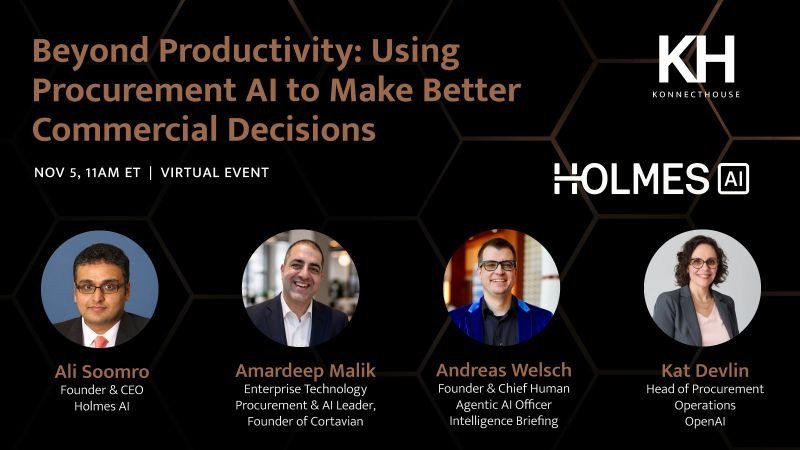
Andreas Welsch, an AI leadership expert and independent AI advisor, moderated the KonnectHouse webinar “Beyond Productivity: Using Procurement AI to Make Better Commercial Decisions” on November 5, 2026. Welsch has followed generative and agentic AI since 2016, and he opened by asking whether productivity is all organizations should expect, or whether there is more.
Three practitioners answered: Amardeep (Ammo) Malik, founder of Cortavian; Kat Devlin of OpenAI’s procurement operations team; and Ali Soomro, founder and CEO of Holmes AI.
Original source: KonnectHouse webinar page
Executive Summary
- Procurement uses AI heavily, but mainly to automate tasks, according to Soomro.
- Malik asks which business problem the AI solves and whether the saving matters commercially.
- Devlin’s agents improve through human review and weekly evaluation.
- Critical supplier negotiations stay human, while AI supplies research and benchmarks.
- Malik’s yardstick: better commercial decisions, not agents deployed.
Key Takeaways
- Automating disliked tasks is a sound first step, because errors surface fast.
- A 20-minute saving matters only if the business can say what happens with the time.
- Procurement touches a large share of spend, so AI limited to its own tasks leaves that influence untouched.
- Agents need feedback loops, because the business around them keeps changing.
- AI can advise on negotiations while people hold critical relationships.
- Working with AI means managing it: clear instructions, feedback and accountability.
What Is Procurement AI?
Procurement AI is the use of generative and agentic AI to support how an organization buys goods and services. It covers task automation, such as drafting contracts, checking intake requests and approving invoices. It also covers decision support, where AI analyzes contracts, market data and supplier performance to inform sourcing, cost and risk choices. The panel treated these as two stages of one AI strategy: automation builds confidence in the tools, and decision support improves the outcomes procurement delivers.
Why Automation Alone Falls Short
Soomro said procurement uses AI quite heavily, but primarily for automation. Soomro did not call that the wrong choice, since some automated tasks are real pain points.
The limit sits in what procurement professionals are asked to do: reduce cost, bring in the best suppliers, manage relationships and reduce risk. Soomro said AI applications in those areas remain limited so far. Welsch summarized the point: the goal goes beyond pointing an RFP bot at a supplier’s RFP bot.
Start With the Business Problem
Malik pushed the conversation toward commercial significance. Malik starts by asking which business problem a company buys the technology to solve. A 20-minute saving is measurable, but Malik asked whether it is commercially significant and whether it covers the cost of running the AI.
Malik put it to the team this way: “if I did save my team 20 minutes, what are they going to do with those extra 20 minutes?” As a buyer, Malik wants vendors to demonstrate net value. Malik described the market as being in a phase of “impressive functionality” and wants to reach real net value.
Welsch added that over the last three years vendors have put AI into products, sometimes where it helps and sometimes where rules or other means would work as well. He urged the audience to ask each vendor what net value the AI delivers.
Key Insight: Malik tests every AI purchase with three questions: which business problem it solves, who uses the time it frees, and whether the gain outweighs the cost of running it. A saving nobody can measure, or that costs more to run than it returns, counts for little in a commercial review.
Where the Leverage Sits
Soomro made a structural argument. A procurement department might make up around one percent of an organization yet touch something like 70 percent of its spend. If AI only makes that one percent faster, the influence over the remaining spend stays where it was.
Soomro would aim AI at the outcome of the work, whether risk, cost or quality. AI can consolidate streams of data on macro events, shipping and suppliers into a recommendation, which a person cannot do in a 20-minute window. At minimum, Soomro said, AI can act as an advisor on hard decisions.
Welsch asked what advantage remains if everyone cooks with water from the same well. Malik answered that use matters more than the model. One team drafts emails and reports, while another challenges supplier strategies and exposes contractual weaknesses, and the same model behaves very differently for each.
Feedback Loops Keep Agents Useful
Devlin described how OpenAI’s procurement operations team builds agents, starting small. An intake validation agent checks requests against rules, and a person can tell quickly whether the answer is right. The task repeats hundreds of times a day, so the team retrains the agent fast.
The helpdesk followed the same path. Humans reviewed every AI answer at first, approving it or supplying the right one, and that feedback taught the agent. Humans now handle the remaining exceptions, and the model keeps learning from them.
Welsch raised the risk of drift, as new suppliers and context arrive after launch. Devlin built feedback prompts into the agents, so a user who dislikes an answer can say why in the same window. Separate agents review the others weekly and produce a dashboard of what worked. Devlin put it directly: “This is not an RPA.”
Key Insight: Devlin’s agents ask for feedback in the moment, and weekly evaluation agents report on a dashboard. A launch followed by a short hypercare phase leaves an agent unmaintained, and Devlin expects it to stop meeting the business need within months.
Negotiation: Advice Yes, Delegation With Care
Welsch asked where agent-to-agent negotiation is headed. Devlin would not let an agent negotiate with a critical supplier, because the relationship matters. An agent can advise in the background. A colleague’s benchmarking dashboard gives the team market intelligence it never had, and the colleague still leads the conversation. For a low-stakes supplier, an agent negotiating makes sense.
Soomro added that negotiation means understanding what goes unsaid, and that AI “hasn’t learned the art of silence yet.” Soomro also sees sales teams with far more AI tools than procurement has, and hopes AI becomes “the great equalizer” for buyers.
Malik said the outcome hinges on knowing what matters to the business, what the supplier values, which risks to accept and when to walk away. Welsch shared a keynote anecdote: a Stanford professor reported that people who bring humor into a negotiation get more value, and people still do business with people.
Key Insight: The panelists split the work between AI and people. AI handles research, benchmarking and historical context, and people hold the relationship on critical suppliers. Malik listed what AI cannot supply, including supplier priorities, accepted risk and the point at which to walk away.
Managing AI Like a Team Member
Soomro treats AI as an extra person on the team. On a $100 million deal, a person stays in the loop and validates what AI researches. Smaller decisions can go to AI, because both sides can learn from a miss. Soomro’s conclusion: “AI has made sure that no one remains an individual contributor ever again,” so everyone must learn to manage.
Welsch tied this to delegation: it requires clarity on what you want, what the deliverables are and how you measure good. He noted the review burden, since agents can produce more output than a person can check, and admitted to saying “just fix it” and then wondering what the agent did.
Devlin said people hold AI to a higher standard than a human coworker. A human who made the same mistake would get coaching and an updated procedure. Devlin’s invoice approval agent checks 14 criteria. It started about halfway to the goal, reached 75 percent, and then beat Devlin by finding issues Devlin had never thought to check.
Key Insight: Devlin treats newly surfaced risk as the intended result. The decision stays with leaders, who can act on the finding, accept the risk, or engage security and add controls. That is the same call a leader makes when a person does the work.
Measure Better Decisions, Not Deployment
Malik cautioned that finding a saving differs from delivering one. Service levels, contractual obligations or business risk can block a flagged saving. Malik welcomes the findings, and adds that it matters less whether a person or a tool finds an opportunity than what the team does next.
Malik’s closing statement gave the room a test: “The question isn’t how many agents are running or how many processes we’ve automated. It’s whether we’re making better commercial decisions as a consequence of using these things.”
Key Insight: Malik rejects deployment counts as proof of progress, because the number of agents running and processes automated describes activity, not results. A team shows value when it can measure the improvement in its commercial decisions and explain it.
Leadership Implications
- Define the decision first. Name the business problem, the owner of the freed time and the measure of improvement, as Malik urged.
- Build feedback into every agent. Add in-the-moment feedback, human review and weekly evaluation, following Devlin.
- Aim AI at outcomes across spend. Target cost, quality and risk, per Soomro.
- Match autonomy to the relationship. Keep people leading on critical suppliers and high-value deals.
Why This Conversation Matters
The questions apply to any function adopting AI: separate activity from outcome, keep people accountable for decisions and design for change after launch. This ties to Welsch’s broader work on moving organizations from AI hype to business outcomes.
Conclusion
Procurement AI starts with automation and earns its place when it improves decisions on cost, supplier performance and risk. Welsch closed with advice for the audience: use AI as a sparring partner, and get hands-on.
Related Reading
- Why AI Adoption Starts With Becoming AI-Ready
- How AI Leaders Really Approach Agentic AI Automation
- Moving from Agentic AI Adoption to Impact
- Agentic AI Vendor Risk: Access Limits, Sovereignty, Workslop
Frequently Asked Questions
What does “beyond productivity” mean for procurement AI?
It means procurement AI should improve commercial decisions, not only speed up tasks. The panel called automation a useful first step, with the larger value in better outcomes on cost, supplier quality and risk.
Why is saving 20 minutes per task not enough to justify AI?
Malik argued a time saving counts only when the business can say what the team does with the time, and the gain exceeds the cost of running the AI. Malik asks vendors to demonstrate net value.
How do you keep an AI agent accurate after launch?
Devlin builds in-the-moment feedback so users can explain a poor answer, and separate agents review performance weekly on a dashboard. This loop lets agents adapt as suppliers and the business change.
Should an AI agent negotiate with suppliers?
Devlin would not use one for critical suppliers, because the relationship matters. An agent can advise in the background or handle low-stakes suppliers, while people hold the relationships that matter most.
How can AI help procurement beyond its own tasks?
Soomro said procurement touches a large share of company spend, so AI should target outcomes such as risk, cost and quality, consolidating data into recommendations a person cannot assemble quickly.
Why do teams using the same AI models get different results?
Malik said the difference lies in use. One team drafts emails, while another challenges supplier strategies and exposes contract weaknesses. The same model then acts very differently for each team.
What does managing AI like a team member involve?
Soomro treats AI as an additional person: ask the right questions, give feedback and hold the work accountable. Welsch added that delegating requires clarity on the outcome, deliverables and measure of good.
How should leaders measure procurement AI success?
Malik recommended measuring better commercial decisions, not agents deployed or processes automated. A team that cannot explain and measure that improvement should ask whether anything has changed.