

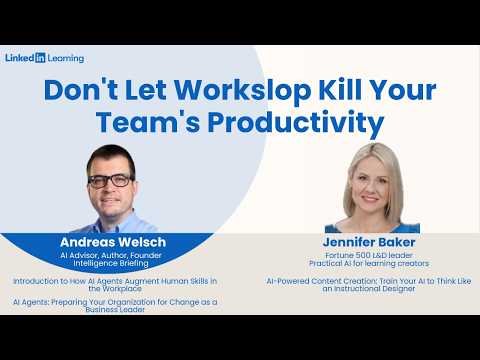
A conversation on catching AI workslop before it ships, and on using AI prompt frameworks and human review to keep AI-generated training content sharp instead of generic.
Most leaders have already seen it: a message, a slide deck, or a training module that is technically finished but says almost nothing. Andreas Welsch, an AI leadership expert, calls this pattern by its now-common name, AI workslop, and it has become one of the most visible side effects of fast, unreviewed AI adoption inside the enterprise.
Welsch raised the problem at the start of a recent LinkedIn Learning Office Hours conversation with Jennifer Baker, known professionally as Jen in AI, a Fortune 500 leader of talent and leadership development at Foot Locker and the instructor behind the LinkedIn Learning course “AI-Powered Content Creation: Train Your AI to Think Like an Instructional Designer.” Welsch noted that AI workslop shows up in his own inbox regularly, and that it is getting harder, not easier, to catch. The two instructors used the session to work through when AI genuinely helps a leader move faster, and when it quietly produces more work than it saves.
Why this conversation matters: as generative AI tools spread through every function, from executive communications to enterprise learning content, the leadership question has shifted. It is no longer “can AI do this,” but whether a leader should let it, and what review has to happen before AI-generated material reaches an audience. That question sits squarely inside AI adoption, AI governance, and workforce transformation, and it is one every CIO, CHRO, and business leader building an AI-enabled team now has to answer.
Executive Summary
- AI workslop is polished-looking output that fails to do real work, and it erodes trust when a reader can tell no human reviewed it.
- The operative leadership question is shifting from “could I use AI” to “should I be doing this myself.”
- A simple prompt framework, role, context, task, constraints, format, cuts down on generic AI output before it starts.
- AI can compress months of content production into hours, but only with a human still directing tone, accuracy, and judgment.
- Sending AI-generated messages without personal review carries real accountability and trust costs, not just a quality risk.
Key Takeaways
- Ask whether a task needs AI or needs you as the human, before opening the prompt window.
- Give AI explicit constraints, tone, format, and length, rather than accepting its first, generic answer.
- Treat AI as an assistant to direct, not a vending machine to accept output from unedited.
- An AI-generated message that reads like a bot undermines the relationship it was meant to strengthen.
- Feeding AI real audience context, reading level, role, and work environment, produces sharper first drafts.
- Human-in-the-loop review is what keeps speed from becoming a liability, especially for people decisions and external communications.
What is AI workslop?
AI workslop is AI-generated content, an email, a slide deck, a report, that looks complete on the surface but fails to advance the task it was meant to serve. Welsch described the experience of opening a message and recognizing, within a sentence or two, that “another piece of low quality content” had landed in his inbox, one that would now cost him time to fix rather than save him time to begin with. Baker connected the term to a specific, common failure mode: asking AI to build a presentation and getting fifty generic, run-of-the-mill slides back when the task needed five. The output exists, but it does not do the job, and someone still has to do the work the AI was supposed to remove.
Why AI Workslop Spreads Inside Organizations
Welsch pointed to a structural gap behind the problem: leaders are frequently told to use AI more, without being given guidance on what tool to use, when to use it, or where the line sits. That gap produces “shadow AI,” employees reaching for whatever personal subscription fills the void left by an unclear company policy, with no shared standard for what a reviewed, ready-to-send AI output actually looks like.
Key Insight: Workslop is less a technology failure than a guidance failure. Without a shared standard for what “AI-assisted, human-reviewed” looks like, individual employees default to whatever the tool hands back first.
A Simple Framework for Better AI Output
When a task does call for AI, tell the AI the audience’s tone preference, the file format needed, whether a chart should render inline or become a spreadsheet, and design details as specific as avoiding orphaned lines in a layout. Treating AI as an assistant that needs direction, rather than a tool that should already know what is wanted, changes the quality of what comes back on the first attempt.
Key Insight: Giving AI a role, context, task, constraints, and format, before asking for output, replaces the usual cycle of generating, rejecting, and re-prompting with a single stronger first draft.
Where the Line Sits: Authenticity and Accountability
Is it acceptable to use AI to write something that will carry someone else’s name and voice, a leader’s motivational note to a team, for instance, even when a human never wrote a word of it? Welsch raised a real example, a recent Wall Street Journal op-ed whose author defended having an assistant, a ghostwriter, or AI draft the piece, arguing that authorship does not matter as long as he stands behind the message.
Key Insight: A message a reader can identify as AI-written loses its persuasive power immediately, independent of whether its content is accurate. Authenticity is part of the message, not separate from it.
Using AI to Scale Content Without Losing the Human Voice
Welsch shared a concrete example from his own work: he took the manuscript of his latest book, “The HUMAN Agentic AI Edge,” fed it into Claude to draft scripts for short video lessons, then ran those scripts through an AI avatar tool using a voice clone he built in ElevenLabs and an animation tool called HyperFrames. The result was a full video course, published on Maven with AI-drafted descriptions throughout, produced without a traditional studio shoot. He noted the advantage for onboarding content specifically: when a process changes, a script line can be updated and the video rerendered, without booking a studio or a vendor again.
Key Insight: AI avatar and voice-cloning tools can compress months of content production into hours, turning one long training session into dozens of short, targeted modules without a full re-shoot for every update.
Why Oversight Still Has to Sit With a Human
Speed does not remove the need for a person in the loop. Welsch extends the accountability question to the avatar use case directly: if an AI avatar delivers a message in the wrong tone, or says something a leader would not have said, the leader still owns it, because the audience has no way to know the words did not come from a live, reviewed decision. Keeping that line clear, he said, is what keeps AI-generated delivery from becoming a liability rather than a time-saver.
Key Insight: An AI avatar delivering a message still carries the human’s full accountability. Oversight is not optional once a tool can convincingly speak in someone’s voice.
Leadership Implications
- Set a shared standard before mandating AI use. Telling a team to “use more AI” without defining what a reviewed, ready output looks like is what produces workslop and shadow AI in the first place.
- Require a constraints-first prompting habit. Build role, context, task, constraints, and format into how the organization prompts, rather than accepting a first draft and editing it down after the fact.
- Draw an explicit boundary around decision-heavy, relationship-heavy, and IP-sensitive tasks. These stay human-led, with AI supporting rather than substituting.
- Treat AI-avatar and voice-clone content as still fully attributable to the human it represents. Build review and sign-off into the workflow before anything goes out under someone’s name or likeness.
- Invest saved time in higher-value human moments. Both instructors pointed to live dialogue, an office-hours session, a town hall, as where the freed-up time should go, not into producing more unreviewed content.
Why This Conversation Matters
The challenge is a leadership problem larger than any single tool: organizations are handing employees AI capability faster than they are handing them a standard for how to use it well. That gap is where workslop, shadow AI, and trust erosion all originate. For leaders building AI adoption programs, governance policy, or workforce enablement strategy, the practical takeaway is before picking up any AI tool, ask not whether AI could do the task, but whether it should be the one doing it.
Conclusion
AI workslop is not a temporary growing pain of early AI adoption. It is the predictable result of speed without a shared review standard, and it will keep showing up in inboxes and slide decks until leaders close that gap deliberately. The path forward that Welsch described is neither AI-avoidance nor AI-maximalism: it is a constraints-first prompting discipline, an explicit boundary around decision-heavy work, and a human who stays accountable for anything published under their name, however it was produced.
Frequently Asked Questions
What is AI workslop?
AI workslop is AI-generated content that looks complete but fails to accomplish the task it was meant for, forcing the recipient to spend time fixing or redoing it. It commonly shows up as generic emails, bloated slide decks, or reports that read as technically finished but substantively empty, and it is one of the clearest signs that AI output shipped without human review.
How can leaders prevent AI workslop on their teams?
Leaders can prevent AI workslop by pairing any AI-use mandate with a clear standard for what reviewed, ready-to-send output looks like, and by training teams on a constraints-first prompting habit rather than accepting a first AI draft as final. Without that standard, employees default to whatever the tool returns, and unclear guidance is what pushes people toward unsanctioned “shadow AI” tools in the first place.
Should AI ever write a message that goes out under a leader’s name?
Both instructors treated this as a live judgment call rather than a settled rule. Jennifer Baker argued that a message a recipient can identify as AI-written erodes trust and reads as disrespectful of the reader’s time, even when its content is accurate, so she reviews and personalizes every AI-assisted output before it goes out under her name.
How is AI changing content creation for learning and development teams?
AI is letting learning and development teams compress content timelines dramatically, turning a task that once took months, such as breaking a long training session into targeted short modules, into a matter of hours by using AI to extract key moments and AI avatar tools to produce the video output. The compression comes with a corresponding need for stronger human review before that content reaches an audience.
What is the difference between using AI and using AI well?
Using AI means letting the tool generate output on request. Using AI well means directing it deliberately, through explicit prompting constraints, audience context, and human review, so what ships reflects the sender’s judgment and voice rather than the model’s generic default. It is as knowing when to pick up AI and when to embed yourself in the work instead.
What should stay human, even as AI takes on more content production?
Decisions involving people, relationships, personal data, or intellectual property should stay human-led. Any AI-delivered message, including one voiced by an AI avatar, still carries the full accountability of the person it represents.
Can AI avatars and voice clones replace a leader in every setting?
No. Both instructors described AI avatars as valuable for scaling reach, delivering a message across time zones or producing many short training modules, but not as a full substitute for live human interaction. An AI avatar’s use directly requires accountability that applies to anything a leader says personally.
Original source
Watch the full conversation, “Don’t Let Workslop Kill Your Team’s Productivity,” on YouTube.
Related reading
- How to Prevent AI Workslop and Retain Human Judgment
- How Real AI Deployments Change Learning and Development Organizations
- Agentic AI Leadership: From Pilots to Value