

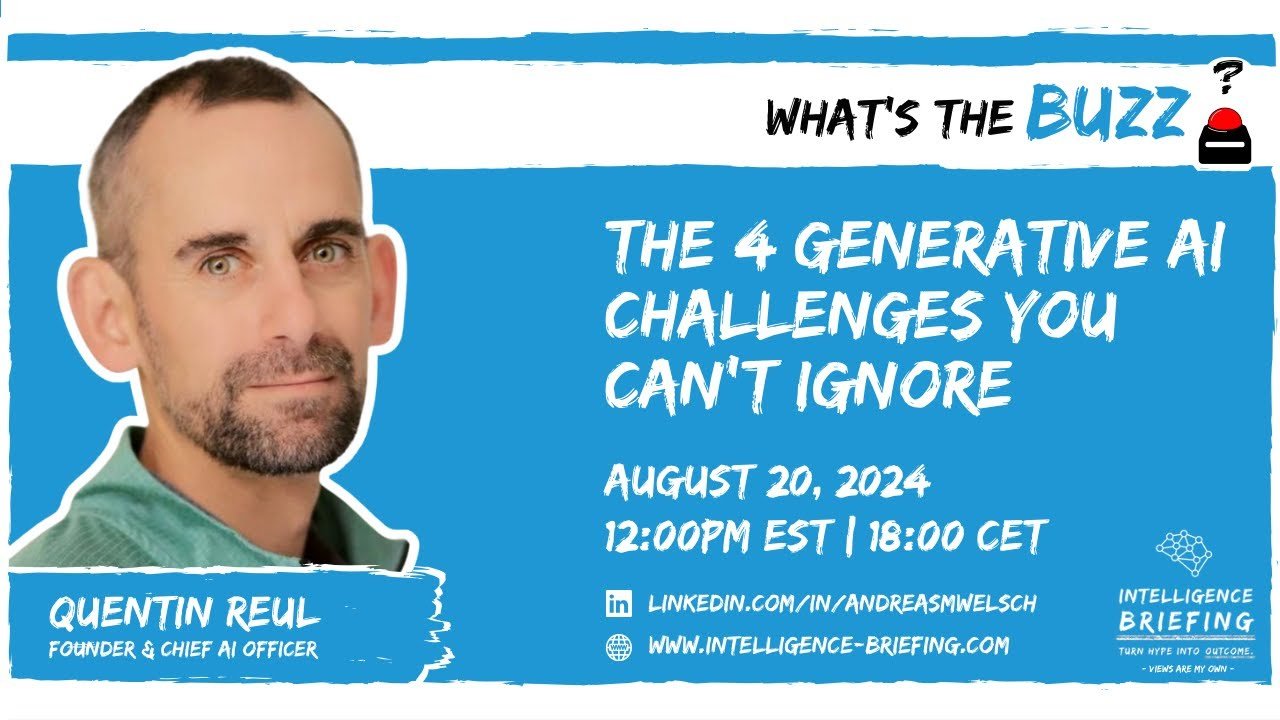
Guest: Quentin Reul, Founder & Chief AI Officer
Host: Andreas Welsch
Episode: What’s the BUZZ?, Season 3, Episode 22
Published: August 20, 2024
Episode Summary
Quentin Reul, Founder and Chief AI Officer, answers the question of which four generative AI challenges business leaders cannot ignore. He and Andreas cover how the generative AI landscape has shifted business strategy, how to assess the fitness of different large language models, which technologies address the challenges, and what role data plays. Quentin argues that business value sits in narrow AI tied to a company’s niche, that teams should test models against a golden set of about 500 data points, and that a company’s own data remains its differentiator when it fine-tunes smaller models.
Key Takeaways
- Quentin says the direction of the big LLM providers, toward artificial general intelligence, differs from where business value sits: in narrow AI specific to a company’s niche.
- Quentin describes a cost to be wrong: the higher it is, the higher the risk of hallucination, and where it is near zero he calls the result creativity. He links this to the risk tiers in the EU AI Act.
- Quentin treats public benchmarks as a pre-selection step and recommends a golden set of about 500 data points to test and monitor models over time, since SaaS models change.
- Quentin recommends LangChain for proof of concept and early analysis, but not for production, where he finds it heavy.
- Quentin says data is still the differentiator: fine-tuning a smaller model on a company’s own data creates an advantage that using GPT-4 out of the box does not.
Timestamps
- 00:28 Welcome and guest introduction
- 02:38 The game In Your Own Words: AI as a fruit
- 04:34 How generative AI has changed business strategy
- 06:44 Combining LLMs with narrow AI, and the cost to be wrong
- 10:13 Not every problem is a generative AI problem
- 11:04 Assessing the fitness of LLMs: benchmarks and golden sets
- 15:11 Trial and error with prompts, Gemini and LangChain
- 18:08 Technologies that address the challenges
- 20:38 Why LangChain is heavy for production
- 22:35 The role of data: regulation, fine-tuning and differentiation
- 27:10 Three takeaways
- 28:31 How to connect with Quentin
About Quentin Reul
Quentin Reul is Founder and Chief AI Officer. He is originally from Belgium, completed his bachelor degree and PhD in the UK, and has lived in Chicago for 10 years. He previously worked at a Fortune 500 company and now helps companies with their AI strategies, combining UX with deep knowledge of the technology.
Full Transcript
Read the full transcript
Andreas Welsch: Today we’ll talk about the four generative AI challenges that you cannot ignore. And who better to talk about it than someone who’s passionately sharing advice on them. Quentin Reul. Hey Quentin, thank you so much for joining.
Quentin Reul: Hi, thank you for having me today.
Andreas Welsch: Wonderful. Why don’t you tell our audience a little bit about yourself, who you are, and what you do.
Quentin Reul: Yeah, so my name is Quentin Reul. I’m originally from Belgium. I did my bachelor degree and my PhD in the UK, and I’ve now been in Chicago in the US for 10 years. On the side of work, I do martial arts with my kids and my wife. And it’s a lot of fun. From a work perspective, I worked at a Fortune 500 company before, and I’m currently helping companies with their journey into AI strategies by adopting UX but also the technology and the deep knowledge in technology in doing so.
Andreas Welsch: That’s awesome. Again, thank you so much for being on the show today. And I know you’ve been sharing a lot of your advice and experiences on social media lately. Should we play a little game to kick things off? Wonderful. Hang on. Let’s see. This game is called In Your Own Words, and when I hit the buzzer, the wheels will start spinning. When they stop, you’ll see a sentence, and I would love for you to answer with the first thing that comes to mind, and why. To make it a little more interesting, you only have 60 seconds for your answer. And folks, for those of you in the audience, you can participate too. Put your answer and why in the chat as well. Quentin, are you ready for What’s the BUZZ? Okay, here we go. Almost. Here we go. It is a live show. If AI were a fruit, what would it be? 60 seconds on the clock, and go.
Quentin Reul: I would be an apple, in as much as you have a lot of layers, and it tastes good if you eat the skin, but if you remove the skin and the layers and you try to dig deeper and eat the apple, the more you know and the better you can leverage it.
Andreas Welsch: Wonderful. And I think there’s a love there at the core as well that you need to know about and how to get close to it. Wonderful. And it grows again if you use the seeds, so it’s regenerative. Perfect! I love that answer. Excellent. And I see comments here from Ashwin, he’s joining us from Hyderabad, and he said, yeah, something sweet. Exactly. I think that’s where we’re still at in that phase where it’s sweet and we’re figuring out what else we can do with it. Can we make apple pie and applesauce and apple cider and whatever else? So very versatile too. Okay. So with that out of the way, why don’t we talk about the topic of the show? The four generative AI challenges that you need to know about. If you look at the history of the last two and a half years, ever since ChatGPT has come on the map, I think there’s been not only so much hype, but also already so much maturity, so much evolution, that I’m curious what you are seeing. How is generative AI evolving, and what is the impact on business strategies?
Quentin Reul: Yeah, I think if we look at what happened from November 2022 to maybe July 2023, a lot of companies were at the forefront of the fear of missing out on leveraging generative AI, and they were looking at a lot of different use cases and what they could do with it, what advantage and what gap it was filling compared to more traditional machine learning. Out of the box, you had thousands of data points that you can now use and models that were pre-trained for problems that were complex, compared to before, where you needed to spend years creating the training sets. But I think now there is a realization that maybe the direction that the big LLM providers like OpenAI or Anthropic are going in and where the companies are going is not necessarily the same direction. OpenAI is promoting artificial general intelligence, and I think that for businesses, their value is more in narrow AI. They will gain value in content creation and marketing by leveraging AGI, but it’s where they are very specific to their niche that the differentiation is going to come. So I think we’re going to start seeing a realization that not all use cases you have could be fulfilled with large language models. If you want to do the prediction of what to put on your shelf tomorrow, an LLM is not going to help you. But if you are trying to create content, or you’re trying to answer questions, it’s there and it can help you.
Andreas Welsch: That’s the part where I’m always curious to see the two combined. We know that LLMs hallucinate, they have factual inaccuracies, they have some biases, they are not even able to do certain tasks that narrow AI and even predictive analytics and machine learning can do. I feel if you combine the two, or if you create a prompt where you substitute some information and some variables and you put in those data points that you have generated using other proven technologies and methods, then it’s a good vehicle to leverage the best of both worlds. What are you seeing there?
Quentin Reul: I think, like what I was working on there at the Fortune 500, we were working with a lot of different models and GPT-4, and to be honest, there were not a lot of use cases for which we needed something different than GPT-4, because they weren’t generic enough. Now, I think once you get to the point that you just mentioned, which I tend to call or refer to as a cost to be wrong: the higher the cost to be wrong, the higher you have a risk of hallucination. If your cost to be wrong is nil or zero, I call it creativity. And I think that’s another thing that businesses need to think about, that there are plenty of use cases where creativity is important and actually useful. I have blank page syndrome. Whenever I try to write, and I wrote a PhD and it took me a long time, if I had had generative AI, it would have been much faster. I get stuck on the page and I want to rewrite everything. LLMs are very good for that problem. But if I try to make a judgment, let’s say predict or give a treatment to a patient or predict how to apply law for particular problems, I can’t be wrong. I can cause someone to go to jail or I can cause someone’s death. So I think that’s where we need to look at the problem at a different scale. I think that’s what is being done with the EU AI Act, where they have different levels of risk for assessment. And more recently, I saw that the IEEE is following that same methodology in terms of accrediting whether your solution is going to be ethical. They look at it from the perspective of low risk, medium risk, high risk and unacceptable risk, and things that are considered unacceptable risk are things like social scoring, where, for example, you would be in HR and you would use whether people are attending meetings or whether they’re sending emails as a way to determine whether or not they are productive and whether they should stay in the company or not.
Andreas Welsch: Now, I think those are really important aspects in coming back to that challenge. It’s first of all understanding what you can use the technology for and what you can maybe use other technologies for that are better suited, that are maybe cheaper, that are maybe more cost effective to operate and to build. Certainly everything has a trade-off, but again, you don’t need a large language model for so many use cases. Now I’m curious, folks, for those of you in the audience, if you have a question for Quentin or me, please put it in the chat. We’ll take a look in a minute or two and pick up those questions.
Quentin Reul: And I think to the last point that you made, Andreas, with regard to not every problem being a generative AI problem, I think that’s a responsibility of the technology leader. They need a deep enough understanding of the technology to be able to advise the business and their partners that yes, you could use generative AI, or you could put an AI label on it, but that doesn’t mean that you’re going to have a better product for your customers. Because at the end of the day, as a business, how are you making money? What is your return on investment? It is about delighting your customers by providing a solution that is intuitive. If integrating AI makes it more complicated for the solution or the problem or the process that people are going through, you’re not really helping your customers and you’re not necessarily going to get the return that you’re looking for.
Andreas Welsch: Now, you’ve mentioned you’ve worked at Fortune 500 companies. I did a bit of work in previous roles in corporate with Fortune 500 companies as well. And I heard leaders say just recently, at the beginning of the year, if it’s not generative AI, it’s not AI, or we’re not pursuing it. And I think that’s misleading in so many ways. It’s challenging. It’s troublesome. To your point, you need to know when to use a large language model and when to use your logistic regression or other capabilities. I’m wondering, from your experience, how can you assess the fitness, if you will, of different LLMs and different approaches if you want to solve a particular need, so you don’t run into the trap of if it’s not gen AI, we’re not doing it?
Quentin Reul: Yeah, I think there’s been a lot of work done in evaluation and benchmarks, and I think they’re providing good insight as to whether or not a model is better than another model. But we have to be very careful when it comes to looking at benchmarks, because they’re not designed for your narrow AI problem. They are designed for very generic problems. The coding benchmark is looking at different languages, but it’s probably not very extensive on SQL. It’s also somewhat misleading because we have seen some companies using part of the benchmark as their training set, and that causes overfitting, because it does what it says it’s going to do because you trained it on that. So I think that’s definitely one aspect: you can use a benchmark as a pre-selection for what you’re going to look at, based on the type of problem that you have. But after that you really have to test it. You have the Chatbot Arena, where you can put two different LLMs side by side, and you have your prompt and you see which one is going to give the best results. That’s an interesting exercise if you are creative. But if you are a company, you really have to invest in a golden set. You probably don’t need as many data points as you needed before. A good training set or a good golden set of 500 data points is probably going to be sufficient, but that gives you the ability to test the different models over time, not only the first time as you’re creating, but a lot of these models are evolving very rapidly, and because they’re offered as SaaS models, today they’re there, tomorrow the new version is out and the old version is gone. And there is an opaque problem in as much as you don’t know what training data is going in. So you don’t know whether the fitness of your LLM from your previous assessment is going to remain as you’re doing your assessment. So monitoring and having that golden set for ongoing monitoring is very important.
Andreas Welsch: That’s an important point that you’re bringing up. And I feel that hasn’t been getting as much attention lately as it did probably a year ago. As models change, even if your API stays the same, if the LLM underneath changes from GPT-3 to 3.5 to 4.0 to whatever is next, you need to do your regression testing again. You need to test if the same prompts work. We know that between 3.5 and 4 there are differences in the creativity and other aspects of these models underneath. So you need to build that into your plan as well, and you need to make sure that you have resources and budget to do all these changes, especially if vendors are deprecating models, so that you can react fast enough to put in the new ones.
Quentin Reul: And it’s very much trial and error. At the end of the day, to give you an example, as I mentioned, I have blank page syndrome and I started creating an application to create blogs, because most of the solutions that exist can get you somewhere, but they were not giving me the solution that I wanted. I used Gemini. I was writing my prompt and my goal was to create blogs that were of a certain length, either in time or in number of words. And when you do LLMs and it fails the first time, what do you do? You go back and you change your prompt, because it’s the cheapest thing you can do. And you tell the LLM to actually rewrite the prompt in a way that it would understand itself, so it will provide more context, it will write the information with the right level of instructions and so forth. But you get to do that four or five times and you realize that it’s not the prompt that is the problem. In that particular case, I did some digging, and what I realized after a while is that there was no training data about length. And therefore, no understanding of that. It could predict length in the next token, but because there wasn’t a notion of length as part of the training data, it was not able to follow my instruction to the end. I think that’s where you really need to test. And frameworks like LangChain are very useful for that because they provide you with an easy way to integrate with different providers in a quick way. About a year and a half ago, if you were on Azure, the only models that you had were the OpenAI models. That has changed now, with Azure AI Studio, where you can have access to Llama and choose every integration through Hugging Face. Before that, you were stuck with one thing. So at least now you have a bit more of that connection, but I think something like LangChain is definitely the best thing to use at the PoC or the early analysis stage. I wouldn’t necessarily use that framework in production, because it’s very heavy and leverages a lot of other libraries. But in terms of doing that research aspect, what we used to call EDA in more traditional machine learning, if you do that with something like LangChain, then you’re going to get faster results and you are going to be able to do that comparison much faster as well.
Andreas Welsch: Awesome. And just looking at the chat here, somebody saying, I asked it one time if it can count, smiley face, it can’t. I’m sure it thought it could. But we’ve seen those examples. It’s a good reminder as well. Now, we’ve already talked about this notion of not giving in too much to this hype of everything should be generative AI. We talked about, hey, there are some evaluation frameworks and methodologies. But what are some of the technologies that you’re seeing that can address those challenges of generative AI?
Quentin Reul: I think LangChain is definitely one that can help you with that integration. I think it’s so difficult today to stay up to date with all the tools. Every day I’m on TLDR getting my news on what is happening in AI, and many other newsletters, and there’s just no way you can keep up with all the tools. You have llamafile, you have a lot of things that are happening. We spoke about different aspects, but completion as opposed to chat also has a totally different aspect. For example, I was asking a normal LLM, I think it was Llama, to write a blog, and I’d given the instruction and the Llama model just gave me back the instruction. But then I used Llama Instruct and I provided the same prompt through Llama Instruct and it created the blog that I wanted. So it’s again with this trial and error that you will find some of these aspects and be able to address them as you go forward.
Andreas Welsch: I think that’s a really important point as well. Do your evaluation, especially now that there is so much choice and it seems like it only keeps getting bigger and more complex. What do you use for what? Do your evaluation and see what type of tasks you have, and which model performs well or even better than others. There’s one question from Jennifer here in the chat, and she says, hey, you mentioned that LangChain is heavy and not suitable in production. Can you share more about this? Or maybe qualify what you meant when it comes to LangChain and similar tools.
Quentin Reul: Yeah, so LangChain, because it was designed as a community effort trying to address all of the different LLMs, brings in TensorFlow, it brings in PyTorch. As you’re creating an image, let’s say a Docker image based on LangChain, it’s going to be bloated. If I recall correctly, it was something like 6 GB. And my prompt and my code was maybe about 200k. And that has an implication on how you are going to productionalize it. A lot of the use cases that I see are still very much on demand. It’s not that you have a lot of use cases where your LLM is going to run 24/7 and process content all the time. One way that you’re going to minimize your cost and be able to scale is something like Lambda or serverless, depending on whatever infrastructure you are on. But there are limitations. For example, Lambda doesn’t support Docker images above a certain amount of memory. So now you have to create layers on top. You are adding complexity by using something like LangChain. It has a lot of things that may be useful, but if you’re using OpenAI, you don’t need access to Oracle Cloud Infrastructure. You don’t need access to Bedrock, because you’re not going to use any of these components. Whereas if you were using the OpenAI or the Microsoft Azure API directly, it’s going to be much leaner because it’s only going to have what is necessary to do the job.
Andreas Welsch: Wonderful. Thank you for summarizing that. I think that was really tangible and some good advice there. What are some of the complexities that you inherit when you go down a certain path? You also mentioned that you don’t have a continuous loop, where it’s not always on, depending on the use cases that you see, especially in the enterprise. To me, that comes back to data, to pipelines, these kinds of topics. And you alluded to that earlier. Yes, large language models help us get to production faster. We might not necessarily need to be a data scientist to get something out there, at least something that’s good enough. I’m curious, what are you seeing? What’s the role of data still when it comes to LLMs in that current landscape, especially looking at regulation? At the beginning you talked about the EU AI Act and the IEEE. What role does data play there?
Quentin Reul: Yeah, I think it goes back to the goal of the companies, like OpenAI and AGI, as I mentioned earlier, and narrow AI. If you take a large language model that includes a lot of information and you want to apply it to a narrow problem, like what you have in your business, trying to make it unlearn things that may be causing hallucination is not that easy. Now, if you take a smaller model, like a Phi model or something else, and you fine-tune it with your own data, which you’ve been gathering for many years, then you actually have that unfair advantage that you want to have against your competitor. If you’re all working out of GPT-4 without any data that is local to your problem or local to what you’ve built over the years, you’re no different than the other companies that are using GPT-4. Now, if you’re using your data and you’re integrating that, either through few-shot learning, but more generally I think through fine-tuning on a smaller model, that’s the point at which you can differentiate the worst shooting. And today, from Gemini to H2O, there are so many platforms that are making it easier for people to fine-tune their models. And the cost of fine-tuning is also much lower than what it used to be. If you think about pre-generative AI, when you needed hundreds of thousands of data points to train your model, for fine-tuning you need maybe a thousand or two thousand. And that has proven to already show a remarkable difference from using a model out of the box. And to be honest, there are certain problems for which an LLM is never going to address the problem, even though it’s generative. If you think about relational databases or knowledge graphs and every query-based language, yes, there’s been some training of the models on SQL and the SQL syntax. But in a lot of these cases, that syntax then needs to map to the underlying data model, which is unknown. So to really be efficient at creating queries that are going to work with your data, you need to fine-tune it to your schemas, to your tables, or to whatever else you have used to express that data. Otherwise, you’re only going to have garbage in and garbage out. And you’re not going to get the answers that you’re looking for.
Andreas Welsch: Awesome. I love that one because I think that’s such an important one in business, where there is so much data, and that’s the key differentiator that makes your business unique, that makes your processes unique, that gives you the edge and has been doing that for a number of years. So bringing that into your LLM application to make the output more specific, whether it’s the summarization or the recommendations, writing assistant type things or tweaking things, I think that’s really key. So thank you for highlighting that as our fourth challenge: you still need data if you want to continue differentiating and not do things that everybody else is doing as well. Now, Quentin, we’re getting close to the end of the show, and I was wondering if you can summarize the key three takeaways for our audience today.
Quentin Reul: Yeah, the first one is a quote that an old colleague of mine used to have. It’s: fall in love with a problem. And I mean the customer problems, the narrow problems that you’re trying to solve. Not the solution. And in this case, generative AI doesn’t apply to all the problems that you may have. Two, as we spoke about: data is still your differentiator. You may have spent a lot of money doing a data warehouse over time. It’s probably translated now into a data swamp, but you have that data and you are able to take a small slice of it and put it back into your model and fine-tune it to your problem. And the last one: data-driven companies were already going to be the differentiator with big data. But I think with AI it is going to be the game changer. And I get confused when I hear companies that were data companies becoming AI companies. Because I’m pretty sure that in a few months they would have to change their labels back to data companies, because that’s going to be the true reason that’s going to resonate with their customers a lot better than AI companies.
Andreas Welsch: Awesome. Wonderful. Thank you so much. And maybe one question. How can people that have joined today’s session or listened to it connect with you and learn more about what you do and maybe how you can help them?
Quentin Reul: Yeah. I’m on LinkedIn. And I’m also on X, and I have recently started a YouTube channel where I’m putting the recordings of different presentations that I’ve given. So I’m trying to curate the material as I go along. I also have written a few blogs about how to take the problem of generative AI from inception, using things like the jobs-to-be-done framework, all the way to how to consider it, how to charge, and how to monetize your solution depending on how you are applying the content and whatever else. So all of that is on my page and you can reach out to me.
Andreas Welsch: So folks, do make use of that opportunity and reach out to Quentin for more advice and insights. Now, Quentin, again, thank you so much for joining us and for sharing your expertise with us. I think it was a great session. I learned a lot and hope you and the audience did as well.
Quentin Reul: Thank you.
Listen and Subscribe
Related Reading
- AI Readiness for Enterprise Leaders
- AI Leadership for Enterprise Leaders
- AI Leadership Handbook
- Why AI Adoption Starts With Becoming AI-Ready
Frequently Asked Questions
What is the cost to be wrong in generative AI?
Quentin uses cost to be wrong to describe the risk of hallucination: the higher the cost of an error, the higher the risk. Where the cost is nil, he calls it creativity. He ties the idea to the risk tiers of the EU AI Act and the IEEE.
How can a company assess which large language model fits its need?
Quentin treats public benchmarks as a pre-selection step, because they are not designed for a narrow business problem and some companies train on part of them. He recommends testing against a golden set of about 500 data points and monitoring it over time.
Is LangChain suitable for production?
Quentin recommends LangChain for proof of concept and early analysis, where it speeds up comparing providers. He would not use it in production because it is heavy: his example was a Docker image of about 6 GB around roughly 200k of his own prompt and code.
What role does data play in generative AI strategy?
Quentin says company data is the differentiator. Companies using GPT-4 without local data look like everyone else, while fine-tuning a smaller model on years of their own data creates an advantage. He adds that fine-tuning needs far fewer data points than training did before generative AI.
Is every business problem a generative AI problem?
Quentin says no, and calls it a technology leader’s responsibility to understand the technology well enough to advise the business. An AI label does not guarantee a better product, and he points to return on investment and delighting customers as the test.