

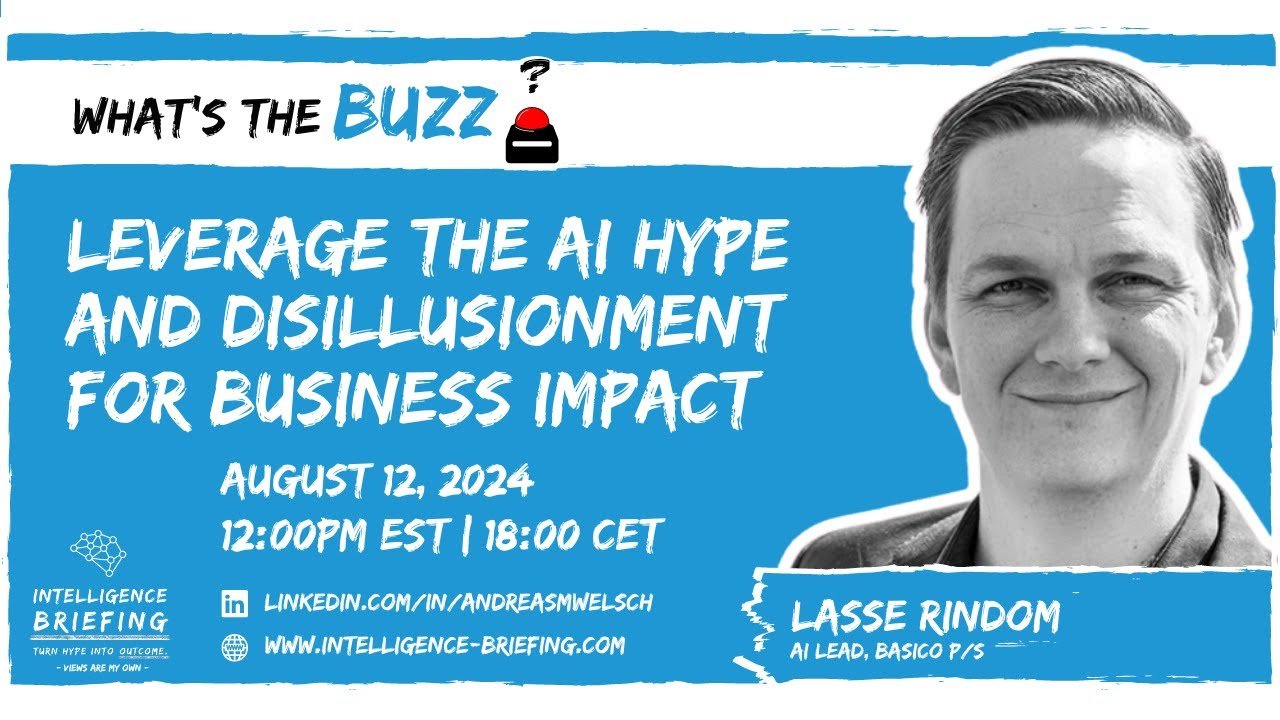
Guest: Lasse Rindom, AI Lead, BASICO
Host: Andreas Welsch
Episode: What’s the BUZZ?, Season 3, Episode 21
Published: August 13, 2024
Episode Summary
Lasse Rindom, AI Lead at the Danish consultancy BASICO, answers the question of how AI leaders can use the gap between AI hype and disillusionment to drive business impact. Andreas opens with analyst warnings, including Gartner’s expectation that about 30 percent of generative AI projects never leave the pilot stage, and asks what happens next. Lasse argues that technology vendors sell capability, not outcomes, and that leaders need to turn broad models into specific AI for specific roles and train people to use it. He also explains why he still sees reasons for businesses to keep investing and what he observes in Denmark.
Key Takeaways
- Lasse says tool developers lead the AI conversation, and they build the equivalent of airplanes while businesses need airlines: it is up to enterprises to translate the capability into outcomes.
- Lasse recommends well-defined, narrow AI for specific roles over broad agents that can do anything, and closes the episode by urging more talk about roles than agents.
- Lasse says buying Copilot and leaving people to work it out falls short: employees need training and patience, because you don’t automate things you don’t understand.
- Lasse sees continued reasons to invest, because the technology works out of the box on unstructured data and expands the footprint of digital transformation.
- Lasse says innovation and risk belong in the same conversation, quoting a guest on his own podcast who called them the two sides of the same coin.
Timestamps
- 00:24 Welcome and guest introduction
- 02:17 The game In Your Own Words: AI as a movie genre
- 04:17 Gartner and Morgan Stanley forecasts: what happens between AI hope and AI hype
- 08:31 The real problem AI should solve: productivity claims and specific roles over broad agents
- 12:35 How leaders can use the market momentum, and which lines of business lead
- 16:24 Analysts tone down forecasts: what leaders do next
- 21:01 Why businesses keep investing in AI
- 24:10 AI adoption in Denmark and the Nordics
- 26:20 Innovation and risk belong in the same conversation
- 27:25 Three takeaways
About Lasse Rindom
Lasse Rindom is AI Lead at BASICO, a Danish consultancy, where he drives go-to-market efforts on AI and automation. He describes himself as an automation pioneer who has worked in automation for the last 10 years, and he runs the podcast The Only Constant.
Full Transcript
Read the full transcript
Andreas Welsch: Today we’ll talk about leveraging the AI hype and disillusionment to drive business impact. And who better to talk about it than someone who thrives in that environment, Lasse Rindom. Hey Lasse, thank you so much for joining.
Lasse Rindom: Hi Andreas, and thank you so much for having me today.
Andreas Welsch: Awesome. Hey, why don’t you tell our audience a little bit about yourself, who you are and what you do?
Lasse Rindom: So my name is Lasse Rindom and I am, first of all, an automation pioneer. I’ve been working a lot in automation for the last 10 years. And I am the current AI lead at the Danish consultancy BASICO, where I drive our go-to-market efforts on AI and also on some automation. I also run the podcast The Only Constant, where I’ve had you, Andreas, also as a guest. So that’s really nice.
Andreas Welsch: Awesome. We’ve been in touch for a long time. So it’s always great to connect with you and now I’m looking forward to sharing that with our audience as well. So with that out of the way, Lasse, what do you say, should we play a little game to kick things off?
Lasse Rindom: Let’s do that. I know you always do that, Andreas. I’m quite intrigued to see what you’ll come up with this time.
Andreas Welsch: Alright, so this game is called In Your Own Words, and when I hit the buzzer, the wheels will start spinning. When they stop, you’ll see a sentence, and I’d like for you to answer with the first thing that comes to mind, and why, in your own words. To make it a little more interesting, you only have 60 seconds for your answer. Folks, for those of you in the audience, please put your answer and why in the chat as well. Lasse, are you ready for What’s the BUZZ?
Lasse Rindom: Yes, let’s do that.
Andreas Welsch: Okay, perfect. Here we go. If AI were a movie genre, what would it be and why? 60 seconds on the clock. Go.
Lasse Rindom: It’s actually quite simple. The first thing I think is sci-fi. It has to be science fiction. This is something I spoke to some other people about on my own podcast: AI is the only technology we have today that has its own Hollywood genre. We’re not going to see ERP movies with Sean Connery and Tom Cruise running around, or BI with Keanu Reeves. We don’t do that, but we have AI as a whole genre. There are tons of movies about AI going wrong or doing good. That plays a lot into the imaginations of people and into the assumptions people have getting into this, and perhaps it adds both to the hype and to some of the disillusionment that we’re seeing in the market. So that’s obviously sci-fi, definitely.
Andreas Welsch: I love that answer, but don’t underestimate the budgets that some of those vendors have to create even shorter videos for more. I love that we’re not seeing ERP or BI movies, but never say never.
Lasse Rindom: Let’s hope it’s not some boring documentary about a budget overrun, right?
Andreas Welsch: Yes. Perfect. So we’ll make sure that the next 25 minutes are anything but boring. And if we look at some of the recent coverage, whether it was Gartner just the other week saying that they expect about 30 percent of generative AI projects never to make it out of the pilot stage, never to make it into production. I think it was Morgan Stanley a couple of days earlier saying there’s so much more investment needed in this market. And let’s tone it down a little bit. Maybe it’s not delivering all the value that we expected so quickly. It’ll take some time. You’ve seen this before, whether it was automation or AI. What do you think happens next when the industry is somewhere between that AI hope and AI hype?
Lasse Rindom: So I think if you only say 35 percent, it’s actually much better than what we saw with something like RPA, where 70 percent didn’t make it. We talked about the POC cemetery back then, and that’s a phrase that some of us would have hoped we wouldn’t have to come up with again. Unfortunately that is happening, and it’s not that difficult to understand why. We’re giving people a novel capability, a tool that’s very techie, very nerdy. The things it does and why it does it is quite nerdy. And we’re just saying, hey, now you’re more productive, have fun with it. So we are inviting people to make mistakes and try things out that won’t work. We’re also letting those who develop these tools lead the discussion. Someone like NVIDIA or OpenAI drives the discussion and the marketing around this. Who’s hiring developers? That’s NVIDIA. And who’s hiring graphic workers? That’s OpenAI. And you’re like, but guys, don’t you know the real world? And they don’t, because what they produce is like airplanes. They don’t produce airlines. It’s up to us to translate this into airlines. So I think a lot of the misconceptions have come from that space, from what we hear we’re supposed to do with this. That’s not necessarily what we have to do with it. Technology has not really touched the world yet. The world has not touched the technology yet. It’s still very fresh and very novel that way. But I also think these messages right now that smell of disillusionment, the winter is coming from the Game of Thrones thing, the winter is only as cold as the summer was hot. So it’s all relative. The hype we’ve had has been so massive that even my wife’s grandmother knows about this AI. Everyone knows about it, everyone’s talking about it. So of course there will be some disappointments, because it can’t be like that. Nothing changes that quickly, and thank God it doesn’t, because it would be incredibly insecure to live in that world. So I think that was a very hot summer. But I also think that most enterprises, and this is just from the conversations I’ve had, have kept a rather tight leash on the AI. Maybe they’ve done Copilot or they’re giving people access to ChatGPT, but that’s still been a limited investment for most of them. So I don’t think the hype is really hurting enterprises as much. Most of them have been playing a waiting game. From older tech waves we’re used to looking at insurance or banking to see what they’ve done with it, because they’ve always been ahead. But this time no one’s been ahead. Everyone has access to the same ChatGPT at the same cloud. There are no better models out there than the ones all of us have access to. There’s no one who’s had it for 20 years. It’s the same level we are at, especially with the foundational models, obviously, that I’m talking about here. That also means there was no one to look to, no one to imitate. So everyone’s been playing this waiting game a little bit, doing some things but not a lot. I think the ones that are going to get a little burned here are the investors who’ve been investing in airplanes when they should have invested in airlines. That might be a real issue.
Andreas Welsch: So real quick, folks, for those of you in the audience, if you have a question for Lasse, feel free to put it in the chat as well. I’m going to take a look in a minute or two and pick them up, but keep on going.
Lasse Rindom: But I think we also have to talk about what the real problem is that these models are trying to solve. The productivity claim is quite unspecific. I used to say that it’s an unfalsifiable claim to say that if you use this AI, tomorrow you’ll be more productive. Maybe I wake up tomorrow and I’m not more productive. I’m still just me. I haven’t changed. So why haven’t I changed, OpenAI? Oh, that’s because you are not using it correctly. And they can keep on saying that, so it’s a free thing to say. Karl Popper would probably turn in his grave with this kind of messaging. It’s like saying you have a problem with your mother. No, I don’t. Yes, you do. You just don’t know it yet. It keeps on being on their terms, instead of us saying, okay, what do we actually want to do with this? What are the problems it’s trying to solve? I think the key issue is we need to turn these capabilities from being just an open model that gives us any type of AI we could possibly want into a platform that actually gives us a specific AI. So instead of talking about this very broad agents thing that can do anything, the non-deterministic thing that UiPath and many others in automation are promoting, just give them your credit card and access to SAP and it will do everything for you, let’s maybe talk a little bit more about how we get them to work in. Be specific. We want to have consistency, or broad, because we can’t do it all at once. And then, once we have all the stuff that we need, we can narrow it down to a few specific individuals, but we can’t point in a role. That’s where you get all the value from it.
Andreas Welsch: That’s awesome. There were so many good nuggets in there. I don’t even know where to start. There are a number of things that I heard. One was, hey, we have technology players pushing the technology saying you can do anything and everything with it. We’re not having enough debate about what exactly we can do with it, how we want to do it, what we want to do. So it’s the old connection that’s often missing between technologists and business people: how can we use it to really drive an impact? And I think something else that you mentioned about the winter really resonates with me as well. Yes, there is going to be some disillusionment that it’s not as easy as everybody has been hoping or has been promising, especially those with financial interests in it. Doesn’t mean that it’s going to be like that.
Lasse Rindom: But it looks like a UX, right? Everyone thinks it is a UX already, something you just interact with. But to be honest, none of us has really been used to interacting with a system that way, talking back to it while it’s talking back to me. That’s not how you go about systems. That was also why someone like Google, who invented the transformer, didn’t win the race to get this out in AI. They thought people wanted accuracy and precision, but then suddenly people were like, oh, it’s okay just to chat with something that makes some things up. But I think the key is to look a lot into the context of these models and the training data, and the multiple models they have in their stomach, because then you get to a point where you can see this can work on any type of unstructured data you have. There’s real power in that, because it expands the potential footprint of your digital transformation. You can digitalize anything now with these models. If you give a model a picture of whatever you do and say, what’s this, put it in tabular form, it will structure it and contextualize it, because it has that context in its mind, most of it at least. That’s quite big. I think that’s really interesting.
Andreas Welsch: Indeed. And I’m wondering, as we’re now seeing on one hand the hype and on the other hand the other side of the slope, the disillusionment, and figuring out where and how we can actually use this: what are you seeing? How can leaders leverage that momentum in the market to still drive business impact? And are there any particular lines of business, to Michael’s point here in the chat, where you’re seeing them leading or being front and center?
Lasse Rindom: First of all, how can they leverage the momentum? I think it’s impossible to miss the momentum. If you’re an AI leader right now and you’re not feeling the momentum, I don’t know what you’re doing. You must be living under a rock. Okay, that’s one thing out of the way. But what you need to do quickly is take the focus away from just buying Copilot, like most other companies are actually doing: just buy Copilot, throw it out there and then see what happens. You need to start building automation using these well-defined, narrow AIs that actually understand what they’re doing, and then also train people to use the technology the right way. So the point is, as I said before, it looks like a UX, but it’s not just the UX, and it’s not simple for that reason. People don’t know how to use it. The best use cases have still been with IT developers, because they know what they’re supposed to do with it, narrow it down, make sure it works on the code they know, and that’s intuitive for them. But it’s not intuitive for everyone else. It’s like with the low-code revolution some years back. I’ve said this for years: it might be low code or no code, but you still need to understand loops and if-then-else and variables. You need to understand these things to work with it. To some extent it’s not the same with LLMs, but there are some things you need to understand about how to prompt-engineer it. How many people outside of IT have you spoken to who say, it doesn’t give me the answer I want? Tons of people. It happens all the time. But I’m from IT, so I understand I need to ask directly and make sure it answers correctly. You also asked, and Michael asked that in the chat, what line of business presents the strongest case. That’s a really difficult one to answer right now. My focus is very much on how we can lift the business support functions into something better, because that’s what we do in my current company. We transform business support functions like payroll, HR, finance, facility management and legal. But the obvious one is marketing. It’s so simple to start doing things there. But I actually think that the interpretation of more data, the controlling that we can do, matters. If we ask any business leader today, if you could get an army of interns tomorrow, or 20 interns, what would you have them do? Well, I would have them control all these invoices for errors and so on. Then we start getting something where it actually gets extremely productive, because you can get these interns tomorrow using these models. Just define the role, have them look at your data and get some responses back. Controlling is immense in this. On the other side, we’re all going to be controllers as well. We’re definitely not going to get out of a job. There are tons of things to control in an AI world as well.
Andreas Welsch: Very true. It shifts from creating to controlling, or to reviewing and guiding. What you said, having a different interaction with these systems and making sure that they create output that you actually want and that you need, and that’s better than me.
Lasse Rindom: Yeah, exactly. And also, Andreas, the unpleasant question in all this, the existential question for an AI leader or someone working in AI like you, is: if everyone gets more productive, is anyone really more productive?
Andreas Welsch: On the other hand, what’s that expression, a rising tide lifts all boats. So there’s some optimism in that as well. Now again, with those corrected projections of, hey, we’re solving each and every problem with AI, AI will outsmart us by the end of the year, all those exaggerated claims now being corrected, like, maybe not this year, but next year, five years, 10 years, who knows? How can leaders still use that momentum when the outside market, when the analysts, are saying, let’s tone it down a little bit? Are they all just going to sit back and wait for the storm to pass? Can they even do that? What are you seeing there?
Lasse Rindom: Well, I think the honest answer is, let’s take the assumptions you’re stating: analysts are toning down their forecasts and projections. But where on earth did they get those projections from, Andreas? To me, most of them seem like someone said 30 trillion, and someone else said, no, I’m going a bit more, 15 trillion, and it just kept on going like that. Then I think Qualcomm said that the potential for generative AI is unlimited, and then you can’t really beat that anymore. That also led to these rumors of Sam Altman asking for 6 trillion in an investment. What are we even talking about? So I always had this feeling that everything they’re saying is over the moon. Now it seems they’re toning it down and that makes everything look negative. But we’re still talking about a technology with immense potential. If you follow along on LinkedIn, someone like Dr. Jeffrey Funk, I follow him a lot, and he’s always very critical of these models. There was news a couple of weeks ago that 80 percent of workers found that working with LLMs made them less productive. He was actually surprised and he said that doesn’t hold up against what he usually sees. I’m critical, but there are definitely value and productivity in this, so this is too much. But we’ve given everyone this tool and the pressure of having to work with a tool we didn’t train them on, and said this looks like an easy-to-use UX, I had it make a poem for my grandma, so now I will fire one of your co-workers and you just have to be more productive. See you, guys. And the world doesn’t work that way. So of course people are stressed out about this. It’s like we gave them Excel. You didn’t go around the next day and say, now everyone’s more productive. You have to train them. You have to learn what they do. Someone invented the steam engine, so let’s put that in a loom factory, but shouldn’t it do something with it? No, we have a steam engine now, let’s have fun with it. You have to integrate it into the way you work, into your production. This is really simple. We’ve said this for years: you don’t automate things you don’t understand. That was my first thought when this came out. This still holds true. This will be an eternal truth. Of course I had my moments of doubt, because this seems so aggressive, everything, everywhere, all at once, this new tool. But really, right now what we’re seeing is that you still need to know what you’re automating. End of story.
Andreas Welsch: I think especially around the part of training, adequately preparing people for it, telling them and letting them know, hey, this is what it can do, this is what it is not really good at, this is how you get better results from it. I think that goes back to community of practice, community of multipliers type ideas that many businesses, especially larger ones, would be well advised to establish again. Have some experts, have some multipliers that then take that knowledge back into their lines of business and say, hey, this is what we found. What are you seeing? How can we help you? I think it needs a lot more collaboration and a lot more hand-holding to get those excellent results than, to your point, dropping it on them and saying here’s whatever tool.
Lasse Rindom: Training, but also a fair bit of patience. That’s the boring thing to say. I’m not going to sell anyone patience as a consultant, but training is obviously something we can provide. Patience also takes time, because luckily, as I said earlier, the world doesn’t change from one night to the other. People have their habits, the way they’re working, and that’s what gives stability to our organizations and creates our organizations in the end. So having this realistic view of things is actually quite important.
Andreas Welsch: Now, I’m curious, if we assume we are only at the very beginning of this, and I think Michael made a good comment earlier when we talked about movies and genres. It’s like silent movies were at the very beginning, and we can kind of see where it’s going 20, 50 years from now. But also, again, in light of those projections, on one hand that this will create an economic impact or a value the size of France’s GDP or Germany’s GDP, I think those were the McKinsey projections last year, or 300 million jobs will be impacted over the next 10 years, I think it was in the US alone, Morgan Stanley type quotes. Why do you think we’ll see businesses and leaders still continue investing in AI, even though we’ve kind of reached the peak, or so it seems, and it’s going down the other end of the slope?
Lasse Rindom: The technology is really great. This is something that’s quite astonishing, and I think it is still astonishing what it can do. Sometimes it feels like I’m narrowing it down and making this a small thing when I say this can work untrained because it’s pre-trained on unstructured data, but it’s actually a huge thing. If you had given this to me three years ago and said, I have a tool that can do this, I still think this is a novelty. We’ve never seen a technology that can do this out of the box with no training. That’s absolutely crazy. And the sheer potential in using that to expand the digital transformation footprint for companies is immense. Not even mentioning the chatbot feature, because I think there are still some hallucination issues that need to be weeded out. That’s what people have been trying to do initially, and I don’t think that’s where you should look initially. I think you should look at assisting you in writing things, being a personal productivity assistant, and working with unstructured data in an automation setup. That’s where you can get value right now. A lot of people have been trying bigger things and then gotten a little bit disappointed with that. But I think the value is so immense that I see obvious reasons for people to keep working with it. And they start to see other companies getting some value. I have a lot of companies coming to me saying, now we’ve heard real stories about other companies getting something from this, and that’s why we want to move on it as well. But you also see companies of a couple of thousand people saying, hey, we saved 100,000 last year using AI, and they’re writing stories about it, and you’re like, that’s very little. But that’s why it’s crawl, walk, run, and we still need to do that. We get the tech, but we didn’t get the change. Tech is not change. Technology doesn’t just change the world. The world needs to change the technology. I think we need to understand that.
Andreas Welsch: That’s a very powerful quote. That’s awesome. Now, I’m wondering, in the Nordics specifically, where I believe you do a lot of your work, what are you seeing there? Is there anything specific, anything that stands out, how people are approaching it, how they’re thinking about it? Is it more collaborative, we can use this automation and it frees up people so they can do higher-value work? Is it more of the we-need-fewer-people? Where’s the discussion going? What are you seeing?
Lasse Rindom: Well, I don’t see anyone saying we need fewer people, because the economic growth is still on. I’m 40 years old, so I’m in the smallest generation in Denmark in 150 years, and I don’t see any reduced demand for anyone in my generation, to be honest. So I don’t see any layoffs that way. But I see a lot of people in Denmark adopting it to the extent they can. Whenever you talk to someone, they say, we tried it, we’re using it for some things, we’d like to get more productive with it. We’d like to know what we can use it for more specifically, learn how to prompt it, get some guidance on how we integrate it into our processes. Those are the discussions I’m having right now. Obviously every developer has embraced it immediately. So this is happening and it’s coming. Denmark has for years been the most digital country in the world in the public sector. That mirrors the rest of the country as well. So our adoption rate is something that people are looking at as well. I think it was a survey that said they surveyed 300,000 Danes, and almost all of them have tried ChatGPT, and I think 30 or 40 percent of something were working with it. I’m still curious where they got 300,000 Danes from, because we’re only about 6 million, so 300,000 Danes is actually quite a lot of people to survey. I don’t think I’ve ever seen that big a survey in Denmark. So I have my doubts about that survey a little bit, to be honest. But it is true: people have worked with it, people know what it is, and they’re not afraid of it.
Andreas Welsch: That’s awesome. That’s great to hear. And I love a good success story and seeing what is working well in different parts of the world, in different countries even.
Lasse Rindom: I see a lot of comms about risk and everything. It’s okay. I’ll share a quote from my last episode on my podcast as well, because I spoke to someone called Bohan Blili Hamelin. I said to him, he works with AI risk, aren’t you afraid that everyone wants to talk about AI innovation and you’re talking about AI risk as well? This seems like you’re barking up the wrong tree. And he said those things are the two sides of the same coin. You can’t have innovation. You can’t take a chance if you don’t understand the risks associated with that chance. And I think that’s something we really need to get to grips with in this market. We need all the AI influencers to stop being either yay-sayers or nay-sayers and understand that we need to have the common conversation, saying that, in order for this to actually change some things, we need to talk about what could go wrong. You’re right. That’s important. And I think people need to get to that point very quickly.
Andreas Welsch: Nothing else to add. It’s perfect. The only thing that I would say though is that we’re coming close to the end of the show. And I was wondering if you can summarize the key three takeaways for our audience from our conversation today.
Lasse Rindom: Yeah, well, the thing I just said: let’s get innovation and risk to be a part of the conversation at the same time. I think also let’s focus a little bit less on the airplane and more on building the airline. And then let’s get specific, let’s make them all specific, make them productive, talk more about roles than agents. I think that’s where we definitely need to go, and we need to start talking about that to make it work right now.
Andreas Welsch: Wonderful. Lasse, thank you so much for joining us and for sharing your expertise with us. It was great having you on.
Lasse Rindom: Thank you so much, Andreas. Thank you for having me.
Andreas Welsch: Perfect. And thanks to those of you in the audience for joining us as well and for learning with us.
Listen and Subscribe
Related Reading
- AI Leadership for Enterprise Leaders
- AI Leadership Handbook
- Why AI Adoption Starts With Becoming AI-Ready
- How AI Leaders Really Approach Agentic AI Automation
Frequently Asked Questions
Why do so many generative AI projects stall in the pilot stage?
Lasse says generative AI arrived as a novel, technical capability handed to people with the message to be more productive, which invites mistakes. He adds that tool developers lead the discussion and sell capability, while enterprises must translate it into specific business outcomes.
Why talk about AI roles rather than broad AI agents?
Lasse argues that a broad agent that can do anything is the wrong frame. He wants teams to turn open models into a platform that delivers a specific AI, defined by role and consistent in behavior, and he ends the episode by urging more talk about roles than agents.
How should leaders prepare employees to use AI tools?
Lasse says buying Copilot and letting people see what happens falls short. Leaders should build automation with well-defined, narrow AI and train people to use it the right way, with patience. His rule: you don’t automate things you don’t understand.
Why will businesses keep investing in AI despite the disillusionment?
Lasse points to the technology itself: it works out of the box on unstructured data without training, which expands the footprint of digital transformation. He also hears from companies that have heard real stories of value from others and now want to move.
How are organizations in Denmark adopting AI?
Lasse says he hears no one in Denmark asking for fewer people. Teams ask where to use AI for specific tasks, how to prompt it and how to integrate it into their processes. He notes that Denmark has long been highly digital in the public sector.