

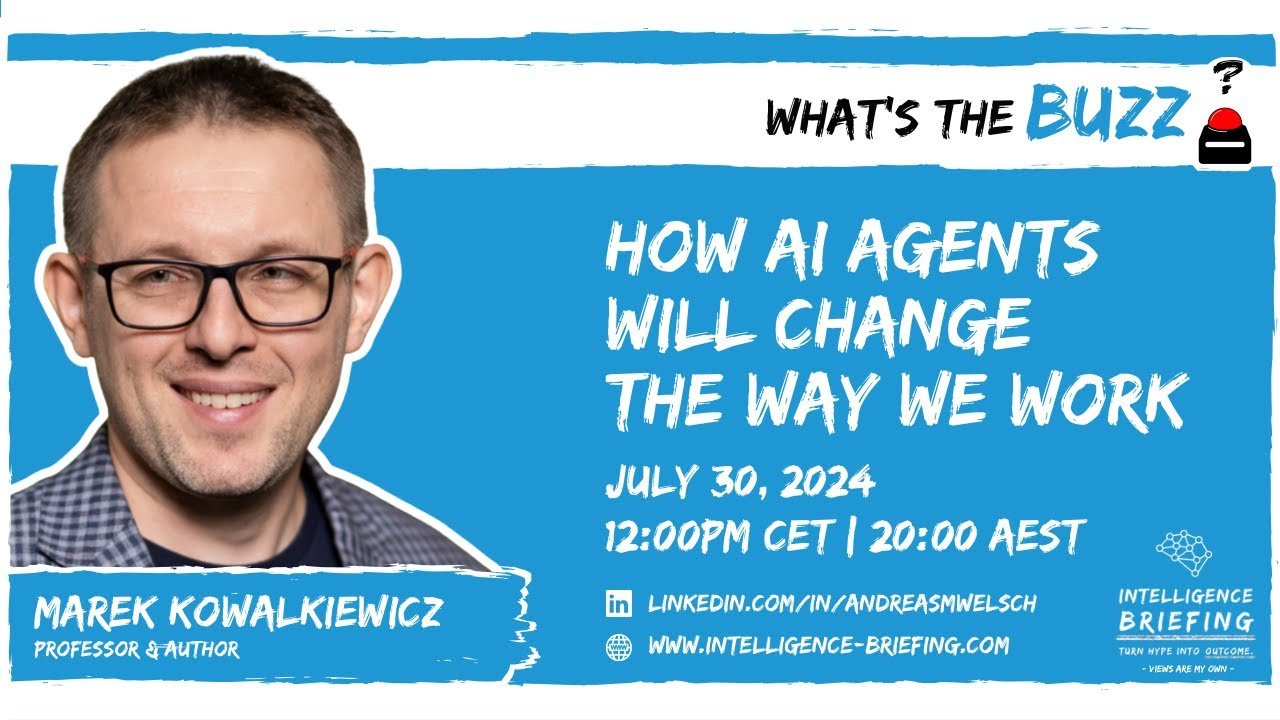
Guest: Marek Kowalkiewicz, Professor & Author
Host: Andreas Welsch
Episode: What’s the BUZZ?, Season 3, Episode 20
Published: July 30, 2024
Episode Summary
Marek Kowalkiewicz, Professor & Author, joins Andreas Welsch to answer how AI agents will change the way people work.
Marek traces a path from an economy of corporations to an economy of people and now an economy of algorithms, in which software agents sit between businesses and their customers.
He explains why leaders should treat AI systems as digital minions that need a human in the loop, and warns about shadow AI and phantom AI inside organizations.
The conversation also covers where AI already works well without anyone noticing, and why a trough of disillusionment leads to a plateau of productivity.
Key Takeaways
- Marek describes an economy of algorithms in which software agents create and consume value, shifting business relationships from B2B and B2C toward B2A2C and B2A2B.
- Marek advises leaders to treat AI systems as digital minions, capable but in most cases in need of a human in the loop, and wants “AI nutrition facts” stickers on systems with generative AI inside.
- Marek calls shadow AI, employees automating their own work without telling their managers, a risk to bring to light, and says organizations should promote people who automate their jobs, not fire them.
- Marek describes phantom AI, in which colleagues accuse each other of using AI, and says leaders must keep AI from becoming a taboo so that it does not create a toxic culture.
- Marek expects work to shift from answering questions to questioning the answers, and says leaders need to learn how to lead mixed human and AI teams.
Timestamps
- 0:22 How AI agents will change the way we work: introduction
- 0:39 The guest’s background in academia and industry
- 2:34 Icebreaker game called In Your Own Words: if AI were a fruit
- 4:46 From the economy of corporations and people to the economy of algorithms
- 8:55 The boterfly effect: when agents prompt people
- 12:08 Studies on productivity, digital minions and AI nutrition facts
- 16:47 From answering questions to questioning the answers
- 17:56 Shadow AI and what leaders should do about it
- 20:52 Phantom AI and its effect on team culture
- 22:31 Examples of AI that works well and goes unnoticed
- 26:08 Pilot-stage figures for generative AI and the plateau of productivity
- 27:11 The guest’s key takeaways
- 28:30 Closing thanks
About Marek Kowalkiewicz
Marek Kowalkiewicz is a Professor & Author.
In the episode, Marek says he is based in Australia and is originally Polish. He describes his background as half academic and half industrial, with time in Silicon Valley, Singapore and Beijing working for large software organizations, and says he helps organizations design digital transformation strategies and understand how technologies such as AI will affect them.
Full Transcript
Read the full transcript
Andreas Welsch: Today we’ll talk about how AI agents will change the way we work, and who better to talk about it than someone who’s actively working on that. Marek Kowalkiewicz. Hey, Marek, thank you so much for joining.
Marek Kowalkiewicz: Thanks, Andreas. Excited to be here.
Andreas Welsch: Wonderful. Why don’t you tell our audience a little bit about yourself, who you are and what you do.
Marek Kowalkiewicz: Absolutely. Thanks, Andreas. My name is Marek Kowalkiewicz. I’m based in Australia, but I’m originally Polish. So good on you, Andreas, for doing the proper pronunciation of my surname. That’s not always a common skill around the world. Like I said, based in Australia, I work for Queensland University of Technology for the business school there. And I work with a lot of organizations, helping them transition, helping them design their new digital transformation strategies, helping them understand how digital technologies such as artificial intelligence will impact them over the coming years. My background is half academic, half industrial. I spent half of my professional life in places like Silicon Valley, Singapore, Beijing, working for large software organizations and really developing my skills there. So I have this mixed skill set and I apply it to real world problems.
Andreas Welsch: Awesome. I’m really excited to have you on and to learn, especially from that mixed background and what you’re seeing right now, working with so many organizations. So fantastic. Now, for those of you in the audience, if you’re just joining the stream, drop a comment in the chat where you’re joining us from. I’m always curious to see how global our audience is, especially today where we shifted the time a little bit to make sure that folks in Australia, including yourself, are able to join. Should we play a little game to kick things off?
Marek Kowalkiewicz: Absolutely. I have no idea what’s coming here, Andreas. So I’m a bit stressed, but let’s go for it.
Andreas Welsch: Wonderful. All right. So this game is called In Your Own Words. And when I hit the buzzer, even the virtual one here, you’ll see the wheels will start spinning. And when they stop, you’ll see a sentence. I’d love you to complete the sentence with the first thing that comes to mind, and why, in your own words. To make it a little more interesting, you only have 60 seconds for your answer. So are you ready for What’s the BUZZ?
Marek Kowalkiewicz: Let’s go for it. Let’s do it. Okay.
Andreas Welsch: Perfect. Then here we go. If AI were a fruit, what would it be? 60 seconds on the clock. Go.
Marek Kowalkiewicz: If AI were a fruit, what would it be? I can tell you what I want AI to be. I want AI to be an apple, just a very simple fruit. Nothing too sophisticated, not a lychee. Hi to Charles from CAIRs. Not a lychee, not a banana. Not anything that people think is in any way unusual. I want AI to be an apple, something that we know where it grows. We have all tasted it. We know what to do with it. We know what to bake with apples. We know what else to do with this fruit. I want the same with AI. Right now AI is this unusual fruit that probably doesn’t even have a name. And that’s not good. So make it an apple.
Andreas Welsch: That’s a beautiful answer. Make it something that everybody knows. A really nice job. Wonderful. And if I look at the chat, I see folks joining from Australia, from Poland, from Switzerland. So great to have you with us. Thanks for being with us today. Now let’s maybe jump to the questions for our topic of the show. How do AI agents change the way we work? And I’ve been following your talks and I know you have a book out as well. And I see you talk a lot about the evolution of labor from corporations to digital to algorithms to AI. What do you say, where are we headed and what would it look like in the future when there are more agents that are taking over even more parts of the work that we do in business?
Marek Kowalkiewicz: I think, like everyone who has spent some of their life in academia, I’m trying to look into the future through the lens of the past. So I’m trying to identify what trajectory we’re on. When you mentioned the corporations in the past, this is what we used to focus on in business 20, 30, 40 years ago, and I call it the economy of corporations. Every business person was focusing on creating a large corporation, scaling it, making it more productive, more efficient, generating more revenues. And then something happened in the early 21st century, initially the dot-com bubble, but then really the productization and growth of the business side of the internet. We realized that you don’t really need to be a corporation to have massive influence on the economy in the world, and individuals, people, could have that. So I call it the economy of people. The economy of corporations shifted into the economy of people. And now what has been happening in the last more or less 10 years, but really accelerated in the last few years, is a new economy where it’s not corporations, it’s not individuals, but it’s software. Agents, algorithms. They can be AI, they don’t have to be artificial intelligence. Those algorithms are often becoming as powerful as those individuals or corporations were in the past. And so I call it the emergence of the economy of algorithms. Now, I love to look at some of the business concepts that we use in those other economies and how they apply in the economy of algorithms. One that I would leave with everyone who’s watching is that shift from B2B and B2C, business to business or business to customer, to something that starts with B2A, business to algorithm. So how do algorithms interact with businesses? But it continues and it becomes B2A2C or B2A2B. We have those algorithms that are in between us. Think about yourself, Andreas. You might have an Alexa in your kitchen and you’ll ask Alexa to interact with some business on your behalf. That’s the concept. That’s the world that’s emerging at the moment, where we have those more sophisticated relationships and algorithms, AI or not, might be sitting between us and other businesses. A very exciting space. And I think this is where we’re heading. We’ll be seeing more of those algorithms being our partners, and being active entities, not just passive the way we saw them in the past, active entities in those relationships.
Andreas Welsch: I think that’s super interesting, especially in business, or even in a business entity itself, where for the most part you still work with people and you have questions and you collaborate, and seeing how this will evolve to you working with agents, and maybe your agent working with your colleague’s agent to figure things out. And you talk to your colleague about certain things, maybe where the agent isn’t able to make a decision, or where you still need to have that conversation. To me, that’s super exciting.
Marek Kowalkiewicz: Absolutely, and there’s a fascinating phenomenon in this space that we’re starting to see. Some of the viewers might be a bit skeptical about what we’re talking about right now, and they could say, hey, we had this automation already in the past. But there is something unique that is happening right now, and Andreas, you already alluded to it, which is that those agents are built using the most recent technologies, and Generative AI is the one that comes to mind immediately. Those agents are often capable of coming up with ideas that are not ones we would come up with. They have this broader spectrum of ideas and sometimes might suggest something that we haven’t even thought about. Which is interesting. It’s good in some situations. It’s a bit worrying in other situations. But it leads to an interesting situation if you have those agents working on your behalf, and they come up with something. Andreas, I’m a smart fridge, I decided I need to buy you this particular brand of ice cream that you should try. You think you’re prompting them, but perhaps they’re prompting you now. And so we’re having this new effect of an AI, a bot, starting an idea and then you building on it. I call it the boterfly effect, just like the butterfly effect. But now we have bots, and if a tiny bot flaps its wings with one idea, does it lead to a storm later on, to play with the metaphor?
Andreas Welsch: Definitely economically. That’s a super interesting concept and perspective as well, that we will have some kind of AI or bots, like you say, that will prompt us to maybe buy additional things, to make the meal tonight, or have some different considerations. Now, folks, for those of you in the audience, if you have a question for Marek and me, please feel free to put it in the chat. We’ll take a look in a couple of minutes. And I see many more people have joined from Australia, from India, and many different other places. So again, great to have you with us. Now, when we talk about algorithms, and even in the example that you gave, hey, this is what’s in your fridge, maybe you can make a certain meal, or maybe here’s a certain brand that you might enjoy. There’s obviously a lot of potential, but I think there’s also a lot of concern when we look at this algorithmic decision making. There’s been a lot of talk about black boxes in the past, where we don’t really know how this software came to a conclusion or how it made its recommendation. And I think there are also a few different narratives in the industry. AI isn’t going to replace you, a person using AI will, or AI is going to make you more productive, and all these kinds of things. But I’m not really sure it’s all rosy red and sunshine. And so I’m wondering, what are you seeing? How can leaders help their business teams with this development of more AI, more agents, more agentic workflows, and so on?
Marek Kowalkiewicz: There are some interesting studies popping up literally in real time right now, questioning the productivity gains from Generative AI and showing that people actually end up being less productive when they use Generative AI. I think this is related to the lack of education and understanding of how to work with those tools. It’s the natural first friction before we become efficient. But that’s already an interesting question for managers and leaders: how do I help my people be more efficient rather than less efficient with those technologies? But to respond directly to your questions and to talk about those various narratives that are in the industry at the moment, I did want to point to one particular narrative which seems to position artificial intelligence as this super entity that’s going to be so much better than everything else that we’ve ever imagined. And for those of us who understand technology a bit more, many of us are puzzled by this narrative. I, for one, welcome our future digital overlords, some people would say. We know that those systems are almost hilarious outside of their very narrow domain of specialization. And rather than calling them digital overlords, I use this metaphor of digital minions, just like minions, those yellow creatures in the movie. You might have heard me use this term, Andreas, many times, I’m sure. But I think it’s actually a pretty powerful metaphor, because what this means is we need to think about those AI technologies as systems that are always ready, just like the yellow minions. Always ready, excited to help. And if we tell them exactly what they should be doing and we’re standing there and looking at them, they’ll do a good job. But the moment we look away and let them do whatever they want to be doing, it’s the story from the movie. Disasters unfold and we see it in real life. So one of the important skills of leaders, of managers, is to explain this to their teams, to show them that while those AI systems are extremely capable, the human, in most cases, needs to remain in the loop. And I’ll talk about cases where it’s not required, but in most cases the human needs to be in the loop. I go as far as saying that every system should have a sticker slapped onto it. I call it AI nutrition facts, just like when you buy food: what’s inside. I want to start seeing IT systems that have a sticker saying this is an enterprise system, but it has Generative AI inside, which means some of the outputs it produces might not be as reliable as the outputs of a system that doesn’t have Generative AI in it. But on the other hand, those outputs might be more creative, and perhaps this is really good for your scenarios. I want AI nutrition facts.
Andreas Welsch: That’s an interesting concept. I can already see the color scale in front of my eyes, the yellow, the red, and where do you fall?
Marek Kowalkiewicz: Is it healthy for me or not? Should I eat it?
Andreas Welsch: Now with that aspect of minions, and if you don’t watch it closely it goes off on a tangent. I’m also wondering, going back to those studies that you’ve referred to, will we all become reviewers of information? Whereas before we created it, now we have an assistant, a copilot, whatever you want to call it, an agent that creates something for us or researches something on our behalf. And it comes back and you’re like, no, that’s not what I wanted. Do it again. And it comes back again. You’re like, yeah, better, but still not. How our work shifts from creating to reviewing and coaching, I think will be a pretty exciting and interesting space to watch and to navigate.
Marek Kowalkiewicz: I think what’s happening right now is that the job of answering questions is being taken by those AI systems. So perhaps our new job is questioning the answers, really the flip side of it. And we need to start to be more curious. In fact, we need to become more critical. Our thinking needs to sharpen because we are being exposed to those artifacts that look okay. But we need to look into them and question them and try to improve them the way that the systems of today, not systems of five years from now, but the systems of today, are unable to when it comes to their quality.
Andreas Welsch: I think that’s a really good point around how work will change: questioning the answers, coaching, giving more guidance. What other aspects are you seeing that people in different business functions need to be aware of as AI, as agents, enter the workplace?
Marek Kowalkiewicz: Look, one thing that I’m seeing, and I’ve been seeing it for a few years now, is this trend of individual employees automating their own activities. This requires some skills. It required more skills in the past, a bit less these days, because you can almost go to a Generative AI chatbot like ChatGPT or Claude.ai or you.com, and ask those systems to help you in performing your tasks. But I see a lot of people who do it and then are a bit afraid to share it with their teams or their managers. Shadow AI, shadow artificial intelligence, is a massive potential problem for organizations. Imagine you have a workforce of people who have automated themselves out of their jobs, or they’re immensely productive and you have no idea how they do it. You were assuming they’re just working like a regular human. And then they leave your organization, you replace them with the same number of employees and realize, hey, that’s not enough. The productivity drops. And so it’s very important for corporations right now to bring this shadow AI to light so that it can be managed well and supported, and to do it in a way that doesn’t alienate those workers. So never ever fire somebody who automates their job. I’m saying it because I came across at least one example of that worst decision ever. Make those people superstars in your organization. Promote them, help them build even bigger teams, train them and so on. So turn shadow AI into AI that’s shining light on the organization. That’s a very important skill.
Andreas Welsch: I really love that angle. Early on in my career I was in IT and I’ve seen many of those examples where people go off and maybe buy their own tools or use something else that’s maybe not approved by corporate. And to your point, I think we’re seeing much more of that now because it’s so much easier to use it and to get access to it. I can use it on my personal phone and I ask ChatGPT to do something, but the second I do that and I enter some proprietary or confidential information, that’s gone. It’s totally outside of my information security and IT security policies or boundaries, or even outside of the access that we would usually have on a corporate network.
Marek Kowalkiewicz: And Andreas, if I can add another buzzword to the dictionary. There’s something that I call imaginary AI or even phantom AI. You know how you have phantom limbs? You feel something, but you don’t have that limb. So phantom AI is a situation in an organization where, and I have come across it already, some employees accuse other employees of using AI to automate themselves, but those other employees are not doing it. This creates a tension in the workplace where an employee says, that person is cheating because I saw their emails, I saw the documents that they’re producing. No way they would write them themselves. They must be using ChatGPT or so. First of all, the question is, perhaps it’s okay with the company policies to be using it. Second of all, is it really a problem in the team? Third of all, why didn’t you ask this person? And so on. And I could confirm there was at least one case where that person was definitely not using AI, but they were accused of using AI and it created a very toxic organizational culture. Phantom AI. Not just shadow AI, but now we have phantom AI.
Andreas Welsch: But I think that again means it starts with the leader and with the leadership, and providing tools, providing opportunities, providing training so that it’s a level playing field for everybody.
Marek Kowalkiewicz: Making sure that AI is not a taboo in your organization, talking about it, sharing all that information. Absolutely.
Andreas Welsch: Now, you’ve already shared a couple of examples over the last couple of minutes of AI and agents, and I’m wondering if you have another example where that’s been implemented and it’s been working really well, like automated, AI-driven decision making.
Marek Kowalkiewicz: It’s a very interesting space, because we as humans typically remember the stories of disaster. I could give you a list of 50 disasters of using AI or Generative AI, because they’re catchy, we remember them, everyone talks about them. Every time we start to think, give me some success stories of the use of AI, that list is a bit harder to generate. That’s not because there are fewer of them. I would argue there are way more cases of successful implementation and use of artificial intelligence. And when I use the term artificial intelligence, we’ve had it for decades, so there’s a really big history there. Why is that the case? Because when the implementations of AI are successful, they become transparent, they become invisible. They just work, full stop, and we stop noticing them. Want examples? Sure. The cars that we drive these days on our roads have never been as safe as they are right now. And that’s thanks to developments in computer vision, in all sorts of robotics, automated braking systems, and lane following, and even seatbelts. This is all the use of artificial intelligence. Some of those are expert systems, the older understanding of artificial intelligence, but computer vision, most definitely, is the modern deep learning type of artificial intelligence system. Airlines? Same story. Of course, the moment I mention airlines, we all remember a couple of incidents. But again, it has never been that safe in this space. Spam filters are so good many people don’t even know there’s something like a spam filter anymore. In the past we had to install a spam filter. Fraud detection systems? When was the last time you went through your credit card transactions to see whether there was any fraud? We don’t do it anymore because those systems work very well in the background. There’s more, supply chain optimization that I could talk about as well. With all those examples that I mentioned, they all have one thing in common, and that is that I have not mentioned a single example of a Generative AI implementation that fits your description. And this is because I think we’re still in that phase of really truly understanding the value of Generative AI. There are some narrow cases of good examples. Even in my team we use Generative AI for things like scenario planning and so on. We’re very happy with this, but I think on the industry scale we might still need to wait until we’re confident that we know where Generative AI really fits the business.
Andreas Welsch: That’s an interesting point. I was just reading an article by Gartner last night. They’re having a conference in Australia this week and they said they found that 30 percent of Generative AI projects don’t go beyond the pilot stage. Now, I think many people might find this alarming, and it fits the narrative of, hey, are we going into the next trough of disillusionment, or the next AI winter? It’s not delivering on the promise. But then when you compare that to Gartner’s statement at the end of 2020 or 2021, when they were talking about machine learning, they said, hey, 54 percent of projects don’t see the light of day. So 30 percent? It’s actually a 24 percent improvement, at least in my book. So maybe we are learning something.
Marek Kowalkiewicz: And remember that after a trough of disillusionment comes a plateau of productivity. And in order to get there, we need to understand what does not work as well. That’s part of the learning.
Andreas Welsch: Absolutely. Hey, we’re getting close to the end of the show and I was wondering if you could summarize the key three takeaways for our audience today, what we’ve talked about, before we wrap up.
Marek Kowalkiewicz: We are witnessing an emergence of a completely new economy where algorithms, software agents, AI, whatever you want to call them, I call them digital minions, are now creating and consuming value. So they should be called economic agents, and that gives rise to this new economy of algorithms. Those agents cannot be fully trusted, just like you don’t jump into your Tesla, set it in self-driving mode, whatever they call it these days, and go and fall asleep. That’s not how you drive a Tesla. That’s how you die in a Tesla. You still watch the road and you still should be able to take over. That’s how digital minions should be treated as well. And in organizations, we need to recognize that there’s a growing wave of shadow AI, and perhaps even phantom AI. As leaders, we need to develop new strategies for how to address that. We need to learn how to lead mixed human and AI teams. This is not something that we learned during our MBA or business courses, at least not so far. That’s a new set of skills that we have to develop as leaders in the coming years, or as soon as possible.
Andreas Welsch: Awesome. Thank you so much, Marek. It was a pleasure having you on. Thank you for sharing your expertise with us. It was a really insightful conversation.
Marek Kowalkiewicz: Thanks for having me on, Andreas.
Andreas Welsch: Perfect. And for those of you in the audience, thank you for joining us.
Listen and Subscribe
Related Reading
- Agentic AI for Enterprise Leaders
- The HUMAN Agentic AI Edge
- Deploying AI Agents: A Practical Guide for Business
- How to Prevent AI Workslop and Retain Human Judgment
Frequently Asked Questions
What is the economy of algorithms?
According to Marek, business moved from an economy of corporations to an economy of people, and is now entering an economy of algorithms, in which software agents are as powerful as individuals or corporations once were. Business relationships then extend from B2B and B2C to B2A, business to algorithm, and B2A2C.
What are digital minions, and why does a human stay in the loop?
Marek uses digital minions as a metaphor for AI systems that are always ready to help and do a good job when told exactly what to do and watched. Left alone, they can cause disasters, so in most cases a human needs to remain in the loop.
What is shadow AI and how should leaders respond?
Marek defines shadow AI as employees automating their own work and being afraid to share it with their teams or managers. He advises bringing it to light, supporting it and promoting those people, and he warns that productivity drops when such an employee leaves.
What is phantom AI?
Marek describes phantom AI as a situation in which employees accuse colleagues of using AI to automate themselves while those colleagues are not doing so. He says it can create a toxic culture and recommends talking openly about AI so it is not a taboo.
Where does AI already work well?
Marek says successful AI becomes invisible once it works. He names car safety systems built on computer vision and automated braking, airline safety, spam filters, fraud detection and supply chain optimization, and says none of his examples is generative AI.