

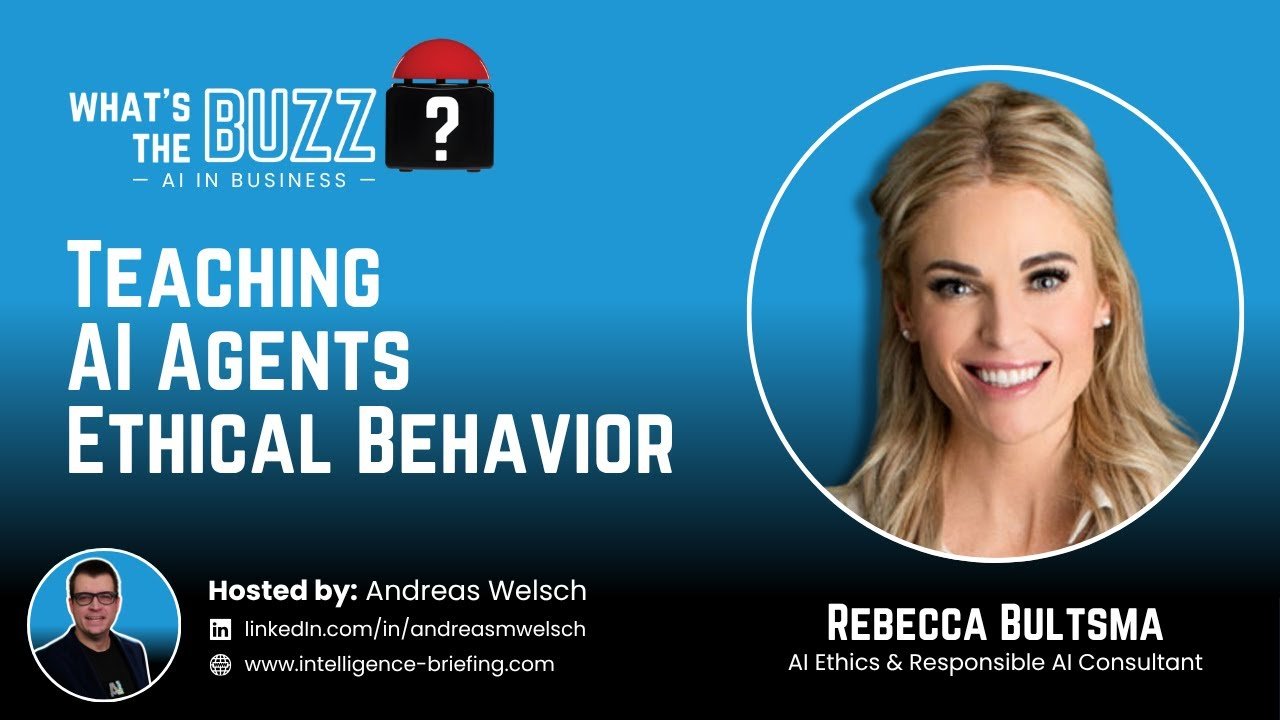
Guest: Rebecca Bultsma, AI Ethics & Responsible AI Consultant
Host: Andreas Welsch
Episode: What’s the BUZZ?, Season 4, Episode 28
Published: November 4, 2025
Episode Summary
Rebecca Bultsma, an AI ethics and responsible AI consultant, joins Andreas Welsch to answer how leaders can teach AI agents ethical behavior. She explains how generative AI moved ethical questions to the front of mind and why models carry the worldview of their builders and the flaws of their training data. Rebecca and Andreas discuss shopping and payment agents, what an agent should optimize for, and who is accountable when an agent decides. Her advice is to train people first, start with narrow, traceable, low-stakes tasks with audit trails, and take a breath before rushing agents into production.
Key Takeaways
- Rebecca discourages organizations from embedding agents before their people have a solid understanding of generative AI’s capabilities, limitations and connected risks.
- She says AI systems carry an ethics system that reflects their builders, plus a flawed training data set, and she points to WEIRD bias, in which Western, educated, industrialized, rich and democratic societies are heavily overrepresented.
- Rebecca says you cannot blame the AI when an agent goes wrong: the company is accountable, which is why she does not want an AI system making decisions it cannot explain.
- She recommends starting with very specific, narrow and traceable tasks that carry low stakes, and she calls for audit trails and internal company oversight because there is no real government oversight yet.
- Rebecca’s three takeaways: learn how agents work by experimenting on your own first, know that they are not foolproof, and take a breath, because there is no rush.
Timestamps
- 00:12 Cold open on teaching agents ethical behavior
- 00:50 Welcome and episode theme
- 01:05 Rebecca on her path into AI ethics
- 02:39 Audience shoutout and the AI Leadership Handbook
- 03:12 What has changed in ethical and responsible AI
- 04:49 Encoded worldviews in models and agents
- 05:53 New ethical challenges agents create for leaders
- 07:14 Shopping and payment agents and their risks
- 08:50 Who is accountable when agents decide?
- 09:37 What should agents optimize for?
- 10:27 Making agents weigh more than the goal
- 13:28 What leaders should do amid vendor pressure
- 16:08 Key takeaways
- 16:58 Thanks and wrap-up
About Rebecca Bultsma
Rebecca Bultsma is an AI ethics and responsible AI consultant. In the episode she says she began experimenting with ChatGPT early and, after a few months, started helping other people make sense of AI while enrolling in a Master’s program at the University of Edinburgh that focuses on data and artificial intelligence ethics.
Full Transcript
Read the full transcript
Andreas Welsch: Welcome to What’s the BUZZ?, where leaders share how they have turned hype into outcome. Today we’ll talk about how to teach your AI agents ethical behavior, and who better to talk about it than someone who’s actively working on AI ethics: Rebecca Bultsma. Hey, Rebecca. Thank you so much for joining.
Rebecca Bultsma: It’s my pleasure. Thank you for having me.
Andreas Welsch: Wonderful. Why don’t you tell our audience a little bit about yourself, who you are and what you do.
Rebecca Bultsma: Sure. At the ChatGPT moment, I was one of the first people to start experimenting with ChatGPT, and I started using it all the time, pushing the limits, using every new AI tool that came out. After a few months, I started having questions about who was behind the curtain, who was making decisions, where it was drawing information from. And I couldn’t find a lot of people who could explain it to me outside of computer science people, who I didn’t necessarily understand.
Rebecca Bultsma: So I started trying to help other people make sense of it while also enrolling in a Master’s program, one of the only ones in the world at the time, at the University of Edinburgh in Scotland, that specifically focuses on data and artificial intelligence ethics. I’ve been fully immersed in AI ethics and still using and experimenting with all the tools. I think they’re amazing. I think they’re cool. I think it’s an amazing time to be alive. But now I also have a very nuanced view of all the ways that this can go wrong and all of the risks that are underneath some of that shiny bright surface.
Andreas Welsch: Awesome. I love that perspective. You tried this out, you were curious, you wanted to learn more. I think it just shows how broad this space of AI is and how curiosity helps us learn more about these things. Almost like Alice going down the rabbit hole and learning more and more in a positive.
Rebecca Bultsma: Absolutely. With a little Mad Hatter on the side for sure.
Andreas Welsch: Exactly. All right, wonderful. Hey folks, if you’re just joining the stream, drop a comment in the chat where you’re joining us from. I’m always curious to see how global our audience is. And also, if you want to learn how you can turn technology hype into business outcomes, take a look at my book, the AI Leadership Handbook, on Amazon and anywhere you get your books and audiobooks.
Andreas Welsch: Now, Rebecca, I know we’re both rushing out of meetings, rushing into the next meeting, so our time today is a little shorter than we had initially planned. That’s why I want to jump straight into the topics that we discussed. I feel for a number of years we’ve been talking about this concept of ethical AI, trustworthy AI, responsible AI. It’s evolved over the last seven, eight, nine years. I’m wondering what you are seeing. What has changed from your perspective when we talk about all of these different concepts?
Rebecca Bultsma: We’ve been talking about responsible and ethical AI for a long time, because AI has been embedded in a lot of our workflows and our daily life in a lot of different ways. For example, the algorithmic powering of social media. There were questions around teenagers using it: a teenager looks at maybe a post about an eating disorder, and then the artificial intelligence powering the algorithm pushes thousands of those notifications on them. So we’ve been talking about AI ethics for a long time.
Rebecca Bultsma: What’s changed is the introduction of generative AI. Because it can act like a human and do really human kinds of things, it raises a ton of new ethical issues to the front of mind for most people, issues that we haven’t had to think about yet, or with this level of urgency. It’s always been there in the background. I could give you a hundred case studies of how AI ethics, or the lack thereof, was super problematic before generative AI, but now it’s an even bigger deal, just because the capabilities have expanded so quickly and there are so many more risks.
Andreas Welsch: So now we take these models with the worldviews encoded, probably largely Western or US-based worldviews, and we put them into our tech stack. We put them into the most critical pieces of our infrastructure, whether it’s dealing with customers or with employees or leaders, getting coaching for employee conversations and whatnot. And we’re even adding one thing on top and saying, hey, you do this autonomously or semi-autonomously. Now with agency, it feels like we haven’t even really started at the foundational level, and yet many organizations are looking to push this.
Andreas Welsch: I’m an adjunct professor and I work with undergrad students, and one of the modules I teach is around ethics. I feel it’s such a broad and big topic, but it’s also very hard to get your arms around. It’s hard enough to teach humans to behave ethically. Now we want to do this with agents, or we need to do that with agents, if they act on your behalf, if they make decisions, maybe optimizing more for a business goal and for the collective good. What are the new challenges that you’re seeing there, and the things that leaders need to be aware of?
Rebecca Bultsma: There are honestly so many. I highly discourage organizations from embedding things like agents before their actual people have a really solid understanding of AI, generative AI in general, its capabilities, its limitations and the connected risks, because those are amplified once you bring in something like an agent. And you’re totally right, there is this major risk of bias. We call it WEIRD bias. It’s an acronym: Western, educated, industrialized, rich and democratic societies are way heavily overrepresented. That’s its own kind of problem.
Rebecca Bultsma: There’s this risk already of relying on AI systems because, as you mentioned, they have an ethics system encoded into them that reflects the builders who built it, and a flawed data system that it was trained on, the internet. So the risk of us using it without awareness is huge. Without having enough awareness to oversee an agent and make sure that it’s aligned with our company values, there could be major reputational damage if it acts in a way that’s contrary to your values.
Rebecca Bultsma: There are shopping agents now where you can buy right from within ChatGPT, and a bunch of the major financial institutions in the world have come together and come up with a way that agents can pay other agents. So if I’m looking at a great pair of shoes and I tell my agent that as soon as they get below $300 it can just go buy them, using my account, there are obviously risks connected to that that we don’t fully understand. ChatGPT has released browsers and agents, but there are malicious actors out there who know very simply how to maybe hack these or redirect them to incorrect websites, and you end up sharing personal information with the wrong places. There are just so many unknowns with those kinds of external agents.
Rebecca Bultsma: Within something like Microsoft Copilot, in an enclosed ecosystem that is more secure, there are some really amazing things you can do with agents. And that’s the problem: the word agent is murky. Like travel agent, it’s a weird word, and it means lots of things in lots of different contexts. But you just don’t want an AI system making decisions ever, in my opinion, because it can’t explain how it arrived at those decisions in any sort of way that’s explainable or defendable. And then when it goes wrong, who’s accountable? It’s not the agent. You can’t blame the AI. It will be you. It will be your company. If it’s biased, if it spends $10,000 on shoes instead of buying one pair, who do you blame? You can only blame yourself, which is why you really need to understand it and have really good control before you do this.
Andreas Welsch: I think it’s a really interesting time that we’re in, for so many reasons. First of all, these things are now possible. Some of them are still in their infancy, but you can see where this is going. To your point, shopping, financial transactions, automation built into your browser. Yes, I can see where this is going, and like I said, many of the things are pretty incredible. But then think about what that agent optimizes for. Does it optimize for the provider’s goals, which could be revenue maximization, or does it optimize for the customer’s goals, which would probably be paying less or getting better service or faster shipping at no cost or what have you?
Andreas Welsch: And then what is ethical in that sense? Is it the win-win? Is it maximizing the greater good for everyone involved? Are you looking at more long-term relationships, customer lifetime value? Maybe I give a little more here, but then you buy more next time. These sorts of things. And how do you even know how these agents decide? I think that’s the big question for me now. From your work with leaders and organizations, advising them on ethics, what should they keep in mind? How can you ensure that agents don’t just optimize for reaching that goal, but also consider other aspects that a human would consider, or that a regular business person would consider, thinking two or three steps ahead?
Rebecca Bultsma: Honestly, it’s tricky, because as of right now it’s hard to know what’s going on in the background of how an AI is working and how it’s making decisions. One of the most interesting stories I’ve ever heard, from a few years ago, was when they were trying to teach image recognition to an AI system. They showed it thousands of pictures of wolves and dogs to teach it the difference between a wolf and a dog. When they tested it later, the only reason it knew what was a wolf and what was a dog was that the wolf had snow in the picture. Even if you showed it a picture of a Frenchie and there was snow in the picture, it decided it was a wolf. That shows that we don’t know how it’s thinking in the background, and it may be very different from how we think it’s thinking, in air quotes, when it makes a decision.
Rebecca Bultsma: I think it’s super important that we take that into account. Obviously it will get better, but a lot of it is going to depend on the very specific instructions and tasks that you provide, keeping things very narrow to start and very traceable so that you can understand where things go wrong, and starting with really low-stakes things. With any AI use, start with things that are low stakes, because low stakes hopefully means very low consequences if it goes horribly wrong. The agents will get better and we’ll have some of these questions answered, but we do need audit trails and mechanisms, because there isn’t necessarily any government oversight over this right now. You would need some internal company oversight for sure.
Andreas Welsch: In a way, you might think that once bad things happen, once unattended consequences happen, then regulation or broader changes are enforced, which is always unfortunate. But I think this part about auditability and traceability, peeking into the black box, checking the logs, what is happening, maybe not so much at an individual user level, but for those who are looking at bringing agents into the business, I think those are features that are so important. Like I said, at the end of the day, if something happens, you will want to trace what has actually happened and why, and not just want to, you will eventually need to have something, what has happened.
Rebecca Bultsma: Absolutely. Absolutely.
Andreas Welsch: So what do you then recommend leaders do at this critical point in time, when all vendors are shouting, we’ve got agents, build on us or on our platform, come here? And you feel the pressure that you should be doing something because your friends on the golf course are doing something, or your competitors are doing something. What do you need to do then?
Rebecca Bultsma: Take a breath. Honestly, it’s not a race to the bottom right now. And there’s new legislation coming in that may impact you. I haven’t done a deep dive into it yet, but some of the new laws that they introduced in California, for example, specifically target chatbots. They’re designed to protect teenagers and kids, but they also potentially impact anyone who has any sort of chatbot on their website, and they introduce new liability if in any way, shape or form it offers any sort of advice or emotional anything, anything that crosses into that territory. Suddenly it’s governed by different laws, and there are other states introducing similar legislation.
Rebecca Bultsma: You might just want to focus on getting your whole staff super, super trained on generative AI and working with things internally, like maybe Microsoft Copilot, working on internal agents before you start thinking about introducing things externally to the public. Until we have a better understanding of what the legal landscape looks like, what the liability landscape looks like, and until we have a really good understanding, wait for it to go horribly wrong for somebody else first is my advice, because it will. Let’s just see what happens. So my advice is to take a breath.
Andreas Welsch: I think that’s actually really good advice. It’s not as urgent or as imminent as it might seem when you read the news, and there’s still enough time that you need to spend anyway learning and experimenting and seeing what works and what doesn’t. The topic about starting with internal use cases and internal scenarios first, and cutting your teeth there before you put something out in the open, is a good one.
Andreas Welsch: I think it was in the July, August timeframe that McDonald’s was in the news. They had connected an agent to the HR backend system so applicants would get information more quickly. Researchers found that they were able to hack the agent and steal the password and get access to, I think it was 6 million records of previous job applicants, and all kinds of things. So, speaking about things that can go wrong, there are more of these examples certainly coming, and it’s usually these moments in time when the risk is realized that we say, okay, let’s take a breath and see what we should really be doing. So yes, I agree.
Andreas Welsch: Now, I said this one is going to be a short episode, and I know we’re getting close to the end of the show. Rebecca, I was wondering if you can summarize the key three takeaways for our audience from today.
Rebecca Bultsma: I think my three key takeaways would be, first, to invest some time understanding as much as you can about agents and how they work. Experiment with them on your own first, before introducing them into your organization or mandating them into your company. Just experiment with accounts that you have in your personal email and your personal name to figure out how they work and where they fail. That would be number one.
Rebecca Bultsma: Number two, know that these are not foolproof. There are a lot of problems with them. You just brought up a good one with McDonald’s. On a large scale and on a small scale, there are issues. And number three, just take a breath. There’s no rush. We’re all figuring this out. Things are going to go wrong, but maybe just don’t let it be you who is the trailblazer in things that go wrong. Just sit back and observe and take a breath.
Andreas Welsch: Wonderful. Thank you so much, Rebecca. It’s been a pleasure having you on the show and hearing your perspective on how we can teach agents ethical behavior. Folks, if you want to connect with Rebecca, you find her on LinkedIn. And thank you so much for spending time with us today.
Rebecca Bultsma: Thanks for having me.
Listen and Subscribe
- Listen to this episode on Buzzsprout
- Watch this episode on YouTube
- All episodes of What’s the BUZZ? on Buzzsprout
Related Reading
- AI Governance for Enterprise Leaders
- Agentic AI for Enterprise Leaders
- AI Leadership Handbook by Andreas Welsch
- 5 AI Governance Controls Auditors Expect to See
- Agent Slop: How Agentic AI Governance Prevents It
Frequently Asked Questions
What ethical risks do AI agents add on top of generative AI?
Rebecca Bultsma says generative AI can act like a human, which raises new ethical issues with more urgency, and agents amplify the existing risks. She names bias from builders and training data, reputational damage when an agent acts against company values, and security risks when shopping or payment agents can be redirected to the wrong websites by malicious actors.
Who is accountable when an AI agent makes a bad decision?
Rebecca says the company is accountable, not the agent: you cannot blame the AI. She uses the example of an agent that spends $10,000 on shoes instead of buying one pair. In her view you can only blame yourself, so you need to understand the system and have good control before you let it act, and she does not want an AI system making decisions it cannot explain.
What is WEIRD bias in AI?
Rebecca Bultsma describes WEIRD as an acronym for Western, educated, industrialized, rich and democratic societies, which she says are heavily overrepresented in the data and views behind AI systems. She adds that these systems carry an ethics system that reflects their builders and a flawed data set, the internet, which makes it risky to use them without awareness.
How should companies start with AI agents responsibly?
Rebecca recommends training the whole staff on generative AI first, trying internal agents before external ones, and starting with narrow, traceable, low-stakes tasks. She also asks for audit trails and internal company oversight, and she suggests waiting for the legal and liability landscape to become clearer, including new chatbot laws such as those introduced in California.