

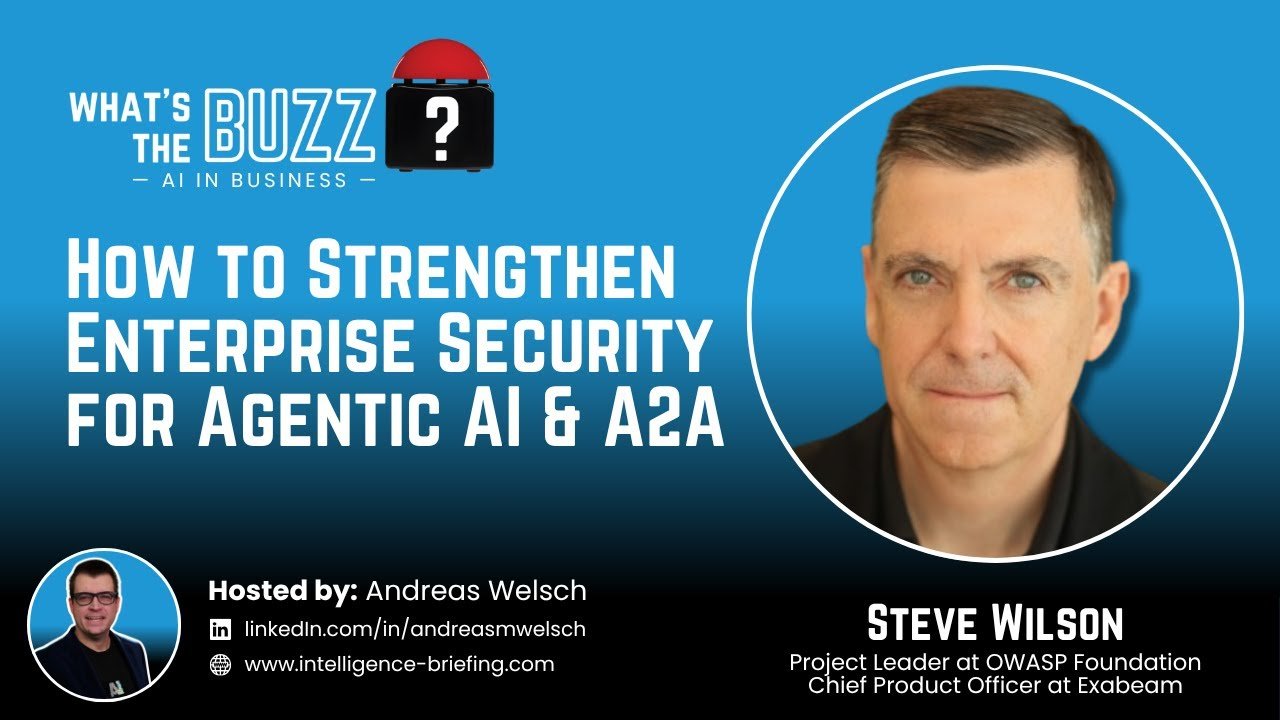
Guest: Steve Wilson, Chief AI and Product Officer at Exabeam & Founder of the OWASP GenAI Project
Host: Andreas Welsch
Episode: What’s the BUZZ?, Season 4, Episode 18
Published: June 24, 2025
Episode Summary
Steve Wilson, Chief AI and Product Officer at Exabeam and founder of the OWASP GenAI Project, joins Andreas Welsch to answer how enterprises can secure AI agents and agent-to-agent communication. Steve describes agency as a volume knob, explains excessive agency as a system that is not very smart but has a lot of capability, and says information management is the first line of defense. He separates agent-to-agent standards such as Google’s A2A, which see limited production use, from MCP, which people use widely to give agents tools. His three takeaways are to understand the agency you give agents, to control their data access and privileges, and to stay aware of the opportunities.
Key Takeaways
- Steve says agency is not a binary switch but a volume knob. A chatbot has little agency, while an agent with tools that can take actions that cannot be undone has much more.
- Steve calls excessive agency the real danger zone: a system that is not very smart but has been given a lot of capability.
- Steve says the first line of defense is information management. Give an agent the minimum data it needs, because a system prompt that tells it not to share information will never be sufficient.
- Steve says A2A and similar agent-to-agent standards see limited production use, while MCP, the tool protocol, is used everywhere and adds a supply chain of tools to consider.
- Steve says an agent that interacts with untrusted sources needs a zero trust approach, with screening on the way in and the way out using traditional methods.
Timestamps
- 00:01:42 Guest background: Exabeam, OWASP GenAI Project and his O’Reilly book
- 00:04:35 What’s the BUZZ? If AI were a band
- 00:06:58 What agents are: agency as a volume knob
- 00:09:14 Excessive agency
- 00:10:38 Insider threats when agents join the network
- 00:13:57 Information management as the first line of defense
- 00:16:43 Agent-to-agent protocols versus MCP
- 00:20:01 Discovery services for agents
- 00:21:23 Zero trust for untrusted agents and Steve’s Chat Playground
- 00:23:28 How companies get agentic AI right
- 00:28:00 Vibe coding and AI-fixed code
- 00:29:43 Three takeaways
About Steve Wilson
Steve Wilson is Chief AI and Product Officer at Exabeam, a cybersecurity company that has used AI and machine learning for 10 years and has shipped LLM-based copilots and agents for 18 months.
Steve founded the OWASP GenAI Project, which develops guidance on building secure software with AI, and wrote The Developer’s Playbook for Large Language Model Security for O’Reilly.
Full Transcript
Read the full transcript
Andreas Welsch: Hey, welcome to What’s the BUZZ, where leaders share how they have turned AI hype into business outcomes. Today we’ll talk about how to strengthen your enterprise security for agentic AI and multi-agent, agent-to-agent communication, and who better to talk about it than someone who is actively working on that. Steve Wilson. Hey Steve. Thank you so much for joining.
Steve Wilson: Hey Andreas, thanks for having me back. I’m excited for the conversation today.
Andreas Welsch: Wonderful. You’re my go-to security expert for anything around AI. You’ve been on the show, I think, five times now or something like that. We always have so much to talk about, and I love bringing you back because you see that the topic keeps evolving. Every quarter, every six months, there’s something new to talk about, something that’s really important. But before I get too excited, maybe you can tell our audience a little bit about yourself, who you are and what you do.
Steve Wilson: I wear three or four different hats that are relevant to today’s conversation. My main hat is that I’m the Chief AI and Product Officer at Exabeam, which is a cybersecurity company that’s been using AI and machine learning for 10 years to improve the cybersecurity stance of our customers. We’ve been shipping LLM-based copilots and agents as part of our product for 18 months now, so I have a lot of experience building those hands-on. The other thing is that I founded something called the OWASP GenAI Project. If you are unfamiliar with OWASP, it’s an open source foundation dedicated to building secure software. About two years ago we started developing guidance on how to build secure software with AI, a super hot topic for the last couple of years. And I think your book and my book came out the same week, right around the same time. I did write a book for O’Reilly called The Developer’s Playbook for Large Language Model Security.
Andreas Welsch: That’s awesome. Like I said, I think it was about two years ago that I first reached out to you when I saw the OWASP Top 10 for Large Language Models. It’s just amazing to see how things have progressed and how quickly they’ve evolved from that initial list. So again, super excited about the conversation we’ll have today. Why don’t we play a little game to kick things off? What do you say?
Steve Wilson: Let’s do it.
Andreas Welsch: All right. In good old-fashioned style, I’ll hit the buzzer, the wheels will start spinning, and when they stop, I’d love for you to answer with the first thing that comes to mind and why, in your own words. To make it a little more interesting, you only have 60 seconds for your answer. For those of you who are watching us live, drop your answer in the chat and why as well. Steve, are you ready for What’s the BUZZ? Let’s do it. Okay, so here we go. If AI were a band, what would it be? 60 seconds on the clock, go.
Steve Wilson: All right. I’m going to go with my dad’s favorite band, which is The Beatles. I’m not old enough to remember this moment, but I remember my dad talking about it. There was a very sudden change from before anybody heard of The Beatles, and then one night they were on a big TV show in the United States and everybody knew about them. That was like the ChatGPT moment for The Beatles. After that they were ubiquitous for a few years, but they always kept reinventing themselves. It’s not like the Beatles music from 1969 sounded like the Beatles music from 1964. It sounded totally different. They kept reinventing themselves, but it was always the same thing, and at some point they disappeared. But they didn’t really. You can listen to all of the popular music today and you can hear the Beatles in all of it. I expect the place where we’re going is that we’re going to stop talking about AI companies, like we stopped talking about web companies. There will just be companies, and just like we all use the web today, everybody will use AI tomorrow.
Andreas Welsch: I love it. That’s such a great analogy. It is really this evergreen thing to some extent, but also something that deeply influences everything that comes after it. Great analogy. Speaking of these companies, and at some point we won’t talk about AI companies anymore, but at the moment we do, we are seeing them bring more and more AI agents into the market on the one hand, and then those that adopt them bring them into their organizations. We see players like Google. They’ve announced protocols to enable agent-to-agent communication and multi-agent scenarios. Many others in the industry are getting behind it. It’s great to see that there’s some collaboration. Everybody realizes we want to have these agents communicate with each other. Like I said, we’ve talked about the OWASP Top 10 for LLMs. Previously we talked about how that’s evolved for Gen AI, and now here we are talking about how organizations that are letting LLMs on steroids loose on their systems and data are facing the next set of challenges. So I’m curious, what are you seeing when you talk to organizations around this topic of agents? Do they even have that on their radar yet? And what are the internal and external threats and challenges?
Steve Wilson: Obviously everybody’s talking about agents. You can turn on CNBC, which is the financial news network in the US, and all they talk about is AI and agents. But I think often people don’t have any idea what they mean when they say AI agents. It’s just the thing they say now instead of AI. I think you need to dissect the word a little bit to really get to the heart of it, because the concept is not completely new. If you get under the word AI agent, or even the more complicated, hip word, agentic, it’s all about how much agency something has, and we’ve had concepts about granting agency for a very long time. I grant my lawyer agency to file papers on my behalf. That’s where the basic concepts come from: you’re giving something the right to do things on your behalf. The way I look at agency, it’s not a binary switch. It’s not like it has agency or it doesn’t. It’s like a volume knob. I’m giving this very little agency, and that’s your classic chatbot use case. It might have the agency to represent you as a company if it’s your customer service chatbot, but at the end of the day the worst it could do to someone is call them a bad name. But if we start to give it tools and give it access to do actions that are undoable, all of a sudden there’s a lot more agency in these things. Do we give them the capability to act on their own? Chatbots never act on their own. You prompt them and they respond, and it’s always that very simple interaction. These agents tend to have longer-running processes, and those could be seconds to minutes, or they could be hours to days, although those are very rare at this point. But I think that’s where people think it’s going. From a security perspective, the way I like to think about it is there’s a grid. How much agency do I give something, and how smart actually is it? How capable is it? Where you get into the real danger zones is what, in the first version of the OWASP guidance, we called excessive agency, which means I have a thing that’s not that smart, but I’m giving it a lot of capability. I’m asking for trouble. I’m asking for security problems to happen. That might be because it can access things inside my company or outside my company that are important, and it opens you up to risk and exposure. On the other hand, the models underneath these agents are so much smarter than they were even nine months ago, much less two years ago, that I can give them more interesting jobs. At Exabeam, our copilot used to be an assistant, and if somebody had a question about something, they could ask the assistant. Now when our low-level AI algorithms detect a problem, the agent runs off and does a complete security investigation and comes back with a report and presents it to the user, where it’s done a tremendous amount of work before it was asked. I think those are the kind of use cases where it can be really powerful as you give it some initiative. But you have to be careful about how much actual agency you give it. And then you get into a lot of questions about where humans come into the loop. How much do you let it do supervised versus unsupervised?
Andreas Welsch: I have a follow-up question there. A couple of years ago I was doing some work with clients in aerospace, and the biggest threat to the organization is not so much the external threats. They’re big and significant too, but it’s actually the insider threats, people that we already know are on the network, that are in the company, within the four walls of the company, that have access to information and that might funnel it somewhere else for malicious purposes. There have been tools to detect insider threats, things like data loss prevention. Now, all of a sudden, in addition to people, you have agents on your network that can do this, not just by clicking manually, but by automating these things, as one agent, or dozens or hundreds or thousands, if you will. Maybe they spawn new ones, what have you. How are organizations able to defend against those threats? How does security need to change? We’ve previously talked about zero trust architecture and these kinds of things. How do all of these factors play into it?
Steve Wilson: By the way, that’s a great question. The first place to start is that insider threats and compromised credentials, which are two sides of the same coin, are the hardest to detect, most insidious security threats that every CISO worries about. Classically, the vectors for those were maybe a disgruntled employee, but more likely somebody who’d been the victim of a phishing attack who lost their credentials, and then somebody who’s on your network who doesn’t belong there. What’s interesting about the agent ones is that as you give a set of agents the right to do work on your behalf on your network, that does become its own cut of insider risk. What I can tell you, though, is that what I see in practice is the bar for what people call an agent right now, for what people are really deploying, is far lower. In a lot of cases, and this doesn’t mean they’re lesser, it just means they’re, let’s call them, less risky use cases. But even at that, we have to manage them. Somebody will say, hey, wouldn’t it be great if we had an agent that was part of the HR department that could answer HR-related questions for our employees? It’s really a classic copilot use case. You give it all the policies and all the stuff nobody knows how to find and nobody knows how to read, you hook it up with RAG and other things we’ve come to understand over the past couple of years, and you put it on the network where people can come to it and interact with it. It doesn’t have a huge amount of agency, but what it does have is access to potentially a lot of data. That’s where the first line of defense really comes in. This is what I talk about with any of these LLM-based systems: the first thing you need to think about is how much data you’re giving it access to. Even the more advanced models are not great at decision making. They’re easy to trick. If you give it access to data and your security defense is something in the system prompt that says, please don’t give this information out, that is never going to work. It is never going to be sufficient. So the first line of defense is information management. You say, for my agent, for what it needs to do its job, what’s the minimal version of that job that it can do, and what’s the minimum amount of data that it needs? Then you can do a classic risk assessment around that. When you do get to these agents and you want them to do work, take that AI HR agent for example. It now gets a set of actions that it can do. You say, I would like to update my tax withholding. There’s a version of that where you just give the agent access to the API set for Dayforce or whatever your HR system is, and you say, I’ll just let it figure out the code to write when somebody asks to do something. It could do anything that they could do, or worse yet, it could do anything the administrator could do. That’s probably not a good idea. What are the low-risk actions that it could do that are undoable later or confirmable? Or does your request get queued up and prepared for somebody in HR to briefly review and approve, so they don’t have to do the action and you don’t have to get hold of them? It becomes a broker with a human in the middle.
Andreas Welsch: As I’m listening to what you’re sharing, I’m thinking especially of things like agent-to-agent communication, multiple agents or multi-agent systems. What are the risks of one agent instructing another to reveal more than it’s supposed to? A2A is a communication protocol, like we have a protocol when humans speak. Usually when one person speaks, the other one listens and responds and vice versa. But the information that is transported, what am I trying to get you to do, is a totally different one. So I hear information management is one critical piece, and locking down the amount of information in the systems and so on, so as not to expose it. What are you seeing when agents communicate with each other?
Steve Wilson: It’s fascinating, because I think there are two kinds of protocols and it’s a big source of confusion, so it’s worth outlining what the two big protocol categories are right now. When you say agent-to-agent communication, there are some emerging standards, like A2A from Google. Those are honestly seeing very limited adoption right now. There’s a lot of experimentation going on. I would say there’s very little actual production usage of these things. The communication protocol that has stormed the beaches and is being used everywhere, whether wisely or not, is the tool usage protocol, and in particular MCP, the Model Context Protocol. When people think about building agents, one of the ways that they now give their agents agency is they give them tools. Classically, an LLM has just been a brain and a mouth, because it was a chatbot and that’s all it could do. Now it has fingers.
Andreas Welsch: Yes.
Steve Wilson: That’s the first thing to really look at. If you’re going to start to use MCP to give your agents fingers and hands, there are a lot of considerations there. There are a lot of security considerations. There’s a lot that’s been written on the topic of how you think about what agency you give them, but also where you get these tools from. It adds a whole supply chain set of conditions. The thing I will say that I think is coming, though, when we look at agent-to-agent, is that the first hurdle to getting there is having more than one agent. The use cases where we see some agent-to-agent interactions are often completely internal, with bespoke agents. Inside a company I might have several agents that I might construct to build a swarm. It might be multiple instances of one agent. One of the first places that we’re seeing this is writing code. You see a lot of talk these days about spinning up multiple instances of an agent like Claude Code, which work together on a code base like a team of engineers, each taking different jobs out of a queue and processing those in parallel. That’s one of the early places where we’re starting to see this, multiple instances of the same agent working together. The next one is, within a company, bespoke agents that are in roles. In the product at Exabeam, we now have three or four different agent types. They actually don’t really interact with each other yet. They’re more like custom agents for vertical use cases. The thing that I think we’re going to see develop, and this is where I think people should start to look, is that we’re going to need reliable discovery services for agents. The thing the internet needed before the web was really viable was DNS, and we’re starting to see ANS-like proposals for, hey, here’s how I publish that I have an agent that can carry out certain kinds of services. What is promising about these is that they’re often much better thought out than DNS from a security perspective. Those early internet services, nobody took trust into account, and it’s the reason the internet is the train wreck that it is. It was just designed to share information between universities. Why would you want to limit it?
Andreas Welsch: But see, I love that on the one hand these concepts are seeing a revival. I’ve also been talking about a central registry or discovery for agents for a bit, and seeing that this is materializing and maturing I think is great. At least this time around, with everything that we know over the last 50, 60, 70 years, we know how to make it better and how to design with security first principles. At least in theory, we should know.
Steve Wilson: Yeah. But when you think about these multi-agent cases where your agent might be interacting with an untrusted third-party agent, a lot of the practices are going to be similar to interacting with untrusted humans. Today, when we put our chatbot or our agent on the web to interact with humans, you have to take a very hard zero trust approach, where you’re guardrailing these things multiple ways. One of the things that I put out in the last couple of months was a new open source project that you can find on GitHub called Steve’s Chat Playground. It’s the embodiment of the Top 10 list in the book. There’s a set of chatbots and you can pick different chatbots, and some of them have built-in vulnerabilities. There are check boxes where you can install guardrails, to look for prompt injection or look for unintended code generation on the back end. If I’m building an agent that I want to interact with untrusted things, whether that’s reading email that I’m getting from an untrusted source or taking API requests from an untrusted source, I need to be screening everything that I can, using very traditional methods, on the way in and the way out.
Andreas Welsch: I like that. That’s really practical. I didn’t know you had put up the playground, so I need to check that out myself. It sounds like a great and helpful tool to see how additional guardrails strengthen your security. Now we’ve talked quite a bit about the things that can go wrong and where all the risks are, but I also want to make sure that we talk about the things that can actually go right. When you bring agents into your business, when you look at security, what are you seeing there? How are companies doing it really well that are embarking on their agentic AI journey, that are bringing in some agents or maybe some more agents?
Steve Wilson: I think there are two big categories to think about when I talk to people about their approach to this. One is, I work at a big company and I’m trying to figure out how to make my company better. And then all the way at the other extreme: how could I make my company act like a big company even though it’s not? These are two very different approaches that may involve a lot of the same technology stack. Let’s talk about what I’ll call the hard case first, which is, I have a battleship and I’m trying to steer it. I work at a Global 2000 company and I see my smaller competitors moving faster, doing things that are AI-native and deploying some of these agentic technologies in efficient ways. What you do see are these very vertical agent stacks that are starting to become productive. The coding one is by far the most mature, even though it’s by far the scariest and the one with the most agency, so to speak. In one case I’ve been involved with at our own company, we have one product that has a 20-year-old code base. It is the gnarliest, scariest thing, and there are parts of that code base no human wanted to touch, but it was problematic. There were things the customers didn’t like, and we had one brave engineer who waded in with Claude Code and a positive attitude and came back four weeks later with this thing rewritten in ways people never thought possible. They thought, if I dedicated a team of 10 for three months to it, I don’t know that I could do it. They went in and did something, and it meant something to the business. We’re doing more and more of that now, and I know people across companies are doing that with software development. All the way over on the marketing side, we’ve seen people generating marketing collateral forever. What we’re just on the early part of is things like agent-based sales prospecting. Your main sales manager persona is one of the most expensive single units that you have at the company. These people may make a million dollars a year. You don’t want them cold calling on the phone. Traditionally you had given them one or two low-level assistants who would place their calls and coordinate meetings. We’re starting to see the ability to replace those or accelerate those. That leads me to the other case, which is, I want to be a one-person startup, and we hear multiple people talk about it. We will see a billion-dollar-valuation company come out of one human soon, surrounded by agents. Somebody who has an idea for a product is going to use agents to build the first version of the product, use agents to sell the first version of the thing that they build, and use software to handle the basic compliance needs that they have, for filing taxes and those basic things. Those are all within reach and we see people really doing that. I think we’ve crossed a line where we see what I’ll call 20-person startups who are well over a billion-dollar valuation. That would never have been possible two years ago. We’re on our way to a one-person startup.
Andreas Welsch: That’s pretty exciting, right? Having all these capabilities at your fingertips, whether it’s something that you built yourself or a collection of different tools that you assemble. Certainly if you’re a one-person startup, it’s pretty straightforward. There are pretty short communication pathways between your head and your hands, probably. So just seeing where that goes. Nonetheless, at some point they also need to think about security and how to secure the data that they generate, that users give them, and so on.
Steve Wilson: You do, and we see that. Vibe coding is part of this, and there has been so much controversy out there about the security of vibe-coded things. The one piece of hope I will give everybody, having worked in what they call AppSec for years, which is the industry that helps people secure their code, is that the code that gets written today by teams of humans is not secure, by and large. We try, and we should try, and we fight that battle. But that battle is hard, and humans are bad at writing secure code. What agents let us do is often what humans do, much faster. The piece of hope that I have going forward is that there’s so much investment in these AI-aided coding tools. What I could never get the human coders to do was really care about security. They want to build new stuff. They want to build exciting stuff. They want to build new features. The bots don’t really want to do anything. If, while we’re training them, we incent them to write secure code, they’ll write secure code. I think in the next year or two we will rapidly cross the point where we say, I don’t want the humans doing the securing of the code. I want the next generation of AppSec tools, which are artificially intelligent, to be the ones fixing those bugs, not the humans.
Andreas Welsch: Talk about rapid development in that space. Speaking of rapid, it seems like the last half hour has gone by in no time. Steve, I was wondering if you could summarize the key three takeaways for our audience today before we wrap up.
Steve Wilson: Sure. First things first, understand the level of agency that you are giving to your agents. Once you’ve moved past just being a mouth and the thing has fingers, think about what you’re allowing it to do on your behalf and what mechanism it is going to use to do that. Think about the intelligence level that your bot has. You’re just as likely to get yourself in a high-risk situation by the bot making a bad decision as by being attacked by a malicious third party, but the malicious case makes it even harder. So you really need to think about what data it has access to and what privileges you’re giving it to execute on those decisions. The third one is to be aware of the opportunities, because the opportunities are massive. You can’t look at the first two and say, we don’t know how to fully secure these systems, so I’m just going to ignore it. You do that and your name is going to be Blockbuster or Sears Roebuck in a few years. You need to start to learn how to do this. Be really conscious about those things in terms of data access and agency levels, find appropriate use cases, and start to move forward, and I think you can change the trajectory of your business.
Andreas Welsch: I love that. It’s very tangible advice and sums up our conversation really well. Steve, thank you so much for joining us and for sharing your experience with us. Again, I’m always amazed how quickly this topic of security evolves and what all the different aspects are that now come into focus. So hopefully, for those of you in the audience, you also have a better understanding of it. Steve, again, thank you so much.
Steve Wilson: Thanks Andreas. It’s always a pleasure.
Listen and Subscribe
- Listen to this episode on Buzzsprout
- Watch this episode on YouTube
- All episodes of What’s the BUZZ? on Buzzsprout
Related Reading
- AI Governance for Enterprise Leaders
- Agentic AI for Enterprise Leaders
- Always-On Agents by Andreas Welsch (forthcoming, early 2027)
- Agentic AI Security: Five Layers and Agent Commerce
- AI Agent Control Plane: Governing Agentic AI at Scale
- Agentic AI Vendor Risk: Access Limits, Sovereignty, Workslop
Frequently Asked Questions
What is excessive agency in AI agents?
Steve Wilson uses excessive agency for a system that is not very smart but has been given a lot of capability, such as access to important things inside or outside the company. He says this combination invites security problems and exposes the organization to risk.
How should organizations limit what data an AI agent can access?
Steve says the first line of defense is information management. For each agent, decide the minimal version of the job and the minimum data it needs, then run a classic risk assessment. A system prompt asking the model not to share data is never sufficient.
What is the difference between A2A and MCP?
Steve distinguishes agent-to-agent standards such as Google’s A2A from tool usage protocols such as MCP, the Model Context Protocol. He says A2A sees very limited production use, while MCP is used widely to give agents tools and raises supply chain questions about where tools come from.
How do AI agents change the insider threat?
Steve says insider threats and compromised credentials are among the hardest threats to detect, and that agents given the right to do work on a network become their own cut of insider risk. He notes that what people deploy as agents today is often a lower-risk, copilot-style use case.
How can companies defend against untrusted third-party agents?
Steve says the practices resemble interacting with untrusted humans: take a hard zero trust approach and guardrail the system in multiple ways. He suggests screening everything on the way in and the way out, and points to his open-source Steve’s Chat Playground for testing guardrails.