

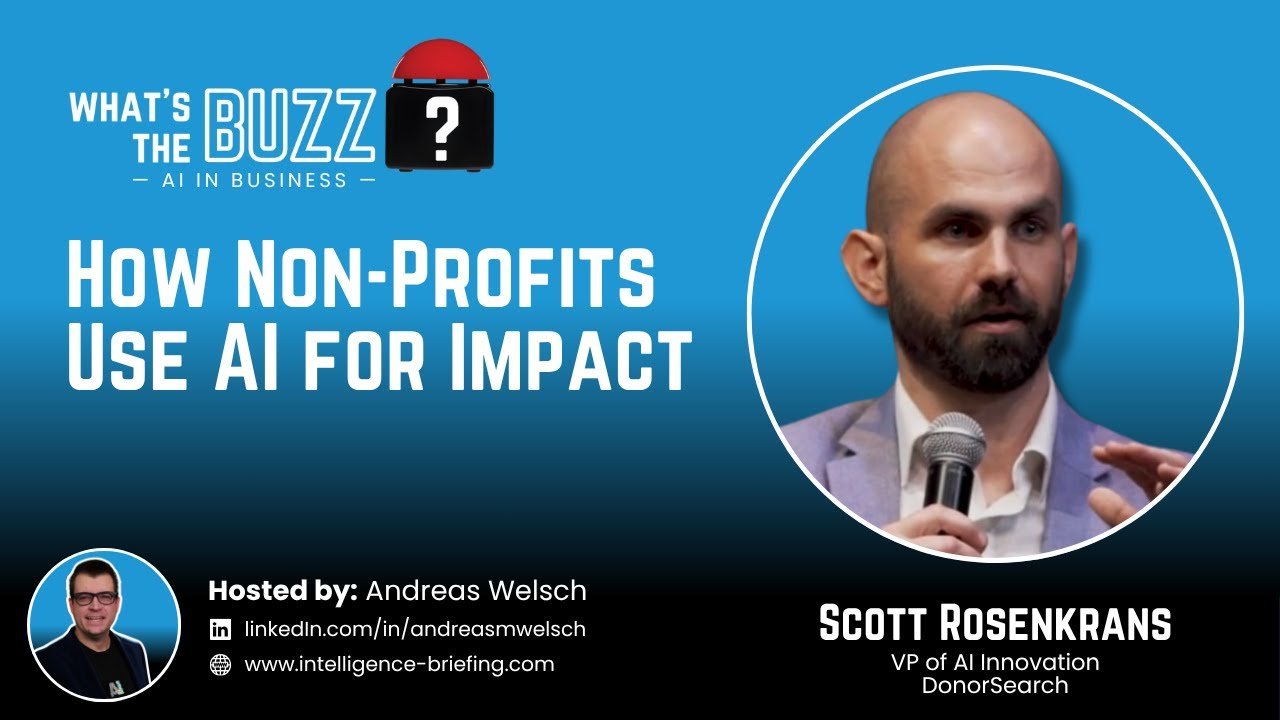
Guest: Scott Rosenkrans, VP of AI Innovation at DonorSearch
Host: Andreas Welsch
Episode: What’s the BUZZ?, Season 4, Episode 21
Published: July 1, 2025
Episode Summary
Scott Rosenkrans, VP of AI Innovation at DonorSearch, joins Andreas Welsch to explain how AI innovation helps nonprofits pursue their mission. Scott says a nonprofit gives donors only trust in return for a gift, and that this shapes how the sector should approach AI. He argues that AI belongs in informational tasks and should stay out of relationship-building, that AI makes a broken system more broken and faster, and that culture drives AI adoption. His three takeaways are to put trust first, to prioritize relationships over transactions, and to ask whether something should be done, not only whether it can.
Key Takeaways
- Scott says that when someone gives to a nonprofit, the only thing the nonprofit gives in return is trust, and trust is easy to break.
- Scott points to a national eating disorder nonprofit that replaced its call center with an AI chatbot, which within three or four days gave harmful advice.
- Scott says AI should handle informational and menial tasks, such as reports or processing a gift, while relationship-building with donors stays with humans.
- Scott cites a figure he has heard, that 70% of successful AI adoption comes from culture, not data or models.
- Scott recommends measuring relationships, such as a three-year rolling average, retention rate and acquisition rate, instead of only dollars raised.
Timestamps
- 00:01:01 Guest background: DonorSearch and predictive models
- 00:02:30 The book Nonprofit AI
- 00:05:00 What’s the BUZZ? If AI were a vehicle
- 00:06:19 Mission, trust and a cautionary chatbot example
- 00:09:53 Fundraising AI, a responsible AI framework
- 00:11:28 Why an autonomous fundraiser undermines trust
- 00:13:54 Why AI in a broken system makes it worse
- 00:16:30 Culture drives AI adoption
- 00:18:05 Combining predictive and generative AI
- 00:21:15 Measuring impact: relationships over transactions
- 00:24:28 Three takeaways
About Scott Rosenkrans
Scott Rosenkrans is VP of AI Innovation at DonorSearch. He has worked in the nonprofit sector for 15 years, both inside nonprofits on charitable fundraising and as a consultant.
For the past eight years Scott has focused on predictive machine learning models for nonprofits, and he published the book Nonprofit AI, a comprehensive guide to implementing artificial intelligence for social good.
Full Transcript
Read the full transcript
Andreas Welsch: Today we’ll talk about how AI innovation helps nonprofits pursue their mission, and who better to talk about it than someone who’s actively working on that. Scott Rosenkrans. Hey, Scott. Thank you so much for joining.
Scott Rosenkrans: Hey Andreas, thanks for having me. I’m very excited to be here.
Andreas Welsch: Hey, wonderful. Why don’t you tell our audience a little bit about yourself, who you are and what you do.
Scott Rosenkrans: Sounds great. I’m Scott Rosenkrans. I’m VP of AI Innovation at DonorSearch. I’ve been in the nonprofit sector my entire career. I actually went to grad school to be a therapist, to help people solve problems, and realized in about six to nine months that I was going to burn out too quickly and found myself in the nonprofit sector. So I’ve been in there for 15 years now, working with nonprofits both in a nonprofit, doing a lot of charitable fundraising, working behind the scenes on identifying who we should be asking for gifts and so on, and also as a consultant helping nonprofits do more with the limited resources that they have. For the past eight years, I’ve been prioritizing and focused on predictive machine learning models. So building custom machine learning models for nonprofits to predict who’s likely to make a gift in the next 12 months, who’s likely to make their first gift, and helping organizations really utilize those limited resources. They’re usually working over budget. They have limited staff, people wearing a lot of hats, so I’ve been helping them make the most out of what they have. And then also doing a lot of consulting about how to adopt AI. We know that just because they have tools doesn’t mean that they’re seeing the success with it. So how do we get them to move a little bit further in their AI journey?
Andreas Welsch: We met in Phoenix at Machine Learning Week a couple of weeks ago, and said we should definitely record an episode together. But you also mentioned that you’re working on a book, right? Or you actually have a book out?
Scott Rosenkrans: Yeah, we have a book out, Nonprofit AI. It came out about two months ago. It’s a comprehensive guide to implementing artificial intelligence for social good. My colleague and I, my friend and my mentor, Nathan Chappelle, have been in this space together for the past eight years. We’ve worked with hundreds of nonprofits, and only a few of them have really seen the success that we would expect them to see with these predictive models. And then it even expanded, as you would expect, with generative AI, right? Everybody wants to jump on the bandwagon. They hear about how the ROI is limitless, and it’s just such an easy thing to adopt, but nobody’s really seeing that come out. So this book is really to help anyone in the nonprofit space move a little bit further along, identifying the challenges that are getting in the way, whether they’re cultural or technical. Spoiler alert, they’re usually cultural. And then giving you some examples of how to actually implement, whether it’s predictive, generative, or automation. And once you’re seeing success, go back to the book, read a little bit about how to get further along the journey, and then see what’s coming down the pike. AI is constantly evolving. New technologies are coming out, so this isn’t a read-it-once-and-you’re-done. It’s a guide to help you along the way.
Andreas Welsch: That sounds great. And by the way, overall, I love the mission of helping others help others as well, that you shared, working with nonprofits. As I said, super excited to have you on. So now Scott, should we play a little game to kick things off?
Scott Rosenkrans: Love it. Absolutely.
Andreas Welsch: So let’s do this in good old-fashioned style. When I hit the buzzer, you’ll see a sentence, and I’d like for you to answer with the first thing that comes to mind and why, in your own words. To make it a little more interesting, you’ll only have 60 seconds for your answer. Okay? Scott, are you ready for What’s the BUZZ?
Scott Rosenkrans: As ready as it’ll ever be. Yes.
Andreas Welsch: All right, so here we go. If AI were a vehicle, what would it be? Vehicle. Okay. 60 seconds on the clock. Go.
Scott Rosenkrans: I’m not sure if this answer applies, but we’re going to go with it anyway. I’m going to say a Transformer. It could be a lot of things all at once. It’s whatever it needs to be in the moment, whether it’s a semi or a bot. Whatever it is, it’s there to get you a little bit further and help you along, and it can change and evolve and adapt to the surrounding circumstances.
Andreas Welsch: Perfect. Sounds like an Optimus Prime answer. Fantastic. Thank you so much for doing this on the fly. I really enjoy seeing how my different guests answer these questions and what comes to mind. Great analogies. We’re here to talk more about nonprofits, and one of the first questions that comes to mind for me is that I’ve spent 25 years working in corporate, in for-profit, a lot of time on AI projects, AI programs, strategy, enablement and so on. I’m wondering, what does it actually look like when you work for a nonprofit? How is it different in that environment from traditional corporate, for-profit?
Scott Rosenkrans: The most obvious thing is that our goals are not profit-based, right? It’s not just increasing revenue and having better returns for stakeholders and shareholders and so on. It’s doing good. It’s completing your mission. The goal of most nonprofits is to put themselves out of business because they’ve solved the problem. When I, as a consumer, give money to a for-profit company, I get something in return. I get an iPad, an iPhone. I get access to a social media platform or whatever it is. I get something in return to evaluate whether I thought my investment was worth it. For a nonprofit, all we get to give in return is trust. If you give money to a nonprofit, you are trusting that the nonprofit is doing what they said they would do with it and doing it efficiently. Trust is very easy to break. There’s a classic example of a nonprofit that, like many others, was under-resourced, and so they got rid of their call center and replaced it with an AI chatbot to save resources. This was the National Eating Disorders nonprofit. Within three or four days that chatbot was giving harmful advice. It would be fine for everyone else, but for that audience, advice like if you want to lose weight, just check the scale or eat fewer calories is not helpful. It’s not beneficial for those suffering from an eating disorder. So that model may have passed ethical guidelines, responsible guidelines, but it wasn’t beneficial. As a result, that nonprofit likely suffered in terms of its fundraising performance, and other nonprofits similar to it probably also suffered. If I’m reading that in a newspaper, I might not pay attention to who it is, but I know it’s a nonprofit. Even more so in today’s political climate, there’s a lot of information coming out about how nonprofits have been misusing funds in certain circumstances, or a lot of allegations along those lines. So there’s a lot of mistrust there. We need to make sure that what we’re doing with artificial intelligence in nonprofits always puts trust first and relationships first, and isn’t just going for a quick win and prioritizing transactions over relationships. Another thing is that nonprofits are very overburdened. A study came out recently in our space showing that 75% of nonprofit employees are looking to leave their job in the next 12 months. 60% of them are considering not coming back to the nonprofit sector overall, and the overwhelming reason is that they’re overworked and under-resourced. And then you have AI that says it’ll give you 98% of your time back, it’s $20 a month, all these things, but it’s just not connecting. Sometimes people just jump in that AI pool without thinking about how they should be employing this and how they should be using it, and not just, oh, here’s a cool use case, let’s try it and see what happens, and we’ll figure out the rest afterwards.
Andreas Welsch: I think that’s the first super important distinction that you’re making, right? It’s about what the mission is, how we bring good to the cause that we’re advocating for, that we’re trying to solve. It’s interesting to hear how that changes how you approach innovation, how you approach things like AI, and what really needs to be at the forefront.
Scott Rosenkrans: Yeah, and my colleagues and I have been working on a program called Fundraising AI. We know there’s no governmental regulation on AI. There’s the NIST framework, the EU has the EU AI Act, but in the US we don’t really have any specific guidelines or frameworks on how to employ this. So we built Fundraising AI, which is the first of its kind. It’s a responsible, beneficial framework for nonprofit artificial intelligence, and it gives those organizations a governance template, a tool to say, this is how we should be looking at it, how we should be using it, and how we should be evaluating it. It’s constantly being adapted and evolved as technology moves on, so that we’re providing that resource and saying, you can’t just go with what Microsoft says is responsible or Meta says is responsible. We need to build this for our own sector and have our own construction around it.
Andreas Welsch: Earlier you mentioned it’s not just about quick wins and showing some value, but about ensuring that you do that right, that you do it in the right spaces, that you connect it deeply to the nonprofit’s mission. So I’m curious, what does AI innovation look like in this space, and how do you even prioritize what you should pursue, especially when you need to check it against additional dimensions?
Scott Rosenkrans: Great question. There’s a lot of “just because we can, should we?” Chatbots are coming out, virtual assistants are coming out. There are all these technologies and all these use cases in the for-profit world that we see. You turn on your TV and there are 40 new applications of artificial intelligence. You can’t separate yourself from it. An example that’s coming out more recently in the nonprofit sector is an autonomous fundraiser. Fundraising should be about human-to-human relationships, right? I’m seeing you as a potential supporter of the organization. I’m trying to find out what makes you tick, how you would want to support this, and how we can establish a strong relationship between the two of us to further this mission and help you feel like you’re expressing your generosity in a positive way. If I say, you know what, I’m not going to do that, I’m just going to replace myself in this with an autonomous bot that can work all the time and knows exactly what to say, it is also manipulative by nature and more successful at being manipulative, and it has to be goal-oriented. That goal is raising dollars. I’m not treating you as an individual that I want to establish a relationship with. I’m not putting trust in this relationship between us, and I am in some senses misrepresenting the organization, because I’m saying what matters more is transactions and getting dollars in the door than an actual human-to-human relationship. So where we say AI should be used is more informational. Use it to save time on those things that you don’t want to do, the menial, manual tasks, like putting together a report or processing a gift. But when it comes to relational, that’s where AI should stay off to the side. Keep that for the humans to continue on and do what we do best.
Andreas Welsch: I think there’s this debate on the corporate and on the for-profit side, what does AI do, what do people do? To me, the way that you articulated that just now makes it very clear, right? It’s a relationship-based, people-based business in that sense. We need to have this relationship between people, and AI can support us on everything else that we do to run our nonprofit.
Scott Rosenkrans: Exactly. And the nonprofit sector, like I mentioned, is under attack, but it’s also been on a downward trend for a long time. Twenty years ago, two-thirds of people, if you asked them, said that they make gifts to nonprofits. Now it’s less than half. If this trend continues, in 40 or 50 years there are going to be no individuals giving to nonprofits. There are a lot of problems, but part of the problem is that we’ve been using the wrong tools to identify who we’re going to ask. We prioritize wealth over relationships. We prioritize transactions over relationships. If you throw AI into a broken system, it’s just going to make that broken system more broken, and faster. It’s not going to make it stronger and it’s not going to fix it. So you need to reevaluate what you want to prioritize and how you use the AI to do that, as opposed to just coming in and doing things quicker and moving faster towards that brick wall that we’re already going to hit.
Andreas Welsch: Again, I see so many parallels here. On the for-profit side, we talk about don’t just automate a process. First of all, look at whether you need it. Do you need all the steps? Can you make it leaner? And then once it’s optimized, automate it. Some of that is what I’m hearing from you as well in the nonprofit space. It doesn’t just help to throw more technology at it. It might just give you worse outcomes faster.
Scott Rosenkrans: Exactly. Nobody wants worse outcomes faster.
Andreas Welsch: No, please, no. But then I’m curious about the organization that you work for, DonorSearch. What are some of the organizational capabilities you need to even bring new AI features, models and initiatives to market? What are the skills? What does the culture look like? What does the data infrastructure look like to bring AI for nonprofits out into the world? How does it change?
Scott Rosenkrans: Again, that’s something that’s always changing. It’s not like the internet. The internet came out however many years ago and people were like, what is this thing? But once you learn it, you learn it. It doesn’t change all that much. Social media is a new thing, but it’s still based on the internet. Electricity hasn’t changed much since it came out. It’s not like you learn it and then you’re done and you’re caught up and never have to think about it again. AI is constantly evolving, and AI is now building new forms of AI. This is an exponential technology that we’ve never really seen before. So you always have to stay up to date and treat it as an iterative process, not just in terms of the tech but also the culture. A number that we keep hearing is that 70% of successful AI adoption, for-profit or nonprofit, doesn’t matter, is based on culture, not data or models. It doesn’t matter what tool you have if your organization is not set up in a way to really change its processes. This is one thing we talk about often. Predictive AI, which is where we spend most of our time and what we do at DonorSearch, makes the decisions for you. A lot of people have valued themselves as being able to make decisions with a lot of information, but if you don’t have to do that anymore, where do you put your value? So people want to hold on to that and keep AI at arm’s length, because it’s threatening to their own view of self. But instead, if you say, okay, if someone else is making decisions for me, I get to free up my time to do other things that I can do better and leverage other skill sets that I haven’t been able to flex as much, because I’ve spent so much of my time making decisions in this sea of data. And oftentimes the decisions were wrong anyway, or at least wrong to the extent that they could be improved now with artificial intelligence. So it’s constantly going back to, how can we treat this as an iterative process? How can we focus, sometimes not on the outcome, but on the process itself, to see how we can make those tweaks, like you’re talking about? There are new ways to do things, there are new technologies that you can apply. In terms of what we’re producing here, we have these predictive models custom for each organization, because we know no two organizations are alike. But now, knowing that generative and agentic are coming into play as well, how do we combine the two? We see most organizations really move the needle when they’re using predictive AI. Generative is incredibly valuable and efficient, but it’s not going to turn a million-dollar organization into a billion-dollar organization. Apple, Amazon, Netflix, they’re not trillion-dollar companies because of generative AI. They’re there because of predictive AI. Generative just allows you to speak more individually to each person and treat them as an n of one as opposed to a cohort of individuals. So it’s about combining the two so that nonprofits can really dig in and hone their human skill sets, and offload anything that could be offloaded elsewhere to something that’s more efficient at doing so.
Andreas Welsch: That sounds great. The part especially around how you do that in a nonprofit, I think there are many parallels. Again, you still need the data. You still need the skills and the resources. It’s interesting to hear you talk more about predictive analytics or predictive AI, but I’m assuming if you work with numbers and you want to make predictions about how people are likely to behave, and what the dollar amounts are that they might be likely to donate and to gift and give, Gen AI really doesn’t help as much, right? It’s not the computation. It’s maybe the email or the report or something around it that articulates when, or puts these numbers in context.
Scott Rosenkrans: It’s funny, we’ve been building these models for eight years now, so before November 2022, when ChatGPT came out. At that time in our sales pitch we used to have to say, AI is not this scary science fiction thing. You’re already using it. When you use Google Maps or Apple or Netflix or Amazon, you’re using it. It’s here already. It’s just that now we can use it for our own purposes. Then November 2022 came around and now we said, no, AI is not just ChatGPT. There’s two different things, generative and predictive. Everyone now thinks that they have a different concept and a grasp on what this thing is, but it muddies the water even more, because they are two very distinct tools with two very distinct outcomes and purposes. It’s about knowing what’s important for what. That was a big part of why we wrote Nonprofit AI. If you were to Google how nonprofits use AI, 99 times out of 100 it’s going to be a blog that has no real examples. It’s a list of generative AI use cases, but not an organization that’s actually done it. So we wanted to put emphasis on predictive, but also not forget that generative exists, and then also automation. Automation plays a big part with AI and leveraging that type of technology. So we wanted to make it more holistic and give a broader view on all the different capabilities that it can do, and not just hone in on, this is the end-all, be-all, it’s ChatGPT and that’s all you need to know.
Andreas Welsch: So how do you then, in this environment, measure the impact? It’s maybe not customer tickets solved or call volume reduced or something else. What’s the impact that you measure for a nonprofit?
Scott Rosenkrans: Most of my work in the nonprofit space is on the fundraising side, the charitable giving, so how do we identify the people to make the gifts. A very clear metric would be dollars raised. But my friend often quotes Charlie Munger: show me the incentive and I’ll show you the outcome. If you’re prioritizing dollars raised, then you’re just going to look to find dollars, and you’re going to speed over any hurdles, speed over any relationships to really get there. So a lot of what we’re trying to do, not as a result of AI but in conjunction with employing AI, is to change the metrics that are being prioritized from transactions to relationships. So instead of looking at how much you raised this year, look at your three-year rolling average, so that you can see if it’s increasing and prioritize more long-term, more sustainable relationships. What’s your retention rate? What’s your acquisition rate? Bringing new people in, but then keeping them along, is going to help nonprofits stay stronger and commit to their mission better than just saying, I raised X this year and now I’m going to try to raise X more. Because otherwise you’re either going back to the same wealthy people and they get tired of giving to you, or you’re not looking to bring in someone that’s maybe at a smaller level now but could grow to be a stronger donor, because that’s not what your incentive is. Your incentive is just dollars now.
Andreas Welsch: So it’s almost like customer lifetime value.
Scott Rosenkrans: Exactly. That’s another model that we build, long-term. RFM is a pretty traditional model, recency, frequency, monetary, but from a fundraising perspective it keeps bringing the same names over and over again, so you keep going back to the same people. We put that into an AI environment to ask, who’s most likely to be at the higher end but just hasn’t given enough runway to get there yet? It helps people prioritize those who are flying under the radar, who are a little newer in their relationship but showing up really strong, and who wouldn’t be prioritized with RFM or other methods. So we’re helping to lead the way with customer lifetime value, and get there through the technology that we can offer.
Andreas Welsch: Awesome. That sounds really great, and I think it puts the technologies, the models, the kinds of techniques that you can apply in a really good context, to show how that is connected and, again, drives the outcomes that you actually want to achieve. Now, Scott, we’re getting close to the end of the show and I was wondering if you can summarize the key three takeaways for our audience today.
Scott Rosenkrans: Key three takeaways. First, nonprofits are built on trust, and if trust is our currency, we need to go in with a different approach to how we’re treating AI, especially in terms of what’s responsible and what’s beneficial, than the approaches presented in the for-profit space. Two is to prioritize relationships over transactions. Whenever you’re using AI, how can you do it in a way that keeps the human at the center, and isn’t just saying, how do we get more money quicker? And three is that just because we can doesn’t mean that we should. Identify the ways that you want to grow and want to build a program that’s sustainable, and that isn’t heading towards this brick wall on a faster-moving train, but that allows you to get over the hurdles of what we refer to as the generosity crisis, and move in a way that changes that trajectory of decreasing dollars and decreasing donors year after year, and helps you establish relationships with people who want to stay and watch you grow.
Andreas Welsch: Wonderful. Thank you so much for painting this broad picture for us of what doing AI in a nonprofit looks like, and doing it for nonprofits. I certainly learned a lot. I think there are a lot of parallels that I could see between corporate for-profit and nonprofit, but you apply them in the context of this particular domain, and especially the part about fostering the human relationships and putting emphasis on them. When technology seems to make everything go faster and cheaper and more efficient, it’s actually still the human-to-human relationship that matters at the end of the day. I love coming back to that.
Scott Rosenkrans: Yeah. Absolutely. Thank you, Andreas. I really appreciate the time, and it was great speaking with you and talking to your community. I love what you’ve built here. Thank you so much.
Listen and Subscribe
- Listen to this episode on Buzzsprout
- Watch this episode on YouTube
- All episodes of What’s the BUZZ? on Buzzsprout
Related Reading
- AI Governance for Enterprise Leaders
- AI Leadership for Enterprise Leaders
- AI Leadership Handbook by Andreas Welsch
Frequently Asked Questions
How is AI different for nonprofits compared with for-profit companies?
Scott Rosenkrans says nonprofit goals are not profit-based: the goal is to complete the mission. A donor receives only trust in return for a gift, so a nonprofit has to put trust and relationships first and avoid quick wins that prioritize transactions.
Should nonprofits use AI for fundraising conversations?
Scott says no. He warns that an autonomous fundraiser is manipulative by nature, goal-oriented toward dollars and treats donors as transactions. He recommends AI for informational and menial tasks and keeping the relational work with people.
What is Fundraising AI?
Scott describes Fundraising AI as a responsible, beneficial framework for nonprofit artificial intelligence, built because the US has no specific guidelines for applying AI. It gives organizations a governance template for how to look at, use and evaluate AI, and it keeps evolving.
How should nonprofits measure the impact of AI in fundraising?
Scott says to change the metrics from transactions to relationships. Instead of how much was raised this year, look at a three-year rolling average, retention rate and acquisition rate, so the organization favors long-term, sustainable relationships.
What is the difference between predictive and generative AI for nonprofits?
Scott says they are two distinct tools with distinct outcomes and purposes. He sees organizations move the needle most with predictive AI, while generative AI is efficient and helps speak to donors individually. He recommends combining the two and adding automation.