

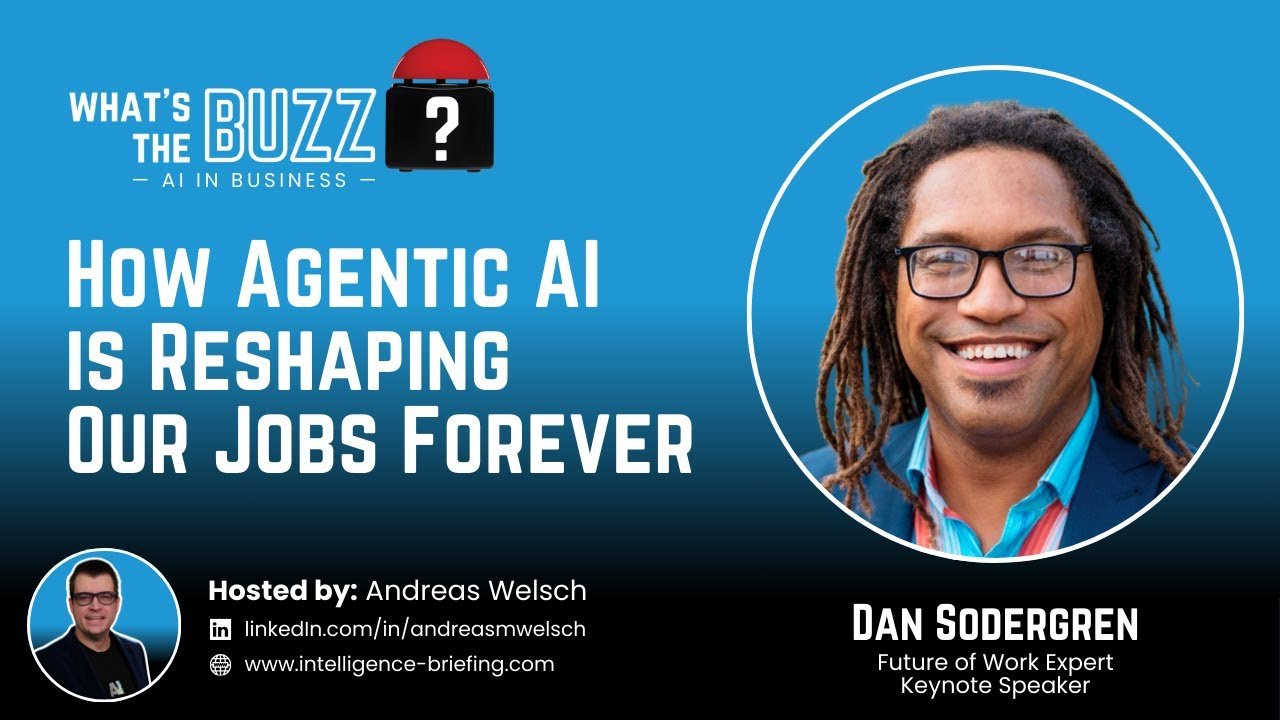
Guest: Dan Sodergren, Future of Work Expert
Host: Andreas Welsch
Episode: What’s the BUZZ?, Season 4, Episode 6
Published: March 11, 2025
Episode Summary
Dan Sodergren, a keynote speaker and corporate trainer who wrote The Fifth Industrial Revolution, joins Andreas Welsch to answer a question many leaders are asking: how will AI agents change jobs, and what should leaders do now?
Dan separates AI agents from chatbots by their autonomy, their adaptability and their ability to pursue a full objective rather than a single task. He then works through what that means for company policy, ownership of the agents employees build, middle management and the case for training people.
The conversation also covers the four intelligences Dan expects people to need, what happens to the productivity AI agents create, and how education has to change. Dan closes with three takeaways for leaders on training, mindset and the resources AI needs.
Key Takeaways
- Dan defines an AI agent by autonomy and adaptability: it can pursue a full objective rather than a single task, which sets it apart from a chatbot or ChatGPT.
- Dan says companies will need an AI agent policy and an answer to who owns an agent that an employee builds on a company laptop with company information.
- Dan describes AI as “automated interns” that people have to train and manage, and he argues humans must stay in the loop because of hallucinations and the need for human experience and emotion.
- Dan names four intelligences people will need: artificial, emotional, independent and organizational. As hard skills diminish, he expects soft skills to count for more.
- Dan urges leaders to train their people and themselves and to spend money on the best AI tools for staff, noting that employees without them turn to free tools as what he calls secret cyborgs.
Timestamps
- 00:00:10 Demystifying AI agents and the future of work
- 00:00:45 Dan Sodergren joins the show
- 00:01:33 Dan Sodergren on his work as a tech futurist
- 00:03:43 Icebreaker: if AI were a vehicle
- 00:05:51 What AI agents mean for work in business
- 00:10:13 Sharing decisions with AI and accountability
- 00:12:50 Who owns the knowledge built into an agent
- 00:14:55 Return to office, layoffs and multiple jobs
- 00:17:53 Will middle managers be agents
- 00:21:08 Where the extra productivity goes
- 00:24:54 How students should prepare for this future
- 00:28:52 What makes Dan Sodergren hopeful
- 00:30:58 Key takeaways
- 00:32:00 Wrap-up
About Dan Sodergren
Dan Sodergren is a Future of Work Expert, keynote speaker and corporate trainer. In the episode he says he has been a speaker and trainer for about 20 years and ran an augmented reality company about 20 years ago.
He is the author of The Fifth Industrial Revolution and wrote Leadership in the Times of AI with about 15 other AI and security experts.
Full Transcript
Read the full transcript
Andreas Welsch: Today, we’ll talk about agent AI and how it’s reshaping our jobs forever, and who better to talk to about it than someone who’s actively working on that and thinking about that, Dan Sodergren. Hey, Dan, thank you so much for joining.
Dan Sodergren: Thanks very much for being here. And just a quick one, I’m definitely Dan Sodergren, and I’m not an AI nor an AI agent, nor a hologram or any of those things. ElevenLabs and HeyGen are doing brilliant work in this sphere, but I promise you, this is me. Just to make it absolutely clear.
Andreas Welsch: And they are doing fantastic work. I’ve been experimenting with them too. And my family and friends, they hardly can tell the difference, if they even can. But I am real too. So just to get that out there now. Hey Dan, why don’t you tell us a little bit about yourself, who you are and what you do?
Dan Sodergren: Hi. My name’s Dan Sodergren. I’m a keynote speaker, also a corporate trainer. Have been for about 20 years and I’ve been for Ally more than a decade, been talking about digital transformation and also AI before I suppose it was called artificial intelligence. It was called a load of other things. And I then had the joy of, we were just joking off stage, that I had the joy of being called a tech futurist. But I’d rather be called a billionaire philanthropist. Tech futurist just means I did stuff far too early in the market. I had an augmented reality company about 20 years ago and did some pretty cool stuff, but I would’ve been much happier to have been a lot richer. So this time I’m riding this wave, so to speak, but I think hopefully I’ve caught it at the right time. I’m not talking about holograms and things, but AI agents are a part of this future of work. And I wrote a couple of books last year, one called The Fifth Industrial Revolution, which is all about this new thing between me and you. I thought we had another year left until we had these AI agents, to be honest with you. It hasn’t necessarily caught me off guard, but the rapid pace of change has got quicker and quicker. So yeah, even for us tech futurists, this is a pretty freaky time to.
Andreas Welsch: That’s for sure. I remember when, what was it, two years ago, we started the first agent frameworks, BabyAGI and what they were called. And then within a couple months or a couple quarters, everybody and tech vendors were jumping on the bandwagon and said, Hey, we’ve been doing AI and agents all along. And here we are trying to hold on and figure out what is actually real and what does it mean? Dan, what’d you say? Should we play a little game to kick things off?
Dan Sodergren: Go on then. I’m slightly scared by this little game. Okay.
Andreas Welsch: Okay. So let’s see. Here we go. If AI were a vehicle, what would it be? 60 seconds on the clock. Go!
Dan Sodergren: If I was a vehicle, what would it be? I would have to have lots of different ways of it being a vehicle. I tell you what, it’s a funny one. I could say something like a submarine because you don’t really see it coming until it’s too late. So maybe a submarine. I’m gonna go with, if it was a submarine, I’m gonna go for submarine. Does that count as a vehicle?
Andreas Welsch: I think it counts. If I may overgeneralize, I hear a British accent, so it might be yellow submarine, something like that. Playing to the stereotypes, I hope you forgive me.
Dan Sodergren: Oh, to be honest with you, I think the Beatles, I think it links in, doesn’t it? Didn’t the Beatles do an AI tune a bit ago? And Paul McCartney did. So there you go. Even yellow submarine people are doing it, right?
Andreas Welsch: Great response. Submarine. I don’t know if I could be stuck underwater for three months or something. That takes a lot, right? Think of all the news that you’d be missing and everything that’d be happening in those three months. Crazy.
Dan Sodergren: I always wondered, so they don’t have we must probably get we diverse amount too much. They don’t have wifi either. God, what a terrifying idea to be under the water doing that for that long. You’d have to be a certain type of person.
Andreas Welsch: Good question. I know, 20, 30 years ago there was no communication, radio silence.
Dan Sodergren: Oh, real. Of course. Yeah, of course. Oh God. Oh, then AI’s nothing like submarines. So that was a terrible thing to say. That was a terrible metaphor.
Andreas Welsch: No. But things happen in stealth and then they come out and we’re surprised.
Dan Sodergren: There you go. Perfect. Like agentic AI. There you go.
Andreas Welsch: Exactly. We’ve been talking about the future of work for more than a decade. I remember those early conversations, 2015, 16 ish, of how awesome things were going to be. And not only would we all spend our days at the beach, while some other things are doing the work for us, but even in a more serious context, we would see work being done differently. And I’ve always perceived it as a change in how we organize work and how the present day work looks like. But I feel now with agents, we’re turning that upside down so quickly and I’m just curious what you’re seeing there. What does it mean for people in a business doing this work? If these agents can do market research and can take on operational tasks and a whole other host of things, what does it mean in business?
Dan Sodergren: Number one, I think it’s most probably the old classic. I used to start all my law essays with the John Spiro quote, which is “Without definition there can be no inquiry.” Because one of the big things we have in AI, and I think in the tech world, is that we presuppose that everybody knows what we’re talking about and that everyone’s talking about the same thing, right? So we are talking about AI agents for a very long time, but then people say, oh, of course we’ve got an AI agent, it’s a chat bot, and it’s ah, that might not be an AI agent, but I can see where you’re going with that, right? And you might say, technically, isn’t ChatGPT an AI agent. No, it’s not and that’s why the definition’s important. So if you define it much more around, I dunno if you agree with me, but adaptability and being autonomous and those kind of things is more important in this kind of AI en gen world. Only ’cause I did a poll on LinkedIn, I think it’s 22% of people didn’t know what an AI agent was. So I was like, ah, I’m gonna talk about it. Let’s at least define it. So I think if you look to that being autonomous and adaptability but also being able to do, almost doing an objective rather than a task, if that makes sense. As I used to say, a bit of a cliche thing, but jobs may shift, but skills uplift. It is the same thing with AI now, it’s now got a new skillset. It’s now got a new ability. So now AI agents have the potential of doing an objective, a full objective, not quite, I don’t think quite a full job, but a full objective, right? Rather than just a task. So they are very different to chat bots. They are very different to GPT. They are very different based. And I don’t know if you’ve seen, and you will have seen of course, ’cause you’re an expert in it too, the stuff that’s coming over from China with Manus and all these other things, and even with operator and these other things, it’s now astounding what AI agents can do. And even though we talked about me coming on the show, I think it was a couple of months ago, even in those couple of months, it’s fundamentally changed what I would’ve said because now we’re at a place which I didn’t think we’d be at for at least six months to a year. So now AI agents are in that. We did, which is again, another cliche, AI won’t replace you, but somebody using AI will, which like we used to say, it’s now actually AI might be using itself to replace you. And I think that’s the thing. So from a leadership point of view, it’s fundamentally different. I talked about this in the book I wrote earlier this year, which was like a how to guide, it was called Leadership in the Times of AI. The point of the end of that book, and I had the joy of writing with about 15 other AI and security experts. The bit at the end of that book was talking about how do we as leaders. We have to fundamentally change because we’ve now got potential of people having, it’s almost like they’re their own company now. I used to joke that it was a bit like, how do you manage the Avengers? They’ve all got superheroes and they’ve all got superpowers, right? But now it’s like, how do you manage one person who potentially is five people or is potentially a company? In their ability because almost everybody now who has a good computer and a good computer understanding and has been trained in this stuff can start potentially building AI agents, and that’s only happened in the last couple of weeks. Now, that is fundamentally terrifying from an employee point of view, from an employer point of view, and an employee, the potential of it, it’s like nuclear power. The potential of it is astounding. It could save the world, but it could also destroy the planet. It’s the same, it’s not the same all.
Andreas Welsch: That’s a pretty broad spectrum.
Dan Sodergren: That’s for sure. Exactly. Of outcomes. But just like we talked about with the submarine thing, now we’re talking about nuclear submarines right now.
Andreas Welsch: I see a question in the chat from Kerry, and he’s asking, what are your thoughts on transferring or sharing decision making with models and how we think about accountability to our stakeholders? I think that fits nicely into the business discussion. It’s a fantastic question, and I think this is the biggest thing now for not just employees, but employers, right?
Dan Sodergren: A month ago it was what’s our AI policy? Now it’s gonna have to be what’s our AI agent policy? It’s actually what’s our employee policy and actually what’s our employee contract. And by the way, I would love that governments are doing this, but governments move too slowly. We are now in this world where we have to start to question pretty much everything about IP, pretty much everything around privacy, pretty much everything around anything that you now do. So you have this big thing now and I’ve gotta be careful with words ’cause this is getting a bit too futuristic, but it’s only in a couple of months, right? There will need to become a conversation about who owns the agent. If you’ve built an agent on a company laptop with company information, but it was you doing the work to build the agent, who owns the outcome? Now this is the nice thing about it, these agents will take the grind. And then human beings will manage ’em and refine. So as I’m talking about, as individuals, we’ve gotta become a lot more mindful about what we do, much more mindful about what we do, and actually more strategic than ever. Because what you are doing now is gonna echo for a generation, and you might feel that silly, but the data that you are gonna be producing in your job is your intellectual property. And the old argument, of course, is no, but it’s weird, isn’t it? This is the great question. If I create a great prompt at work, what’s my incentive to share the prompt? And at the moment there’s no way you don’t go, oh, you get a bonus for a thousand pounds ’cause you did a great prompt. But then we laugh a bit, right? We laugh, but it should be. When we all worked in factories and someone came up with a great idea to make the factory better, they got money because they came up with a great idea. This is how it works. Right now we’ve got this bit where we’re talking about knowledge. There aren’t the incentives in place right now to really reward people. Now, if you are clever enough to start coding an agent which does your job for you, are you still doing that job? Now that’s a big question.
Andreas Welsch: I think you bring up an excellent point and I haven’t heard anybody else articulate it at all, and definitely not in the same way. And that is, if you are an employee at a company, you come in with a certain knowledge, you gain knowledge. But once you leave, you take that experience with you to whatever other company or venture you go into. To your point, if you build an agent and that agent stays with the company, what happens to that knowledge that either you have transferred into it in building that agent if you leave? If you’re an employee today, you leave, there are no agents, then your knowledge is gone. It’s no longer accessible for the company beyond what you’ve documented. But if this agent continues to do work for the company, you’ve built in and conceived and fed with your insights and your previous knowledge even. Exactly, right?
Dan Sodergren: And no, it is not quite the same as when it was a human being because, and I used to joke, and I still think it’s true, AI is just automated interns. That’s what it should stand for, right? You’ve got an intern that you have to train and that’s how you get better at the AI getting better. It’s not just prompt engineering, it’s managing the AI right now with that moment when if your apprentice then moves on and the apprentice becomes the master. Like, where’s the situation then? As human beings, we’ve gotta learn to manage AI before the AI manages us, and that’s where we are right now. Now, the question for everybody is if the productivity increases are huge, what happens to the future of work? Because if an AI agent can do some of your job and then starts doing 50% of your job, is your job to manage the agent? And the answer is yes. By the way, I do not believe that we should take human beings out of this equation. I do not believe they should be semi, they could be autonomous, but they can’t not be managed. They must be managed with human experiences, human emotions. Otherwise we are in a huge amount of danger, not just ethically, you know, the reason why, because of hallucinations, et cetera. But it’s a big question we’ve all gotta ask ourselves. We are managing the machines that will take on most of the work, but we have to manage the machines.
Andreas Welsch: That’s right. And let me build on that because I think we’re seeing a lot of these return to office mandates. We’re seeing CEOs ordering the staff back. At the same time we’re seeing layoffs, and we need to prepare for AI and trim our workforce, have more capital to invest. Is that the future of work? And to your point, right, I was discussing that with Joe Reis a couple weeks ago on the show. Will we all have multiple jobs because now agents do 50% here, and we ideally maybe not have 50% more time? Do we need a second job to cover the other 50% and the other 50% of the income?
Dan Sodergren: Again, in the book The Fifth Industrial Revolution, I talk about the four different intelligences that we are gonna need. We need artificial intelligence taken as a given. I think we need more emotional intelligence. Ironically enough, as the hard skills become diminished, the soft skills go up. We are gonna need to be more cooperative and nicer to each other because the people who aren’t very nice will basically not have jobs because the people who are technically great lawyers but aren’t very nice as people will not be lawyers anymore because they’re technically great. Lawyers are actually the AI machines. This is the irony of the whole thing. Anyway, that’s emotional intelligence. I lack emotional intelligence. I’m not saying this because I’m really emotionally intelligent. I’m not. I lack emotional intelligence. I just recognize the fact it’s gonna be important. The third one was independent intelligence. And that brilliantly leads into what you were saying about this, which I believe will become, we’ll have more gig economy kind of work and more fractional work. The job for life is gone, but I actually think the job for the year might be very soon upon us. And again, that becomes a massive thing about who trains who, if you’re not training up, what happened to loyalty. But again, remember, these are all concepts. So in the fifth industrial revolution, which we’re in, a lot of those concepts will disappear because actually your manager will realize that they are, if middle managers still exist, you know that you’ve got an amazing amount of power. And actually employees are more important. Highly productive and highly flexible. More employees are more important than they thought they were before, right? Now, the other thing is, which is just with organizational intelligence, and we’ve got to become cleverer. We’ve got to do more with less. It is likely that we’re gonna have much smaller businesses, not much bigger, and it’s very likely we’re gonna have some hyper successful businesses, which are tiny. Now, if you look online and you’re massively geeky around AI stuff, you already know this is happening ’cause of vibe coding, and you already know this is happening because people are making mobile games and making silly amounts of money with only one person. But you’re gonna have, Sam Alton talks about the first business, very soon we’ll have a billion turnover company of just one person. But that’s because they’ll have 50 agents. Or a hundred agents. Or a thousand agents.
Andreas Welsch: And to me that brings up another good point about middle management, right? To what extent will we still have or need middle management, or will there be orchestrator agents in that sense, orchestrating the work between other agents and people that supervise them?
Dan Sodergren: Absolutely. We’ve gotta remember as well, we’ve gotta be careful ’cause I imagine there’s quite a few middle managers on the call perhaps. I don’t know. But it is a job. Like I’ve gotta be careful. Alright, that job will disappear. But it will just shift. So basically we’ll shift the role, but we’ll keep the goal. The goal of middle management will still exist, but middle managers might not. Also, we might be able to give this stuff to lots more of the AIs, and if you have a load of data, and this is why I built something called your flock a few years ago with Michel Wichnevsky. And the idea behind that is that you could most probably quantify company culture and help company culture through data points. Now that can be built really quickly with AI, which is why we didn’t get a third round of funding because it didn’t have a moat anymore because AI can do it through three or four different prompts and maybe a little bit of knowledge base, and you could build it with a customizable GPT. Now we’d spent 300,000 trying to build our own system and open AI just said, oh, have this one for free, and you could just use a prompt. Awesome. Great for them, not great for us. Same principle here is if you have all that data and knowledge, do you need middle management as much anymore? Now, I would think the answer’s no, but you still need a human being because some of that stuff is too nuanced for a machine, right? But what if the machine is managing machines? Now that’s different because the nuance therefore isn’t needed, ’cause the machine’s never gonna be crossed. The machine will never say, I’m not working anymore. I’m gonna leave because the machine doesn’t have emotions. Then you don’t need emotional intelligence. You need a lot of artificial intelligence. And that’s where we are now. We’re in this world potentially where, and by the way, this is terrifying in some respects, the middle managers are machines that are managing the machines. And really you only have the bosses of the machines. But what if you are the boss of the machine? And that’s the point, isn’t it? You know what, if you are a super powerful accountant? ’cause you’ve got 10 accountants in your company, but it’s not a company, it’s just 10 agents.
Andreas Welsch: To me that’s both right, like you said. Exciting, thinking about where does this actually go so you can properly prepare and also see where the opportunities are. And on the other hand, a little bit frightening too, because where do we stay in, where remain as people, and what does it mean to our identities, to our knowledge, to how we see ourselves and how we’ve been trained to work, how work has been done for decades or 200 years. And we have to remember that I’m sure we used to work in the fields, right? 95% of people worked in the fields. And then when we didn’t work in the field, it didn’t stop, did it? We still work now. We’re still working, right? But we’re just working on different things.
Dan Sodergren: Like we used to work in factories and now not all of us work in factories. We used to work in mines, but now we don’t work in mines. And this is the bit that I don’t get. This is why I always talk about it, like the fifth industrial revolution. When industrial revolution happens, this massive shift happens. So the work hasn’t gone, it’s just the tasks move on. So all you’re gonna be doing is managing a machine to do more of your work for you. Now, the bigger question for us all, and by the way, I think this is a brilliant question, is what happens to that excess productivity? Now, that’s a great question. Like where does the money go? I literally had a slight argument with someone this morning on this, and they’re absolutely right to say it, but I’d never thought of it like this because I just hadn’t thought about this. They were like, if I become 400% quicker at marketing and better at marketing, I don’t make 400% more money because my employee will pay me the same. They’ll just fire three of us.
Andreas Welsch: And that’s where I think the difference between corporate employment and freelancing or running your own business comes in. If you’re an independent and you can do four x the work that you’ve previously done, that means you can, or you do it four times faster, that means you can do four projects. And even if your rate doesn’t go up, you scale, right?
Dan Sodergren: Yeah, absolutely. And even if it’s not times four, it’s times two. It still works. But, okay. And then this is the thing, but same thing, which is why I like to call AI apprentices automated interns. Same principle, isn’t it? If I had all this and then I got five interns, would I have a better company? It depends how well I manage the interns, doesn’t it? It depends how well I do prompt engineering. It also means if I pick the right AI, ’cause so many people use AI and say, I have used chat GPT and I didn’t really like it. It didn’t do what I wanted it to. Therefore it’s rubbish. That’s ’cause you haven’t used Claude. That’s ’cause you haven’t downloaded reel. There’s like horses for courses. Every one of these things is different. And also you haven’t trained your AI in the first place. So it’s actually, it’s on you ’cause you have, but also you haven’t been trained how to use AI. And that’s why I teach people now how to use AI because actually it’s been going so quickly that people have just had a go. But I haven’t been trained in it. You remember when computers first came out, you had to be trained how to use a computer. It’s thinking you can plan your way through AI is potentially quite dangerous, but also it’s on your employer to train you in how to use AI. That’s what we should do. And you’ll be amazed the low rates for adoption in the UK on are actually to deal with the fact that there’s so many small businesses. Most large businesses now have done AI and they’ve done a bit of AI training. They’ve got an AI policy. Were you surprised? You might be surprised how many don’t actually have AI policies. It’s terrifying actually. Anyway, but a lot of small businesses don’t do the AI training part. Less than a hundred people that haven’t done the AI training. And then, this is what I talk about in the book. There’s this whole thing called the secret cyborg that are turning up and doing the work on a different computer or logging in with a different browser. But they’re doing it on systems that are free because you are not paying the 20 pounds a month. That’s really bad. It’s like not giving someone a laptop when they turn up to work. I’m not giving them a chair or not giving them a mobile phone. Whatever it is, you’ve gotta spend the money. If we’ve got leaders on the call, I employ you. Spend the money not only researching and doing some training on yourself and your own mindset, but also on what’s the best AI that your people can use.
Andreas Welsch: I see an interesting question from Dita and I’d love to take a stab at it, but also give your perspective. Dita is asking, what would you recommend to students to prepare for this future? I teach at the local university. I teach management information systems. And as part of that, we have been talking about AI for different cohorts and semesters. And last fall I started incorporating gen AI and prompt engineering and a bit of AI literacy in my class to say, Hey, look, here are examples of AI. Here’s how you can try it out. Google teachable machine. Here’s how you generate an image. Here’s how you use chat GPT and cloud. And here are different techniques to get students to warm up to the technology and use it if they haven’t already done so. That’s another thing, then have used it before. But then I think the interesting part where I have conversations with fellow professors is, how do we evaluate what students actually learn and retain and do? And I think it’s true that we change those assessments, right? It’s not necessarily about the output you generate, but if you’re able to assess, is this good? Is this specific? Why is it good? Why is it not good? How can you make it better? What was your thought process going into it? So to me that is something we need to change and to teach. What’s the thought process?
Dan Sodergren: I’ll give you a great example there, ’cause I use it all the time. I also have a non-for-profit, which I run with a friend of mine who’s a teacher and it’s called the AI teacher course. The AI marketing course I run and my training company I run, but the AI g course is a non-for-profit, and we go around trying to help teachers use AI, right? But one of the biggest things actually is the mind shift here. And I always use this example, like years and years ago, I’m this old, that you didn’t have calculators. It took 13 years for calculators to come inside UK schools, but teachers literally wanted to ban them forever. And then of course, we then had this revolution where they realized actually it’s no bad thing. They’re bringing a piece of technology. Actually, it’s great. So maths changed in the way it was taught because you had to show your workings and had to work out other things. So the calculator was a tool, but it wasn’t such a tool that it destroyed the education point ’cause it couldn’t have been. It’s the same thing here. It’s like AI is a tool, it’s not a rule, like it’s not that powerful that it should overtake everything. But if you are just assessing people on their ability to write an essay, that’s fundamentally dangerous because the AI can now write the essay. But we shouldn’t be doing that anyway. That’s why education has to change now. But to answer the gentleman’s question, I say it’s the soft skills, not the hard skills. We’ve gotta be teaching the next generation, because actually it’s the questions and the creative question and the analytical thinking behind this. AI is brilliant, but you’ve gotta know how to ask the right questions of it to get the right responses. Now that critical questioning, that is something that I don’t think we teach enough in schools. We also don’t teach enough in schools things like entrepreneurship or how to be nice or how to budget or just life skills stuff. And I actually know that being nice is gonna be more important because the grunt work, the grinding work, is got what the AI’s gonna do. As I always say, we’ve gotta be more mindful, less grind. We’ve gotta not be thinking, I’m gonna work really hard on this because actually the machine will do the hard work for you. And that changes everything. Whether are we ready as a society? As businesses, we’ve got to be, because that’s how businesses work and make money. And we can only blame ourselves and the leadership if we don’t change our mindsets. But as a society, are we ready for a new world where you can love what you do and therefore, because as I talked about in my TedEx talk, the future of work isn’t what you think. It’s most probably what you love. But are we ready for that in society? Are we ready for people that have to be engaged and love their work to actually get paid? I’m not sure we’re at, I hope we are because that’s the fifth industrial revolution. But yeah, I think to take a, hold an advantage of that, we’ve gotta fundamentally change how we educate people, including ourselves.
Andreas Welsch: Now then, let me ask you this before we wrap it up for today. With all this change coming and all that uncertainty, and again, rapid change, or orders of magnitude of bigger change than what we’ve been used to, what makes you hopeful about that future with AI and for the future of work?
Dan Sodergren: The reason why I’m so excited by it is because now we have a potential where, in a kind of odd way, the means of production are now in the hands of the workers. Which sounds a bit weird, but basically we can start creating our own destinies. We can do things now with AI that are in a madman’s dreams. Before we could have not done all this dumb stuff before. My concern would be that governments and slightly bigger people in power might start to corrupt some of that or even start to delimit it and say, actually you can’t have AI anymore and take it offers. But right now, you’ve got the ability to take an LLM and put it into your own machine and to actually build your own agents and build your own AIs right now. Now that’s very exciting ’cause that means that a lot of the cognitive load that you would normally have to do for your job can be done by a machine, which means that the 50% of your time can be done to do either more high value work, which I think inherently is more fun for human beings. Or even better have more time out to see your family and friends. Because actually society’s gonna need us to actually be more present with our loved ones in society than it is gonna be present at work. But you can only do that if the AI does your work for you and you can manage the AI. And that’s why I’m excited by the future of work. It’s not because I’m excited by AI, I’m excited by what AI can do for human beings to make the world and hopefully their own lives a better place. But I am a massive hippie, so who knows? I might just be a techno optimist. But honestly I see it as being something that changes society in a very positive way. And if I didn’t, I wouldn’t do the job that I do.
Andreas Welsch: That’s wonderful. Dan, maybe before we wrap up, what are the three key takeaways for our audience today from our conversation that you’d like to.
Dan Sodergren: I would think that they have to start to retrain, to retain. So really start thinking about how do you train your people up, and including yourself. Because at the end of the day, that evolution is really to do with your own mindset. So how are you gonna train your people up? How are you gonna train yourself up and change the mind shift? And then the big one for me around this whole fifth industrial revolution point is, how are you going to manage the resources in the business so it can fully take advantage of this moment? I think a lot of people at the moment are thinking AI can just do stuff without time, money, and energy. It can’t. It cannot. But if you put the time in and if you put the energy and you put some money into it, you will fundamentally change your business. And then hopefully change the world for yourselves and your family and everyone else. So as long as we’re mindful that it’s not just a magic bullet and we go, shim sham and the agents will do it all, I think we’ll be okay.
Andreas Welsch: Wonderful. Alright, Dan, thank you so much for joining us and for sharing your experience with us. I really appreciate it.
Dan Sodergren: Thanks for having me on.
Andreas Welsch: Alright, and for those of you in the audience, thanks for joining us as well.
Listen and Subscribe
Related Reading
Frequently Asked Questions
What is the difference between an AI agent and a chatbot?
Dan defines an AI agent by its autonomy and adaptability and by its ability to pursue a full objective rather than a single task. He says that makes agents very different from chatbots and from ChatGPT, which he does not count as an agent.
Who owns an AI agent that an employee builds at work?
Dan treats it as an open question: if someone builds an agent on a company laptop with company information, who owns the outcome? He says companies will need an AI agent policy, and that employee policies and contracts will have to address it.
Will AI agents replace middle managers?
Dan says the job will disappear but shift: the role changes while the goal of middle management stays. He expects machines to manage other machines in some cases, and he insists people must still manage the agents.
What should leaders do to prepare people for AI agents?
Dan tells leaders to train their people and themselves, to spend money on the best AI tools for staff, and to plan for the time, money and energy AI needs. Without approved tools, he says, employees turn to free ones.
What should students learn to prepare for AI?
Dan points to soft skills over hard skills: critical and creative questioning, analytical thinking, entrepreneurship, budgeting, life skills and being nice. Andreas adds that assessment should test a student’s thought process, not only the output.