

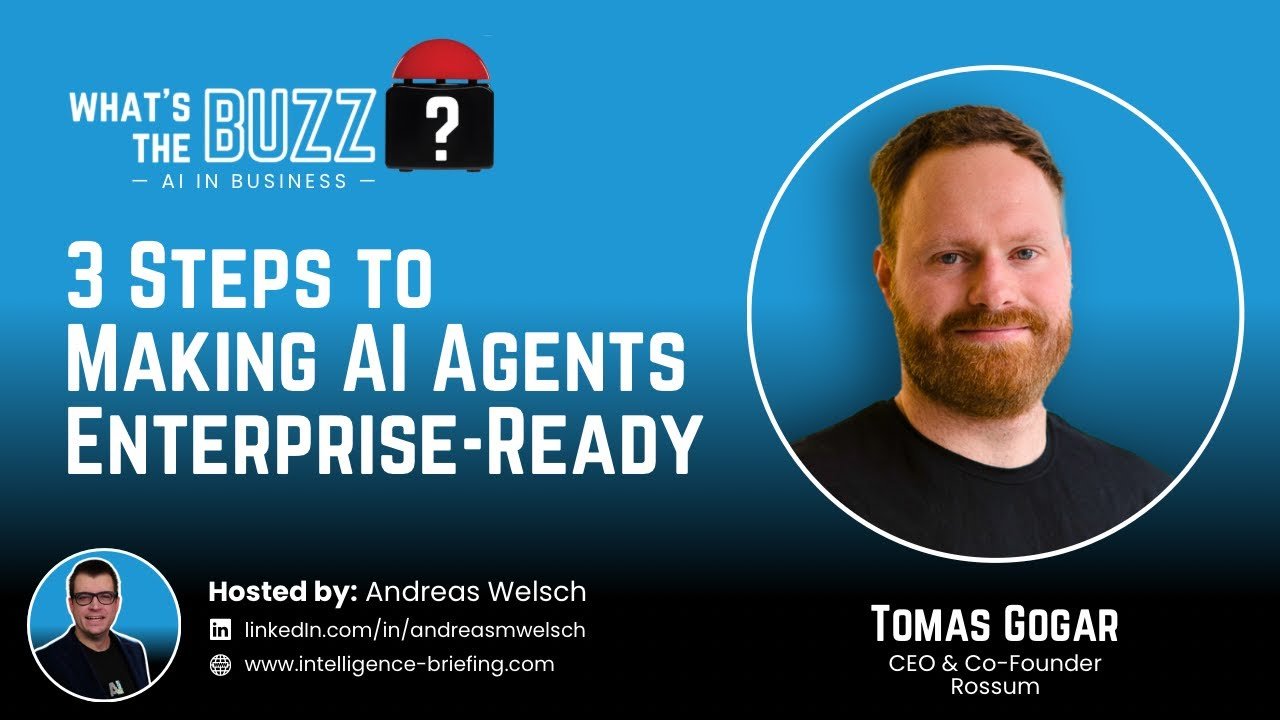
Guest: Tomas Gogar, CEO and Co-Founder of Rossum
Host: Andreas Welsch
Episode: What’s the BUZZ?, Season 4, Episode 7
Published: March 18, 2025
Episode Summary
Tomas Gogar, CEO and co-founder of Rossum, joins Andreas Welsch to answer what makes AI agents enterprise ready. Tomas explains that agent demos are quick to build but unpredictable in production, because large language models are non-deterministic and cannot reliably judge the limits of their own knowledge.
He names three properties of a reliable enterprise agent: it understands when to escalate, it works within guardrails like those that bind human employees, and it has the factual and procedural expertise of the task.
The conversation covers treating agents as virtual colleagues that escalate to human peers and managers, how agents and humans will work in mixed teams, and why Rossum’s narrow focus on transactional paperwork lets it build a model that assesses its own confidence. Rossum sponsored this episode.
Key Takeaways
- Tomas cautions that agent demos can be far from production use. In his words, an agent driven by an LLM “usually works well in 70% of cases and it can have disastrous results in the 30%,” and teams usually do not know which cases will fail.
- Tomas names three properties of an enterprise-ready agent: it understands the limits of its knowledge so it can escalate, it operates within guardrails such as access rights and approvals, and it has factual and procedural expertise in the task.
- Tomas says guardrails like access rights are enforced at the API layer, but knowing the limits of its knowledge requires an agent to estimate its confidence, which he says a prompt cannot provide.
- Tomas recommends modeling autonomous agents as virtual employees, so an AI clerk escalates to a human clerk and then to a manager. He sees mixed teams ahead and says the AI handles 60 to 70 percent of cases on its own in Rossum deployments.
- Tomas’s closing advice: be skeptical of overhyped demos, deploy agents under human supervision or where the provider can guarantee confidence, and keep innovating on the fundamentals of AI instead of relying on current LLMs alone.
Timestamps
- 01:20 Tomas introduces himself and Rossum
- 02:32 The icebreaker game: if AI were a vehicle
- 05:19 Why agent demos fail in production
- 06:57 Three properties of an enterprise-ready agent
- 12:12 How to build guardrails and why prompts cannot supply confidence
- 15:23 Agents as virtual colleagues and mixed human and AI teams
- 19:16 Agents collaborating across departments and the self-driving car analogy
- 21:31 Does an agent need its own address book?
- 23:45 Rossum’s narrow-domain model that assesses its own confidence
- 26:15 Tomas’s three takeaways
About Tomas Gogar
Tomas Gogar is CEO and co-founder of Rossum. He describes himself as a computer scientist and AI scientist who met his co-founders in the same AI PhD lab. Rossum focuses on automating paperwork for large enterprises and sponsored this episode.
Full Transcript
Read the full transcript
Andreas Welsch: Today we’ll talk about the three steps to make AI agents enterprise ready, and who better to talk about it than someone who’s actively working with that, Tomas Gogar. Hey Tomas, thank you so much for joining.
Tomas Gogar: Hello, Andreas. Thanks for having me.
Andreas Welsch: Fantastic. Hey, why don’t you tell us a little bit about yourself, who you are and what you do.
Tomas Gogar: I’m Tomas Gogar. I’m currently CEO and one of the founders of Rossum. Computer scientist, AI scientist. Originally, we started the company. I met the co-founders in the same AI PhD lab. So really, from the AI space before it was cool. And also we focus on automating the paperwork for large enterprises.
Andreas Welsch: I’ve done quite a bit of work in that space before, and I’m always surprised how much paper there is in a business. I’m excited to see that you’re solving a real problem and a real need, and I’m also excited to have you on the show today. And by the way, thanks to the team at Rossum for sponsoring today’s episode. Why don’t we play a little game to kick things off? What do you say?
Tomas Gogar: Let’s do it.
Andreas Welsch: Okay, perfect. So this one is called In Your Own Words, and when I press the buzzer, the wheels will start spinning. When they stop, I would love to hear your answer. You have about 60 seconds for it. And let me know what’s the first thing that comes to mind. So are you ready for What’s the BUZZ? That’s it. Okay, perfect. Here we go. If AI were a vehicle, what would it be? 60 seconds on the clock, go.
Tomas Gogar: I think it would be definitely an electric car. Exciting, huge opportunity, but still immature in certain ways. Yeah. So, basically I think it’s very accurate. All manufacturers focusing on that, knowing that this is the direction. And big race. How to make it real and impactful.
Andreas Welsch: I love that. And indeed it seems like it’s this big race. If you follow the news and the headlines, it’s crazy. I don’t know how people are holding on, or if it even still makes sense to hold on, or if you just accept that there’s so much stuff flying by. But anyways. Great answer. But that brings us to the topic of our show today, making AI agents enterprise ready and building them in ways that are enterprise grade. This term of enterprise readiness can mean many different things to different people. If you follow the headlines in the news, it seems like AI agents obviously are the big thing of 2025. Everybody’s doing it, everybody’s been doing it for a long time, whether it’s vendors or companies and practitioners. I think when you peel it back, it’s a lot more nuanced. And just because you can run an agent on your own machine or deploy it somewhere in the cloud and tinker around with it doesn’t necessarily mean it’s enterprise grade. Is it ready for production? But I know you guys at Rossum have been building AI agents and have just come out with the first one. So I’m curious as a software leader and as a founder, what are you seeing there? What makes agents enterprise grade? What do you need to get right if you’re building them?
Tomas Gogar: It’s a great question. Look, what we are seeing around is a tremendous hype, and I believe that the hype comes from the fact that you can build demos extremely quickly, right? Really good looking demos. You can take an agent framework and build an agent, having an LLM deciding and planning and doing a lot of things, and it looks extremely cool. However, the challenge is that it looks cool in a demo, but what we are seeing is usually when you try to deploy it in real life, production scenarios, there is a lot of situations where it doesn’t work well. And the challenge is that usually with the current state of LLMs, if you let the LLM drive the workflow of that agent, it’s unpredictable, right? Because of the nature of how LLMs are designed, how they work, they are non-deterministic and they can hallucinate. So the challenge is that it looks cool. Usually works well in 70% of cases and it can have disastrous results in the 30%. And the challenge is that usually you don’t know which 30 percent will go wrong. So what we are seeing around on LinkedIn and on social media are those pre-recorded demos, because somebody just recorded the scenario where it went well or cherry-picked situations where it actually works. But for enterprise readiness, it needs to be reliable in the job in which you want to use the agent. And that reliability comes from a couple of properties. For example, the agents need to understand the limits of their knowledge. If you are an employee advert and you don’t know, you are not certain, you have a way how to escalate to your boss, how to ask your colleagues. But in order to escalate, you need to understand the limits of your knowledge. And that’s where LLMs are tremendously bad, because they are like those students that always try to answer. I think understanding the limits of the knowledge is one of the things. Then obviously you need to have certain types of guardrails for that agent to execute. And we know those guardrails from the standard corporate world. Like, I’m a CEO of a company and I cannot go and increase my salary tomorrow on my own. I don’t have access to that system and I probably will need some approvals from, let’s say, my board members, right? So there is governance. I’m a CEO and co-founder of the company and I cannot access the data of our customers, for very good reasons. So there are limits to us as humans, and agents as well. And we need to build a system that AI agents have those limits and guardrails around them as well. So that could be the second one. And the third one is really just having the expertise of the task that you are doing. And the expertise needs to be factual as well as procedural. How it is done in my company, employees know this, so the AI agents need to copy the human employees, I believe, with all their skills before they are really enterprise grade.
Andreas Welsch: I have a question there because I’m really curious. For a long time we said, let’s not compare AI and humans, let’s not anthropomorphize now with agents. I also go into this mode a lot of times and say people in a business are expected to do X, Y, Z, and like I said, they’re expected to know what they know and figure out what are the things they don’t know and where they need help. They need to read the code of conduct. They need to know things like IFRS and other accounting standards. Agents will eventually need to have some kind of knowledge or similar knowledge too. So comparing humans and AI, are we blurring the lines, and is that helpful or is that harmful in some ways?
Tomas Gogar: I think that building this one-to-one relationship and, like, logging them, I think that to really deploy them at scale for the corporate structures, it’s actually helpful if we model an AI agent as a replacement of a human. For example, but there might be different setups. So imagine, if I have an AI agent that needs to be supervised because of, let’s say, a lack of the confidence skills, I can still use an AI agent as a personal assistant to every employee. That’s fine. So we can suddenly say, hey, every employee has an AI assistant. Good. But whenever we will try to have those AI agents act autonomously, because that’s what I believe is the holy grail, the best way to plug them into the corporate structure is actually to have that as a virtual employee. That allows you, you will not change your corporate structure just because of AI agents. You need to plug them somewhere, let’s say, in certain processes. And the best way to do that is to do that in this way, as a replacement or widening your team.
Andreas Welsch: Yes. That makes a lot of sense. That resonates. So we have these familiar structures of how teams and organizations and companies are set up, and it helps us use similar concepts now with these pieces of software that can do more than just follow basic rules. Now there was something else that you mentioned around, we need to teach them or tell them what are the limits of the knowledge and putting guardrails. How do you do that? Probably many of us have seen these basic prompts: you’re a helpful customer service agent, and you do X, Y, Z, and if you don’t know, then you escalate. Is that how you do it? Or how do you put these guardrails in place? What does it mean?
Tomas Gogar: I hear you. Some guardrails are simply like, I don’t want to say physical because they are actually virtual, but I simply cannot do certain things. I don’t have the access rights to this file. I don’t have user rights to do something in my SAP instance, right? So very similar guardrails to human employees, but that needs to be executed on the, let’s say, up layer, the API layer that the agent is using, right? However, what I was talking about before is the limit of my knowledge comes from the ability to estimate my own confidence in my decision, and that is something that cannot be solved by the prompt. It can’t be. And we’ve proved that many times here at Rossum. But for that, we need to change how LLMs are actually working on the next generation of Gen AI, because the design of LLMs simply doesn’t allow you to come up with something like calibrated confidence scores. If I try to explain it in technical terms, it just tries to generate the answer, but doesn’t assess its confidence in the answer. The fact is, if you try to prompt it, tell me how confident you are, it will not work. It’s not what I’m talking about.
Andreas Welsch: Awesome. Thank you for sharing that. I think that makes it a lot more tangible in seeing that it does come back to basic principles of security, of architecture and design. And you simply don’t have access to this data. Duh. Sounds obvious, but when you talk about you need to have guardrails in place or you need to tell her what to do and what not to do, I think then it’s more nebulous. So, great to see that it can be as simple and as tangible as that. And by the way, I’m looking at the chats, where folks are joining from Luxembourg, from Dubai, from many other places. So excited to have you with us. Also, if you have a question for Tomas, please put it in the chat and we’ll pick it up in a minute or two. That’s one of the benefits of having this as a live stream, engaging with both the guest and the audience. Now we’ve talked about agents being similar to employees at a minimum on a conceptual level. As we think about these new capabilities, what does that actually mean? And what does it look like on a day-to-day basis, from maybe where we are today to where you are seeing things go in the next couple of quarters or the next year or two years? How will people work with these technologies?
Tomas Gogar: Every company defines it differently. Rossum defines an AI agent as a virtual colleague you can delegate work to. Very simple definition. And you typically delegate the work to a colleague using natural language, or in more structured processes by sharing standard operating procedures and telling them, hey, this is how this particular job is being done here. So you delegate the work and you expect them to finish, to do their job end to end. And when they are not confident enough, you expect them to escalate to their manager. I do believe, and we are seeing it, let’s say in our deployment, is that you will have corporate structures there, you have a manager. And that manager has, let’s say, some direct reports, which can be either human or AI agents. And the way it can work is that the AI agents will do their part of the job. It can be anything; in our case at Rossum, for example, processing some paperwork tasks. And when they are not confident enough, they, let’s say in the first instance, escalate to their human colleague, to their human peer, right? So you can imagine a clerk, an AI clerk that is doing some paperwork job, and if not confident enough, it escalates to a human clerk. And if the human clerk is not enough, then they escalate to their manager. And if the manager is not confident enough, they can escalate even higher. So I do see them working side by side, and as an outcome of that, you’ll have smaller teams that can actually handle more work as a team. But I do see that in the close future, a couple of quarters or a year, it’ll be more like a mixed team. That’s what we are seeing in our deployments, let’s say, that the AI is able to handle 60, 70% of the cases on its own. If it can’t, it escalates to human colleagues. It learns from them as well. And there are cases when even the human colleague doesn’t know, and then they escalate to the manager. So I see them working side by side.
Andreas Welsch: Now how do you see that work across different departments? So maybe you have a sales order that needs to be scanned, or you have a production order, or you have a bill of lading, in the different departments. How does that work? Are agents going to collaborate with each other and maybe even on the same platform, if they know, I have an agent here for sales and I have one for manufacturing and planning? Do you envision them collaborating and figuring things out?
Tomas Gogar: Yeah, sure. I think it’s needed because I think the premise is that, the expertise, right? Like, I’m an agent that does X and part of my job description might be, if something happens, I need to involve some other team members. And I think that the basic premise should be that I don’t know who it’ll be. Will it be a human or another agent? I don’t know. And that’s the way to build it, because that’s the way how you can scale it. I think here the analogy to self-driving cars works pretty well. We could build self-driving cars by rebuilding the whole infrastructure, changing our roads, changing our crossroads, but it’s a huge infrastructural change that would need to happen overnight to really have an impact. Impossible. So instead of that, we use intelligent agents, intelligent cars that can use existing infrastructure and can live next to the cars driven by humans. And you don’t care, because we might be driving behind each other on the highway and one of us will not be driving, because it will be a self-driving car, but the other one doesn’t know. So I think that this is the way how you can gradually deploy. And the self-driving car analogy works here as well, because first it works on the highway or during parking, and later on it works in a small Italian town where driving is extremely difficult. So I think it’s needed for gradual deployment to copy the corporate structure. And not assume, if the job description involves communicating with somebody, being internally or externally, you cannot assume whether it’ll be a human or another AI agents pretending and communicating like you.
Andreas Welsch: I really like that analogy to self-driving cars and the similar conditions that exist, right? And as long as they’re safe or maybe even safer than a human driver, that meets the standards that authorities and departments of transportation and so on set. So similarly, right? If we know that agents will behave according to certain rules, or that they don’t go crazy or break out of their little box, right? That analogy works really well. One other thing that I’m wondering there is, do we need a second address book for agents? Today if I’m in a business and I’m stuck, I know I need somebody in procurement. Maybe I’m new to the organization. It’s a larger company. I don’t know everybody personally. I can ask around and say, who should I talk to for this procurement question? Maybe they point me to the right person, or they point me to a generic inbox or submit a ticket or something like that. But eventually I get to a person. Next time I have a question, I call this person directly. I send them an email and say, hey, you were able to help me last time. Can you help me again? Do we need something like that for agents too? Kind of like a registry, a register, or an address book, to know this agent can work with that one, but don’t use this. That sort of thing. There are some protocols and standards being proposed by some of the vendors. How do you see that working, that agents even know that there are other agents surrounding them?
Tomas Gogar: I think the only difference to humans is that agents will be better in using APIs. It’s unnatural for us. But at the same time, I do believe that they will also need to be able to use the channels that the humans are using. Exactly, because of this coexistence. There will be a phase where we will coexist next to each other. We see it in the paperwork jobs. So you need to have, obviously it’s good in calling APIs, and for the APIs it probably needs an address book. But for non-API-ish communication and collaboration, it needs to have user interfaces and address books like humans do.
Andreas Welsch: Yeah, that makes sense. Thanks for sharing. I’m looking at the chat and I see Karina put two messages there. One saying, hey, agents don’t think or understand their tools for specific tasks. And when we know those limitations of these tools, we can develop safeguards and eliminate them. So validation against trusted databases, methods for detecting when an LLM is operating outside its training domain, and so on. How do you approach that at Rossum? I think security was one point that you mentioned, but are there maybe others?
Tomas Gogar: Yeah, look, guardrails are easy, right? The physical guardrails, you don’t have access to this, you have access to that, that’s easy. But at Rossum, because we are narrowly focused, right, on a specific type of supply chain paperwork, we’ve built a different type of LLM. We call it TLLM, transactional large language model, that is trained specifically to process transactional paperwork. Because it’s such a narrow domain, we were able to build it in a way that it can actually assess its own confidence reliably. So the brain behind Rossum has the ability to assess its confidence, and when it’s not confident enough, it has the humans. So that’s a big safeguard, like a big one. We are now releasing functionality that is specifically designed, like a reasoning functionality, which is able to intelligently interpret data on the documents, but again with the ability to assess its confidence. But this is not easy and we are able to do that just because our domain is fairly narrow. It’s not known currently in the research community how to do that in a generic Gen AI setup. Our paperwork task is simpler, and that’s why it allows us to build a type of AI that is able to do that. But in traditional LLMs, we currently, nobody has that. And that’s, I think, the big next holy grail to chase, if we really want to live in that dream where we have really, truly autonomous AI agents that are also very generic, generalistic.
Andreas Welsch: No, that’s exciting. I love how you described that, right? And because you’re staying focused, you’re able to do that on a very specific task and do it really well. Now we’re getting close to the end of the show and I was wondering if you can summarize the key three takeaways for our audience today to take away from today’s episode.
Tomas Gogar: The three main takeaways. Number one, just be a bit skeptical to the overhyped AI demos that you see out there. Demo is usually, especially in the current age of GenAI, can be very far from the real production usage. If you are deploying these AI agents, choose wisely where you are deploying them, either in a setup where you will have human supervision, or in a setup where the AI provider can guarantee the sense of confidence before you really let it run autonomously. And I think the third one, at the same time, and that goes to the AI vendors: let’s keep innovating the fundamentals of AI. Let’s not just rely on the current LLMs, because there is so much they can’t do and will not be able to do. True.
Andreas Welsch: Awesome. I love that. Maybe before we really wrap up for good, I see there’s one more question in the chat around whether in this agentic AI era we will still need to have a graphic user interface, or how that will work. Or are we going back to MS-DOS and putting our commands in a command prompt? Where do you see that going?
Tomas Gogar: I think the answer is both. The reality is that there will be a lot of vendors that will be fighting this change and will close their APIs and so on. So we will probably have both API way as well as the user interface way.
Andreas Welsch: All right, Tomas, thank you so much for your insight. It was a pleasure having you on and hearing and learning about how you are approaching this and where you’re seeing the opportunities with agentic AI, and also how you make sure that it stays relevant and responsible as well. So thank you so much.
Tomas Gogar: Thank you, Andreas.
Listen and Subscribe
Related Reading
- Agentic AI for Enterprise Leaders
- AI Governance for Enterprise Leaders
- Deploying AI Agents: A Practical Guide for Business
- The HUMAN Agentic AI Edge
Frequently Asked Questions
What makes an AI agent enterprise ready?
According to Tomas, an enterprise-ready agent is reliable in the job it does. He names three properties: it understands the limits of its knowledge so it can escalate, it works within guardrails like the access limits that bind employees, and it has factual and procedural expertise in the task.
Why do AI agent demos fail in production?
Tomas says demos are quick to build, but when an LLM drives the agent’s workflow the result is unpredictable, because LLMs are non-deterministic and can hallucinate. He describes agents that work well in about 70% of cases and fail badly in the rest, without showing which cases.
Can a prompt make an AI agent estimate its own confidence?
Not according to Tomas. He says estimating confidence in a decision cannot be solved by a prompt, because an LLM generates an answer without assessing its confidence in it. Rossum built a model for a narrow domain, transactional paperwork, that assesses its own confidence.
How should companies fit AI agents into the organization?
Tomas recommends treating autonomous agents as virtual employees who escalate to a human peer and then to a manager when they are not confident. He says this avoids changing the corporate structure, and he expects mixed teams of humans and agents.
Will AI agents use APIs or user interfaces?
Tomas expects both. He says many vendors will fight the change and close their APIs, so agents will use APIs where they exist and user interfaces and address books like humans do where they do not.