

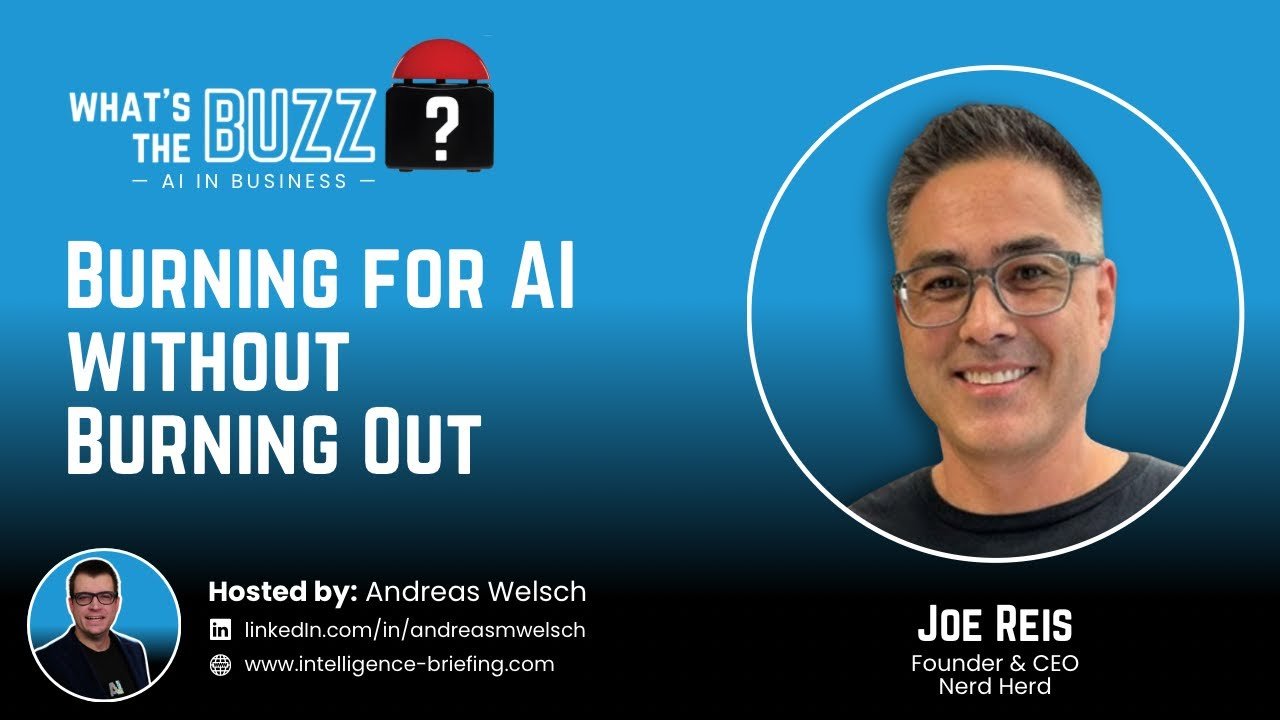
Guest: Joe Reis, Founder & CEO of Nerd Herd
Host: Andreas Welsch
Episode: What’s the BUZZ?, Season 4, Episode 4
Published: February 11, 2025
Episode Summary
Joe Reis, Founder & CEO of Nerd Herd, joins Andreas Welsch to answer how leaders can keep teams from burning out while the pressure to deliver AI keeps growing. Joe describes a gap between AI plans on executive slides and the state of company data systems, where many companies want AI but are still working on business intelligence.
He ties rising burnout to layoffs, thinner teams and less compassion from employers than a decade ago. The conversation also covers how AI agents could change the roles of frontline workers and middle managers, and what leaders can do for their teams now.
Key Takeaways
- Joe says many companies want to do AI but are barely doing business intelligence, and that the underlying data is always the crux when AI vendors work with enterprises.
- Joe names customer support as the lowest hanging fruit he sees for mature enterprises, by augmenting people with AI or replacing them.
- Joe sees record corporate profits alongside record burnout and layoffs, with employees expected to do more with fewer people and less compassion than a decade ago.
- Joe expects middle management could be affected sooner than frontline workers, because frontline workers know the work and can guide agents in ways managers cannot.
- Joe advises leaders to make their teams feel valued, to give them attention and to get to know them as people, and to be a person rather than speak in cold, clinical terms.
Timestamps
- 00:00:24 Burning for AI without burning out
- 00:00:59 Joe Reis joins the show
- 00:03:09 Icebreaker: if AI were a vehicle
- 00:04:13 The pressure to have an AI story
- 00:08:47 Data, processes and systems come first
- 00:11:45 Data is still the differentiator
- 00:12:49 Speaking openly about burnout
- 00:14:09 Record profits alongside layoffs and stress
- 00:19:32 Agentic AI and pressure on leaders
- 00:21:13 Will middle management shrink first
- 00:23:02 Working for several companies through your own agents
- 00:27:09 How leaders can keep their teams from burning out
- 00:30:54 Key takeaways
- 00:32:16 Wrap-up
About Joe Reis
Joe Reis is Founder & CEO of Nerd Herd. In this episode he describes his work as writing books, speaking his mind online and still practicing data engineering and architecture, and he says he is sometimes known as a recovering data scientist.
Full Transcript
Read the full transcript
Andreas Welsch: Welcome to “What’s the BUZZ?”, where leaders and hands on experts share how they’ve turned hype into outcome. Today, we’ll talk about burning for AI without burning out. And I have somebody on the show who recently posted about this and who’s an expert in anything data engineering, and a trusted voice in the community. Joe Reis. Hey, Joe. Thank you so much for joining.
Joe Reis: Hey, what’s up? How you doing?
Andreas Welsch: Awesome. Hey, for those of you in the audience or that don’t know Joe, maybe Joe, if you can introduce yourself real quick, that’d be awesome.
Joe Reis: Yeah, I’m Joe. I don’t know what to say. Write books, rant online, still practice data engineering, architecture and so forth. I’ve been in the space a long time. I think sometimes known as a recovering data scientist. Probably unpack that a bit. But anyway, good to see you.
Andreas Welsch: Awesome. Wonderful. It’s been a while since you invited me to your show. I think about a year and a half or so. So it’s more than overdue to reciprocate. Obviously super passionate about how we can help folks in the community do that better. And I think that’s still a big need. But not just that side, the mental health side obviously as well. Make sure that we don’t overstretch ourselves. But before we talk about today’s topic, should we play a little game to kick things off in good tradition?
Joe Reis: I guess so. Let’s do that.
Andreas Welsch: Good. All right. So this one’s called In Your Own Words. And when I hit the buzzer, the wheels will start spinning. We’ll see a sentence and I’d like for you to answer with the first thing that comes to mind and why, in your own words. To make it a little more interesting, you only have 60 seconds for your answer. And if you’re in the audience, feel free to play along with us, too, and put your answer and why in the chat as well. So Joe, are you ready for “What’s the BUZZ?”
Joe Reis: Never been readier. Let’s do it. Oh, kidding. I have no idea what you’re going to ask, but
Andreas Welsch: If AI were a vehicle, what would it be? 60 seconds on the clock.
Joe Reis: Oh, geez, I think it depends what country you’re in. I think in America, definitely a Cybertruck. In Europe, probably a Fiat. Or a Peugeot, whatever.
Andreas Welsch: Maybe the Fiats are highly regulated and reliable or something, but the Cybertruck definitely resonates with me.
Joe Reis: Or a Volvo, right? It’s supposed to be safe on land.
Andreas Welsch: Awesome. I love that. Good. So whatever your answer would be, put it in the chat. I’m curious. But now how do I build that bridge from cars to mental wellness? Let’s see. Look, it can feel a lot like going on the German Autobahn, and even if you feel you’re going 140, there’s a car behind you going 160 and flashing the high beams and you need to move over.
Joe Reis: Autobahn is fun though, I will say.
Andreas Welsch: It is fun. It can also be stressful, right? Much like a tech job. And I feel that the industry is in overdrive. It’s been in overdrive ever since this thing, ChatGPT, obviously popped on the map. And business leaders, tech leaders said, wow, what’s this? We need to do something. What’s our AI strategy? What have we been doing all these years? Yes, we have some AI or machine learning, but this, we didn’t see this coming. More and more announcements, advancements, we all read the tech news and blogs, it’s mind blowing sometimes, even within a given week, how we jump from news and do all that hopping. But I also think it’s really hard when you talk to folks in the industry, nobody really wants to admit that they’re behind. Internally, I think there’s a big push in many of these organizations, not just software and tech, but across different industries. But I’m curious, what are you seeing when you talk to people? What’s that sentiment?
Joe Reis: It’s interesting. I definitely talk to a cross section of people from some of the biggest companies in the world to small and everything in between. It is interesting. You do point out, I think this, a fake it till I make it approach. Maybe it’s not the right way of putting it, but I’ll go with it for now. And yeah, there’s definitely got to be a put on appearances that you have a quote AI story. Your board expects it. If you have a board, your customers might expect it. I can get into what that actually is, nuance into that. But the expectation is universal, obviously not universally, but quasi, that the expectations are you’re doing something with AI, you have some sort of a use case, use cases. But it is interesting because I feel like this has been ordained as a transformative technology of at least this decade and maybe we’ll see about others, but the transformation part is something I’ve been very curious about. What if you’re a regular tech company, for example? Obviously there’s probably more use cases for it, you’ve probably already transformed your business because you’re more probably AI or data native or digital native than maybe mature enterprises. But then the mature enterprises, I often wonder what are the use cases that are really going to cause the transformations for these mature companies. Because if you take a step back, and I wrote about this in one of my articles, a lot of companies want to do AI, but most are barely doing BI. This is still the challenge for a lot of mature companies. It’s not a knock. It’s just, you have the data systems that are pretty old, BI is still a challenge. And now we’re going to throw LLMs and AI on top of these same data systems. And miraculously things are going to happen, right? So I think that’s a disconnect that I see, I live in reality. I think a lot of other, we talked to technicians, especially practitioners. They’re like, yeah, I think there’s a difference between what maybe is on the C suite’s slide deck for AI versus what’s actually happening, and it could be possible just given the current state of affairs. That’s not to say, of course, that AI is not going to get traction, especially if we talk about more mature enterprises, that there’s use cases that probably don’t directly involve a lot of the corporate data systems as they are. You could do customer support. That’s a big one. That’s like the lowest hanging fruit that I see, is just augmenting people with AI or replacing them, whatever, with these solutions. That’s how it is. What are you seeing?
Andreas Welsch: So I was meeting with a few prospects over the last couple of weeks and I saw a similar picture as well, right? AI is that shiny object that triggers, which I think is already good because leaders realize, hey, we need to do something. We haven’t done enough over the last couple of years and we haven’t been able to invest as much as we should have. Now we see there’s AI. It’s an opportunity. It’s a threat. We need to do something. But then when you peel it back, it really comes down to data, processes and systems, right? And actually business transformation at the very core. It is an enabler. So that to me is still an eye opening conversation that you have when you’re in the room with senior leaders and they say we’re not quite sure where we’re leaving money on the table or we feel we’re doing okay. We’re doing better in some areas than in others, but we don’t really have the data, but if we had, we could do so much more. What is step 1 then? Gathering that data and starting to gather it in a way that you can use it before you can,
Joe Reis: It is an interesting, I would say conundrum, that many companies find themselves in because they’ve been told over and over from people like us and other pundits, take your data seriously, be data driven, all these things, hooray type things. And guess what? They ignore it and say we don’t really want to invest in that. We want to invest in other stuff, like my yacht or my Cybertruck or something. Just kidding. But, or bonuses, right? And so that’s, but now I think there’s no free lunch here. You either make the investment or you don’t. Now, of course, that assumes that AI doesn’t just miraculously heal your data and solve your problems for you, but we’re assuming that that’s not really the case right now. And you talk to any AI vendor as well that actually does stuff with enterprise. It’s the underlying data is always the crux. Period. Hands down. If the data is in great shape, if there’s good data quality, if the data is well modeled, governed, whatever. Terrific. If it’s not, I suppose then you get to fix that.
Andreas Welsch: I agree. And by the way, that’s why I think GenAI, whether it’s Copilot or ChatGPT or Cloud or whatever, it’s actually a good tool or a good way to show why you need data, why you need good data and specific data. We’ve all had these first experiences when we’ve used these tools that the output was, okay, hey, yeah, sure. It wrote something, but it was me. It wasn’t specific. It wasn’t specific to what I needed, but once you recognize, hey, I need to give it more context, more data, or even more specific data, then I get better output. I think from a conversation with senior leaders who have used this, early GenAI tools make it a lot clearer why we need data again.
Joe Reis: Yeah, exactly. And it goes back to, just data is everything at the end of the day, right? You’re finding that even with very sophisticated algorithms and obviously very great hardware and so forth, the data is still the differentiator. It doesn’t really matter, the models are great. It’s data that goes into it that matters at the end of the day. And seeing as we’ve probably tapped out the publicly available data, all that’s left is, what do you have in your company? And that’s where you’re going to see the yields.
Andreas Welsch: Correct. But that’s where the gold mine is, right? That’s the gold mine for sure.
Joe Reis: Yeah.
Andreas Welsch: Also a little bit the dirt mine.
Joe Reis: It might be a mine of mud. You don’t know what you’re dealing with. I think it depends on, and here’s the thing too. I would say that there’s a big race, but like all races that you enter, there’s people that are going to be storming ahead. If you’ve done 5Ks, there’s always that person that finishes in 13, 14 minutes. There’s the other people that finish in, I don’t know, 90 minutes, right? So we’re all racing, but a lot of it depends on how you started the race out. It’s not equal. There’s no such thing as everyone going at the same speed with this thing, not at all.
Andreas Welsch: No, definitely not. I remember a couple of weeks ago you posted about this topic, especially the mental health burnout type topic. And I think, first of all, it’s fantastic that you do talk about topics like that, because a lot of our peers that are in full time roles are afraid to speak out, right? And are afraid to say, hey, raise my hand. It’s too much, right? Just catching up and continuously catching up and more and faster and shipping product all the time, announcing new products, marketing products all the time. It’s exhausting and we’re only two years in, right? How much longer is this going to go? And is that the new pace? So I met with a former colleague before the holidays, by the way, and they shared, hey, it’s an incredible opportunity to be in tech at this time of AI, but being so humbling in a once in a career opportunity, it’s also unsustainable because it’s unsustainably stressful. So I’m curious. What are you seeing? What do you recommend? How can leaders and professionals balance the passion with those high expectations that are in the market without burning out?
Joe Reis: That’s a big question. I think it’s one of the biggest questions of our time right now. I think you’re simultaneously seeing record corporate profits and revenues and valuations and so forth, and at the same time at these same companies you’re seeing record amounts of burnout, record amounts of layoffs, right? Some big ones were announced just today, actually. My friends who were part of a, I think several thousand people got laid off at one of the big Magnificent 7 companies, right? At the same time, I also saw another group of friends were laid off at small companies today. Today alone, and this is constantly the thing I keep seeing. You want to talk about anxiety. First, you lose your job. That sucks. That makes you anxious. But then imagine being at the same companies where they do these layoffs. They’re expecting more out of you. They’re almost eager to talk about layoffs. Now, where I was thinking the past, 10 years ago, right? You had all the accoutrements that you wanted in your office. You had a sous chef, you had big tech, at least, could play video games. It was like daycare for adults. And they wanted to treat their employees really well. I don’t say it disparagingly, daycare. It was like, this is awesome. And so you fast forward today and the gloves are off, it feels like there’s almost an animosity that employers have towards their employees. And that’s the biggest change that I’ve seen. And what this means is people go to work, they’re stressed, they’re expected to do a lot more with a lot less resources, a lot less people, probably with a lot less compassion than they had earlier on. And so this manifests itself into, yeah, I think gobs of stress, right? How do you feel in that kind of situation? You don’t feel like anyone has your back anymore. And then it turns into kind of the Squid Game or Game of Thrones kind of thing, where you don’t even know who’s going to turn on you at any second. Who’s colluding behind the scenes? Because in environments like this is exactly what happens. It manifests itself in the behavior of the coworkers too. The company’s obviously not sending a signal they care, I may be in my immediate group, I care about them, but it’s everyone for themselves at this point. I’ve seen it happen personally, many times. And I see it happening to my friends right now. I don’t have a day job. I don’t really want one for precisely the reason that if I get into it, first I limit my opportunities. Second, I’m going to be stressed out. To me, it’s a no win situation given where I am at in my career. For other people that are in that situation, they can’t say the same thing. They have to be muzzled, like you were saying, and keep a straight face, and all the while, right now with AI, I expect to do much more and much more. I keep marching towards the school, and it’s the Red Queen effect, if you’ve read Alice in Wonderland. It’s basically you run faster and faster to stay in the same place. Ideally, you’re running faster and faster to go towards a goal, or in the case of the Autobahn, driving faster, but it’s just more and more work. And hope, for God’s sake, I hope AI shows up and solves a lot of these problems and alleviates a lot of the pressure. I was actually on a walk just before this, I was reading a really good book called Offline Matters. It’s about just unplugging from digital, there’s a constant stress of digital online work, and I was thinking about the nature of modern knowledge work. Why do we do this to ourselves? It was separate from our conversation, but I was walking my dog and I was like, what does my dog think? I often think this, because I’m dumb. What goes through her head? I think the only thing I can think of is she’s just excited to be outside, hanging out with me. But then I look at what we get stressed out about. I’m like, why, what is this all for?
Andreas Welsch: And if you look, especially at the corporate role, for a long time, you would say, hey, corporate jobs are stable. You have a regular and stable income, look for good companies or growth companies or companies that have been around for a long time. And then precisely what you share there, there are layoffs in tech and in other places, especially as well. And if that happens on your team, you look around and you say, if it happened to that person and it happened to that person, who’s to say that it doesn’t happen to me or to my other really good work friends or colleagues. And I think that is one of the stressors for sure.
Joe Reis: Oh, big time. I always equate it to if you’re in World War One, for example, you’re in the trench, you don’t know who’s going to be around tomorrow. And that’s sadly, that’s morbidly how it is these days. That’s just reality. I’m not trying to be melodramatic about it. In fact, I’m probably being under dramatic in some ways. But it’s just like that. I know execs right now, a lot of big companies, who are planning reorgs right now. I’m not going to say which ones, but I know what’s going on and this is happening a lot right now, not announced yet.
Andreas Welsch: And then you have a couple of weeks of uncertainty, let’s figure out who we are, what we do, but keep doing what you have been doing until we hear from the top what is really going to change, and a lot of uncertainty especially at the beginning of the year, as always. Now, I would also see that if things like agentic AI become more prevalent, even more robust, if it permeates large organizations, that there will be even more stress and more change. And again, for me that hinges on the fact that the technology is robust and enough organizations use it without adversarial side effects. So let’s assume that happens. And to me that is still in the phase where it’s being proven. But if that happens, I think it also gets very stressful at a leadership level. All of a sudden you’ll get targets, you won’t be able to backfill. It’s already the reality in many organizations today. If you’re not downsizing or reducing the headcount, you cannot backfill if someone leaves. But you can backfill with agents or with technology that is cheaper, that runs 24/7, that ideally runs at least as reliably as humans do. And then guess what? We might also cut your budget. Instead of 10 million, you have 5 million. The other five go towards some automation. Now, you lose budget, you lose people. In our old thinking, you lose influence, right? Especially if these kingdoms, organizational kingdoms, have been built around people, around having large organizations, larger responsibilities, large budgets. And that’s what determines, again, who moves up. I think it’ll be a big change, not just for individual contributors, but for leaders as well.
Joe Reis: It’s interesting. So I’ve been thinking two thoughts about this. One is that there’s definitely a situation where frontline workers, ICs basically, get augmented, we’ll say, with agents. It can be coded for a lot of things. If you invert it though, and if you look at the nature of work, in fact, I see the middle management actually getting affected maybe more quickly than frontline workers because the frontline workers know the work and they can guide the agents in ways that the managers probably can’t. Historically management, if you go back to the beginnings of modern day management when it was in the industrial age, it managed the output of workers. But you take it a step down now, if the workers understand, because again these agents will be, probably for a bit, managing, I don’t know, unruly workers. I can’t imagine they just come out of the box and just do great work. But over time, through reinforcement learning, for example, they can do great work. And so the flip side of it, I can actually see a scenario where middle management gets reduced, because the frontline workers actually can manage more and more agents because they know the work better. They’re just closer to the metal, so that also could be a possibility. And I think
Andreas Welsch: That to some extent we see in multi agent systems. If you have a coordinator or a supervisor agent that manages and reviews the output of several others, that’s one of the core definitions or tasks of management.
Joe Reis: Yeah, exactly. This is one of those fascinating thought experiments right now, what does the nature of an organization look like with AI? Another thing I’ve been talking about in the last couple of weeks, and we’ll talk about this for a while, but two conversations in the last two weeks, it’s just a notion that if individually we have our own agents and we have the ability to farm out our work, so to speak, what’s to stop us from renting out those agents to other companies and being employed by multiple companies? And that’s something I’ve been really pondering, the nature of what does work look like? Why do you have to be tied to one company? There’s nothing in the Bible that says you have to be monogamous to one company. That’s not in there. And you had the phenomenon, especially during COVID, where people were working multiple jobs and making a ton of money. But I think this is actually going to be the reality. It’s the gig economy, but I guess you call it the agent economy, where if you’ve finally tuned to your skills and personality and so forth, and that works with other bots, then maybe that’s it. But it also makes me wonder long term, what is even the nature of a company in that situation? Why can’t you just band together to solve a problem, which is the nature of a firm under Robert Coase back in the day, the nature of a firm is to solve a problem and create customers. But if that whole paradigm inverts itself, I could actually see something very, we’re a ways from that.
Andreas Welsch: Yeah, luckily. And I don’t want you to a lot of conversations with dystopian view.
Joe Reis: I think it’s an optimistic view actually. Because if you have the agency to go out and do your own thing and rent it to the highest bidder, it’s not just singular bidder, perhaps it’s a good thing, right? You could infinitely scale yourself.
Andreas Welsch: And I think if you start from the entity of a company and you say, directionally it will be augmentation, it will likely be some replacement. What do you do then as an individual who’s affected by that change? Either you need to work fewer hours because you’re being augmented, but we don’t have a 40 hour workweek for you, we have a 20 hour workweek for you. If you can scale through agents, again, or through technology, there are two companies or three companies you work for and to your point, you can scale your knowledge through agents in essence and make that same income ideally, but through multiple jobs.
Joe Reis: That’s just it. Why not just have a 24/7, since you’re not doing any of the work, like the 40 hour work we came about because of labor negotiations, remember? People used to work nonstop at factories. And then that was kibosh and put the 40 hours, under Henry Ford, just because it’s probably not healthy if you want to have good labor relations. But that was also at a time when Ford was very considerate of the long term impacts of factory employment on the employees. And he was very conscious of this. That’s why he paid people well and treated them well, so they would produce better output. But that was over a hundred years ago, right? And we’re still using that same model today, but it’s no wonder people are stressed out. Because again, on my walk, I was just thinking, what is the nature of knowledge work these days? This wasn’t what humans, we weren’t supposed to be sitting at a desk, typing away at a keyboard. I think this is a good transition point to something else. But anyway, that’s a book for another decade.
Andreas Welsch: That makes me wonder then, on one hand, leaders are either already under this kind of stress or will experience it. ICs are definitely under the stress that yes, I have a permanent role as long as my employer wants me there. How permanent is that? Semi permanent? When does that run out? How do you feel leaders can then prevent the team from burning out, especially in these high pressure situations where we’re behind, we need to innovate, we need to do new stuff. We need to do a lot more foundational work before we can even do the new stuff.
Joe Reis: Yeah, but we
Andreas Welsch: Need to do it faster and we need to catch up on all that time that we’ve not utilized or not spent well over the last couple of years. So how can leaders help their team from burning out?
Joe Reis: There’s the old saying, right? People don’t leave their job, they leave their manager. I think that’s really true. So I think things that I’ve seen effective, at least in my experience, and talking to lots and lots of people, is that when a manager or a leader makes their team feel valued, when they take the time to give them attention, to be compassionate, to get to know them as people, I think that’s a really good way to stave things off because you have your personal connection with your team, right? I had one friend today who was laid off, right? And he told me how he got laid off was very cold, very clinical, not even a thank you, right? That says a lot about that company. And I would say being cold and clinical isn’t going to get you any favors, it’s going to get you output. And if that’s all you care about, go for it. But if you want to develop a team and a culture, there’s a lot more to it. But this isn’t easy to do. It requires that you do the things that aren’t scalable. It means going and talking to people and understanding what makes that person tick and so forth. But I think it’s things as quote simple as that. But also playing blocking and tackle for your team I think is a big one, but you can only shield your team so much from what’s going on. And the big thing, especially in big companies, is nobody seems to know what’s going on. I’m sure you know how this goes. You hear rumors and stuff, but there’s a lot of information asymmetry that happens. And that’s just reality for better or for worse. But I would say just do the best you can, just be a person at the end of the day. That’s who I want to relate to and feel like I can get behind, a person who is just a person. If you’re going to come to me and talk to me in cold clinical terms or corporate speak, even worse, try and be all jolly but talking just nonsense corporate BS, then I don’t have respect for that. I don’t have time for that either.
Andreas Welsch: I love that. Especially in that time and age of more AI and more machines, more automation, fewer humans in the end, to some extent, be human towards the people that you work with. I think that’s a very good call to action.
Joe Reis: Yeah, and I would say that holds true with or without AI, right? You don’t have to wait for the robot apocalypse to be nice to your people. It’s just something you should be doing. Because ideally that’s the role of a leader and a manager, it’s leading people. But to me that also means just being a person. Which is hard to do. I think for a lot of corporate people, it’s hard to do because you’re so used to muzzling yourself. You’re so used to, as you say, your friends that you talk to. And I see this especially at big companies. You gotta put on the face. You gotta put on the act. You’re partly hired for your experience, partly hired for your brains, but I think you’re also hired to conform to this LARP, this acting role that you have to have. Which is what it is.
Andreas Welsch: We covered a lot of topics. We’ve covered a lot of ground over the last half hour. Joe, I was wondering if you can summarize the key three takeaways for our audience out of all the things that we touched on, burning for AI without burning out.
Joe Reis: Going backwards, I would say, if you’re a leader, be a human, be a person. That also includes individual contributors, by the way, just be a person. And that’s the one thing I think people sacrifice too often. And then they look back and they’re like, what did I do? Where did I spend my time? So that’s a big one. The other one is just try and find ways to put your data house in order, so AI is good to go. But I think finally, just figure out ways where AI is going to have the most impact for your company, right? We danced around this a bit, but find ways where you can do it in a humane way as well. I think that’s the thing that’s missing from the conversation, how can we get rid of all this cost? How would you feel if I called you cost? That’s your pronoun.
Andreas Welsch: Are you asking me as an individual or as a shareholder?
Joe Reis: Yeah, that’s a good point. So when you, as an individual, are referred to as cost, you’re like, that’s pretty inhumane, yeah. As a shareholder, you’re like, yeah.
Andreas Welsch: Asset is the right word, not cost.
Joe Reis: Yeah, sure.
Andreas Welsch: Awesome. Hey, we’re getting close to the end of the show. And Joe, I just want to say thank you for joining us and for sharing your expertise with us. I’m glad we’re able to have that conversation. Like I said, it’s so much easier having it with someone who’s seen it, who’s been through it, who has lots of connections to people who are going through that, because I know that a lot of folks in corporate roles and full time roles cannot speak so openly about the challenges.
Joe Reis: I understand, man, it is what it is. Yep.
Andreas Welsch: Yes. Wonderful. Again, thank you so much for coming on the show and everybody.
Listen and Subscribe
Related Reading
- AI Leadership for Enterprise Leaders
- AI Readiness for Enterprise Leaders
- AI Leadership Handbook by Andreas Welsch
Frequently Asked Questions
Why do many companies struggle to get value from AI?
Joe says a lot of companies want to do AI but are barely doing business intelligence, because their data systems are old. He adds that when AI vendors work with enterprises, the underlying data is always the crux, so data quality, modeling and governance come first.
Why are teams burning out in the AI era?
Joe sees record corporate profits and valuations alongside record burnout and layoffs. He says employees are expected to do much more with fewer people and fewer resources, and with less compassion than a decade ago. Andreas adds that reorganizations bring weeks of uncertainty.
How can leaders help prevent team burnout?
Joe cites the saying that people leave their manager, not their job. He says leaders can make the team feel valued, give attention, show compassion and get to know people. He notes this work does not scale and that leaders can only shield a team so much.
How could AI agents change management roles?
Joe suggests frontline workers may manage more and more agents because they know the work, which could reduce middle management. Andreas notes that multi-agent systems already use supervisor agents that review the output of others, which is a core task of management.