

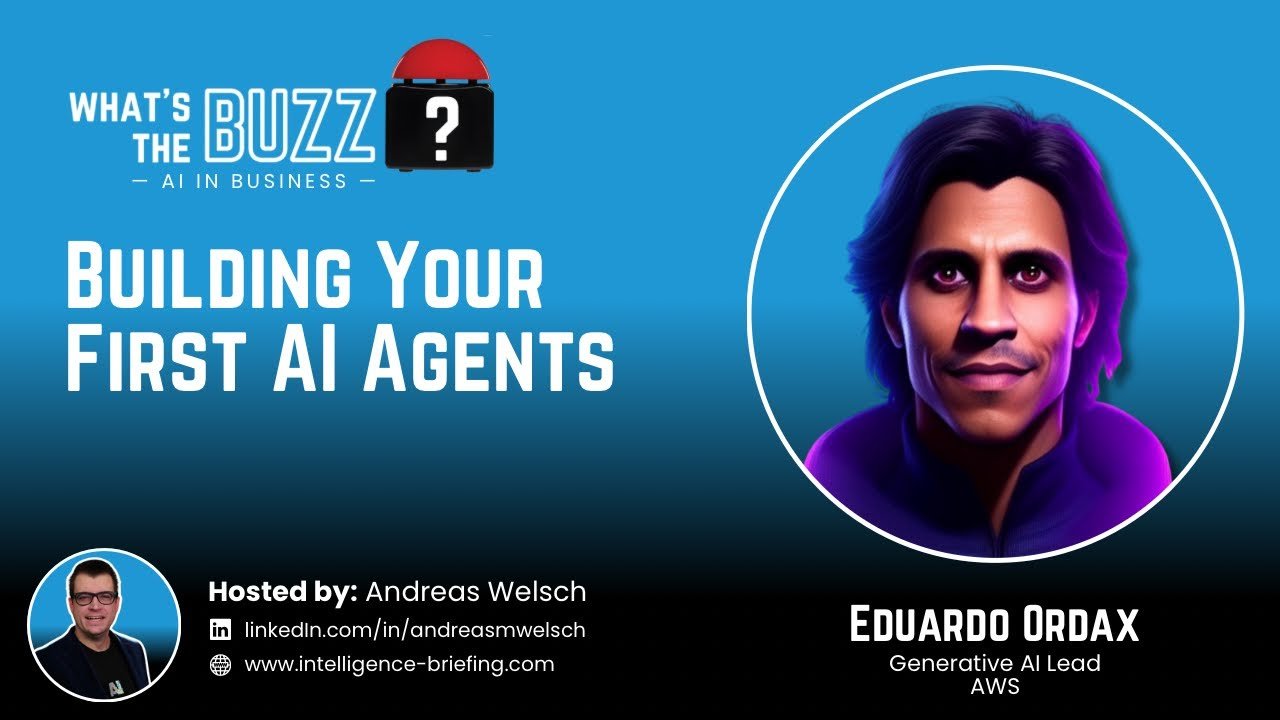
Guest: Eduardo Ordax, Generative AI Lead at AWS
Host: Andreas Welsch
Episode: What’s the BUZZ?, Season 4, Episode 5
Published: February 18, 2025
Episode Summary
Eduardo Ordax, Generative AI Lead at AWS, joins Andreas Welsch to answer a practical question: how can a business build its first AI agent? Eduardo explains where he sees enterprises start, which components an agent needs, and how to choose between off-the-shelf agents, a managed service and a framework used to build from scratch.
He also describes how agent adoption has moved from tightly scoped pilots toward use at scale over the past year, and why agents need defined relationships to work together. The conversation closes with three takeaways: remove the hype, start on platforms that shorten time to market, and look for manual processes where automation pays off.
Key Takeaways
- Eduardo sees customers in highly regulated industries, such as financial services, insurance, healthcare and life science, moving first, because they invested early in data, systems and the cloud.
- In Europe, the most typical first use case is automating internal processes, such as booking holidays, requesting a service or opening an internal ticket.
- Eduardo names four main aspects of an agent: self-reflection, planning, tool use or function calling, and collaboration across agents.
- The choice between vertical agents, a managed service such as agents on Amazon Bedrock, and a framework such as LangGraph depends on skills: the lower the entry barrier, the less room to customize.
- Agents need defined relationships, such as a master agent with employee agents, hierarchies or peer-to-peer teams. Eduardo says autonomous agents that coordinate on their own are not there yet.
Timestamps
- 00:01:16 Eduardo introduces himself
- 00:02:08 The In Your Own Words icebreaker
- 00:04:34 Which customers and departments explore agents first
- 00:07:43 Does the first agent matter, and which departments start
- 00:09:14 Agentic RAG as a top use case
- 00:10:21 The technology components an agent needs
- 00:14:18 Buy off the shelf or build it yourself
- 00:17:55 How far along companies are with agents
- 00:22:34 How agents communicate and interoperate
- 00:26:22 Three takeaways
About Eduardo Ordax
Eduardo Ordax is a Generative AI Lead at AWS. He is based in Madrid, Spain, and manages the EMEA region (Europe, the Middle East and Africa), where he works with customers on applying generative AI.
Full Transcript
Read the full transcript
Andreas Welsch: Today, we’ll talk about how you can build your first AI agents, and who better to talk about it than someone who’s actively working on that with a lot of customers in Europe, Eduardo Ordax. Hey, Eduardo, thank you so much for joining.
Eduardo Ordax: Thanks so much for inviting me today. It’s really a pleasure to be here.
Andreas Welsch: Hey, Eduardo, I’ve been seeing a lot of you on LinkedIn over the last one or two years, and I see you’re picking up a lot of good momentum, so I’m super excited that you’re spending this time, not just with me, but with the audience as well. For those of you who don’t know you, maybe you can introduce yourself real quick and tell us a little bit about who you are and what you do.
Eduardo Ordax: Yeah, sure. My name is Eduardo. I’m living right now in Spain, in Madrid. I’m working as a Generative AI lead for AWS, managing EMEA, Europe, Middle East and Africa. That means essentially how we can help our customers leverage all the potential of generative AI. This is what I’m doing. I’m having so much fun, and I’ve had so much work during the last few months. And yeah, that’s me.
Andreas Welsch: Eduardo, should we play a little game to kick things off?
Eduardo Ordax: Yeah, sure. Let’s go.
Andreas Welsch: Wonderful. All right. This one’s called In Your Own Words. When I hit the buzzer, you’ll see the wheels spinning, and when they stop, you’ll see a word. I would love for you to answer with the first thing that comes to mind and why, in your own words. To make it even more interesting, you’ll only have 60 seconds to answer. Are you ready?
Eduardo Ordax: I’ll try. I’ll do my best.
Andreas Welsch: Good. So here we go. If AI were a vehicle, what would it be? 60 seconds on the clock.
Eduardo Ordax: Wow, that was super easy. I would say it would be a Cybertruck.
Andreas Welsch: Okay. Why?
Eduardo Ordax: I don’t know. The first time I saw it, it was like something coming from the future. Many of the things we are seeing right now related to artificial intelligence seem like something that really comes from the future. Two or three years ago, we could not even imagine all the capabilities of the large language models, but also of any other foundation model. I think it’s the first time we really believe that the things coming in the next five to 10 years are going to be more impactful for all of us. That’s why I see the Cybertruck and I imagine a remote world in the future, maybe on Mars. I don’t know. I’m thinking of this kind of artificial intelligence idea. It’s as simple as that. It reminds me of the Cybertruck.
Andreas Welsch: Thank you so much for sharing. I’m curious what you think in the audience, what comes to mind now? There are many ways that we can think about the future and futuristic technology. Some of it is already here, like the Cybertruck that is on the roads in the U.S. In many ways, I also see parallels to AI and AI agents. Certainly it’s the big hype topic of this year. I think there’s still a lot more momentum that this technology will gain, and vendors keep pushing it. But I’m curious, in your work with customers, what do you see? What departments are exploring AI agents at the moment?
Eduardo Ordax: In my opinion, it’s even more than departments: they are all the customers in general. But if you are asking me which kind of customers are more willing to start exploring and implementing agents, these are probably the ones who started in the very early days with AI. All the customers from highly regulated industries like FSI, financial service industries, insurance, healthcare and life science, because they have invested a lot of money, a lot of time and a lot of resources, in terms of teams and people, and they have gained a competitive advantage in working with artificial intelligence. They really know how to structure their data and their systems, and most of them are already moving to the cloud, because if you want to use AI, it’s much better when you’re in the cloud. These customers are the ones for whom it has been much easier to start implementing agents, for many different use cases. The most typical use case right now is to automate internal processes, because you have control over these kinds of workflows. There is a lot of hype around agents, and sometimes an agent is nothing else than a cool workflow. I used to call it a cool workflow, because most of the time it’s just an LLM making different API calls, or doing this kind of self-reflection. Internal processes are a good fit because you can automate things that take a lot of time and involve a lot of manual steps, and you are going to be more efficient and save a lot on costs. Of course, there are also customer-facing cases, like customer support, where you can implement a chatbot that is expected not only to provide information to your end customers but also to take actions. For example: “I want to book a room for next week in Toronto, in a hotel, for four people.” You expect this chatbot not only to give me information about the room but also to make the call to the system where I can book the room, give me special offers, connect to a different database, retrieve the data and send it to me. But right now, at least in Europe, it’s mainly for internal processes. How can I automate the process to book holidays? How can I automate the process to request a specific service? How can I automate opening an internal ticket, or submitting anything, whatever. This is what I’m seeing the most right now.
Andreas Welsch: Thank you for sharing. I think that’s a really good perspective on where companies are looking at these things right now. It seems similar to AI and machine learning, RPA and those previous hypes: look for something where, like you said, it’s your internal process. You know how it works, you ideally have it documented, and there are ways to make it more efficient and faster. That brings me to my next question that I’ve been thinking about. Does it really matter what your first agent is? Are there specific departments? Is it mainly the IT department that looks to tease out the last 20 percent of, “Hey, can you reset my password?” or “I forgot where my nearest printer is,” or some other standard problem? Is it those departments that are looking at this first, or do you see business, finance, …
Eduardo Ordax: Yeah, I’m seeing a lot of IT departments, especially those managing the life cycle of different tickets, different claims and so on. But also the business, sales and marketing departments: how can you automate the relationship with the customer? They are super interested in this because, as I said, when we started to talk about generative AI, probably the top use case was implementing chatbots to automate the relationship with the customer. Right now I’m seeing all these departments say, “I want to take one step further, not only to provide information to my customers, but ultimately to take actions.” Something else I’m seeing a lot is part of RAG use cases, retrieval augmented generation. One of the challenges with RAG is that as soon as you scale the number of documents you want to query, the different techniques become so challenging, because it’s not easy to find exactly the place where the answer to your query is. So we are seeing this kind of agentic RAG, where we take different approaches, like hybrid search, query rewriting and a query re-ranker, implemented through agents. This is very effective because I can initiate different journeys to make sure I retrieve the most important chunk for my previous question. Agentic RAG is one of the top use cases I’m seeing right now. Not because of agents, but because of RAG: it’s probably one of the things most customers are implementing. It is nothing else than a knowledge search.
Andreas Welsch: I think you mentioned a good point about RAG documents, different approaches to RAG, and we see so many schematics of agents and their components in our LinkedIn feed and news feeds day in, day out, from planning to memory to core modules and everything else. What are the key technology components that you actually need if you want to build an agent or use an agent?
Eduardo Ordax: At the end of the day, an agent is nothing else than an LLM doing some kind of action. If we look at an LLM in its most simple form, I ask it something and it gives me an answer. An agent is trying to take one step more. I can do some specific planning: if I’m asking you to write a document, I’m not going to write it in one thought. I’m going to analyze what I need to do, this kind of self-reflection. First of all, I’m going to come up with different answers, and I’m going to analyze whether my answers are good or not. So the model is asking itself how good or how bad this is going to be, and I’m going to make a plan: I’m going to do this first, this second, then this. But you can also use external tools. Most LLMs have what they call function calling or tool use. As an LLM, I can make an API call to an external system and retrieve information. If I’m asking you for some information that I don’t know, I can say, “Let’s go through this website,” find the answer, and augment the answer that I’m going to provide with this information. This is the part of the agents that you need: the LLM, where you can write this kind of self-reflection where you can analyze. It’s pretty much like us. If I’m asking you to write something, you’re not going to do it in one shot. Maybe you will write a document, you will do a draft. And even before a draft, you’re going to start planning: this is the schema of my document. I start a first draft, and then I review my draft and say whether it’s good or bad. If it’s not good enough, I take another review. So these are just LLMs: not responding the first time, but doing this kind of self-reflection, analysis and planning. At the end, if I need it, I can make different calls to different tools. And if we take it one step more, this is pretty much like us: we are not experts on everything. So at the end of the day, we will have many agents working together. It’s not one agent doing all the different steps; I’m going to put different agents to work on different tasks. You may have an agent that is an expert on finding information on the website. Another agent is the expert trying to orchestrate all the others. Another one is the one who is going to book your travel to Toronto. So you will have many different agents, but I even need to orchestrate those agents. That is called meta agents and multi-agent collaboration. There are many different names, but I would say these are the four main aspects: self-reflection, planning, tool use or function calling, and collaboration across agents.
Andreas Welsch: Now, we’ve been talking in the tech industry for a long time about microservices: having individual capabilities compartmentalized so we can call them or string them together. That definitely sounds a lot like that, even on a more granular level. But I’m curious too, for someone who might be new to this topic. If you hear all about agents in the news, do I have to build all of this myself? Do I have to be a developer, or do I need a team of developers? Are there some things where I should use things off the shelf? What’s your recommendation between off the shelf and building this yourself? When does it make sense to build it?
Eduardo Ordax: Yeah, I think at the end it depends. There are many different approaches and many different flavors. If you have something super specific, “I want to do this, and it’s going to be A, B and C,” you may already have many agents that integrate with your ERP and your different systems, and you don’t need to create them from scratch. You can use the agents from Salesforce, or agents to create a virtual assistant, or customer support agents. There are many different companies creating these agents, and they remove all this heavy lifting about how to manage the agents, how to manage the resources, how to query different databases. If you don’t have the expertise or the skills, maybe it’s better to go this way. But there are all different flavors. With AWS, you have agents on Bedrock. You can still customize which kind of agents you are going to build. You can say, “I want to build these specific agents for customer support,” and you are going to have access to all these different systems. But again, it’s a managed service, and it’s much easier to implement. You can give some instructions and build different workflows, so the entry barrier is going to be very low. But even if you have very specific requirements and you want to create everything from scratch, you have frameworks like LangGraph. With LangGraph, you can create everything from scratch. Probably the most complicated part is that the level of abstraction is so high and the entry barrier is high as well, so it’s probably not the best way to go for everyone in the business unless you have enough experience. You have different approaches based on your skills and your capabilities. If you use vertical agents, like sales agents or HR agents, the entry barrier is very low, but the possibilities to customize these agents are not so high, because they are very specific. You have something in between, like using agents on Bedrock, where you have many things to customize. Essentially, you can customize almost everything, but you still build on top of a framework that is already defined. And then you can build everything from scratch, but you need to manage your agents, you need to manage your resources, you need to do this level of abstraction. Again, it depends on the customer. I’ve seen all different aspects, and I think it’s not different from normal software. Probably you are going to use SAP, so don’t build it from scratch, but if you need to do something very specific, you will have to do it. It’s not different from traditional software, to be honest.
Andreas Welsch: That makes a lot of sense, and I think that’s good reassurance. Look at what your standard vendors already put out there. If you need something else or more than that, or something highly customized to your business, not just your industry, build it on top of the platform. Now, I’m curious, in your work, how far along do you see companies on this journey? Are they just scratching the surface and trying to figure out what these agents are, whether they are any good and where we can use them? Or do you already see leaders thinking about how to make sure that agents act in the same way, that they use the same tone and the same style in how they respond, and that they are grounded in the same documents? Not just the business documents, but a code of conduct or values, or, say, if they’re a finance agent, that they’re grounded in IFRS accounting standards. How far along is that thinking from what you’re seeing?
Eduardo Ordax: So I think I’ve seen a shift over the last few months. Of course, Europe is different from the U.S. In the U.S. they are much more advanced right now. But what I saw probably 12 months back was mainly experimentation. They were trying to build something like a POC that was going into production, but the scope of these agents was super limited. So there were agents working in production, but with a very limited scope. Let’s say I want to implement an HR agent to book your holidays: it was exposed only to a reduced number of employees, for example. What I’m seeing right now is that this is starting to change. It’s not only exposing agents to this kind of control group, but trying to expose them to everyone. Of course, the main challenge here is about the outcomes and about the cost. But right now I’m seeing customers move more to the use of agents, in general, agents and AI at scale, because, to be honest, at the end of the day everything is going to be around agents. If we think about generative AI just about LLMs, I think it’s useless. Let me explain. It’s not that it’s useless, but we as humans are expecting not only to receive information, but at the end of the day to accomplish a specific task. This is what we get by using agents. That’s why I’m saying LLMs are useless, because all these companies are expecting to automate processes. It’s not “I’m expecting to know what the HR policy is for vacation,” but ultimately to book my holidays in the tool through agents. So what I’m seeing right now is more and more customers implementing agents at scale. Of course it depends on the industry. For digital-native customers and startups, customers that don’t have an IT legacy, it is much easier and more natural, because they don’t have the problem with data. They usually already have the data lake, and everything is integrated. But customers from highly regulated industries, FSI, insurance, healthcare and life science, are also implementing agents for many different use cases, like research and discovery, which could be super complicated. You can use agents to do that. I think within the next 12 months we are going to see an explosion of people consuming these services. I think that’s good, because this is the flywheel that we really need. As soon as we have more people consuming these services, we will get much better, much more capable models, because to train these models you need a lot of money. All these companies, like OpenAI and Anthropic, need to be profitable. They need to make a business with that. So as soon as we see more people using these systems at scale, we will see a clear improvement of these LLMs and foundation models as well.
Andreas Welsch: I like how practical you make that and how you share what you’re seeing. I think it’s great to see companies experimenting with this, but also looking at the next steps we should be doing, and connecting what you said with our earlier point: use what your out-of-the-box vendors offer, and combine it with something more customized on your platform. Build it there. I’m just wondering, with scaling the number of agents, and even if there are many very specialized tasks that you put together in a collaborative workflow, how do they communicate? How do we make sure that they communicate well, that they exchange the right information, that they expect the right input and give you back the right output? We’ve established protocols in the past, things like TCP/IP and HTTP, that handled that communication. Do you think we’ll see something like that to ensure interoperability going forward as well? Do we need that?
Eduardo Ordax: Yeah, you asked the million-dollar question. How are these agents going to communicate? I still find people who believe that they are autonomous, super intelligent systems that will know how to communicate with many others to accomplish tasks. We are not there yet. These agents are not people. But what we can do is organize these agents pretty much like us. We can have different kinds of organizations. We can have a master agent that is going to do many different things, but we can also have hierarchical agents, where we define: this is going to be the master, and these are going to be its employees. I can assign different tasks to different agents. I just need to make sure that I establish a protocol or relationship between these agents. This is much, much easier, because it’s one single agent connecting to many different ones. It’s only a one-to-one connection across all these agents, and you have control, but there is only one kind of connection, or one kind of protocol. But you may also have higher levels of hierarchy. You may have one agent, then different departments, and within the different departments you’re going to have specialist agents. So you are adding one more layer of complexity. You can even have peer-to-peer agents that work as a team, where there is not one single agent acting as a planner, but we all work together at the same time. There is a way to do that. You can implement that, as I said before, by using LangGraph, but you need to define these relationships first. You need to be very clear on the structure of what every single agent is going to accomplish, and also the parameters and the variables they are going to use between each other. And as I said, within Amazon Bedrock we recently announced at re:Invent this kind of multi-agent collaboration, where you can define these relationships very easily. You can say, “This is going to be my master agent, and it’s going to communicate with A, B and C. It’s going to send all these different parameters. It’s going to expect all these different answers. I’m going to allow them to call these different systems.” So we are doing all this heavy lifting behind the scenes, and for you it’s going to be much easier. But again, you need to define the relationships between the agents. Otherwise, you can expect something that you won’t like if you just leave them on their own. That’s why it’s super important. And maybe in the near future we will see something closer to autonomous agents that can interact on their own, but for sure we are not there yet.
Andreas Welsch: Okay. Sounds like it’s a journey, but many have already embarked on it. Now we’re getting close to the end of the show, and Eduardo, I was wondering if you can summarize the key three takeaways for our audience today.
Eduardo Ordax: I think, first of all, I would say: try to remove all the hype about agents and try to see what the value is. The value of an agent could be as simple as, “I just need to build a simple workflow that is going to do A, B and C.” That could be an agent. So don’t worry too much about autonomous agents and so on. Let’s start with the basics. My recommendation is also to start with tools that are going to allow you to move faster. At some point you will probably be in a situation where you can build everything from scratch, but at the beginning it’s about trying, testing, experimenting, failing, and then trying again. My recommendation is to start with tools that are going to reduce the time to market. I think tools like Bedrock, or even vertical agents, are going to help you a lot in the process. Probably the third element is to be very clear in identifying those processes where you are going to get a lot of value. Agents can be super powerful, but it’s not about overcomplicating the stuff. It’s about identifying those processes that right now seem super manual, where you are losing a lot of money: “I need to do this every single day,” or “I’m not even able to automate it,” whatever. Identify all these different parts of your processes that lack a lot of automation, and try to see how it would be by using agents. So those would be my three takeaways. Try to remove all the hype on agents; sometimes it’s just pure workflows. Second, start by experimenting a lot and try to reduce the time to market; use platforms that are going to allow you to move faster. And third, it’s all about finding the value where you are going to implement it. Try to identify the steps of your processes that right now don’t look pretty good, and try to automate them by using agents.
Andreas Welsch: Now, that sounds like really sound advice, and I know it’s grounded in the experience that you have and that you see every day working with customers in Europe. So Eduardo, thank you so much for joining us and for sharing your experience with us today.
Eduardo Ordax: Thanks a lot, Andreas, for inviting me today.
Listen and Subscribe
Related Reading
- Agentic AI for Enterprise Leaders
- Deploying AI Agents: A Practical Guide for Business
- The HUMAN Agentic AI Edge
Frequently Asked Questions
Which companies adopt AI agents first?
According to Eduardo, customers in highly regulated industries such as financial services, insurance, healthcare and life science move first. They invested early in AI, know how to structure their data and systems, and have mostly moved to the cloud, which makes implementing agents easier.
What is the most common first use case for an AI agent?
In Europe, Eduardo sees agents used mainly for internal processes, such as booking holidays, requesting a service or opening an internal ticket. Companies keep control over these workflows, and the processes involve many manual steps that cost time.
What components does an AI agent need?
Eduardo describes an agent as an LLM that takes action. He names four main aspects: self-reflection, planning, tool use or function calling, and collaboration across agents, where several specialized agents are orchestrated together.
Should a business buy or build its first AI agent?
Eduardo says it depends on skills and requirements. Vertical agents have the lowest entry barrier and the least customization. A managed service such as agents on Amazon Bedrock sits in between. A framework such as LangGraph offers full control with a high entry barrier.
How do multiple AI agents work together?
Eduardo says agents are not yet autonomous enough to coordinate on their own. Builders define the relationships, such as a master agent with employee agents, layered hierarchies or peer-to-peer teams, and the parameters the agents exchange.