

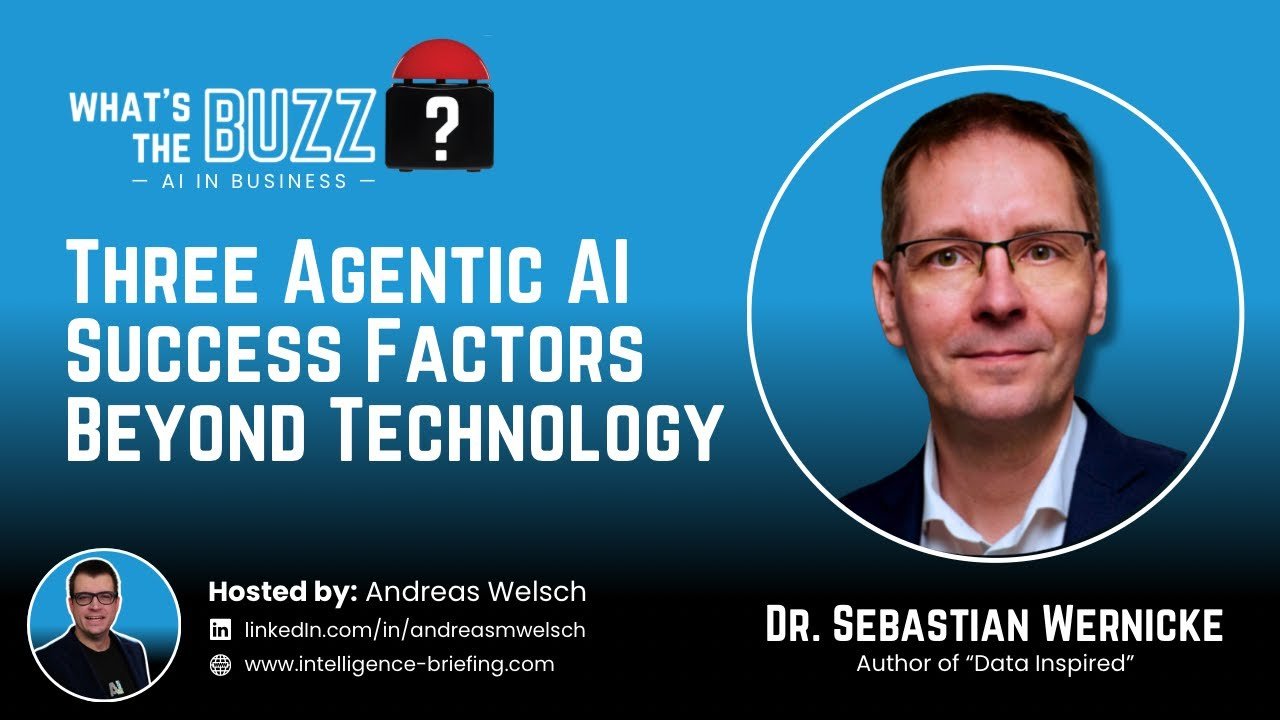
Guest: Sebastian Wernicke, Author of “Data Inspired”
Host: Andreas Welsch
Episode: What’s the BUZZ?, Season 5, Episode 15
Published: July 22, 2026
Episode Summary
What does agentic AI need beyond technology? Sebastian Wernicke, author of Data Inspired, joins host Andreas Welsch to name three success factors beyond technology: data, culture and strategy.
Wernicke said an AI agent needs the right information, set up the right way, and that enterprises will still be made of people who make the decisions. His third factor is strategy. In his book, a headline reads “data second”: consider the purpose first, because AI without a clear purpose usually fails.
Wernicke described Data Inspired as an addition to data driven, not a replacement. In his view, data driven is quickly becoming the baseline, while data inspired uses data to transform the organization and find the next breakthrough. He said perfect data changes nothing unless the culture is prepared to be wrong and change its mind.
Wernicke said his biggest revelation while writing the book was that an organization is a decision-making machine. Data, machine learning, AI and agentic AI are steps in how much of that decision making is handed to a machine. He recommended two first steps that can run in parallel: settle the purpose, and discuss culture and technology in the same room.
Key Takeaways
- Three factors beyond technology: data, culture and strategy. Wernicke said these are the soil agentic AI needs to grow. Without the right information set up the right way, an agent has nothing to work on.
- Strategy first, data second. Wernicke said that starting with “let’s do AI” and no idea why usually fails. Leaders should ask what threatens the business and what is hard, and he expects the answer in most cases to include AI and agentic AI.
- Data driven is the baseline, data inspired is the edge. Wernicke said every organization has access to the same dashboard and AI tools. Data inspired adds using data to transform the organization, drive innovation and act as a compass, not only a steering wheel.
- Culture decides whether data gets used. Wernicke said people given perfect data will dig in or dismiss what disagrees with them. A receptive culture means being prepared to be wrong and to change your mind, and failing in a risk-controlled way generates the most interesting data.
- An organization is a decision-making machine. Wernicke said AI and agentic AI are ways of handing decisions to an algorithm, from tightly controlled machine learning to handing over a goal. He noted that people tend to distrust machine learning they could verify and trust AI they cannot.
Timestamps
- 00:00:11 Teaser: three success factors for agentic AI beyond technology
- 00:00:46 Welcome and Sebastian Wernicke joins
- 00:01:26 Sebastian Wernicke introduces himself and Data Inspired
- 00:02:54 Icebreaker: if AI were a plant
- 00:05:04 Three success factors: data, culture and strategy
- 00:06:27 Data second: consider strategy and purpose first
- 00:08:04 Data driven versus data inspired
- 00:10:01 The missing component: using data to transform and innovate
- 00:12:02 Why perfect data is never enough
- 00:13:56 A failure culture and the data that failing generates
- 00:15:20 How leaders set the tone on innovation
- 00:16:05 Quarterly goals are not a strategy
- 00:18:05 What Wernicke learned while writing the book
- 00:18:48 An organization as a decision-making machine
- 00:21:44 Why people trust AI more than machine learning
- 00:24:01 The first steps toward becoming data inspired
- 00:27:23 Three key takeaways
- 00:28:59 Data Inspired and The HUMAN Agentic AI Edge as companion reads
About Sebastian Wernicke
Sebastian Wernicke is the author of Data Inspired. In the conversation he described himself as an extremely curious person who works in data and AI day to day, and said he is a partner at Oxera, a consultancy where he leads the data science and AI team.
Full Transcript
This is a lightly edited transcript.
Read the full transcript
Andreas Welsch: Halfway into 2026, agentic AI is still picking up speed. We’re adding new topics like agentic commerce and we’re talking more about governance. But today we’ll talk about the three success factors for agentic AI beyond technology. So join me for that one.
Andreas Welsch: Welcome back for another episode of What’s the BUZZ, where leaders share how they are turning AI hype into outcomes. Today we’ll talk about the top three success factors for agentic AI, beyond technology to be more precise, and I could not be more excited to welcome our guest to the show, Sebastian Wernicke. Hey Sebastian, thank you so much for joining.
Sebastian Wernicke: Hi Andreas, thank you for having me. Excited and looking forward to the conversation.
Andreas Welsch: Awesome. It’s been a couple months since we met in person earlier in the year when I was launching my book. I know you have a new one coming out. We’ll talk about that in a couple minutes, but maybe for those in the audience who don’t know you yet, can you introduce yourself real quick and share a little bit about what you do?
Sebastian Wernicke: Yeah, of course. So, I’m Sebastian. I always like to describe myself as an extremely curious person. I think that’s who I am. And so it’s no wonder that I work in data and AI day to day. I’m a partner at Oxera, a consultancy where I lead the data science and AI team. And now I’m also an author. We recently released the new book called Data Inspired, and as you know, as an author this is now becoming a second job that I have, I guess.
Andreas Welsch: Wonderful. Well, I’m so glad you’re spending your time with us, and I know you’ve been in the industry for a long time. You’ve also built quite a following on LinkedIn. Folks, if you’re not following Sebastian yet, head over there real quick and give him a follow. Lots of good information about data and AI that he posts there on a regular basis. And if you’re joining our stream just now, please drop a comment in the chat where you’re joining us from. I’m always curious to see how global our audience is. And Sebastian already held up his book. If you’re looking to learn how you bring AI into your organization and get people to use it well, consider picking up this one, The HUMAN Agentic AI Edge, which came out in February. Now, in good old fashion, we’ll kick it off with a little icebreaker. This one has been running for a long time. And
Sebastian Wernicke: Do I need to hit a buzzer button or anything?
Andreas Welsch: I will buzz you. It shows up here. But this is the one that I will press. So let’s see. If I press it, the wheels will start spinning and you’ll see the question here. If AI were a plant, what would it be? 60 seconds on the clock. Go.
Sebastian Wernicke: If it were a plant.
Andreas Welsch: What’s the first thing that comes to mind?
Sebastian Wernicke: Okay, so I’m going to offend my fellow biologists. I’m not going to use a plant, I’m going to use a fungus here. If AI were a fungus, I think it would be mycelium, which is the fungus that some people might know is growing inside the earth and connecting the trees and various organisms. AI is of course also this really big network of connections. So I think a fungus is more fitting here.
Andreas Welsch: Okay, I like that. Some people have said it’s a cactus. Others have other
Sebastian Wernicke: I like that.
Andreas Welsch: A little pointy spirit. But fungus, that’s a good one. It’s probably been there for a long time too, and it keeps on growing.
Sebastian Wernicke: Technically incorrect, as I said, but we’ll take it.
Andreas Welsch: Exactly. We’re not biologists here, at least few of us are. So now, how do I segue into our actual topic? For fungus to grow and plants to grow, we have some success factors. For agentic AI to work, we need them too, and it’s not just about the technology. We’ll talk about three. I know we spoke about this a little bit before we went live, but maybe you can share what you think are the three key success factors that you’re seeing, and then we’ll talk a little bit more about your book and what it means to be data inspired.
Sebastian Wernicke: I think the analogy is actually perfect, because for a plant to grow you need the right substrate. Not every plant will grow in every environment. And so for AI, and particularly agentic AI, there are three components that you need in your soil for it to grow and flourish. The first one is data, because even though it’s a very fancy technology, it’s all grounded in data. Unless you have the right information and you have it set up in the right way, there’s nothing that AI can actually work on. The second one is culture, because where are we using AI and agentic AI? It’s not in a vacuum. It’s not a pure technology topic. We are putting these technologies into enterprises. And even enterprises of the future, even if they are autonomous enterprises, will still be comprised of people operating the whole thing. They will still have people making the decisions. So we need the right culture within an organization for AI agents to actually unfold their full power and not, for example, just be used as a replacement for a process that should be replaced in its entirety anyway. And the third factor for me is strategy. I know this is a topic that can sound quite abstract to many people, but what I essentially mean is this: in the book I have a headline where I say data second. So consider strategy first, consider the purpose first. And with AI and agentic AI that’s become ever more true. If we just say let’s do AI and don’t have any idea what that means, why we’re doing it or what the purpose is, it usually fails.
Andreas Welsch: I like that. Data second. A couple weeks ago I was at an event and someone from municipal government was in attendance, and she said, “We’re AI last.” Everybody looked at her like, “What do you mean?” She said, “Well, we have so much catching up to do that while everybody talks about AI first, we’re actually on the other end of the spectrum.” So I have a lot of empathy for data second, because we need to think about what our strategy is to begin with.
Sebastian Wernicke: Yeah.
Andreas Welsch: Now, in February I think it was, we met near Philadelphia and I saw one of your talks about what it means to be data inspired. But obviously not everybody here in the audience has had a chance to see it or learn more about it. What is Data Inspired all about? I mean, we’ve seen so much about data. We’ve read so much about data. There’s been so much written about data. But Data Inspired, what is
Sebastian Wernicke: Why are we still talking about data even, right? Sometimes that amazes people. I think there are two things to mention here. The first one is that often when we talk about data we use the term data driven, and that term has been around for quite a while. We want to build data-driven companies, we want to make data-driven decisions. The thing I appreciate about that term is that it tells you very exactly where you’re trying to place data within the organization. You’re basically saying we have too many decisions where we don’t feel we have the facts right, where maybe gut feelings are prevailing. When somebody says we want to become a data-driven company, what they usually mean is we want to have more information and we want that information to guide us. We want it to help us make the right decisions, be faster, be more autonomous, be more automated. So there’s a lot of clarity in the term. And just to be clear, when I say data inspired, and I’ll explain in a second what I mean by that, I don’t mean to replace that. Data has that place. Data is very important for measuring, for transparency and ultimately for optimization. You just become a better and faster business if you add data to the business and make good use of it. But I also felt that this wasn’t enough in the end. Every organization is collecting more and more data. Most organizations are luckily becoming a bit better at least at organizing the data, even though that’s still a huge topic. And they all have access to the same tools to make use of data. They all have access to essentially the same dashboarding tools now, the same AI tools. So the question becomes: if you’re only striving to be data driven, how is that going to give you an edge? In my mind, data driven is very quickly becoming the baseline, because if you don’t use data to improve your business, you’re not going to be around for much longer. It has become an essential tool. So I was trying to look at what the missing component is. If data driven is a lot about optimization, then being data inspired is still about that, but it adds another component, which is: how can we use data to transform our organization? How can we use data to drive innovation? How can we use data to find the next breakthrough product idea? How can we use data not just as a steering wheel but more as a compass that shows us where the future of our company might lie? Data inspired is a term that was already around before, but I found it used in a way that was a bit wasteful of that word inspired. It was sort of used as in, we have data around and we might be a little inspired by it. And I thought, no, you need data to actually drive you towards the future. So I thought, let’s give that term another chance, put it on the book title, and hopefully we can have an inspired use for it.
Andreas Welsch: I think this part about the inspiration is so important. There are so many technical books and works that cover how you do the foundation. There are so many strategy books. But a lot of times we miss the part that you said: when we talk about data driven, we don’t talk about where we actually want to be, what the end state is, and what we can do with the data and the information we have available. And we know that your data is never as complete and as fresh and as clean as you would like it to be or as you need it to be. So what’s the inspiration?
Sebastian Wernicke: There are also some parts where we just have to spill a bit of truth and say, of course your data is never going to be perfect. And by the way, when you make an important decision, of course the data is not going to tell you precisely how you should decide. That’s just not how complex decisions work. And yet you’ve heard that sentence as well, where somebody will come and say, if only we get the right data to the right people at the right time, then suddenly magic things will happen. First of all, for many decisions that’s just impossible to do. And the other part is that there are two chapters in the book that I snuck in about psychology. It turns out that this whole right data to the right people at the right time is also an illusion, because it suggests that we’re operating on a data deficit and as soon as we get the right data we will make better decisions. Human psychology and the science behind it, for decades, have shown that this is not the case. You can give people perfect data, and unless they are psychologically prepared to use it, and in an organization that also means culturally prepared, nothing will happen. They will just dig in or dismiss the data that doesn’t agree with them. So this is why, besides having the right data, that culture element becomes so important. If you don’t have a receptive culture for data, and that essentially means being prepared to be wrong and to change your mind, you don’t stand a chance, even if you have the best data you could imagine.
Andreas Welsch: So that’s kind of why we’re saying beyond technology, right? The success factor beyond technology. It seems there’s a lot more of that human element again, and like you said, the leadership culture too. In some countries we talk about a failure culture, about being open and accepting that on the path to success you will encounter some hardships, some challenges, some failures, and they’re all part of the process of learning and getting better. But we also need to encourage this learning to happen. Otherwise we’re too afraid of risks, to the point that nobody’s willing to take them because there’s such a big stigma around taking risks and
Sebastian Wernicke: Potentially nothing. And the most interesting data comes from failing, of course, right? So if I want to generate interesting data, I need to be prepared to fail. I need to want to fail in a way. Of course in a risk-controlled environment, we’re not betting the company, but still I need to be willing to do that. Otherwise I’m just generating boring data that may allow stepwise changes but isn’t going to drive transformation in the end.
Andreas Welsch: Now, a lot of times that sounds so easy. Yes, we need to embrace more failure, we need to embrace risk taking, we need to embrace innovation. But then you get stuck in the day-to-day. You’re in the quarterly goals.
Sebastian Wernicke: Yes.
Andreas Welsch: You know, things that we do every time. You have some quarterly goals, you have some annual goals that you really want to hit or exceed, and you get dinged if you don’t, but you’ve taken the risks. What are you seeing there when it comes to culture? How can leaders really live and breathe that kind of change?
Sebastian Wernicke: I think leadership sets the tone for this, and this is a very important one. What I always like to joke about is that I hear too many leaders trying to achieve efficient innovation, in a way. We want innovation but we want to do it in a very secure way. That is not possible. And so ultimately, and this is where we come to the topic of strategy, what is the strategy driving all this? If your strategy is that we want to be efficient quarter by quarter, we want to hit our quarterly goals precisely for the next quarter, the next two quarters, three quarters, four quarters, that’s fine. By the way, that is not a strategy at all. Even by definition, that is not a strategy. But if you say that, then go ahead. We are of course realizing, or everybody’s realizing, that we are living in a time of rapid change, of complexity, of, if you will, megatrends. Supply chains becoming extremely brittle, an aging population, we need to see where our food comes from, we have climate change to deal with. All of these big topics will compel you over time to be innovative. And not just in the sense of let’s be innovative once and reinvent the company, but actually build companies in a way that they are innovative on a continuous basis, that they become resilient, that change is the new normal. Even though that’s a bit of a cliche, I realize that. But that is the way you need to build a company. So this innovation topic becomes very quickly strategic. And if you want to be innovative at speed and at scale, then all of the other topics we talk about, AI, agentic AI, data, become inevitable. But this is turning it around. It’s not saying, how can I add AI to my company as it is today? It’s saying, it’s a strategic imperative that we build around change and innovation, and the only way to achieve that at the speed and at the scale that we need is to embrace AI, agentic AI, data, all of these concepts.
Andreas Welsch: Let’s switch gears a little bit. I know that’s a question we didn’t talk about before. We had very little prep and we said let’s have a free-flowing conversation.
Sebastian Wernicke: We already had a buzzer, so let’s go for it.
Andreas Welsch: Yes. Something that just crossed my mind, because you talked a lot about culture, data and strategy: as an author, what is something that you learned in the process of writing the book? Because I’m sure it’s not a four-week project, anything but that. What was the one thing, maybe a big revelation, comparing where you started with where you ended up with the published book?
Sebastian Wernicke: Yeah. The book started out with many fragmented thoughts and also little frustrations. I always think there’s a bit of a not-so-noble way that I started writing the book, which was that whenever I got into an argument with a client or on a project, I said okay, I’m going to write that in a book one day so I can say, sorry, but it’s in the book, and I don’t have to have that argument anymore. But then as you continue writing, of course, you’re trying to find the red thread, what is keeping all of this together. I struggled with this for a while until I had lunch with a friend of mine who works in organizational psychology. After we had been discussing organizations and culture for a while, she said, well, ultimately what is an organization but a decision-making machine? This notion that it’s all about decision making was, I think, my biggest revelation, because that ties all of it together. Why are we using data? To make better decisions. That’s what it’s all about. If we don’t make better decisions, then we don’t need all that data, because it’s quite expensive. And when we talk about AI, what is AI? AI is something that we can hand decisions to, mostly in the way of a recommendation engine. Before that we had decision rules or machine learning. So it’s all stepwise: we have data to influence our own decisions. At some point we decide, let’s hand a bit of that over to the machine. With machine learning, it’s an algorithm that has learned what we care about, and we’ve been very precise about defining goals. With AI, suddenly that’s no longer the case. If we define AI in the sense of large language models, they are basically trained on whether the user likes what they’re saying. A very broad goal, which we should also be careful about. And with agentic AI, it’s of course the complete handover. We’re essentially saying, I’ll just tell you my goal and I’ll let the machine figure out everything. But decision making is what ties it all together. So I like to talk about the decision framework that an organization gives itself and operates in, because if you look at it from the lens of decision making, it becomes very clear what choices you have to make. What am I going to hand over to an algorithm? And if I do that, what is the nature of that algorithm? Is it something very controlled, or is it something where I’m happy to say, specify a general goal and hope for the best, fingers crossed? That became very clear through this, and that was my biggest revelation in the end. It’s a very useful framework to apply to this whole technology discussion, in my mind.
Andreas Welsch: That’s awesome. I love that. At the end of the day it’s about decision making. To your point, it’s about having the data to make a confident decision, whether or not the reality turns out to be right or wrong based on the decision you’ve taken, but having data, having facts to make a decision, and then making it quickly too. So to your point, now with agents, when we delegate more agency and more autonomy to these systems and components, how can they make decisions that are aligned with our values and aligned with the facts that represent reality?
Sebastian Wernicke: Yeah. And psychology becomes so interesting here, I find. I distinguish very clearly between machine learning and AI. The interesting thing is that machine learning is something where we control the decision environment quite tightly. The classic example is tens of thousands of cancer images, and the machine learning algorithm learns whether something is dangerous or benign. And the thing is that people intuitively don’t trust machine learning. There are studies where you can show people that, for example, a prediction algorithm is superior to the predictions that you are going to make. Then you ask people, I’m going to let you bet some money, are you going to make the choice or is the algorithm going to make that choice? They see the algorithm make a single mistake and they say, I’d rather do this myself, I don’t trust this thing. And now with AI it’s so ironic, because AI is trained in a much, much less controlled environment. We’re throwing all of the data at this huge thing, which is impossible to understand in its entirety, and we’re training it on the goal of whether I like what you say or not. And still, because of the interaction mode and because it can sound so natural, suddenly we trust this thing. So there’s machine learning, which statistically we should trust because we can prove it’s better than a human. Then there’s AI, where we can’t prove anything, but we say, let me tell you about my relationship, let me ask you for relationship advice, ask you for strategy advice, let’s hand the business over. It’s so ironic, I find.
Andreas Welsch: For sure. And to me that comes back to how we’ve learned to trust automation, and how automation has traditionally been deterministic. Every time I press the button, it switches the channel, if-else.
Sebastian Wernicke: Yes.
Andreas Welsch: Then we adapted more. I need to train my thermostat, for example, especially here in the US where Nest was a big thing, and it learns when I like it hot and cool and when I come and leave the house, things like that. To your point, we’re now delegating more and more to these systems. I’m curious, though, talking about Data Inspired: yes, there’s data as a foundation, but we also want to see where we want to go, and how data, culture and strategy fit into this. What’s the one thing, what’s the first step that any leader should take to become a more data inspired business or business unit?
Sebastian Wernicke: I would recommend two steps, and they can go in parallel. The first step is really that strategy discussion and finding the purpose, because without it you are entering a large transformation without having a reason to do so. It’s very important to understand how doing this is critical for the business, how becoming a company that permanently innovates with data is critical for the business. Unless you’ve discussed and answered that question, you can of course start the projects and the innovation, but we know from transformation projects, and there’s tons of research on that, that if you don’t have a clear purpose and don’t know where you’re going, these things fizzle out. Sometimes I say transformation is like climbing Mount Everest, but not with oxygen, with PowerPoint, and that is just very, very hard. So you need to know why you’re getting yourself into that.
Andreas Welsch: I love…
Sebastian Wernicke: Now the other part of that is to realize that the culture discussion and the technology discussion cannot happen in separate rooms, right? We cannot just sign the check and say let’s buy the tools, let’s buy the AI, which by the way you need to do. This is not anti-tool. This is not anti-technology. Of course you need the tech. But if you don’t supplement the tech with that culture discussion, asking how we want to make decisions in the future, how we are prepared to hand over decisions to algorithms that might or might not be trustworthy and where our intuition about trust might be different, you won’t get there. And by the way, the classic decision making with data isn’t going away, so you also need to discuss that, because people are usually quite bad at making good decisions even when presented with very good data. You need to initiate that as well. So the purpose part and how we tie culture and technology together are, I think, two essential stepping stones that will lead you towards that path of inspiration. I know it sounds a bit lofty, but when I was writing the book, sometimes I was just thinking, that company I’m describing is a company I would like to work for. So ultimately it is about building more inspiring companies that spark joy and energy.
Andreas Welsch: We certainly need more of those.
Sebastian Wernicke: Yeah.
Andreas Welsch: Right. Especially when we look at the headlines, things are pointing in the other direction of being less inspired, maybe inspired by cost savings, but not inspired by what we could do if we gave people access to this technology.
Sebastian Wernicke: And yet, isn’t that so ironic? These are all things that are so well described, because that in the end is the classic innovator’s dilemma, and it’s been described technology cycle after technology cycle. Now AI comes along, what do we do? We’re going into the innovator’s dilemma.
Andreas Welsch: Absolutely. Now Sebastian, we’re coming up to the end of the show, and I’m wondering if you can summarize the key three takeaways for our audience today. We had such a great conversation and touched on so many important points, but what are the key three things that the audience should take away?
Sebastian Wernicke: Yeah. If you’re excited about AI agents, I completely understand why you would be, but please do these three things. First, make sure that the data is right, because your AI agent will be using data and it needs that soil to grow in, and to grow in the right way. The second one is to make sure that you understand that AI agents are not just buying a technology. They’re all about changing your business. They’re about changing your organization, how it operates, how you make decisions, and ultimately your decision-making culture. So it’s a culture topic. And the third one is, don’t start by saying, I have a business, how do I now bolt on this technology of AI? You have to go one step deeper into the strategy discussion and really think about what’s threatening my business, what’s hard, what the challenges are and how I overcome them. And no worries, I think the solution in 99% of cases will be, we need to embrace AI, we need to embrace agentic AI, because otherwise we don’t stand a chance to survive what’s going to come.
Andreas Welsch: Right, perfect, thank you so much. And what’s the book again that people should read?
Sebastian Wernicke: Well, they should also buy and read your book, so definitely. But of course I’m also hoping they will go for Data Inspired as well. I love your book. I think it’s a very complementary read. This is the culture book in hiding. I think yours very much points out all the amazing possibilities that are out there and the way to go. So read them both. Read Data Inspired and read The HUMAN Agentic AI Edge, and then you’ll be doing well.
Andreas Welsch: Right. So some good summer reading for sure, by the lake, by the pool, wherever you are. Don’t forget that they’re also available digitally, and mine as an audiobook.
Sebastian Wernicke: Yeah, but send us pictures, you know? You love that as well, right? When you get these pictures of people in fantastic places, and they’re like, “Oh, I have the book with me.” Do it. We love them.
Andreas Welsch: That’s a great joy for me, seeing where it pops up all across the world and what people are saying. So yes, do share it with us, tag us on LinkedIn, follow us, and we’ll certainly respond. And
Sebastian Wernicke: As you can see, it makes our author’s heart beat super fast. It’s one of the greatest joys. If you’re wondering how to bring joy to an author, leave a rating somewhere where other people can see it and send those pictures. That’ll be perfect.
Andreas Welsch: Exactly. Wonderful. Sebastian, thank you so much for sharing your expertise with us. It was great learning from you how to become more data inspired and, most of all, what the three key success factors for agentic AI beyond technology are.
Sebastian Wernicke: What a joy. Thank you so much for this conversation.
Andreas Welsch: Awesome. Thanks, folks in the audience. See you next time for another episode of What’s the BUZZ. Bye-bye.
Listen and Subscribe
- Watch on YouTube
- Listen on Buzzsprout (show page)
- Listen on Apple Podcasts (show page)
- Listen on Spotify (show page)
Related Reading
- Agentic AI for Enterprise Leaders
- Agentic AI Adoption Guide for Executives: Where to Start
- Why AI Strategy Should Start With Business Goals
- AI Adoption in Marketing: Guardrails, Culture, Tools
- How to Bring AI Into the Business Without the Hype
- The HUMAN Agentic AI Edge by Andreas Welsch
Frequently Asked Questions
What are the three success factors for agentic AI beyond technology?
Wernicke named data, culture and strategy. Data is what an agent works on, culture determines whether people use agents and data well, and strategy sets the purpose. He summed it up as the soil an AI agent needs to grow in.
What does data inspired mean?
Wernicke said data driven is about optimization and is quickly becoming the baseline. Data inspired adds using data to transform the organization, drive innovation and find the next breakthrough product idea. He described data as a compass that shows where the future of a company might lie, not only a steering wheel.
Why does culture matter more than perfect data?
Wernicke said human psychology research shows that people given perfect data will dig in or dismiss data that disagrees with them unless they are prepared to use it. A receptive culture means being prepared to be wrong and to change your mind.
What is the first step to becoming a more data inspired organization?
Wernicke recommended two steps that can run in parallel. First, hold the strategy discussion and find the purpose, because transformation without a reason fizzles out. Second, discuss culture and technology together, including how decisions will be made and handed to algorithms.
How does decision making connect data, AI and agentic AI?
Wernicke said his biggest revelation was that an organization is a decision-making machine. Data informs human decisions, machine learning and AI take over parts of them, and agentic AI is a complete handover of a goal. Seen this way, the choice is what to hand to an algorithm and how controlled that algorithm should be.