

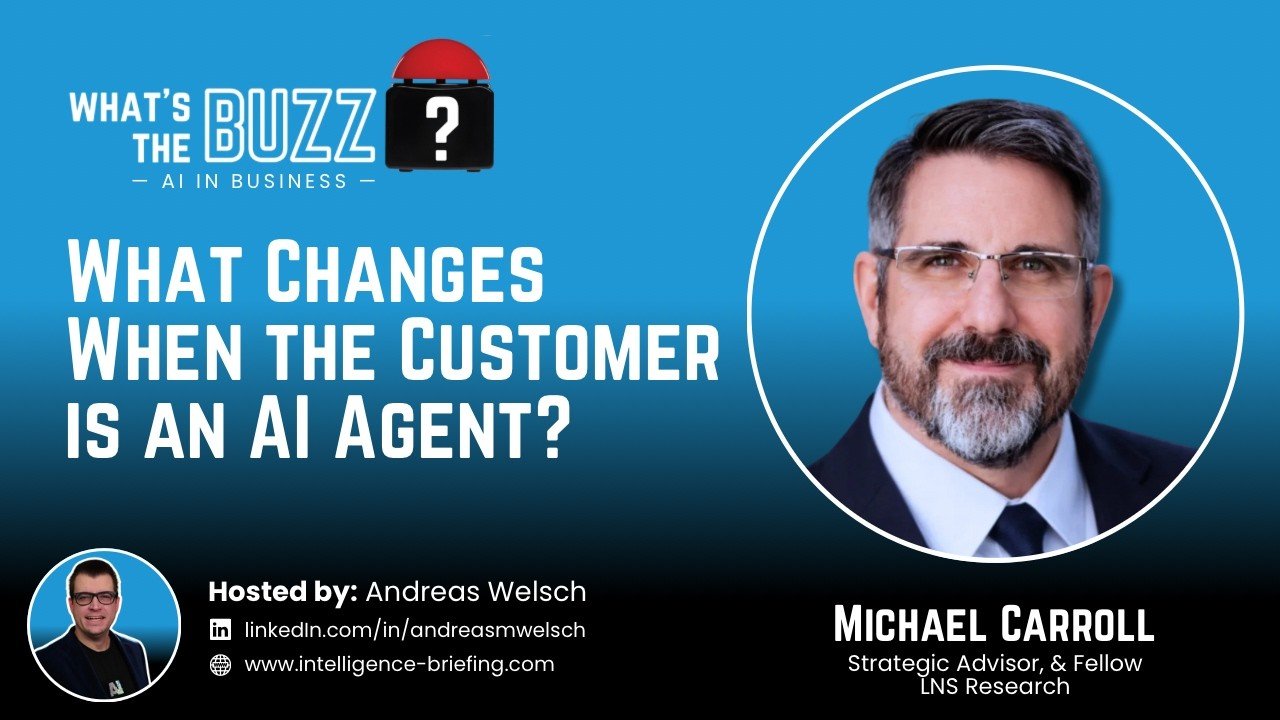
Guest: Michael Carroll, Strategic Advisor & Fellow at LNS Research
Host: Andreas Welsch
Episode: What’s the BUZZ?, Season 5, Episode 17
Published: August 19, 2026
Episode Summary
When the customer is an AI agent, commerce moves from clicks to intent. Michael Carroll, Strategic Advisor and Fellow at LNS Research, joins host Andreas Welsch to explain what changes.
Carroll said the web was built around clicks, while agents are built around intent. Businesses have to deal with an agent that negotiates on the buyer’s behalf.
Carroll expects ads to survive but change target. Ads will try to bias what a person tells their agent to prefer.
Carroll argues that trust depends on an architecture of permission and a causal chain of reasoning. Carroll’s line to write down: “If you can’t trust it, it won’t happen.”
Key Takeaways
- The web was built for clicks, agents are built for intent. Carroll described a move from a click-based economy to one built around what a person wants. The agent does the orchestration. The person focuses on why they want what they want.
- Ads do not disappear, they change target. Carroll expects people to turn to their agent when an ad catches their interest. Ads will therefore try to bias what the person tells the agent to prefer.
- Intermediation goes autonomous, mediation needs permission. Carroll said AI will be good at the translation and transfer of information, because rules-based state changes are largely reversible. Anything that requires approval needs defensibility. Responsibility then transfers to a person, and a machine does not bear it.
- Causal reasoning is the trust architecture, not explainability. Carroll said a causal chain of reasoning makes decisions auditable and defensible. In Carroll’s words: “Explainable AI is an abomination. It’s an invitation to re-litigation.”
- Whoever closes the triad holds the influence. Carroll named three parts: the reasoning agent at the edge, the platform of influence and the architecture of trust. Carroll agreed with Andreas Welsch that companies with existing reach, such as Google, are likely contenders.
- The collapse of distance points back at the individual. Carroll cited Stanley Milgram’s six degrees of separation and LinkedIn’s three. Agents take it to one degree between a person and everything else, Carroll said, if the person chooses to engage.
Timestamps
- 00:00:41 Welcome and Michael Carroll joins
- 00:02:02 Michael Carroll introduces himself
- 00:03:15 Amazon, Perplexity and agentic browsers
- 00:04:35 Can we trust an agent that shops on our behalf?
- 00:05:02 Ubiquitous connectivity and reasoning at the edge
- 00:06:40 An architecture for trust and permission
- 00:07:37 Fairness and pricing by ability to pay
- 00:09:19 From a click-based economy to one built around what you want
- 00:11:00 Buying a car with an agent
- 00:12:28 Making your business visible to agents
- 00:14:17 From single agents to agents that transact with vendors
- 00:15:27 Intermediation, mediation and responsibility
- 00:16:59 Causal reasoning, auditability and defensibility
- 00:19:02 If you cannot trust it, it will not happen
- 00:22:21 Do ads go away? Ads that inform your agent
- 00:24:32 Who controls the reasoning agents and the platform
- 00:26:45 Key takeaways
About Michael Carroll
Michael Carroll is Strategic Advisor and Fellow at LNS Research. Carroll also does AI research on how the technology develops and how people can begin to trust it. The focus is on what AI should do for us, not only what it can do.
Full Transcript
This is a lightly edited transcript.
Read the full transcript
Andreas Welsch: There’s been a lot of talk about AI agents and especially agentic commerce lately. But what actually changes when your customer is an AI agent and no longer human? Today we’ll explore that with my guest. So let’s jump right in.
Andreas Welsch: Wonderful. Welcome back to another episode of What’s the Buzz where leaders share how they have turned hype into outcome. Today we’ll talk about what actually changes when your customer is no longer human but actually an AI agent. And who better to talk to about it than someone who’s been exploring this topic for quite a bit. Michael Carroll. Thank you so much for joining.
Michael Carroll: Hey, it’s fabulous to be here. I’ve really been looking forward to this. This has been kind of top of mind for me for quite some time. I think the world’s been headed this way. We’ve been experiencing a little bit of it. It’s going to transform all of our lives in ways we just can’t imagine. I think this conversation is going to help us at least start to ask better questions. Does that make sense?
Andreas Welsch: Absolutely. I’m looking so forward to it. We met in person in Washington, D.C. a couple of weeks ago at an event, and we just didn’t have enough time to have that conversation. But it was so insightful already that I said, why don’t we spend some time on the show and explore it for the audience’s benefit as well. So I’m so thankful for you making the time to be with us today.
Michael Carroll: I’m looking forward to the conversation. We’ll see where this goes. Our initial conversation was like, “Wow, we’ve got to do more of this.”
Andreas Welsch: Yes, exactly. Now Michael, not everyone in the audience might know you yet. So I thought it might be a good idea to introduce yourself real quick, who you are and what you do.
Michael Carroll: Yeah, so I’m Michael Carroll. I’ve been around a long time. That’s why I’ve got gray hair, gray beard. And so I’m actually retired, but as a lot of people in my situation can learn, it can be quite liberating. So the thing about retirement is that you get to choose the things you want to go do. And in this case, I get to go hang out at national events and talk about the things that we think are going to matter and shape the future, right? This is one of those things where I think the right perspective and better questions help shape the future. So I get to work on advisory boards and do AI research. And in that AI research, we push the frontiers of how this technology develops and how we can begin to trust this technology in a way that’s different than what we hear in the hype, right? So we make it more trustable, more understandable for people, and maybe improve our perspective on what it not only can do, but more importantly what it should do for us.
Andreas Welsch: What it should do, I think that’s the key point here. I remember back in November of ’25, I was reading this news article that Perplexity was being sued by Amazon because Perplexity had just come out with its agentic AI browser. And Amazon said, hey, we’re actually quite opposed to this, because if a browser acts on behalf of a user, if an AI system or agent browses our catalog and recommends products, that means we’re actually not making as much ad revenue, which was quite interesting to see, that Amazon feels this business model is being threatened. Obviously a big revenue source for them. And then I think it was in March of ’26, the court actually said yes, Amazon, you’re right, and companies like Perplexity and others are not allowed to use their agentic browsers to browse or scrape your websites exactly for that reason. But for me that triggered the question of what changes, because companies like Amazon obviously are making a lot of money from their ads. I have two books on Amazon, and certainly there are ads that I place so more people see them. So I’m as much of a customer as I am someone who’s being affected by that change. Then there’s generative engine optimization, answer engine optimization, there are ads in ChatGPT, and all of that. So can we actually trust that an agent that acts on our behalf, that shops on our behalf, finds the objectively most valuable, most relevant product for us?
Michael Carroll: I think the answer is maybe, right? But first I think we need to say to ourselves what’s actually going on, right? And in the world there’s two things that are coming together, and in the middle we’ve got to sort out how we want that trust to develop. On one side, you have this ubiquitous connectivity that is enabling these degrees of separation of humanity, right? And Stanley Milgram did a big study back in the ’60s that said, in the current paradigm, people were six degrees of separation. And we all remember that. And then along comes social media and technology, and now if you believe LinkedIn it’s three, and if you believe other studies it’s 3.4, if you want to be precise about it. And so ubiquitous connectivity that’s improving all the time is one side of it. And then at the other side of it, the edge is starting to become more and more powerful. And I mean process compute at the edge, to the point that now whatever shape you wanted to take, reasoning is going to become a standard at the edge. And what I mean by reasoning is when you talk about the agentic behavior, right? And agents are things that act on your behalf to try and shape outcomes for you that use the ubiquitous connectivity. What you’re looking at is collapsing the distance between you, everybody else, and everything else, from three to one. Right? And the minute that happens, the question you have to ask yourself is, if that reasoning is doing it, now it has to operate through an architecture that enables trust and permission. And so it’s that architecture in the middle that gives you the enablement, right, to access the connectivity and then to engage on your behalf. So what’s required? Well, now you have to have some kind of trust and some kind of trace of trust and something that says my reasoning and my agent is legitimate, right? And it’s defensible, right? So now I have to have some way of saying you can trust me without me having to re-litigate my existence every time I want to go do something. So that whole architecture has to be built. It also could give us some strife in society, right? Because you could segregate society relative to their ability to pay, relative to other standards that we may not fully appreciate in society, right? If we don’t get that architecture right.
Andreas Welsch: Right. And I remember not too long ago I was seeing some chatter about airfare, for example. If you live in a certain zip code or you make certain transactions of certain amounts, we assume that you’re more affluent than others. If you’re more affluent, that means you can pay more for the same ticket that somebody else pays less for. Now, is this fair? Is this just? That’s one of the questions that comes to mind. The other part for me is, hey, the World Wide Web is what, 25, 30 years old in its current form, certainly much older than that if you think of ARPANET and others, but you started to see companies optimizing their ranking in search engines like Google. You started seeing companies place ads to influence humans. Now we have agents. We have on one hand ads in tools like ChatGPT. And I think it’s quite interesting to see and to understand how that is going to develop. Why are you seeing certain ads? Is it because you’re getting certain responses to your questions in the chat? And are these responses already influenced by the ad that you’re going to see? And let’s assume that’s the case. How can you piggyback onto that as a brand to say, well, if somebody asks about these questions, show them our ad, recommend that this is the best product?
Michael Carroll: I think it’s going to be the Wild West for a while. Right? Because figuring that out. So if you think about it for a second, we’re going from this architecture of the web, as you talk about, that was a click-based architecture and economy, to an architecture that’s built around what do I want? Right? And the reasoning engines are all going to be the collapse of everybody. So the way personal agency works is you spend most of your life trying to orchestrate to get what you want, and you do most of the effort for the orchestration. What the reasoning at the edge will do is it will do all the orchestration for you based on what you want. And so it will go out and arrange all the orchestration relative to what you want, and you just have to determine what you want. Which now means all the effort for you is in determining why you want what you want. Right? And so now that’s basically all the effort for you, and it does all the orchestration through the architecture using the ubiquitous connectivity. Right? How do you build a non-click-based economy, right, that allows that to suffice when basically it does all the optimization for you? Right? So I’ll give you an example, right? This is a real recent personal example for me. My wife decided it was time for a new automobile. And because you and I are really proficient AI users, I built tools that went out and secured quotes through internet commerce. So I built these things that went out and did it, got responses back through the internet commerce engines of the dealerships, in the forms that they were needed to reply in, evaluated all of them relative and optimized every one of them, and pulled it down to the best option and negotiated the deal for me. And I didn’t have to do anything, right?
Andreas Welsch: Right. They have agentic commerce, right? Good example.
Michael Carroll: And it is, and it was a great example. And it found all the best deals, all the best discounts, all that stuff for me, right? Just with a little bit of guidance on my end.
Andreas Welsch: Right. It’s phenomenal. So a couple months ago I spent some time working with Claude Code and some agents there to optimize my website. And I found some repositories on GitHub where users put up these agents. And they were so good that they gave me recommendations for how I can improve the website. Not just the copy, but the structure, add schema so agents can process it more easily, add things like llms.txt as a file of the most important information you want to see. Optimize it in little chunks and provide answers to certain questions. And similarly, right, to your scenario, I think that’s right now something that many organizations either are already thinking about, and if they’re not, they should be thinking about: how do I make my business more visible and accessible to agents on the internet so that they can transact with me, in that car dealership example.
Michael Carroll: I think that’s what all commerce is going to have to learn, right? Is that ads, in the way that we used to think about things, aren’t what they were, right? And that commerce is going to be more engaging in the way that how do I deal with an agent that’s doing the negotiation work for you, and that’s going to be a different kind of world, because all of us are going to be optimized through the agent itself doing the mediation, the intermediation work, and that’s going to be different for all of us and the optimization.
Andreas Welsch: Look, for about the last two years I’ve had this slide in my keynotes and in workshops where I said this is the progression we’re going through. We’re starting with single agents, then we have two or three agents, then we have agents that are part of a business function, and then at some point we’ll have agents that transact on your or your company’s behalf with your vendors. And while this is one example from our consumer lives, the same scenario obviously happens in B2B too, and is already happening to some extent. So when you have two agents, vendor and customer, transacting with each other, exchanging information, finding information, I think to your point earlier, trust becomes a big factor. To what level and to what degree are they authorized to transact with each other? Is this a repeat order? Is this something new? What information are they basing it on? Is it aligned with our contracts? Whose interest does the agent represent and have in mind? Can they be swayed? Things like that.
Michael Carroll: So I think that’s a worthy discussion, right? So if you think about organizations for a second, right? Organizations are largely built for two things, right? Intermediation, which is basically the translation and transfer of information, and mediation, which is the transformation of things from information or things from one state to the other, right? And when you look at that transformation piece, and that permission to transform something from one state to another, the intermediation part, AI is going to be really good at doing that, because the rules-based state stuff is largely reversible. Right? And so I think we’re going to see largely that become autonomous in companies. So whether it’s, if you’re familiar with the Purdue stack, right, you’re going to see a lot of that stuff. So the categories that exist to support the Purdue stack will probably become somewhat disrupted, but the functionality is going to stay for many of those components. But when you look at the mediation piece, that transformation part of things, anything that requires some type of approval or permission, so if you’re going to wear the responsibility of it, you’re going to need some type of defensibility, because that responsibility transfers to you. A machine is never going to bear the responsibility of it. So it has to have a causal chain of reasoning. Explainable AI is an abomination. It’s an invitation to re-litigation that we already have way too many alignment meetings to litigate what it is we think we meant, right, when we agreed to do something. And so causal chain of reasoning is why causal exists in the first place. Right? And I think having that as a part of what trust means, so it’s auditable, it’s defensible, it’s legitimacy, is a part of what it would mean for the transformation of one thing, whether it’s information to some other type of information or change of state, is part of what this architecture will have to have.
Andreas Welsch: But it sounds like we’re really just at the very beginning of all of this, where we are figuring out what can we use these agents for? I mean, many of us in the industry are exploring, and at a minimum on a personal level, what can these agents do? How do we build them? What are some of the pitfalls? Larger organizations are not just experimenting but are rolling this out. I’ve seen some good examples in financial services and in business functions like customer service and so on. But to your point, I think this next part is really about building this trust architecture, having also a record of what was done by whom, human or agent, at what point in time, based on what information, so you can go back and actually trace and say, okay, this is what happened and why it happened. Which hasn’t always been that easy, thinking back even a couple years ago with machine learning and looking for things like SHAP or some of the explainable AI methods. So early, but we know where this needs to go if something like agentic commerce is to take off and is to expand from consumer into B2B as well.
Michael Carroll: If you can’t trust it, it won’t happen. Right? I mean, I think everybody would be in agreement that if you can’t trust it, it won’t happen. And if you go back to our experiences with LLMs, right, for those of us that were early into it, we didn’t go very far and we went, “Wait a minute, right? This is cool, but we better be really, really good at this.” And most of them got really good at it fast.
Andreas Welsch: Right. To some extent, I think that’s still the question that needs to be solved next. How do we trust these systems to act reliably and repeatedly? So we know that we can give them more autonomy. The fact that they can do it, yeah, sure. I think that the technical capabilities are there. But does it work every time? What happens if it doesn’t? How do you become aware of it? Can you jump in? Does another agent jump in? And to your point, I think those are the architectural decisions that need to be made.
Michael Carroll: Yeah, so when you hear me talk about causal, causal is an architecture, right? It’s not anything else other than a reasoning architecture. And so Pearl basically laid the foundation, a guy named Judea Pearl laid the foundation of it. And then it’s the application of how you apply thinking to something. So that gets you to the trust part of it. But a lot of people would say, well, that means it’s deterministic. Causal is not deterministic, because it’s actually agentic in nature, right? It’s the same thing that people do to create agency, and that’s what it’s based on, the human agency model. It means that I understand what’s true about the world around me. I understand what I can do to make things true, and then that’s how I build a hypothesis that if I do this, what if, right? And then I have the ability to understand the actions I took relative to the evidence of the outcome, and then I learn from that evidence and I iterate forward. That’s how I shape outcomes for the future. That’s causal, but it’s not deterministic.
Andreas Welsch: So what do you think, where is this going? Again, I’m coming back to the ads that we’re seeing. You search for something on the web, maybe you still use Google to do that, and shortly after, ads start popping up for the same or similar products. So you might take an action because you see or you keep seeing these ads. I’ve been listening to Spotify lately, I keep getting the same ads. And yeah, I know, but I’m not taking action. So how is that changing with agents, and how do you know that an agent acted on verifiable, trusted information or because somebody convinced them that that’s the best option for them?
Michael Carroll: I really don’t think ads go away, right? I think you’ll still see ads show up on TV. I think you’ll still see them show up on the phone. But if an ad piques your interest, I think what’ll happen is that, because people still like to watch YouTube, people still like to watch TV, I still think there’s room for ads to show up. But what I think will happen is that people will turn to their agent and say, “I’m interested in this. Is this the best option for me?” And I think the agent will evaluate that. Now, they may say that’s their preference. And what the ads will likely do is they will actually try and bias you to inform your agent that that’s your preference, more or less. And I think you’ll probably see that become more of a tone in the ad, to get you to use your agent to inform preference. Right? Likely, that’s what will become true.
Andreas Welsch: That’s an interesting angle. So far I’ve been thinking about it as vendors trying to make it into Perplexity’s recommendations, right? Or a ranking, or getting into OpenAI’s ranking. So whenever you ask a question, that’s your ad that’s being shown. And that’s the level of influence. Plus, I feel a lot of ads that we listen to or that we see, they are geared towards triggering some kind of emotional reaction. There’s a need, there’s a paucity or an absence of something that you’re feeling, or that you didn’t know you were feeling, but now after watching it you are craving ice cream or fast food or you see this new car or what have you. But there’s usually some emotional component that vendors want you to act upon. And right now, with agents, that emotional component goes away. It’s in theory factual and objective. But what are the ways in which your agent will be influenced to take an action?
Michael Carroll: So let’s play that out for a second, right? Who’s going to build the reasoning agents at the edge, right? And then who’s going to have the greatest amount of influence over you? So today we have this commerce engine, whether it’s Google or Amazon or whatever, right? And then the reasoning agents at the edge. Who’s going to have the greatest amount of influence over you that basically connects the ad space, whatever platform you’re watching it on, and then that ties to the reasoning agent, and then the last closure loop would be, not probably the ubiquitous connectivity, it’s the architecture of trust. And so whoever closes the triad of my ability to influence the reasoning agent, right, and the platform of influence, which is the optics that you’re watching things through, the media influence, right, and that architecture of trust that we talked about. If you can close that triad, now you’ve got something that’s fairly controllable, right? Who has the power to do that? That’s a good question.
Andreas Welsch: I think the ones that have been called dead, the ones that have been doing it for a long time. So the likes of Google, right, for example. I think Google is not dead.
Michael Carroll: Oh no, no way. No way, shape or form. And I think if you’ve got the reach to do it too, right? I think that’s likely.
Andreas Welsch: Yeah. So then it becomes more of an evolution of how to advertise, search and influence in the search engine, right? So fascinating. Michael, we’ve covered a lot of ground over the last 27 minutes of what changes when your customer all of a sudden is an agent. I was wondering if there are any key takeaways, maybe two or three, that you’d like to take the audience away with from our conversation today before we wrap up.
Michael Carroll: I think the major key takeaway is this collapse of distance between people and things, right? The reality of our lives is that this confluence of technology is really pointing back to people, right? And so all the confluence, whether it’s biomedical, whatever, everything’s kind of pointing back to people. AI is actually pointing back to people, right? And so it’s going to reduce the separation. It’s not pulling people apart. It’s actually pulling people back closer to everything in your life, right? And it’s separating you by one degree from everything and everybody else, right, if you choose for it to be. And so you’ve got to make this choice to be more engaged, because these tools are massively powerful. And I think the ability to touch everybody else on the planet that’s connected to this, everything else on the planet that’s connected to this, all the biomedical that’s going to be connected to this, it is wonderfully exciting. But everything’s pointing back at the individual. And as it should be.
Andreas Welsch: So that means I need to update my phrase, right? And my knowledge. It’s not the six degrees of Kevin Bacon, but the one degree.
Michael Carroll: It’s the one degree. Yeah, it’s liberating.
Andreas Welsch: Yes, for sure, and super exciting, especially if you get hands-on and you explore how this works and think about where this might go eventually.
Michael Carroll: Will there be any downtime for us, because you and I work more than we ever have now, even though it was said AI would reduce the need for it. It surely hasn’t.
Andreas Welsch: So, to me that’s where the human component comes in to say, hey, I need a break, and I want to take a break, and the world is still turning when I come back to it.
Michael Carroll: Yes, it is.
Andreas Welsch: So, wonderful. Michael, it’s been a pleasure having you on the show. Thank you for sharing your expertise with us, and I really appreciate this unscripted format, continuing our conversation that started a couple weeks ago in Washington.
Michael Carroll: This has been fabulous. I thank you so very much.
Andreas Welsch: Awesome. Thanks, folks. For those of you in the audience, looking forward to seeing you for the next episode of What’s the Buzz. Bye-bye, and thanks again, Michael.
Michael Carroll: Thank you.
Listen and Subscribe
- Watch on YouTube
- Listen on Buzzsprout (show page)
- Listen on Apple Podcasts (show page)
- Listen on Spotify (show page)
Related Reading
- Agentic AI in CX: Preparing for Agentic Commerce
- Agentic AI Security: Five Layers and Agent Commerce
- Agentic Commerce Infrastructure: 4 Questions for CX Leaders
- Agentic AI for Enterprise Leaders
- The HUMAN Agentic AI Edge by Andreas Welsch
- Always-On Agents by Andreas Welsch (forthcoming, Early 2027)
Frequently Asked Questions
What changes when your customer is an AI agent?
The business has to deal with an agent that negotiates on the buyer’s behalf. Carroll said commerce moves from a click-based architecture to one built around what a person wants. The agent does the orchestration. The person decides what they want.
Will advertising still matter when agents do the shopping?
Yes, but ads change target. Carroll does not think ads go away. Carroll expects people to ask their agent whether an ad’s product is the best option. Ads will try to bias what the person tells the agent they prefer.
How can a business trust an agent that acts for a customer?
Trust requires an architecture of trust and permission. Carroll said that architecture needs a causal chain of reasoning that is auditable and defensible. Host Andreas Welsch added that organizations need a record. It shows what was done by whom, human or agent, based on what information. Carroll summed it up: if you can’t trust it, it won’t happen.
What is the difference between intermediation and mediation?
Intermediation is the translation and transfer of information. Mediation is the transformation of something from one state to another. Carroll expects AI to take over intermediation, because rules-based state changes are largely reversible. Anything that needs approval or permission needs defensibility.
Who holds the influence over AI shopping agents?
Influence belongs to whoever closes a triad, Carroll said. The triad is the reasoning agent at the edge, the platform of influence and the architecture of trust. Andreas Welsch suggested Google is not dead. Carroll agreed that companies with the reach to do it are likely contenders.