

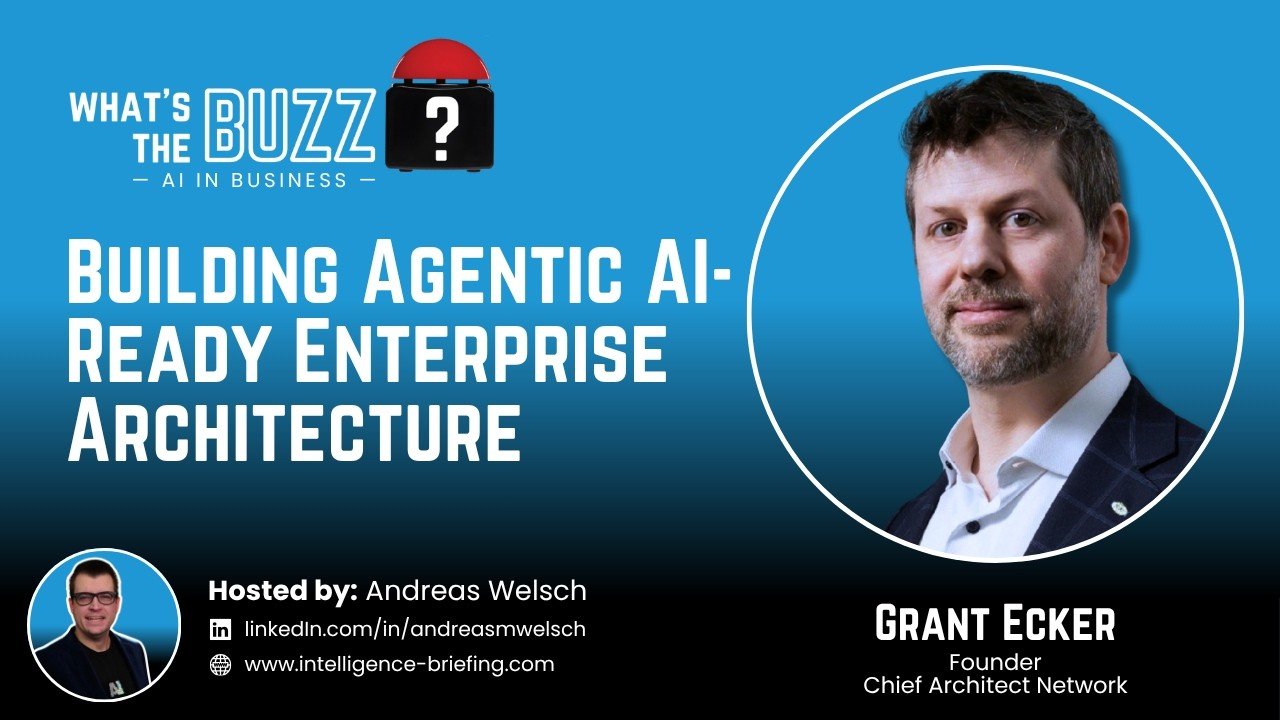
Guest: Grant Ecker, Chief Architect, Ecolab
Host: Andreas Welsch
Episode: What’s the BUZZ?, Season 5, Episode 16
Published: August 5, 2026
Episode Summary
Enterprise architecture has to plan by business capability instead of adding agentic AI on top of the existing stack. Grant Ecker is the founder of the Chief Architect Network.
Ecker joins host Andreas Welsch to answer what enterprise architecture has to do when agents transact on behalf of customers.
Ecker confirmed that, in Ecker’s experience, organizations are sprinkling agentic AI on top of an existing stack. That works for low-hanging use cases. It assumes the business will keep operating as it always has.
Ecker argues for capability-based planning, which maps strategy to the capabilities a business has to be great at. Architects should become pie-shaped by adding business depth to their technical depth.
Ecker closes with advice to learn from peers in non-competing industries. Published articles trail what is proven by six to nine months.
Key Takeaways
- AI adoption often starts by sprinkling it on the existing stack. In Ecker’s experience, it begins with out-of-the-box tools on specific use cases. The low-hanging fruit runs out quickly. The approach assumes the business will keep operating as it always has.
- Plan by capability. Ecker said capability-based planning is the answer. Decompose the strategy into what the business has to be great at and find the gaps. Across all strategies, build a heat map of the biggest opportunities for transformation.
- If it is fixed and in the middle of transformation, break it. Ecker offered this as a twist on “if it ain’t broke, don’t fix it.” The twist takes the diligence of a capability map. Focus on capabilities that tie to more than one strategy area.
- Overestimate the near term, underestimate the long term. Ecker said plugging in an agent will not fix everything. Once an organization codifies its logic into a reasoning engine, much of it can pivot and operate without human intervention.
- Earn the seat at the strategy table. Ecker said the pace of AI change makes architects more relevant. Trust inside IT is what enables trust with the business. Ecker described becoming pie-shaped, adding business depth to the T-shape.
- Watch the token bills. Ecker said AI FinOps is a hot topic in the Chief Architect Network. Put meters on every proverbial house so the bill goes to the right department. Forecast costs to avoid sticker shock.
- Learn from peers. Ecker recommended a trusted contact in a non-competing industry. By the time something is published, it has been out there for six to nine months.
Timestamps
- 00:00:57 Welcome and Grant Ecker joins
- 00:01:55 Grant Ecker introduces himself and the Chief Architect Network
- 00:04:35 Sprinkling agentic AI on a legacy stack
- 00:06:08 Why sprinkling AI runs out of easy wins
- 00:07:16 Capability-based planning and business architecture
- 00:08:19 Getting architects a seat at the table
- 00:10:48 Earning trust with IT and the business
- 00:11:32 Pie-shaped people: broadening the T-shape
- 00:12:57 Reconciling legacy systems with new agent technology
- 00:15:10 Overestimating the near term, underestimating the long term
- 00:17:04 The director of electricity and chief AI officers
- 00:18:33 Centralize first, then federate: the innovation funnel
- 00:19:40 The US AI Congress and upskilling
- 00:21:09 AI reference architectures and AI FinOps
- 00:23:26 Budgets and token pricing
- 00:23:53 Learn from peers in communities
- 00:26:08 The Chief Architect Network and how to join
- 00:26:53 People are the keys to the future
- 00:28:03 Closing thoughts: bring people along
About Grant Ecker
Grant Ecker is the founder of the Chief Architect Network. On the show, Ecker said the role is about 18 months old. Before that, Ecker was Global Chief Architect at Danaher and held the same role at Walgreens Boots Alliance and Medtronic.
Ecker also helped build the architecture practices at Lowe’s Home Improvement and General Mills. Ecker created the Chief Architect Network. Ecker described it as a Fortune 500 collaborative of about 682 industry architecture executives and an all-volunteer 501(c)(3) nonprofit.
Full Transcript
This is a lightly edited transcript.
Read the full transcript
Andreas Welsch: So, the reality is you’re likely in a business that’s grown over time, and so has its IT infrastructure and enterprise architecture. But what do you do now when you are supposed to bring agents into your business, when agents transact on behalf of your customers with your business? And how does all of that patchwork actually work together? Isn’t agentic AI just another layer on top? Today, we’ll go deep on this topic with my guest. So, stick around for this one.
Andreas Welsch: Hey, welcome back for another episode of What’s the Buzz where leaders share how they have turned hype into outcome. Today, I’ve invited a personal friend of mine to join the show and share a little bit more about what it actually takes to get your enterprise architecture and enterprise architecture organization ready for agentic AI. So, Grant Ecker, thank you so much for joining.
Grant Ecker: Great to be here. Excited about the conversation. It’s a really timely topic.
Andreas Welsch: Absolutely. I can’t believe we actually met twice already in person this year, in February and then in May, so we said, hey, we actually need to make this happen and get on the show and talk about this more for the benefit of the audience.
Grant Ecker: Yeah, it’s been an awesome year, and actually there’s been a lot of great conversations evolving. Isn’t it interesting how much things have changed from when we first met in February to just a few months later?
Andreas Welsch: Oh, yeah, you bet. It seems like there’s never a dull moment in the industry, and whether it’s vendors or companies adopting the technology, you know, whatever keeps the world going round. But not everybody knows you as well as we know each other. So I thought maybe you can introduce yourself real quick for the audience, who you are and what you do.
Grant Ecker: Absolutely. So, my name’s Grant Ecker. I’m the Chief Architect at Ecolab. I’ve been here about 18 months. Before Ecolab, I was the Global Chief Architect at Danaher and had the exact same role at Walgreens Boots Alliance and Medtronic prior to that. I also helped build the architecture practices at Lowe’s Home Improvement and at General Mills early in my career. What I’m most known for is creating this fun thing that Andreas and I are part of called the Chief Architect Network. It has this little cool cloud logo. So, what that is is a Fortune 500 collaborative of industry architecture executives. We have about 682 of us internationally and we come together to share outcomes, best practices, grow as leaders. It’s a 501(c)(3) nonprofit and an entirely volunteer organization. So, what’s really fun about it is it gives us, Andreas and I, a point of perspective to talk about things a little bit bigger than we might see in our own circles.
Andreas Welsch: Absolutely. And I think that is so critical at this moment in time when we’re inundated with news and breaking news and you should be doing this and you should be doing that. Keeping it real and grounded in what are we actually doing? What are we seeing as leaders in this space? And I mean, we were just in Washington, D.C. at the end of May for the first U.S. AI Congress. And how many network members were there? Over 50?
Grant Ecker: 50 of us, yeah.
Andreas Welsch: 50, right?
Grant Ecker: Pretty amazing.
Andreas Welsch: So, I remember having so many great conversations with fellow Chief Architect Network members. So, if you’re in a role like that, consider looking up Grant and consider joining. How long has it been around?
Grant Ecker: It’s about five years. We had a new name about two years ago. And it’s just been a real joy to watch this thing grow.
Andreas Welsch: Absolutely. And growing is actually a good point as well, because it feels like in organizations, when I meet with CIOs, when I meet with technology leaders, but also with business functional leaders, they all tell me, hey, I need to figure out what I do with AI. And I mean, we’ve had this conversation for a long time now, but now it’s evolving to I need to figure out what I do with agentic AI. And then when you actually peel it back a layer or two, you realize maybe the systems are not yet in the cloud, maybe it’s not everything in one system or on one stack. It gets diverse, it gets messy, it gets heterogeneous very, very quickly. So, I’m curious, what are you seeing? Are we just sprinkling agentic AI on top of that legacy, brittle, broken stack right now? And what can enterprise architects and leaders do in this space?
Grant Ecker: Well, we absolutely are. We absolutely are doing that, but it’s just like any other change bell curve, right? You’ve got the pioneers that are driving out causal AI and agentic reasoning on the edge, and they’re using it. Like, I heard recently one of my previous employers is using this technology to get their labs from idea to concept 10x faster. That’s your early, early edge, right? And then you’ve got most of us that are folks that are just trying out Copilot and using different LLMs to try to find answers to general questions or to optimize their email, even, maybe not so optimized as you and I have discussed. If you read your awesome book, you’ll get into some of what that AI slop really shows up like. And that’s where a lot of the people are. So, we kind of have to first understand where people are in that journey, and then you understand what kind of problems you’re solving. I think that, as we’ve been talking about opening this up, it’s changing so fast. It’s never changed this quickly before, but honestly, it’ll never be this slow again. So, we better get used to it, right? So, I think, you know, I’m lucky and privileged to be at an organization that’s at the tip of the spear in bringing AI into their business and adopting it. And generally, you see it come in a couple of ways. It starts off sprinkling, right? Just trying it out in different spaces and using out-of-the-box tools, taking a specific use case, popping out to an AI-delivered outcome that can shorten the time to delivery for certain things. But we run out of those low-hanging fruit apples on our tree pretty quickly, because ultimately, that approach assumes a very flawed assumption, which is our business will continue to operate as it always has. AI is just going to help us do it better. I think the correct assumption is that AI is going to transform our businesses and allow us to completely rethink how we deliver horizontal capabilities, not just vertical projects.
Andreas Welsch: But wait, that sounds like the hard work that you’re talking about.
Grant Ecker: It is. It is.
Andreas Welsch: Are you actually seeing organizations be prepared to make that big step to think if we actually need to take a look at how we’re running our business now and how we should be running it with AI as part of the fabric?
Grant Ecker: Well, this is where you get to that adoption bell curve. So, the pioneers and the early adopters, not so much the early majority yet, right? Not the late majority, not the laggards. That first 25%. Yeah, they’re doing it. And this is the moment. As an architect, I’m so excited, because this is the time for business architecture, right? Capability-based planning is the answer to this problem. Looking at your strategy, decomposing to what things do I have to be great at to achieve that strategy. Some of these things might be really fun, like product and service innovation, and some of them might not be the sexiest capabilities, like order management or email campaign management, or even things that aren’t technology, like key opinion leadership. Like, if I don’t have the key opinion leaders for a medical device, it doesn’t matter how good that device is. If the doctors aren’t talking about it, it’s not going to expand my market share. So, mapping that all out with business architecture and a capability-centric approach allows you to figure out where do I have the gaps to achieving strategy? You do it across all those strategies and you get a heat map of your biggest opportunities for transformation.
Andreas Welsch: So, but that also means that as an enterprise architect and as an enterprise architecture leader, you have to have a seat at the table to have these conversations, right?
Grant Ecker: Spot on. So, one of the wonderful things about this updraft of AI in our organizations is it’s creating a moment where we’re more relevant. In the past, it’s always been that people in the strategy room don’t necessarily know what architects do or how they could add value to their conversations, and as architects, we don’t know which room those are in and we’re not usually aware of what’s happening. So, what’s changing is that the pace of change we’ve been talking about is happening so rapidly that people are looking for help. They’re looking for advice, and one of the things that architects are great at is trying to find the signal from the noise. So, ultimately the conversations we have create a virtuous cycle of engagement that ultimately brings us into these rooms of, hey, have you met Andreas? He’s got some great things to say about this. He gave me some helpful advice. Would you like to talk to him? Yeah, I would. That was great. Andreas, you’ve got to come to our strategy planning meeting next Thursday, and that’s how it begins, because you have a great strategy meeting and now they’re talking about it among their other business peers and you see that turn into a snowball. It also helps a lot if you are under a leader like I’m fortunate to have who empowers you and allows you to be in that room. Sometimes, being a thought leader in a space can be a threat to others in the room, but ultimately that small thinking isn’t going to drive the kind of transformation, and usually the smarter, the right voices prevail in that scenario, but you do want to be careful, if you are in a role like ours, to make sure that you have the organizational support to be in the conversations you’re in, so you don’t end up undermining the leadership that you’re fortunate to be a part of.
Andreas Welsch: I think that’s important, right? You need to have the support of your senior leaders to say, yes, go into this room where I know these rooms exist. I helped you get in there because I trust you, and at the same time represent the organization and represent your senior leaders well. Now, one question that I would love to talk a little bit more about, and you alluded to this, of getting into the room. How do you get into that room when you don’t know where it is, and maybe when you’re relegated to the IT department, right? Those are the ones that manage the systems, don’t talk about how we run the business. That’s our thing.
Grant Ecker: Well, let me give you a metaphor. So, you might see someone driving around in a really fancy car that you like, right? And you see what they’re wearing and you see who they’re engaging and what they’re doing. So, you think if I mimic those things, if I buy that T-shirt, if I hang out in this store, eventually I’ll get to drive a Bentley. And that’s just not how it works, right? So, I think we see the same thing when we see an IT executive speaking freely with the business. It’s like seeing somebody driving a Bentley. They did a lot of work to earn that conversation. So, you have to remember that trust among the IT leadership is what enables you to build trust with the business. And the other thing is this flips on its head. If you start to have a lot of conversation with the business and you haven’t built the relationships in IT, the first thing they’re going to tell you is the thing that their IT partner’s been telling them not to do, or what is broken forever. And in our network, my friend Jamshid has a thing called pie-shaped people. We’ve always talked about T-shaped people in architecture, which is, I think now if you’re listening, if you’re hearing this conversation, we should all be thinking about how to broaden our T-shape of engagement, because being depth in a particular area is no longer sufficient to support your career. You really need to be the connector and the strategist for whatever piece of the ecosystem you own. So, what’s very important is that we expand out and know what comes into our space, what exits our space, what our business consumption looks like, and really be the go-to person for our area and then use our expertise to oversee how AI helps us execute instead of just hand-curating every piece of that puzzle. So, as an architect leader, we have to go a step further and become pie-shaped, which adds a little piece to the front of that T of business understanding and business communication. It’s another point of depth. Instead of technical depth, we need the curvy business depth to be able to really connect these two domains well.
Andreas Welsch: So, with that depth, my question then becomes, again, in your business, especially if it’s been around for a few decades, that not everything is as modern, as integrated, as up to date or state of the art as it should be, or as you see it in vendor demos. How do you reconcile these two different worlds of we’re here, where we have this ball and chain to some extent? Yes, it runs and it works well, and it’s fine as long as we don’t touch it. Don’t touch it. And on the other hand, here’s the new stuff that we want to do. Maybe it also doesn’t have an API yet. How do you connect it to an agent? How do you do MCP? How do you do all the awesome stuff that vendors are pitching you that you should be doing and that you could be doing when you have this dual reality?
Grant Ecker: Yeah. Well, I’d like your help and our mutual friend and member Jeff Winters’ help on this one. I’ve got a catchphrase I’d like the world to take on. So, we’re all used to, if it ain’t broke, don’t fix it. I would say, if it’s fixed and in the middle of transformation, let’s break it. We need to get into the weeds with these things and start to reinvent how our company works. But it has to be done with a bit of diligence to have that mapping. I talked earlier about the capability map of what we need to be successful. We go deeper into the technology underpinnings of each of those that have a gap, particularly then they tree up to more than one of those strategy areas. And now we know, okay, this particular capability needs to transform. What are our opportunities? And this is where you look at some of the things that are fixed within your architecture, and this is the moment to challenge it, because you have a business outcome that matters. It’s just like cleaning your data. If cleaning your data is an infinite exercise, what you want to do is focus your data cleansing efforts on the things that, if you curate it, you’ll be able to drive a better business outcome. It’s the same here. If I decouple this and re-architect it and modernize it, I can reshape how I deliver this for the organization. And that might include also decoupling and harmonizing process. Right? Bringing departments into a different order. Instead of a hierarchy of decision-making, how do we refactor decisions in a way that an agent can make them on our behalf with the right guardrails, governance, trust and permissions, as well as the intelligence to codify our logic into its reasoning edge. Those are the kinds of things that get the opportunity to reshape, and it’s so exciting. So, one other thing I want to plug here is that we’re so used to, and this is true of all technology, drastically overestimating the impact of technology in the near term and underestimating it in the long term. We think we can plug in an agent and have it just fix everything and it’s going to get everything done for us. That is our overestimation. The underestimation is once we codify the logic that we perform today into the reasoning engine of this technology, how much of our organizations can pivot, adjust, and operate without human intervention, allowing us to solve bigger, more transformative problems, and to allow our organizations to be more agile and nimble. Ultimately, this is going to disrupt industries.
Andreas Welsch: Now, question there. No doubt about that, and I’m seeing this in my work, too. Hey, we should be trying this out. The whole shiny object conversation, throwing spaghetti at the wall and seeing what sticks. There are some ways to do it, and there’s a place and time to do it when the technology is new, but you need to get quickly to the part that drives the value and understanding where and how does this drive value. So, like you said, sure, if you clean your data, it’s a never-ending story. You’ll be doing it for a long time, but you should know what are the outcomes that we can achieve and how can we drive value there. Now, coming back to AI and agents and all of that conversation, as an IT leader, who are you seeing in the driver’s seat, or who holds the keys to say, let’s go? Is that IT that keeps pushing the business? Is that the business that gets pitched by vendors or that has a need and it says, if only we could do this, and IT, can you help us do it? Is it a little bit of both? Where are we?
Grant Ecker: So, I’m going to take us back in time, because one of the easiest ways to learn about the future is to look at the past. In the past, there was a position created called the director of electricity. And it of course existed when electricity was new to the world, and you’ve probably heard this story before, Andreas. So, the idea there is how many directors of electricity do you see? Well, unless it’s like your local power company, probably not a position we often see. That’s the point. So, right now we have chief AI officers, and they’re helping to shape and curate demand and to deploy it and federate it across the organization as much as possible. We also see people using AI tools in self-service, creating their own agents, and starting to deploy things, which can be great, or if you’re a Star Trek fan, can turn into trouble with tribbles if we’re not careful, right? So, I think this depends on where you are in that journey, but ultimately, I believe that AI is going to be, already is, an age-like change, just like the printing press, just like the connective technology of the internet. The thing that it changes is reasoning. Where the internet changed connectivity, and the printing press changed access to information. So, with those things in flight, ultimately, this is going to pivot, and everyone is going to have a play in how this ultimately changes our world. It’s just a matter of where each of our companies are in that journey. So, to start with, centralized is a great way to go, with federated off-the-shelf tools that are safe for people to use, and then you slowly embed that as you create capabilities, first centralizing, and then federating pods as you can embed them. There’s a structure we have in the Chief Architect Network called the architecture innovation funnel, which is how you move things from that piloting and learning into centralization, and finally into embedding in an organization. We’re on the exact same curve, and it was the same with cloud back in its day, and it’s going to be the same with the next thing, like quantum, around the corner.
Andreas Welsch: I think that’s the important part, understanding that this is a process where you increase your level of maturity if you do things well and you expose yourself to this new information, to the new technologies. If you’re making baby steps, that’s perfectly fine, right? You don’t need to run the race and win the race today, but being part of the race is important already. So, understanding what is out there, how do I get from here to there, and what comes next, like I said, in a maturity model or in an innovation model, is something you should certainly take a look at if you’re watching and listening. I want to pivot a little bit. Like I said, in May we met in DC, the inaugural US AI Congress, and it was amazing to see business leaders, technology leaders, government officials, state or federal, state, local government come together, higher education with a lot of representation there, and they all kind of shared the same sentiment I felt in many ways, that yes, we’re doing something. Here’s how we’ve done it, at least those that have been more advanced, but also recognizing that there’s more that we need to do, and that’s primarily been around the enablement, the upskilling, not just giving people tools and, you know, call it a day, and that was our AI strategy. Now we have Claude, we have Copilot, and that’s it. Bye-bye. But helping people understand how do I use these tools, from challenges, risks, opportunities of the technology all the way to how do I use this in my day-to-day? What can I do with Claude in Excel? How do I build an agent? Things like that. How are you seeing this across the Chief Architect Network being a topic of priority, being rolled out, maybe some experiences from your own work that you could share?
Grant Ecker: Absolutely. So, this is why we’re coming together in September, the 9th through the 11th. I’d love it if you could make it. We’ll be pulling together about probably 70 to 100 of us to chat through how are we adapting our enterprises for AI, because it’s something that’s very nuanced by where we are in the journey, how it’s supporting our business, and ultimately our maturity in that process. So, I find that last quarter it was all about AI reference architectures, and we were trying to figure out what are the common approaches in the layers, because you don’t just engage this architecture from the top down. Agent to agent. One agent to a data product another agent usually consumes. It’s all over and multifaceted, and I think that’s a big pivot for how architecture used to work in three-tiered architecture. Dialing forward, we’re all starting to see some of these bills that are coming in from our token costs, and AI FinOps is a really hot topic right now. How are we managing that? And we just had a chat, maybe it was last Friday, that was looking at, okay, do we have the meters on every proverbial house to know who’s consuming what, so that we actually are sending that bill to the right department as these things take shape? And then how do you forecast that so that we can avoid sticker shock as these things come to our cost centers, and we are already making sure that we’re getting an ROI on these investments as we plan the next wave of things? So, those topics are becoming incredibly important to architects.
Andreas Welsch: Great to hear that. Especially, it’s very comforting for me to hear that we’ve moved past that whole topic of token maxing that was in the news for a little while. I think at least once leaders saw the bill, they were like…
Grant Ecker: With abandon.
Andreas Welsch: Right. Let’s stop maxing the tokens and rather max the value.
Grant Ecker: Max the outcomes.
Andreas Welsch: So we don’t, you know, create artificial leaderboards or people have the agents do something that’s not business related just so they individually rise to the top. You know, going with your example, electricity consumption is not necessarily assigned for the quality of the output.
Grant Ecker: 100%.
Andreas Welsch: It’s not correlated. The last question that comes to mind, because you’ve talked about AI FinOps and tokens and budgets. It’s been an interesting pivot that AI labs have been performing over the last couple of months from, hey, here’s your subscription fee, $20, $30 per user per month, to now it’s based on tokens, because we can and it’s actually more expensive than what we’ve been feeding you in this all-you-can-eat menu of sorts. With the budget cycle coming up in the latter half of this year, what is your recommendation that leaders should be thinking about, those that already have AI in house, those that are looking at it and are getting more serious now? How should they approach it?
Grant Ecker: Frankly, lean into communities where you can learn from peers. I think you and I find this value in a lot of the conferences we go to, certainly at our Chief Architect Network events. This is changing so fast that by the time something’s published on the internet, it’s old news. It’s something that’s already been out there six months, nine months, to the point where it’s been proven, tested, and learned from, and now they can write an article about it. Well, that’s great and good learning, unless you want to be on the edge and you want to be planful ahead. You need to be nine months ahead of that, when we’re starting to experiment. What are we seeing? So, getting contacts and a trusted relationship with a colleague in a non-competing industry that can share what they’re doing and you can share what you’re doing is one of the fastest ways to move forward in this market. So, I highly recommend investing in that tactic so that you have a partner in the journey and the ability to stay ahead of the curve in a rapidly changing space.
Andreas Welsch: See, I keep seeing these headlines and these eye-catching posts on LinkedIn about the demise of professional experience. You can get everything from a large language model, you get everything in Claude and everything in Perplexity and whatnot. But what I think you’re missing is exactly what you’re saying, and what I’ve been experiencing over these last two years as well, and that’s in real-life events, talking to real people who share real-life experiences and that you can have a conversation with. How did you approach this? What worked? What didn’t work? Why did you do this and not that? Oh, you tried these five other ways before you came to that conclusion. Great, saves me some time and some hardship in how to want to learn some of my own. Exactly that. So, let’s make it explicit, because I think you did a very nice job subtly alluding to the fact that the Chief Architect Network is one of those places. Where can people find more information, because I would love to see more people join that conversation and share their knowledge?
Grant Ecker: chiefarchitectnetwork.com. You can also, if you’re not a chief architect but interested in the themes and the trends, follow us on LinkedIn, Chief Architect Network. Just look for us. We also have a newsletter that’s getting pretty good followership and engagement. Another great way to see what’s trending and what topics we’re finding as a group. So, we’d love to have you engage with us on that platform. And also, I think this is an opportunity where we just talked earlier about how near term is overestimated, long term is underestimated. That near-term overestimate of this can just solve all problems and we don’t need people anymore and X, Y, and Z is far from the truth. I think that T-shapedness, people are the core. Actually understanding not how to do things anymore, what are the right things to do, how do we decide what is right, how do we codify that into the things that make our house for us is ultimately the future. So don’t take the bait. The people around you are your keys to the future.
Andreas Welsch: Beautiful. I don’t even have anything to add. I’m not even going to ask you for the three key takeaways. You just did that so beautifully and naturally. Grant, we covered so many different topics over the last roughly half an hour. I can’t believe it. But it was certainly all about how do you build your agentic AI-ready enterprise architecture. If you’re in an IT leadership role, if you’re an architect, if you want to move into an IT leadership role, take those comments to heart that Grant shared. Lots of value right there. Consider joining the Chief Architect Network, where you’ll meet 682-plus like-minded individuals. And Grant, what else should I have asked you that I didn’t? Any famous last words?
Grant Ecker: My famous last words are, don’t forget that. Oh, you’ve got to put me on the spot on that one. Sorry. My last words are, welcome. Because there’s so much here. Like, don’t forget the journey, right? We’re trying to drive these outcomes. Bring people along, right? So if you see somebody that’s not quite getting it, don’t see them as a roadblock, see that as an opportunity to coach somebody on what’s ahead and what the future can bring. Because ultimately, we all want to get to the other side of this together. So if you find somebody that may not be there yet, take that extra five minutes, go buy them a coffee, sit down and have a conversation. Because ultimately, this thing is really powerful, but it only works if we’re all in it together. So, take those moments of friction and lean into them, because they’re great opportunities to build relationships and have another advocate on the journey.
Andreas Welsch: Beautiful. Thank you so much. What a great message. It’s all about doing this together. Kind of like we’ve done this together. So, Grant, thank you so much for sharing your time and your expertise with us. I always enjoy talking to you. There’s always something new that I learn, and especially hearing what you’re seeing in the network and what’s actually happening in real life. So, thank you again so much for that.
Grant Ecker: Thanks for having me on. This was wonderful.
Andreas Welsch: Awesome. Folks, if you’re in the audience listening or watching, see you next time for another episode of What’s the Buzz. Thanks. Bye-bye.
Listen and Subscribe
- Watch on YouTube
- Listen on Buzzsprout (show page)
- Listen on Apple Podcasts (show page)
- Listen on Spotify (show page)
- Chief Architect Network
Related Reading
- AI Roadmap: How IT Leaders Go From Pilot to Scale
- Agentic AI Adoption Guide for Executives: Where to Start
- Nvidia AI Tokens: Why More Tokens Won’t Fix AI Projects
- Agentic AI for Enterprise Leaders
- The HUMAN Agentic AI Edge by Andreas Welsch
Frequently Asked Questions
Is agentic AI just another layer on top of the existing IT stack?
In many organizations today, yes. Ecker said that, in Ecker’s experience, organizations are doing exactly that, starting with out-of-the-box tools on specific use cases. That approach runs out of low-hanging fruit quickly. It assumes the business will keep operating as it always has. Ecker’s view is that AI will transform businesses. Businesses can rethink how they deliver horizontal capabilities, not just vertical projects.
What is capability-based planning?
Capability-based planning decomposes the strategy into what the business has to be great at to achieve it. Ecker described it that way. Mapping those capabilities shows where the gaps are. Doing it across all strategies produces a heat map of the biggest opportunities for transformation.
How does an enterprise architect get a seat at the strategy table?
Earn trust inside IT leadership first. Ecker said the pace of AI change makes people look for help. Architects are good at finding the signal in the noise. Conversations create a virtuous cycle of engagement that brings architects into strategy rooms. Trust within IT leadership is what enables trust with the business. Architects also need organizational support from their own leaders.
What does Ecker mean by pie-shaped architects?
A pie-shaped architect adds business depth to technical depth. Ecker’s friend Jamshid in the Chief Architect Network uses the term. Architects have talked about T-shaped people, with depth in one area. Ecker argues they now need to add a piece to the front of the T for business understanding and communication. That is a second point of depth that connects the technical and business domains.
How should leaders handle the cost of AI tokens?
Meter consumption so the bill goes to the right department. Ecker said AI FinOps is a hot topic among chief architects. Ecker raised two questions. Are there meters on every proverbial house to know who is consuming what? How can leaders forecast costs so that cost centers avoid sticker shock and still get a return on the investment?
Where can leaders learn from other chief architects?
Start with the Chief Architect Network. Ecker pointed to chiefarchitectnetwork.com, the network’s page on LinkedIn and its newsletter. Ecker said the network was coming together on September 9 to 11, with about 70 to 100 members expected.