

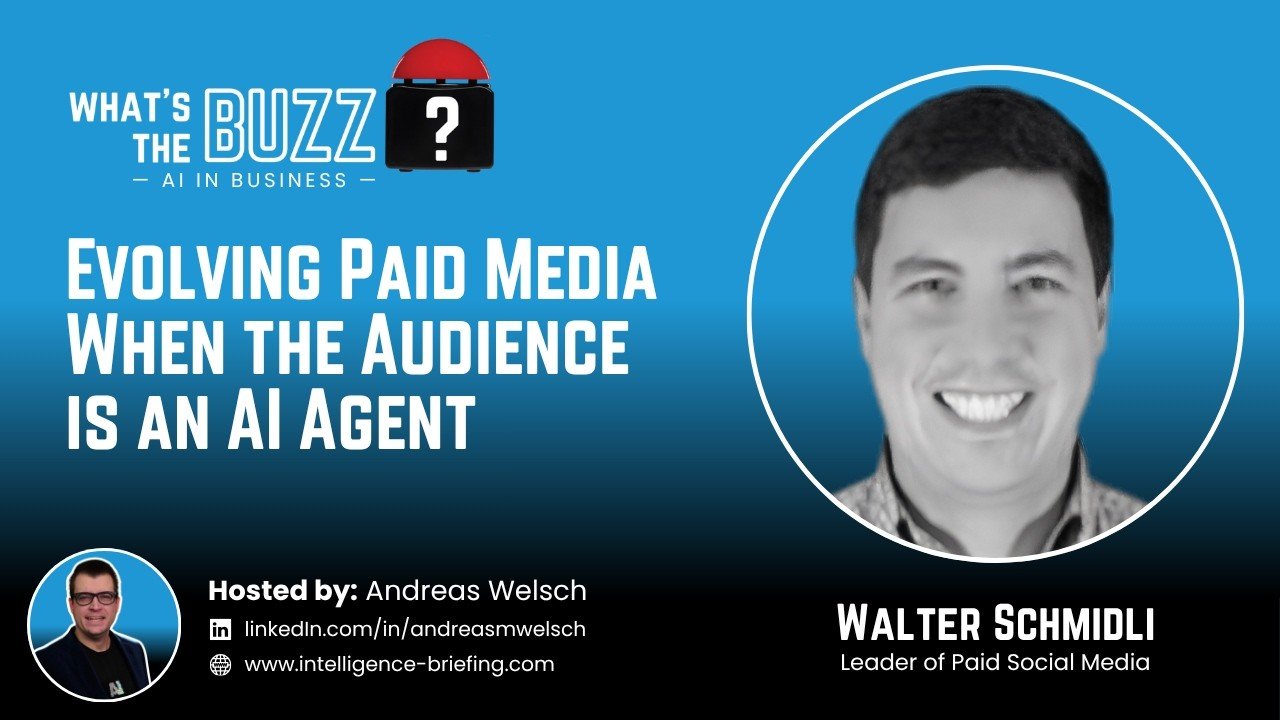
Guest: Walter Schmidli, Senior Leader of Paid Social
Host: Andreas Welsch
Episode: What’s the BUZZ?, Season 5, Episode 22
Published: October 27, 2026
Episode summary
Personal assistants from Meta, OpenAI and others are reaching consumers at scale, and advertisers have to decide what that means for how they reach people. In this episode of What’s the BUZZ?, host Andreas Welsch and Walter Schmidli, Senior Leader of Paid Social, discuss how paid media changes when an AI agent, not a person, completes the purchase. Schmidli said advertising keeps its place higher in the funnel, that brands should get their SEO and GEO in order for agents, and that the message shifts from “buy right now” to “consider it in the future.” He also covers who will own the agent relationship, how large language models choose their sources, and why content for agents needs to be descriptive and crawlable.
Key takeaways
- Consumers will have to get comfortable delegating. Schmidli said people will have to get used to relying on a bot for tasks they used to do themselves, and that if it works, people will use it. He called the field a moving target for consumers, advertisers and sellers.
- In the short term, tune SEO and GEO for agents. Schmidli said brands can first make sure their SEO and GEO strategies are on point for agents.
- Advertising moves up the funnel. If an agent makes the last click, ads still have a place where people consume content, such as social media and TV. Schmidli cited the idiom that reach and frequency drives conversion, and said results may be harder to track and the lead-in to conversion longer.
- Messaging may need to account for a person training an agent. Schmidli said advertisers may have to rethink their messaging for a person who gives an agent preferences.
- Algorithms are not new, automation is the next step. Schmidli said his field has used algorithms to target people for 10 to 15 years. He sees room for AI to automate manual processes, reporting and insights.
- Who owns the agent is still open. Schmidli asked whether platforms such as Meta, or the brands themselves, will run the agents, and how they will share data. He compared it to apps: 15 years ago not every brand had one, and now everyone does.
- LLMs are picky about sources. Schmidli said models pull from social platforms but have become more precise: official content, spokespeople and key opinion leaders get cited, not an average LinkedIn post.
- Agents respond to information, not emotion. Schmidli said descriptive, verbose content has to live on a crawlable webpage or social platform, and the emotional side is where people come in. He also expects sponsorship and API integrations that can raise one result above another.
What leaders can do now
- Make all data available in a form agents and LLMs can digest, with SEO and GEO up to date as the baseline.
- Shift the approach from “right message, right time, buy right now” to “right message, right time, consider it in the future.”
- Watch for new opportunities across publishers and agents and test which fits your brand best.
Timestamps
- 00:01:20 Walter Schmidli introduces himself
- 00:02:36 What personal assistants mean for consumers
- 00:04:08 What brands can do in the short term
- 00:07:06 Where advertising goes if an agent makes the last click
- 00:10:12 How paid media itself is changing
- 00:12:12 Platform scale and who owns the agent
- 00:17:10 Sponsored results and new ways to monetize
- 00:19:15 How LLMs choose their sources
- 00:22:07 Emotional creative versus descriptive content
- 00:24:18 Schmidli’s three takeaways
Full transcript
This is a lightly edited transcript. Filler sounds and repeated words are removed, and the wording is otherwise as spoken. Timestamps link to the video.
Read the full edited transcript
Andreas Welsch: The last few weeks have brought us personal assistants from Meta’s Muse to OpenAI’s Dots, GrokBot, Microsoft Copilot. Everyone is going after this topic, and I’m wondering what happens when an AI agent is your audience. How does advertising change? How will agents be influenced, and how will they influence you? So today, I have a very special guest to talk about that. Join me for this one. Welcome back for another episode of What’s the BUZZ?, where leaders share how they have turned AI hype into business outcomes. Today, we’ll talk about how advertising is evolving when the customer no longer is human, but is an AI agent. Super excited to welcome a good friend of mine, Walter Schmidli, to the show. Hey, Walter. Thank you so much for joining.
Walter Schmidli: Hey. Thanks for having me. Super excited to be here.
Andreas Welsch: Awesome. Hey, Walter, maybe you can share a little bit about yourself, who you are, and what you do, for those in the audience that might not know you yet.
Walter Schmidli: I’m a VP of paid social at a, at an agency, and really focus on specific niche industries, but have a background across a variety of industries, so have a pretty good understanding of, the broader marketing and especially digital marketing and how AI is impacting it, because it’s a very exciting time.
Andreas Welsch: That’s for sure. And I mean, we’ve, we’ve been talking about this for months, how AI is changing advertising even before personal assistants came out. and over the summer I’ve, I’ve started to learn more about it and, you know, go deeper in, into the topic of personal assistants and agentic commerce. But I mean, just the last couple of weeks it seems like there’s this whole flood of new assistants and agents, and everybody’s pulling one out of a hat like a magician, pulls a rabbit out of a hat. And I’ve got one too, and we’ve got one too. and I’m wondering what are you seeing? What does this mean for consumers when there are personal assistants where companies promise that they will help us solve a lot more menial tasks, do our shopping, do our, air travel booking and what have you? What does it mean for consumers?
Walter Schmidli: I think for consumers, they are predominantly gonna have to get used to the idea that they can rely on something like this, something they used to have to do themselves can now be outsourced to a bot really. So, getting comfortable with that idea. but I think at, if any of the more recent tech developments are any indication, if it works, people are absolutely going to use it. So, I think as you mentioned, there’s a lot of stuff happening right now, but it is absolutely a developing field. And so a lot of, a lot of elements need to kinda be figured out still. It’s very much a moving target for- … for consumers, but as well as advertisers and also people who are trying to offer products.
Andreas Welsch: Yeah. I mean, we’re really just a couple of weeks into this and into these agents being more available and more accessible to even a broader audience. And I mean, it seems that with Meta, with OpenAI, they’re, they’re already two very strong contenders that have an enormous reach, hundreds of millions of active users a week and a month. so you don’t need to sign up for a new service. It’s maybe a new feature that you try out or that you need to enable it at best. what does it mean on the other side for brands, for businesses that are looking to reach consumers in the end?
Walter Schmidli: I think one of the key things in the short term that brands can do is obviously make sure that their SEO and their GEO strategies are on point and tweaked for these agents. I think in the long term, this is definitely going to have an effect on how people shop in the first place, and the age of someone scrolling through an Instagram, say, and making a, an, a purchase on the fly because the right ad reached them at the right time, that may be coming to an end, and that may be changing a little bit, in the near future, right? I don’t think we’re there yet, but in the near future, definitely, like, if all… if agents are handling all e-commerce, say, for consumers, then, Brands are going to have to definitely pivot on how they, on how they reach consumers and make sure they still are impact- reaching them impactfully rather.
Andreas Welsch: I think the part that you mentioned around SEO and, or search engine optimization, generative engine optimization, answer engine optimization, that’s, that’s really exciting, and I think many companies and brands should be looking at this already, right now to get ready for this wave of agents that are starting to look for information. And personally, I’ve, I’ve been experimenting with that quite a bit over the last six months roughly, and I’m starting to see some results. All of a sudden, some of the articles that I posted on my website on intelligence-briefing.com are showing up in citations, the Copilot mentions, or, ChatGPT and Claude are bringing traffic to the website. And so the other day, I haven’t shared this with you yet, but, I looked at what are the top five articles by citations and click-throughs, and then I asked Claude, “Hey, what makes those better than the other 75? And can you rewrite the other 75 to have the same structure?” And that was a pretty exciting exercise, so now I’m waiting for the next four to six weeks to see how this actually turns out, and I can’t wait to share more with you, kinda how all of that goes. But super important, as you said, get your SEO, GEO, AEO in order so these agents, can pick up the information. But what really changes… I mean, SEO, GEO to me is a lot more organic, I would say. Do I show up in these results? but when it comes to paid media, and I know you’ve, you’ve been living and breathing that for most of your career, what really changes there now, with AI, with agents? What do marketing leaders need to know if they don’t have it on their radar yet?
Walter Schmidli: I think it’s worth a consideration, as I mentioned, if the last click is executed by an a- by an agent and no longer a human being. That doesn’t mean advertising loses its place at all. I think- Advertising has its place potentially just a little further up in the funnel. and, because people are still going to be browsing social media to consume content, people are gonna be watching TV shows, and, that’ll be an opportunity to serve them ads. And really, an old advertising idiom is reach and frequency drives conversion. So, like, s- taking a step back and maybe not focusing on the last click so much is still going to be key for advertisers.
Andreas Welsch: So that sounds like out-of-home billboards. sounds like, the radio advertising, TV advertising. Is that kinda what you mean?
Walter Schmidli: It’s, it’s certainly part of it, and, obviously, that’s how advertising got started anyway, and over the years has gotten just incredibly more focused and targeted and, also more dynamic with, like, s- personalized messaging. All of that I think will continue, of course. And with AI in that regard, the opportunities for more tar- more targeted advertising, more personalized advertising is only going to increase. However, when it comes to making the purchase, again, if it’s an agent doing that, then, you know, you may have to just rethink the messaging of, the advertiser messaging to account for a person training an agent, for instance, and training an agent to have certain… That you have certain preferences. and I think from a creative messaging perspective, that will absolutely be something that’s gonna change. And of course, it may r- just not be as easily, trackable anymore to be like, “All right. I served this Instagram ad, and I sold this new pillow.” it’s just gonna potentially be a little bit of a longer lead in conversion time.
Andreas Welsch: So I must tell you, what you shared, it aligns very nicely and perfectly with a previous guest that I had on just a couple weeks ago, former marketing executive in the food and beverage industry. And he similarly shared, we need to reach people first, and then there comes the technology part of it. So good to hear, two independent, voices share a similar, thought there. But how does paid media itself change when Meta, when Google and others are making AI available to set up campaigns to do targeting or micro-targeting? What are you seeing there? How is the field of paid media changing?
Walter Schmidli: I mean, I’d say all of those things are certainly part of, What’s gonna continue developing, although I l- I do like to say we’ve been leveraging algorithms for 10, 15 years to target people. So like f- you know, like learning technology is something we’ve been lear- we’ve been working very productively with for quite some time. of course, that’s gonna get better over time, but I think it’s just gonna be a different application of again, where the messaging is served and how it’s served. I think other aspects are just like automiz- automization of processes that we currently have to do manually, or reporting and insights on those ends, there’s lots of room for AI, you know, to help streamline the process.
Andreas Welsch: I mean, that’s, that’s pretty common and probably similar across other, marketing agency, creative functions, and pretty much any business too, so, right. now- The other part that I’m curious is, we talked about this a little bit, when platforms with such an enormous reach start introducing these agents, and just the other day I was read- I was reading Muse is now also becoming available for small businesses. Yes, finally, right? Maybe my electrician and my heating and plumbing, company can organize themselves even a little better. Al- although here in the US I think it is pretty digital already. But how is that changing, what’s the next frontier when these personal assistants become available to hundreds of millions or billions of users? Do you already have that footprint then to say, “Okay, hey, I can distribute it out more easily. I don’t need to have somebody sign up for an app,” and it’s a niche market, it grows. What are you seeing there?
Walter Schmidli: I mean, we do know some platforms who have successfully rolled out new products, like a Meta, Why because they have such scale. Like, it’s basically impossible for one of their new products to kind of fail, because people automatically sign in and start using it. I think from really everyone’s perspective, it’s gonna be a bit of an arms race to see who can… who rolls out what, when, and where. like, is it the Metas of the world, that have agents? Or is it gonna be, you know, the brands themselves that create their own agents? And then also, how do those two interact? does Amazon share data with Meta, or does Google share data with Amazon and Meta? those all seem like very open-ended questions, and it’s gonna be kind of a to be determined on who can drive mass scale of users first, and then it’s gonna be like that’s the new default going forward, and then everyone just kind of has to align. I mean, that’s how it historically goes. Yeah. Not to mention, or not to mention something like a VHS versus Betamax, but that’s what I’m kind of expecting. But a more, recent analogy is, like, 15 years ago not each brand had their own app, right?
Walter Schmidli: Now, nowadays everyone has their own app. So, like, is everyone gonna have their own agent, or is… who’s gonna sign up with who to kinda streamline these conversations? and then, I mean, it’s funny you brought up how in the US things are relatively digital. I mean, in other countries, the digital ecosystem is very much combined into one platform where everything is done through that. So, like, is that… You know, like, that seems like a much easier place-
Walter Schmidli: to place something like an agent that can already- Answer personal correspondences, pay bills, book flights, et cetera. Whereas, like, we have an ecosystem of very many partners that are all gonna vie for people’s attention, and it all comes back to people in the end.
Andreas Welsch: So, but the part you mentioned about the isolated apps and experiences, a couple thoughts that come to mind there. I think on one hand, I’m excited to see more of that autonomy, more of delegating things to maybe my Amazon app or my Target app or, you know, some of the other apps that I might be using. But to your point, right, there would then need to be an ecosystem around this, some kind of a layer or some kind of abstraction where your personal assistant, whether that lives in ChatGPT or that lives in Facebook, can then talk to these others and say, “Okay, if he says coffee, he means Dunkin’ Donuts or he means Starbucks, and if he says shopping, he means Target and not Walmart or vice versa.”
Walter Schmidli: Absolutely. Like,
Andreas Welsch: to do that here. and then place the ads there. I mean, on the flip side, now this early in the game already, last year in November, Amazon was suing Perplexity because Perplexity came out with a browser that let their users shop Amazon’s website and make purchases, and Amazon said, “Hey, hang on. We make a lot of money, from ad revenue. If all of a sudden fewer people are seeing the ads and clicking on it, that means we… our revenue will go down.” And, I think in the meantime, they won the case, and then I think it went back. I’m not quite sure where that stands right now. but now they are blocking Muse from a- from accessing their website. So-
Walter Schmidli: Exactly …
Andreas Welsch: kinda makes me think there’s probably something in the works at Amazon. and I mean, they cannot be sleeping on this or not forever at least.
Walter Schmidli: Definitely not, no.
Andreas Welsch: but given the scale, it has to be good too. It cannot just be something that fumbles or sends you the wrong brand or even the wrong product.
Walter Schmidli: Absolutely. But I think to your point, like, will we have a Target agent and a Amazon agent, or we’re, we’re just gonna have an agent that deals with all of those entities, In, w- I, yeah, in one fell swoop rather than, like, the individual communication. But I think all of that still needs to be really decided upon. and I think users are gonna, or people are gonna have a huge influence on what comes out ahead.
Andreas Welsch: From an advertising point of view, that would get interesting, too. Do you influence at the individual personal assistant level, or do you influence and place ads on the brand level? And probably both, or some mix of both, right?
Walter Schmidli: And I think that’s another really… That’s future state what’s gonna happen, right? Like, I mean, to your- Yeah … point, Amazon’s already doing some of this. But, like, there’s gonna be opportunities for brands to- sponsor certain, results or sponsor certain integrations, or there’s gonna be, other elements that are monetizable by publishers and brands and everything to make this whole thing a little… I mean, if there’s an opportunity to make money, people are gonna figure, people are gonna figure out how to do it. So I think, but none of that has really been hammered out yet, but I’m sure there’s a lot of people thinking about it very hard.
Andreas Welsch: You know, with all the talk about job loss, I think there’s also a good amount of job security, because things are changing in whatever field you are in. They’re changing, in to some extent either you get to adapt or you get to shape it, which would be even better. but who are brands then ultimately trying to influence? You said at the end of the day, it’s, it’s the consumer or it’s, it’s the business, that buys from your business. But I mean, if I look at the internet, it’s, it’s always been somewhat dubious sometimes, depending on what corners of the internet information comes from. We’ve seen this early on with large language models that were reciting information that you said, “I don’t think that’s right. where did you get that from?” And then we found out, hey, things came from Twitter or X or from Reddit and from other sources. but what do brands need to do there to influence these agents to surface quality information, to surface accurate results? is it… Sorry, follow on question. Is it true that Twitter, Reddit are the no-gos, the no-no areas anymore?
Walter Schmidli: I, for a brand specifically, I would say no. I think, so, specifically social platforms are gonna be an important first start for influencing some of these conversations because, to your point, LLMs do pull from certain social platforms. They do– They are picky and, or I mean, I think what has been figured out over the last year or two is that they’ve become a little bit more precise in the sources that they get their information from. So it’s not an average r- LinkedIn post that gets cited, but only like very official or, spokespeople or influ- like a key opinion leader content that gets funneled into LLM eventually. So I think- Again, kind of along the line of taking a step back as a brand, as an advertiser, and, identifying opportunities where you have where you can influence people to then, put content on specific social platforms that can then influence LLMs. I think that’s definitely a consideration that everybody needs to start making right now, advertisers need to start making right now. having been on the ground of this for a little bit, no one has figured it. And, it… There’s a lot of mystery around the process still- … but I think it’s absolutely one of the elements that people could focus on to f- and need to test to see what works best.
Andreas Welsch: So as we’re talking, I’m thinking a lot of the memorable advertising, a lot of the good creative work has been either triggering emotions, whether, you know, I’m, I’m thinking of the Vrbo ads, “Go on a vacation and, you know, sit by the fireplace with your loved one or loved ones and make memories,” or the, memorable Nike ads or, memorable car ads and things like that. But usually they weren’t, v- they were not very verbose, right? Or slogans are very pithy, with as few words as possible, but a lot more imagery, a lot more emotional. Do you feel we’re seeing a switch there when it comes to agent? Do we have to be a lot more verbose? Is it going to be a lot more text, a lot more context, a lot more written words rather than, images, videos, emotion when it comes to influencing them?
Walter Schmidli: The verb- the verbosity and the descriptiveness and everything, yes, needs to exist, but it needs to exist, like, on a webpage or on a social platform that can then be scraped by agents and LLMs. So I don’t think the agents themselves are ever gonna be influenced through anything emotional, right? the emotional portion is gonna… is really where the people come in. so I think coming back to kinda like the initial point, the SE- the SEO needs to be on point. The GEO needs to be up to spec, and that is gonna change frequently over the next couple of years still. but if that information is available and crawlable, then, like, that’s where the key is gonna be in influencing, agents. But also, of course, they’re gonna… Th- there’s the, possibility that, you know, there’s new API integrations, and again, that’s where potentially different sponsorship or monetization opportunities are gonna come into play where something gets a higher ranking than something else just because y- they were able to support it. So I think that’s where we’re gonna see a lot of development over the next couple years.
Andreas Welsch: Sounds like there is no shortage of change. also sounds like the advertising space, paid social, you’ve, you’ve been at the forefront of this with each and every development, right? so this changes a few things, and it probably, opens up a few new opportunities, a few new channels, and also poses a few more questions on how do we reach agents, how do we measure the impact and so on. but what’s the, what’s the one thing or maybe even the three key takeaways, for our audience, especially if they’re more on the business leadership, marketing leadership side? What are the things that they should be doing right now to prepare for this, you know, intended or perceived uptick of personal assistants and agents in commerce?
Walter Schmidli: I mean, first things first, I think all avail- all data needs to be available in a agent and LLM digestible manner. So SEO, GEO are gonna be absolute key. Having that on point, and up to date is gonna be the baseline. Absolutely. I think the other thing is advertising’s probably not gonna go away. it just needs to take a little bit of a different approach from, like, right message, right time, buy right now, to right message, right time, consider it in the future. and lastly, I think there’s just gonna be a absolute increase in opportunities for different brands to leverage different publishers, different agents, and just keeping on top of that, to see what the best fit is. That’s gonna be key for brands as things develop quickly over the next couple years.
Andreas Welsch: Wonderful. Walter, it’s been a pleasure talking to you. I mean, I could talk to you for hours, and we still wouldn’t run out of topics. I’m, I’m so excited, that we’ve had the chance to, connect today and learn more about what is happening when you need to advertise to an agent, and it sounds like some things are changing, some things not so much, and I’m glad to see that you’re at the forefront of this.
Walter Schmidli: Absolutely. Thanks so much for having me. This was, so much fun.
Andreas Welsch: Wonderful. All right. Folks, if you’re in the audience, thanks so much for joining. I hope you took a few good notes and a few takeaways as well, and I’m looking forward to seeing you again on the next episode of What’s the Buzz? Thank you. Bye-bye. Bye.
About Walter Schmidli
Walter Schmidli is Senior Leader of Paid Social at a media agency. On the show he said he works with an agency focused on specific niche industries and has a background across a variety of industries, with a broad understanding of digital marketing and how AI is affecting it.
Listen and watch
- Watch on YouTube
- Listen on Buzzsprout (show page)
- Listen on Apple Podcasts (show page)
- Listen on Spotify (show page)
Related reading
- Agentic AI in CX and agentic commerce
- The five security layers of agent commerce
- Agentic commerce and CX infrastructure: the questions to ask
- Agentic AI for Enterprise Leaders
- The HUMAN Agentic AI Edge by Andreas Welsch
- Always-On Agents by Andreas Welsch (forthcoming, Early 2027)
Frequently Asked Questions
Does advertising still matter if an AI agent makes the purchase?
Yes, according to Schmidli. Advertising moves a little further up the funnel, because people still browse social media and watch TV, and reach and frequency still drive conversion. Results may be harder to track, with a longer lead-in to conversion.
What should brands do first to reach AI agents?
Schmidli said to make sure SEO and GEO strategies are on point for agents. All data should be available in a form agents and LLMs can digest, and kept up to date, as the baseline.
Which sources do large language models trust?
Schmidli said models pull from certain social platforms but have become more precise. Official content, spokespeople and key opinion leader content gets cited, not an average LinkedIn post, and no one has fully figured out the process yet.
Can emotional creative influence an AI agent?
Not directly, said Schmidli. He does not expect agents to be influenced by anything emotional. Descriptive content that agents can crawl is the key, and the emotional portion is where people come in.