

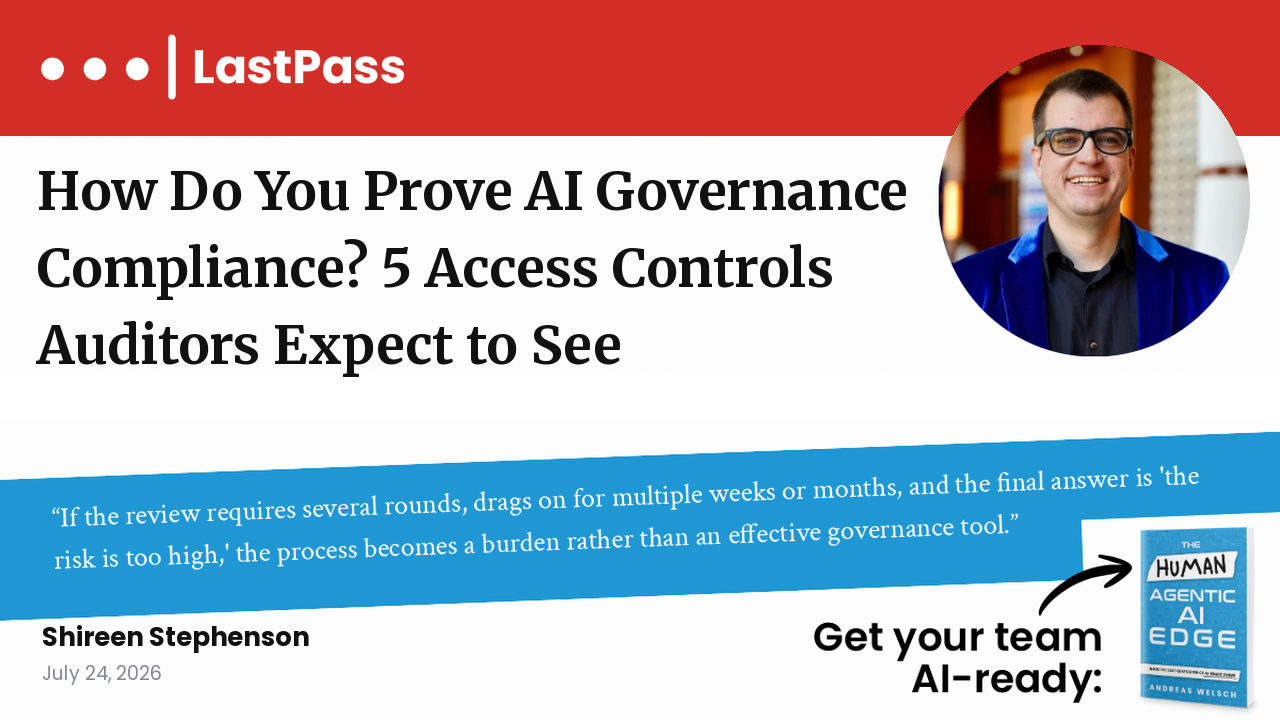
Most organizations can point to an AI acceptable use policy. Far fewer can prove, on demand, that the policy is actually enforced. That gap between a written rule and a demonstrable control is where AI governance audits are won or lost, and it is the subject of a LastPass blog post examining how lean IT teams can pass compliance reviews without a dedicated security function.
Which AI governance controls do auditors expect? Five: Discovery, Classification, Authentication, Governance, and Auditability. Together they identify every AI tool in use, assign each a risk tier, tie access to named users, enforce policy at the point of login, and produce the evidence that a written AI use policy alone cannot show.
Andreas Welsch, Founder and Chief AI Strategist at Intelligence Briefing, is the featured expert in the piece. He explains why policy alone no longer satisfies auditors: “the risk landscape is becoming significantly more complex as systems move toward autonomy.” Organizations that rely on governance frameworks built solely on policies, ethics guidelines, and oversight committees are increasingly out of step with how fast AI tools are adopted inside their own teams.
Original source:
LastPass: How Do You Prove AI Governance Compliance? 5 Access Controls Auditors Expect to See
Why this media coverage matters
The article translates enterprise-grade AI governance into a five-control framework that any IT team can run without added headcount. For CIOs, CISOs, and compliance leaders preparing for SOC 2, HIPAA, GDPR, ISO 27001, ISO 42001, NIST AI RMF, or EU AI Act reviews, it draws a clear line between having a policy and being able to evidence one in real time.
Executive Summary
- A written AI use policy is not sufficient evidence; auditors expect enforced, real-time controls.
- Five controls anchor AI governance compliance: Discovery, Classification, Authentication, Governance, and Auditability.
- Major frameworks (SOC 2, HIPAA, GDPR, ISO 27001, ISO 42001, NIST AI RMF, EU AI Act) all demand some form of access governance evidence.
- Personal AI accounts and shared credentials are the most common blind spots for small and mid-sized teams.
- Identity-layer controls, applied at login, are the most practical enforcement model for lean IT organizations.
Key Takeaways
- An AI governance policy defines the rules; AI governance controls enforce them and generate the evidence auditors ask for.
- Unmanaged guest accounts make up 69% of accounts in SaaS environments, based on Kaseya’s analysis of 27.6 billion-plus SaaS security threats across 50,000-plus SMBs.
- Discovery and authentication are the controls where lean IT teams are most exposed, according to Welsch.
- An AI tool inventory should, at minimum, capture the tool name, the email address used to log in, and the date of last access.
- Classification decisions should weigh data retention practices, DPA availability, SSO support, OAuth scope, deployment model, and vendor security posture.
- Quarterly access reviews, tracked in a simple tool-tier-and-change log, provide ongoing proof of governance rather than a one-time snapshot.
- A slow, multi-week classification process pushes employees to route around governance entirely, undermining the program it was meant to protect.
What is AI governance?
AI governance is the set of policies, controls, and evidence practices an organization uses to manage how employees access, use, and are held accountable for AI tools that touch corporate or regulated data. It spans discovery of which tools are in use, risk-based classification of those tools, authentication that ties usage to named individuals, enforcement of access rules at the point of login, and auditable records that prove the first four are working. In regulated environments, governance is judged not by the policy document itself but by whether an organization can produce evidence, on demand, that the policy is enforced.
What Is the Difference Between an AI Governance Policy and AI Governance Controls?
Welsch and LastPass draw a sharp distinction: a policy tells employees which tools are approved and how to handle data, but it does not tell an auditor which tool was accessed, by whom, on what date, or through which type of authentication.
Two failure modes illustrate the gap. When an employee logs into an AI tool with a personal email on a corporate device, attribution disappears. When several employees share one login to an AI platform, no one can say who accessed what, when, or how.
Key Insight: A policy describes intent; a control produces evidence. Auditors score organizations on the evidence trail, which means discovery and authentication (the two controls most likely to expose personal accounts and shared logins) deserve priority over additional policy language.
Which Compliance Frameworks Require AI Governance Evidence?
Every major framework referenced in the article converges on the same underlying requirement: access governance, expressed as inventory, authentication, monitoring, and audit evidence. SOC 2 calls for logical access controls and user accountability. HIPAA requires authentication, access control, and audit controls. GDPR expects records of tools processing personal data. ISO 27001 requires asset inventory, monitoring, and access controls. NIST AI RMF calls for AI inventory, governance, and risk management. The EU AI Act requires logging, monitoring, and risk-based oversight. ISO/IEC 42001 requires AI management system controls.
Any organization whose employees use AI tools to process personal, corporate, or regulated data should expect an auditor to test against this common thread, regardless of which specific framework applies.
What Are the 5 AI Governance Controls Auditors Expect?
Auditors expect five controls to function together, enforced and evidenced: Discovery, Classification, Authentication, Governance, and Auditability.
Control #1: Discovery, Building a Complete AI Tool Inventory
For compliance purposes, an AI tool is any application employees use that processes corporate or client data, whether or not IT sanctioned it. A complete inventory accounts for both corporate and personal logins, since chatbots, writing assistants, code assistants, meeting-note tools, HR platforms, design generators, analytics tools, and agentic browsers are all commonly accessed through personal credentials on work devices.
Welsch frames discovery as the starting point: “[Visibility] starts with a clear and actionable AI governance policy that employees can actually understand and apply in their day-to-day work… Without this clarity, employees will make decisions on their own, often without fully understanding the implications.”
Key Insight: A healthcare technology company cited in the article discovered roughly 80 AI agents that had spun up inside one already-sanctioned Sales tool, unmonitored and drifting from their original purpose, inside a single department, for a tool IT already knew about.
At minimum, an inventory should capture the tool or app name, the email address used for login, and the date of last access. Those three data points answer what is being used, who is using it, and whether it is still active.
Control #2: Classification, Deciding What to Allow, Warn, or Block
Two tools in the same category can carry very different risk profiles depending on data handling, login security, and deployment model. The article lays out six questions for classifying any AI tool: how it retains and uses prompt data for training, whether a Data Processing Agreement is available, whether it supports SSO, what OAuth scope it requests, whether its default deployment model is publicly accessible, and whether the vendor publishes a SOC 2 report or comparable security documentation.
Welsch recommends a lightweight intake process for lean teams: a short online form routed to a small cross-functional review group covering IT, legal, finance, and HR. “Keeping the online form lean and review timeline short demonstrates an organization is taking governance seriously without putting up hurdles to innovation.”
Tools that raise red flags on training-data use, SSO support, or public deployment should default to Warn or Block rather than Allow.
Control #3: Authentication, Tying Access to a Named User
Authentication functions as a compliance control because it determines whether AI tool access can be attributed to a specific individual. Where individual accounts are not available, LastPass recommends documenting shared-access rules explicitly: which employees are authorized, the business reason for shared rather than individual access, a defensible review cadence such as quarterly, and any access changes since the last review.
Key Insight: The article cites a case where a developer changed teams but retained his prior access permissions. After he left the company, his coding agent used his still-active credentials to access data in another jurisdiction, including cross-border human genetic research data. Without user-level attribution, that failure was nearly impossible to trace.
Multi-factor authentication carries specific regulatory weight here: SOC 2’s CC6.1 lists MFA as a point-of-focus control for logical access, and HIPAA’s §164.312(d) requires person or entity authentication, which MFA enforcement logs are a standard way to satisfy.
Control #4: Governance, Enforcing Policy at the Point of Access
Governance means applying policy decisions at the moment of login rather than discovering violations after the fact. For lean IT teams, the article recommends identity-layer enforcement in the browser: a Block-classified tool shows a block screen directing the user to an approved alternative, while a Warn-classified tool surfaces a policy reminder before the user proceeds.
Welsch cautions against over-engineering the review process itself: “If the review requires several rounds, drags on for multiple weeks or months, and the final answer is ‘the risk is too high,’ the process becomes a burden rather than an effective governance tool. Users will look for ways to sidestep the process, which will further diminish security and governance.”
Key Insight: Point-of-access enforcement handles real-time risk, but quarterly access reviews remain necessary because permissions and vendor terms shift over time. A simple three-column log (tool, current tier, and change since last review) creates ongoing, exportable proof of governance.
Control #5: Auditability, Producing Evidence on Demand
Auditability is the control that turns the other four into evidence. The article maps each major framework to the specific artifact an auditor needs: SOC 2 wants proof that logical access controls apply consistently; HIPAA wants access governance and audit control evidence for systems that may process ePHI; GDPR wants visibility into which AI or SaaS apps process personal data; ISO 27001 wants discovery, inventory, and access attribution; NIST AI RMF wants inventory lifecycle management and ongoing monitoring; the EU AI Act wants evidence that staff were informed of policy and that access to high-risk AI systems is monitored and attributable; ISO/IEC 42001 wants inventory and access governance records supporting a documented AI management system.
A ready evidence package includes an AI tool inventory, named-user access records, MFA enforcement records, classification decisions, Allow/Warn/Block enforcement logs, access review documentation, and audit logs covering the review period.
Leadership Implications
- Treat AI governance as a control-and-evidence program, not a policy document: auditors test for enforcement, not intent.
- Prioritize discovery and authentication first; they close the two blind spots (personal accounts and shared credentials) most likely to fail an audit.
- Keep classification intake lightweight so employees do not route around governance to avoid a slow process.
- Move enforcement to the point of login rather than relying solely on after-the-fact monitoring.
- Institutionalize a quarterly access review with a simple, exportable log so evidence exists continuously rather than only when an audit is announced.
Why This Matters
As AI tools proliferate across departments, often adopted independently by individual employees before IT ever sees them, the distance between a written governance policy and a defensible, evidence-backed control grows wider. Welsch’s broader body of work on enterprise AI adoption and Agentic AI governance consistently returns to this same theme: organizations that treat governance as a real-time operating discipline, rather than a static document, are the ones that can both move quickly on AI adoption and withstand regulatory scrutiny.
Conclusion
Proving AI governance compliance no longer rests on having a policy on file. Auditors expect to see Discovery, Classification, Authentication, Governance, and Auditability functioning together as enforced, evidenced controls, reachable even for lean IT teams without a dedicated security function. Organizations that build this evidence trail continuously, rather than assembling it only when an audit is scheduled, are the ones best positioned to demonstrate real AI governance.
Related Reading
- AI Governance for Agentic AI in Enterprises
- AI Leadership in the Age of Agentic AI: Governance, Upskilling, and Better Workflows
- Practical Adoption, Governance, and Measurable Impact for Agentic AI
- AI Governance Decides Which SaaS Systems Survive
Frequently Asked Questions
What is the difference between an AI governance policy and AI governance controls?
A policy defines the rules for AI use; controls enforce those rules and generate evidence that they were followed. Auditors evaluate controls, not policy language, because a policy alone cannot show which tool was accessed, by whom, or how. Enforcement and evidence are what satisfy frameworks like SOC 2, HIPAA, and ISO 27001.
Which compliance frameworks require AI governance evidence?
SOC 2, HIPAA, GDPR, ISO 27001, ISO/IEC 42001, NIST AI RMF, and the EU AI Act all require some form of access governance evidence. Each frames it differently, but the common thread is inventory, authentication, monitoring, and audit-ready documentation of AI tool access across the organization.
What are the five core AI governance controls?
The five controls are Discovery, Classification, Authentication, Governance, and Auditability. Together they identify every AI tool in use, assign risk tiers, tie access to named users, enforce policy at login, and produce evidence that the other four controls are functioning as intended.
What counts as an AI tool for compliance purposes?
Any application employees use that processes corporate or client data counts, even if IT never approved it. This includes chatbots, writing assistants, code-writing tools, meeting-note assistants, HR and recruiting platforms, design generators, analytics tools, and agentic browsers, regardless of whether access is through personal or corporate credentials.
Why are personal AI accounts and shared credentials the biggest blind spots?
Personal accounts and shared logins break user-level attribution, which auditors specifically test for under controls like SOC 2’s CC6.1 and HIPAA’s §164.312(d). Without attribution, an organization cannot show an auditor which named individual accessed a given system, undermining the evidence trail entirely.
How should a lean IT team classify AI tools without a dedicated security staff?
Use a lightweight intake form for new tool requests, reviewed by a small cross-functional group spanning IT, legal, finance, and HR. Score each tool on data retention practices, DPA availability, SSO support, OAuth scope, default deployment model, and vendor security posture, then assign it Allow, Warn, or Block.
How often should AI access reviews happen?
A quarterly cadence is defensible under most frameworks referenced in the source article. Each review should record which tools sit at each risk tier, whether any tool’s security posture or terms changed, and whether access rights themselves changed, creating an ongoing, exportable record of governance.
How does identity-layer enforcement work for AI governance?
Identity-layer enforcement applies classification decisions in the browser at the moment of login. A tool classified as Block shows a block screen with an approved alternative; a tool classified as Warn shows a policy reminder before the user proceeds, enforcing governance in real time rather than only through after-the-fact monitoring.