

As organizations move from AI pilots to production, the hardest problems are rarely technical. The real challenge is AI leadership: setting direction, enabling people, and creating practical ways to work with fast-changing tools without delegating human judgment to machines.
What changes when organizations deploy AI in learning and development? Access does not equal adoption, so hands-on training tied to real work comes next. AI literacy has to be tailored to each persona, champions or “multipliers” scale it across departments, and lightweight governance with data hygiene keeps experimentation safe.
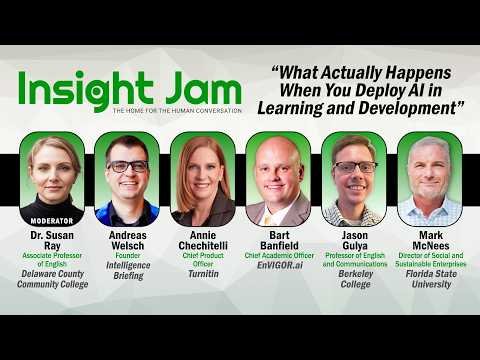
These themes surfaced clearly in a Solutions Review Insight Jam panel on what actually changes when AI is deployed in learning and development. Andreas Welsch, an AI leadership expert and founder of Intelligence Briefing, discussed what he sees in multinational organizations and in higher education classrooms when experimentation becomes operational reality.
Original source: Solutions Review Insight Jam – Q2 Mini Jam
Executive Summary
- Tool rollout is not deployment; training and workflow change come next.
- Hands-on, practical AI upskilling creates immediate on-the-job impact.
- AI literacy must be tailored by persona: faculty, staff, students, and more.
- Lightweight governance and data hygiene enable safer experimentation.
- AI is pushing a broader rethinking of education and workforce readiness.
Key Takeaways
- Andreas Welsch observes that many organizations deploy tools first, then realize training must follow.
- Practical, hands-on learning helps professionals apply AI changes “the next day” at work.
- Welsch emphasizes that the pace of change is a core leadership problem, not a side issue.
- Students quickly move beyond basic prompting and expect broader AI capabilities (e.g., video, avatars, voice cloning).
- AI literacy cannot be one-size-fits-all; different university and business personas need different enablement.
- Communities of “multipliers” or champions can scale adoption and feedback across departments.
- First steps should combine lightweight governance with immediate, safe experimentation.
What is AI leadership?
AI leadership is the executive practice of guiding an organization’s AI direction from strategy to roadmap to workforce enablement. In the panel, Andreas Welsch describes his work helping leadership teams and employees become “AI-ready,” which includes practical upskilling, understanding risks and opportunities, and changing ways of working so AI tools improve outcomes rather than replace human judgment.
In practice, AI leadership connects governance (guardrails and data hygiene), operating model decisions (who owns what, and how work changes), and adoption at scale (training, champions, and measurable workflow integration).
What changes first when organizations move from AI pilots to deployment?
Welsch notes a recurring pattern in large organizations: AI tools are deployed broadly (Copilot, Claude, Gemini, ChatGPT), and only then do leaders realize that access does not equal adoption. The next step becomes training that is hands-on and directly tied to real work.
In his view, training is most effective when it clarifies where AI works, where it fails, what risks exist, and what people must change in their daily workflow to use the tools well.
Key Insight: Organizations often mistake “tool availability” for adoption. Welsch observes that after rolling out popular AI assistants, leaders quickly discover the missing layer is practical training that shows when AI works, when it doesn’t, and what people must change in their day-to-day workflow.
Why does practical AI upskilling beat generic AI literacy?
Welsch emphasizes that AI learning must be actionable. When professionals see hands-on demonstrations (risks, limitations, and workflow changes), they can apply those lessons immediately.
That immediacy matters for executive sponsors because it turns AI training into operational change rather than a one-time awareness session. It also reduces the likelihood that teams adopt AI as a “black box,” a dynamic that can lead to over-reliance and weak decision-making.
In the panel discussion, Welsch also highlights the time challenge: the tools evolve rapidly, and educators and professionals need time to explore what works, what doesn’t, and how to incorporate AI responsibly.
Key Insight: Welsch’s emphasis is not on abstract policy documents. The most durable capability is hands-on upskilling that helps people build judgment: how to validate outputs, what to trust, what to challenge, and how to integrate AI into real tasks without losing accountability.
How should AI literacy be tailored to different personas?
In higher education, Welsch outlines at least four distinct groups with different needs: faculty, staff, research, and students. While each group needs foundational AI literacy, they also require tailored guidance based on daily responsibilities.
Faculty may focus on incorporating AI into syllabi and course materials. Students need guidance on using AI without delegating their own judgment. Staff functions (from finance to HR to admissions) need practical patterns for responsible use in their workflows.
One scalable approach discussed is building communities of “multipliers” or champions across departments who can share what works, identify new needs, and bring feedback into a central learning loop.
Key Insight: A single, generic AI training program cannot serve the whole institution. Welsch argues for persona-based enablement (common foundations plus role-specific scenarios), supported by champions who scale adoption and surface real operational feedback.
The pace of change is the leadership challenge
Welsch repeatedly returns to a core reality: AI is moving faster than many education and organizational change cycles. Instructors and leaders may feel behind as new capabilities appear, students and employees adopt tools quickly, and expectations shift from basic prompting to richer multimodal applications.
In his classroom experience teaching AI modules, Welsch observes fast adoption growth: from a quarter of students reporting regular AI use, to half, to near-unanimous use across semesters. He also notes the learning curve: students soon ask to move beyond prompting into avatars, voice cloning, and short promo videos, expanding the conversation from text to broader media creation.
This accelerating baseline changes what “AI literacy” must include, and it creates new ethical discussions about rights, appropriate use, and boundaries.
Where does AI governance help, and where can it hurt?
Welsch supports governance, but he also flags a risk: governance can become a choke point that slows innovation when the technology and the market are moving quickly. The leadership task is to strike a workable balance: enough guardrails to protect the organization, without stifling experimentation and learning.
How is AI in learning and development changing instructional design and facilitation?
Welsch describes concrete ways AI is changing instructor and facilitator work. One example is rapid development of relevant case studies. When something appears in the news that relates to a class or training session, AI can help generate exercises or assignments quickly and contextualize them to the module being taught.
In building corporate AI literacy programs, Welsch also highlights how AI can accelerate standardized content creation: drafting outlines, slides, and layouts. That shifts the human role from producing every artifact manually to orchestrating, reviewing, tightening, and ensuring relevance and accuracy.
In executive terms, AI changes the cost structure and speed of content production, but increases the importance of editorial judgment, quality control, and outcome-focused design.
First practical steps for organizations starting tomorrow
For organizations that have not deployed AI, Welsch recommends two immediate moves.
- Lightweight governance from IT or the AI owner: clarify which tools are approved, acceptable use, and basic data policy and hygiene (what data can and cannot be entered).
- Hands-on experimentation: encourage teams to try AI on everyday writing and work products, iterating and learning through use.
This pairing keeps momentum: guardrails reduce avoidable risk, while practical use builds capability quickly.
Leadership Implications
- Fund adoption, not access: pair tool rollout with hands-on AI upskilling tied to real workflows.
- Build persona-based enablement: design separate tracks for leaders, faculty, staff functions, and learners.
- Establish lightweight governance: define approved tools, data hygiene, and safe-use boundaries without blocking experimentation.
- Create champions and multipliers: use cross-department communities to scale learning and capture feedback.
- Design for judgment: train people to validate outputs and avoid delegating accountability to AI systems.
Why this conversation matters
This panel discussion matters because it reflects the operational reality many leaders face: AI is already present through popular tools, but the outcomes depend on human systems: governance, training, and workflow integration.
For CIOs, CTOs, CHROs, and learning leaders, the conversation offers a practical lens on workforce transformation. Welsch’s contributions connect strategy and enablement: the organization’s AI posture becomes real only when people can use tools responsibly, critically, and effectively in daily work.
The themes also align with Welsch’s broader positioning as an AI leadership expert: moving from experimentation to roadmaps, upskilling, and scalable adoption, while keeping human judgment central.
Conclusion
As AI becomes embedded in learning and development, the differentiator is not which model or assistant is selected. The differentiator is AI leadership: lightweight governance that enables safe experimentation, practical upskilling tied to workflows, and role-specific guidance that helps people use AI without surrendering judgment.
Welsch’s perspective highlights a pragmatic path forward: move quickly enough to keep pace, but intentionally enough to make adoption real, measurable, and responsible.
Frequently Asked Questions
Why is hands-on AI upskilling more effective than awareness sessions?
Hands-on training builds practical judgment (when AI works, when it fails, and what risks exist), so people can apply lessons immediately. Welsch emphasizes actionable learning that changes day-to-day work, rather than abstract AI literacy that stays theoretical.
How should universities tailor AI literacy across different groups?
AI literacy should be persona-based: faculty, staff, researchers, and students share foundations but need different scenarios and guidance. Welsch highlights that role-specific needs vary widely, including syllabus design for faculty and judgment-focused use for students.
What is a practical governance approach that doesn’t slow innovation?
A lightweight governance model clarifies approved tools, acceptable use, and data hygiene while leaving room to experiment. Welsch supports governance but warns it can become a choke point, so leaders must balance guardrails with the pace of change.
What are “multipliers” or AI champions, and why do they matter?
Multipliers are cross-department champions who share practical examples, scale adoption, and bring feedback back to the institution. Welsch recommends building these communities so AI enablement is not centralized only in IT, but distributed where work happens.
How is AI changing instructional design and facilitation work?
AI can accelerate drafting outlines, slides, and case studies tied to current events, shifting humans toward orchestration and review. Welsch describes using AI to create relevant exercises quickly, then refining them with human expertise and judgment.
What did students start asking for beyond prompting?
Students quickly moved past prompting and wanted broader AI capabilities like avatars, voice cloning, and short promo videos. Welsch observed that once AI use became common, learners asked what else was possible beyond text, and debated ethical boundaries.
What is the first practical step for AI adoption in an organization?
Start with lightweight governance and immediate hands-on experimentation. Welsch recommends clarifying approved tools and data policy (what can be entered), then encouraging teams to try AI on everyday writing and work products to learn through iteration.
How can leaders prevent teams from delegating judgment to AI?
Leaders should train for critical use: validation, risk awareness, and clear accountability for decisions. Welsch teaches responsible AI use that avoids treating model outputs as final answers, reinforcing that humans remain accountable for quality and outcomes.