

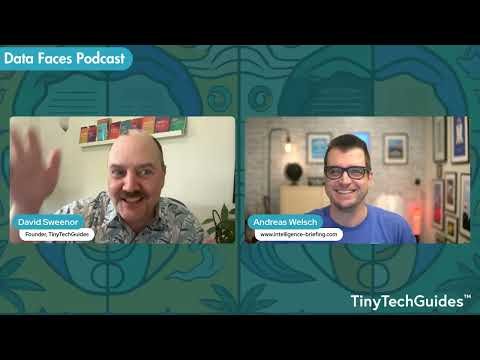
Agentic AI is moving fast—from boardroom mandates to employee-led experimentation—but most organizations still struggle to translate prototypes into durable business value. In a conversation on the Data Faces podcast, Andreas Welsch shares what separates meaningful progress from “pilots that die on the vine.”
Welsch, founder of Intelligence Briefing and author of The AI Leadership Handbook and The Human Agentic AI Edge, draws on experience building enterprise AI inside SAP and advising leaders on AI strategy, adoption, and governance.
The discussion also surfaces a leadership tension that is shaping workforce transformation: executives talk about productivity and automation, while employees worry about job loss and the quality of AI-generated “workslop” flooding daily workflows.
Source context: This article is adapted from a podcast interview transcript featuring Andreas Welsch on the Data Faces podcast hosted by David Swanner.
Executive Summary
- Value-first workflow redesign beats “spaghetti on the wall” experimentation.
- Agentic AI momentum is real, but public case-sharing is limited by risk and competition.
- Workforce fear and AI-driven layoff narratives undermine adoption.
- Governance matters because agentic risk can compound as autonomy scales.
- Build-vs-buy decisions shift: SaaS often equals convenience and risk transfer.
Key Takeaways
- Andreas Welsch sees a familiar adoption cycle: new technology triggers “throw spaghetti at the wall and see what sticks.”
- Organizations getting value from agents start with process reality: inputs, outputs, and which steps can be eliminated or redesigned.
- Welsch argues leaders should emphasize growth (new products/services) over cost-only narratives that fuel burnout.
- Generative AI accelerated hands-on experimentation, but enterprises must move from personal productivity to team workflows.
- Welsch warns against over-trusting probabilistic systems: agents can be confidently wrong, even inside guardrails.
- SaaS is not “dead”; subscriptions often pay for peace of mind, maintenance, and compliance, not just features.
- Tool-hopping across models can waste time; when something works, it often should remain untouched.
What is Agentic AI?
Agentic AI refers to AI systems (often called “agents”) that can execute multi-step tasks with some degree of autonomy—using tools, accessing information, and taking actions within defined workflows. In the conversation, Andreas Welsch frames the practical challenge as moving beyond slideware and prototypes toward operational use, while keeping humans in the loop for judgment, governance, and risk management.
As autonomy increases—from one agent to multiple agents coordinating—Welsch highlights that complexity and risk can rise quickly. This makes workflow redesign, evaluation, and leadership intent central to realizing business value.
Why This Conversation Matters
This Data Faces discussion is aimed at practitioners and executives who must make AI, analytics, and automation work “in the real world.” It is especially relevant for leaders navigating agentic AI hype, workforce anxiety, and the operational realities of governance, tool sprawl, and process change.
Andreas Welsch, an AI leadership expert, connects tactical questions (how to prioritize use cases, how to get teams to adopt tools well) with strategic consequences (how organizations talk about layoffs, how risk compounds as autonomy scales, and how build-vs-buy decisions shift in the AI era).
Key Insight: Welsch suggests the market is noisier than reality: many organizations are building agents, but fewer are publicly describing what works—because competitive advantage and workforce concerns make disclosure risky.
From “Spaghetti on the Wall” to Value-First Agentic AI
Welsch describes a recurring enterprise pattern: when a “new shiny object” appears—cloud, mobile, machine learning, and now generative and agentic AI—organizations often begin with broad experimentation. Some pilots succeed; others collapse or fade away.
In Welsch’s view, companies that do well with agentic AI anchor their efforts in value early. They start with a clear understanding of the current workflow and identify opportunities to change it—not just automate a task inside the existing process.
That redesign is difficult in large enterprises where processes have existed for 15–20 years and “work” by providing predictable inputs and outputs. But Welsch argues the hard work of determining which steps are still needed—and which can be eliminated—is what creates the path to value.
Key Insight: Welsch ties agentic AI success to process realism: leaders must map current workflows, question whether each step is needed, and redesign around outcomes—rather than layering agents on top of legacy processes and hoping productivity emerges.
Workforce Transformation: Fear, Burnout, and “Workslop”
Welsch observes a widening leadership challenge: top-down AI pushes collide with bottom-up anxiety. He hears persistent narratives about AI-driven layoffs, reduced entry-level roles, and job insecurity—concerns echoed by his students as an adjunct professor in Pennsylvania.
At the same time, leaders often fixate on cost reduction because it is easier than driving revenue growth. Welsch critiques the vicious cycle: one public layoff story creates pressure for competitors to follow, reinforced by analysts and investors asking why peers “run leaner.” The result can be employee burnout as fewer people carry more work.
In contrast, Welsch advocates for a more growth-oriented view: if AI increases capability and productivity, leaders can invest that leverage into new products and services—rather than sacrificing future growth through headcount cuts alone. He also warns about low-quality AI outputs (“workslop”) that clutter inboxes when people are not trained or guided to use AI well.
Key Insight: Welsch positions workforce enablement as a strategic requirement: if employees believe AI equals replacement, adoption will stall—and AI-generated “workslop” will rise because quality, judgment, and accountability degrade under fear and ambiguity.
Governance and Risk: Why Agentic Complexity Compounds
Welsch challenges a common myth: that agentic AI “does everything perfectly.” He emphasizes that organizations are still deploying probabilistic systems that can be confidently wrong—even when governance guardrails, evaluation, and testing harnesses exist.
As agentic systems scale, risk does not stay constant. Welsch warns that the jump from one agent to multiple interacting agents increases complexity significantly. This matters because many enterprises are still building their first or second agent while simultaneously talking about “autonomous enterprises” and broad, fully agentic operating models.
The leadership implication is not to pause innovation, but to align autonomy, evaluation, and accountability to business impact. Welsch’s caution is particularly relevant where agentic AI can affect processes, customers, or regulated operations, and where the consequences of errors can cascade.
Adoption Reality: Experimentation Is Everywhere—Coordination Isn’t
Welsch agrees that generative AI has accelerated hands-on adoption because employees do not need to be data scientists; they can “speak the language” to the system. Individuals use tools for meeting summaries, email drafting, research, messaging, and more.
However, Welsch points to the next step: operationalizing AI for teams, not just individuals. The focus must shift from personal productivity to operational excellence and process improvement—then onward to strategic differentiation using a company’s unique data, expertise, and customer base.
He also acknowledges organizational tension: IT, legal, risk, and security may be uneasy when employees connect tools broadly (for example, via integrations that make connecting systems easy). That tension reinforces the need for leadership to guide what should be scaled—and what should remain experimentation.
Key Insight: Welsch describes a maturity path: generative AI starts at the “inner layer” of personal productivity, but leadership value emerges when organizations return to team workflows and operational processes—then advance toward strategic differentiation.
SaaS Isn’t Dead: Build-vs-Buy in the AI Era
Welsch disputes the claim that “SaaS is dead.” In his own experimentation, he rebuilt clones of tools he used—such as an e-signature workflow similar to DocuSign and a live polling tool used in presentations. These builds demonstrated how quickly AI-enabled development can replicate features.
But Welsch highlights the less visible side of SaaS value: subscriptions often pay for convenience and peace of mind, including maintenance, dependency management, regression testing, cybersecurity, data privacy considerations, and support when systems fail at inconvenient times.
He draws a line between “non-essential” apps and core enterprise software such as ERP, CRM, HR, and finance. For core systems, auditability and vendor accountability matter—and the organization often wants to transfer risk to a provider rather than rely on internally “vibe-coded” systems.
Welsch’s build-vs-buy conclusion is strategic: leaders should decide what the business should build, even if it technically can build more—because ongoing ownership is the real cost.
Future-Proofing vs Tool-Hopping: A Practical View
Executives often ask how to “future-proof” AI investments across fast-changing models and tools. Welsch shares a cautionary example: setting up a multi-model front end to avoid dependence on a single assistant sounded attractive, but it created friction, confusion, and reduced usage because it was clunky.
His recommendation is pragmatic: if a solution works, it should stay in place. Tool-hopping can consume time for minimal gain—especially for small teams and leaders already operating as the “CXO of everything.” New tools can be explored for net-new work, and migration can happen later if benefits are clear.
This perspective aligns with Welsch’s broader theme: convenience, reliability, and focus can outperform constant optimization when the external landscape changes monthly.
The Underused Question: “Should This Be Built at All?”
Asked what practitioners should be asking more often, Welsch points to a simple but underapplied question: “Should this be done?” He argues many organizations would save time, politics, sunk cost, and governance headaches by applying “just because it can be done doesn’t mean it should.”
Welsch connects this to responsible AI leadership: deciding what not to automate can be as important as deciding what to automate. This is especially true when agentic AI touches customer-facing workflows, regulated processes, or sensitive data.
Leadership Implications
- Start with value and workflow redesign: map current inputs/outputs, then eliminate steps before adding agents.
- Address workforce fear directly: counter replacement narratives with enablement, upskilling, and growth-oriented use cases.
- Set quality expectations to reduce AI workslop: establish guidance so AI outputs improve, not degrade, communication.
- Scale autonomy cautiously: govern multi-agent systems with evaluation, guardrails, and clear accountability for outcomes.
- Be intentional about build-vs-buy: SaaS often buys risk transfer, support, and compliance—especially for core systems.
Conclusion
Agentic AI is no longer just a slide; enterprises are building platforms and early agents. Yet Andreas Welsch argues that durable advantage will come from disciplined Agentic AI leadership: value-first workflow redesign, responsible governance as autonomy scales, and workforce transformation that prioritizes human judgment over fear-driven cost cutting.
In Welsch’s view, organizations that ask “should this be built?”—and can align people, process, and risk—will move beyond pilots to measurable outcomes.
FAQ: Agentic AI Leadership and Adoption
1) What separates agentic AI pilots from production value?
Organizations get production value from agentic AI when they start with workflow outcomes and measurable value, not experimentation alone. Welsch emphasizes redesigning processes—eliminating unnecessary steps—before adding agents, rather than hoping prototypes naturally scale.
2) Why are fewer companies publicly sharing agentic AI wins?
Fewer public stories do not necessarily mean agentic AI is not happening. Welsch notes competitive dynamics and reputational risk: sharing details can help competitors, while internal audiences may interpret agent announcements as signals of impending layoffs.
3) How should leaders respond to employee fear of AI replacement?
Leaders should address fear directly by emphasizing enablement, upskilling, and how AI can expand capability rather than only reduce costs. Welsch highlights how layoff narratives depress morale and adoption, increasing burnout and degrading output quality.
4) What is “AI workslop,” and why does it matter?
AI workslop is low-quality AI-generated content that clutters workflows—such as inboxes filled with shallow drafts. Welsch argues that without guidance and human judgment, productivity tools can degrade communication and trust, undermining AI adoption and leadership credibility.
5) Why does risk increase with multi-agent systems?
Risk rises because probabilistic systems can be confidently wrong, and complexity grows as agents interact. Welsch warns that moving from one agent to many agents can compound errors and unintended behavior, even when guardrails and evaluation exist.
6) How should enterprises move beyond personal productivity AI?
Enterprises should shift from individual tasks (summaries, drafts, research) to operational excellence: team workflows and process improvements. Welsch describes a maturity arc from the “inner layer” of personal productivity back to organizational processes and strategic differentiation.
7) Is SaaS really threatened by agentic AI and coding assistants?
SaaS is not “dead” because subscriptions often pay for convenience, support, security, and compliance—not only features. Welsch’s experiments rebuilding apps show feasibility, but he highlights maintenance and risk transfer as core reasons SaaS persists.
8) How should leaders think about build vs buy for core systems?
For core enterprise software like ERP, CRM, HR, and finance, auditability and accountability are essential. Welsch argues that organizations often want the vendor “on the hook” for support and reliability, which changes the economics of replacing enterprise platforms.
9) Should organizations standardize on one model (GPT, Claude, Gemini)?
Standardization can help, but Welsch cautions against tool-hopping and over-engineering multi-model setups that create friction. His practical guidance is to keep working systems stable, experiment on net-new initiatives, and migrate later only when benefits are clear.