

Subtitle: Executive guidance on SAP Joule adoption, KPI-driven pilots, and workforce transformation.
Agentic AI is moving from product announcements to board-level expectations, especially in core enterprise systems like SAP. Yet leaders still face a familiar challenge: how to adopt powerful new capabilities without compromising predictable processes, accountability, and trust.
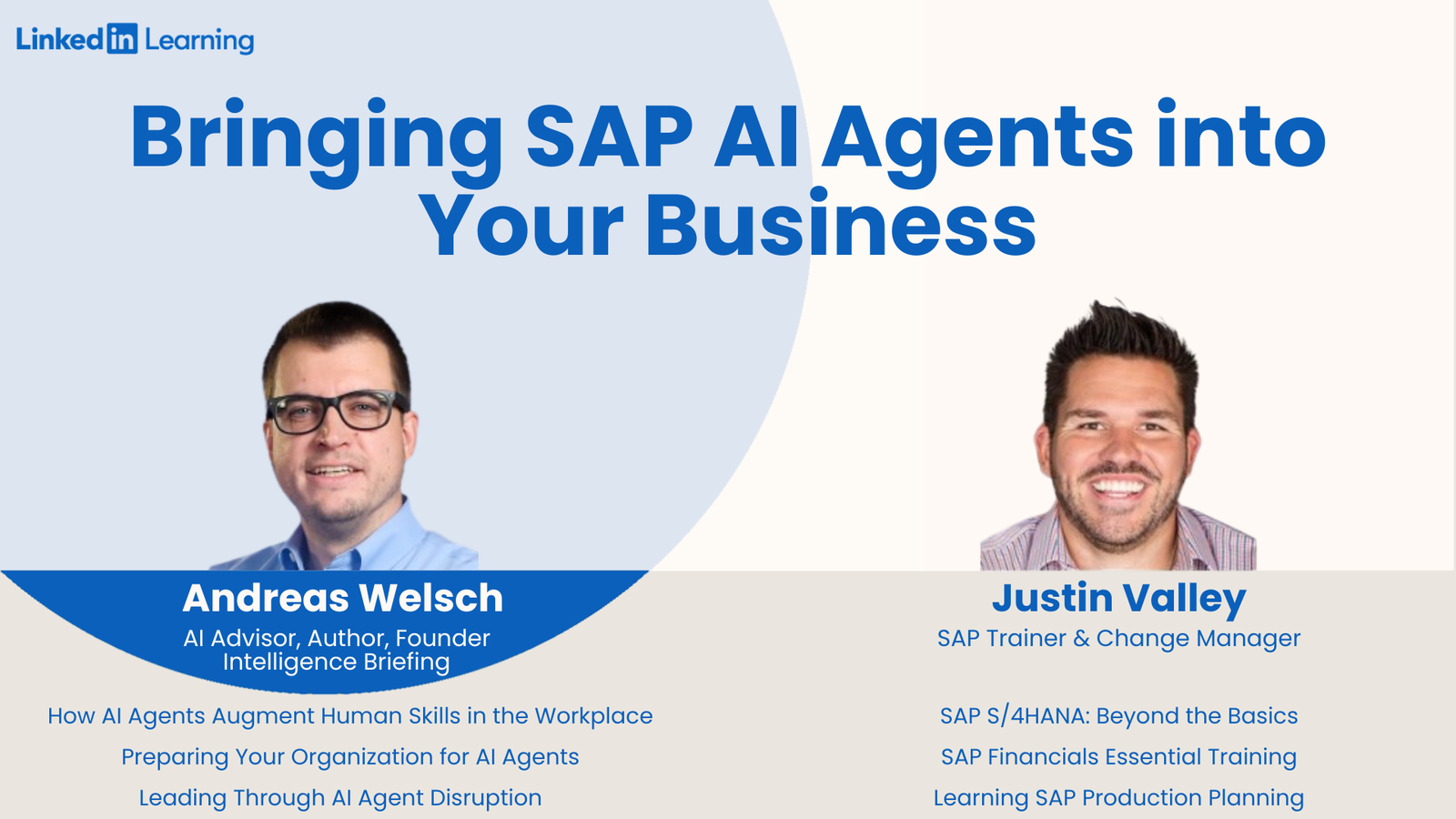
In a LinkedIn Learning Office Hours conversation, Andreas Welsch—an AI leadership expert with more than two decades in senior leadership roles at SAP—discussed what it takes to bring AI agents into business workflows, alongside SAP consultant and LinkedIn Learning instructor Justin Valley.
The discussion followed SAP’s Sapphire event in Orlando, where SAP emphasized its “autonomous enterprise” vision, AI agents, and its copilot, Joule. The conversation focused on what executives should do next: how to select early use cases, reduce risk in core processes, and lead workforce adoption.
Executive Summary
- Agentic AI adoption in SAP is real, but many enterprises remain in migration mode.
- Trust and governance matter most in high-impact areas like master data.
- Start with KPI-driven pilots backed by a sponsor, budget, and clear outcomes.
- Prioritize pre-built capabilities before building custom AI from scratch.
- Upskilling remains essential as automation increases and exceptions persist.
Key Takeaways
- Welsch emphasized starting with business value: sponsor, budget, and a KPI to improve.
- He recommended using SAP’s publicly available AI feature catalog to identify quick wins.
- He warned against treating AI like a purely technical project disconnected from business stakeholders.
- He highlighted trust-building as central when AI enters “predictable” ERP processes.
- He advised beginning with pre-built SAP capabilities to reduce time and complexity.
- He argued that layoffs framed as “AI replacement” can sacrifice future growth.
- He stressed workforce enablement: avoiding low-quality “AI slop” by keeping humans accountable.
What is Agentic AI?
Agentic AI refers to AI systems that can carry out multi-step tasks on a user’s behalf—often across applications—based on natural language instructions and defined permissions. In an SAP context, this can include Joule-powered skills or agents that assist with tasks such as creating records, handling exceptions, or supporting process steps like dispute management. Unlike traditional automation, agentic AI introduces probabilistic behavior, which increases the need for governance, testing, and human accountability in core enterprise workflows.
1) The “autonomous enterprise” meets enterprise reality
Justin Valley described a “tale of two stories”: SAP marketing promotes rapid innovation, while many large companies remain focused on ECC-to-S/4HANA upgrades. In practice, that means less bandwidth to adopt Joule or agentic capabilities, and more waiting for other companies to go first.
Welsch acknowledged the excitement around Joule’s evolution, noting his involvement in launching Joule and shaping early messaging around business AI. At the same time, he underscored why adoption can be slow: SAP systems exist to run processes predictably, repeatedly, and audibly—so introducing probabilistic AI changes the risk equation.
Key Insight: Agentic AI does not only introduce new features—it challenges the enterprise’s expectation of determinism. Leaders must treat AI-enabled ERP changes as governance and operating model changes, not only software enhancements.
2) Trust, risk, and the master data hesitation
Valley pointed to a practical friction point: master data. Even if Joule can create a business partner from natural language instructions, organizations hesitate to “hand over the reins” because master data has downstream impact across modules and processes.
Welsch reinforced the underlying tension: ERP platforms exist to mitigate risk through predictable execution and auditability. AI components can be powerful, but they may not always provide transparent reasoning for decisions, which elevates scrutiny—especially in high-stakes workflows.
Key Insight: The earliest agentic AI wins often sit near high-volume pain points—but leaders should expect the strongest governance pushback where downstream impact is greatest, such as master data, finance, and compliance-sensitive workflows.
3) Workforce transformation: transparency beats fear
Welsch shared an example from a large life sciences organization that approached change differently. From the start, it involved shared service center teams (including teams in South America and Eastern Europe) and communicated why automation mattered: increasing volume required changes, and automation could free time for higher-value work.
Welsch noted that the organization stayed true to its message, which earned buy-in. Rather than “throwing it over the fence,” the teams were involved in feedback loops, outlier analysis, hypercare, and steady-state improvement—building trust and adoption together.
He contrasted that with a common leadership narrative in the U.S.: using AI primarily as a cost-cutting rationale. In his view, replacing experienced people who hold product and customer knowledge can sacrifice future growth, especially where relationships and exceptions still require humans.
Key Insight: Workforce transformation works best when leaders communicate role shifts honestly—moving people from processing work to managing work—while reinforcing that accountability and domain expertise remain essential.
4) Where executives should start with SAP AI and agents
When asked what advice to give a CTO preparing to bring AI into SAP, Welsch focused on disciplined prioritization. The first step is selecting a problem where there is a clear sponsor, a budget, and a shared interest in improving a KPI—whether that KPI is cost, output, scrap reduction, or process cycle time.
He then recommended using SAP’s publicly available catalog of AI features to identify what is already included in the organization’s products and subscriptions. That enables teams to discover capabilities they may already be paying for, and to understand what else is available commercially through SAP platforms and credits.
Only after clarifying value and available options should leaders engage systems integrators and trusted consultants to design a practical start. Welsch cautioned against “spinning wheels” by searching for problems after selecting technology.
Key Insight: The most reliable starting point for agentic AI in SAP is not a broad mandate (“do AI”)—it is a narrow value case with ownership, funding, and measurable outcomes.
5) Use pre-built features before building from scratch
Welsch argued for an adoption sequence that reduces complexity. If SAP already offers an out-of-the-box capability—such as built-in AI features, templates, or Joule skills—leaders can pilot faster while focusing effort on the harder part: change management, stakeholder alignment, and operational adoption.
Starting by “building something from scratch” adds time and technical risk, while also increasing organizational friction. Piloting pre-built capabilities can provide a concrete baseline to compare performance with and without AI, using A/B testing and measurable benchmarks such as time saved or cycle time improvements.
As an example, Welsch pointed to dispute management and dispute resolution as a potential starting point for organizations running finance through SAP—since disputes over invoices are common and measurable.
6) Upskilling remains non-negotiable—even in an autonomous future
Valley emphasized that even if transaction-heavy work becomes more automated, understanding core SAP processes remains critical. Exceptions will still occur, and customer and supplier relationships still require human judgment. In his view, people should remain “bullish” on learning SAP because the process foundation will continue to matter.
Welsch extended the point to leadership and accountability: when AI makes work easier, dependency risk grows. He referenced instances where AI tools were unavailable and users struggled to complete tasks manually. He also highlighted the risk of low-quality output (“slop”) when people delegate too much thinking and accountability to AI.
For leaders, this implies a dual requirement: raise AI literacy while protecting process literacy. Agentic AI changes workflows, but it does not remove the need for skilled professionals who understand what “good” looks like in finance, supply chain, and operations.
7) The supply chain promise: seeing backward and forward
Valley identified supply chain planning as a particularly compelling area for AI. He described the potential for AI to combine backward-looking historical signals with forward-looking trend indicators—something many organizations do not do today because it is too complex for one person or team to synthesize.
In production planning terms, that could influence materials requirements planning (MRP) by helping businesses ensure the right components are available to meet demand. Valley suggested AI could “supercharge” these processes and reduce waste, spoilage, or inefficiencies over time.
Leadership Implications
- Anchor agentic AI in measurable value: Require a sponsor, a budget, and a KPI improvement target before starting.
- Choose low-regret entry points: Start with pre-built SAP capabilities to learn faster and reduce delivery risk.
- Design for trust: Apply heightened controls where downstream impact is greatest (e.g., master data, finance).
- Make change management explicit: Involve affected teams early; transparency increases buy-in and reduces fear.
- Protect process literacy: Build AI upskilling without letting accountability and exception-handling skills atrophy.
Why this conversation matters
This LinkedIn Learning Office Hours discussion matters because it connects SAP’s agentic AI narrative to operating realities inside large enterprises. The intended audience—business and technology leaders, SAP professionals, and change leaders—needs guidance that balances innovation with accountability.
Welsch’s perspective is grounded in both enterprise AI leadership and SAP context: he described the governance tension created when probabilistic AI is introduced into systems designed for repeatability. He also focused on adoption fundamentals—value, sponsorship, and workforce involvement—that remain consistent even as technology changes.
For executives navigating workforce transformation, the core message is practical: agentic AI can augment teams, but organizations must intentionally design workflows, manage risk, and avoid narratives that undermine trust or long-term capability.
Conclusion: Agentic AI success depends on leadership
Agentic AI in SAP—through Joule skills, agents, and AI-enabled features—can create real operational leverage. Yet success depends less on announcements and more on leadership choices: selecting KPI-led pilots, prioritizing pre-built capabilities, governing high-impact data areas, and enabling people through transparent change.
As Welsch emphasized, the fundamentals still apply. Agentic AI is a new layer, but the path to adoption remains rooted in value alignment, trust, and accountable execution.
FAQ: Agentic AI, SAP Joule, and Enterprise Adoption
1) What is the fastest way to start with agentic AI in SAP?
The fastest approach is to pick a narrow use case with a sponsor, budget, and KPI goal, then start with pre-built SAP AI features before building anything custom. This reduces complexity while leaders learn how agentic AI behaves in real workflows.
Welsch emphasized focusing on value first and using SAP’s AI feature catalog to identify what is already available.
2) Why are enterprises hesitant to use Joule for master data?
Enterprises hesitate because master data changes have broad downstream impacts across modules and processes, so “handing over the reins” to probabilistic AI feels risky. Agentic AI can help, but leaders must build trust and controls around high-impact data creation.
Valley noted the excitement and the hesitation: errors in master data propagate quickly and are costly to correct.
3) Does SAP’s autonomous enterprise mean users will stop using transactions?
No clear outcome was claimed, but the conversation suggested transactions may decline while process understanding remains critical. Valley argued exceptions will still happen, and relationships with customers and suppliers still require human management even as agentic AI automates more routine work.
This implies leaders should plan for role shifts rather than assuming end-to-end autonomy.
4) What should a CTO do first to prepare for SAP Joule adoption?
A CTO should identify a business problem with a committed sponsor, a budget, and a KPI to improve, then review SAP’s AI feature catalog to see what is already available. Welsch described this as the best foundation for responsible agentic AI adoption.
After that, leaders can involve integrators and consultants to implement and measure impact.
5) Why is sponsorship so important for agentic AI projects?
Sponsorship matters because agentic AI projects fail when treated as technology experiments without business ownership. Welsch said the best starting point includes a sponsor, a budget, and a KPI improvement target, ensuring the work is tied to measurable business value and adoption support.
This prevents teams from “throwing spaghetti at the wall” and hoping something sticks.
6) How should leaders build trust in probabilistic AI inside ERP?
Leaders should start with controlled pilots, measure outcomes with benchmarks, and involve affected teams early to build confidence. In the conversation, Welsch highlighted the tension between predictable, auditable processes and probabilistic AI behavior—making governance and change management essential.
Trust increases when teams can compare “with AI” versus “without AI” performance and see accountability retained.
7) What’s an example of a practical starting use case in SAP finance?
Dispute management and dispute resolution can be a practical starting point because invoice disputes are common and measurable. Welsch suggested evaluating performance with and without Joule in the loop, using A/B testing and benchmarks like time saved and process cycle time improvements.
This kind of use case supports early ROI discussions without deep custom builds.
8) How can leaders avoid low-quality AI output (“AI slop”)?
Leaders can avoid “AI slop” by keeping humans accountable for decisions, ensuring teams retain core process knowledge, and treating agentic AI as augmentation rather than delegation. Welsch warned that over-reliance reduces learning and can degrade quality when people stop applying judgment.
Upskilling and clear workflow ownership help maintain standards even as automation grows.
9) What skills should SAP professionals build as AI agents expand?
SAP professionals should deepen core process knowledge while gaining exposure to AI tools and prompting approaches, then test Joule capabilities in practice systems when available. Valley emphasized broad exposure first, then narrowing to relevant workflows, especially in modules like materials management and production planning.
This balance supports exception handling and helps teams evaluate AI outputs responsibly.
10) Where does agentic AI offer the biggest operational upside?
Supply chain planning may offer major upside because AI can combine historical signals with forward-looking indicators that teams typically cannot synthesize at scale. Valley highlighted production planning and materials requirements planning (MRP) as areas where AI could improve availability decisions and reduce waste over time.
The promise is optimization, but leaders should still govern decisions and validate outputs.