

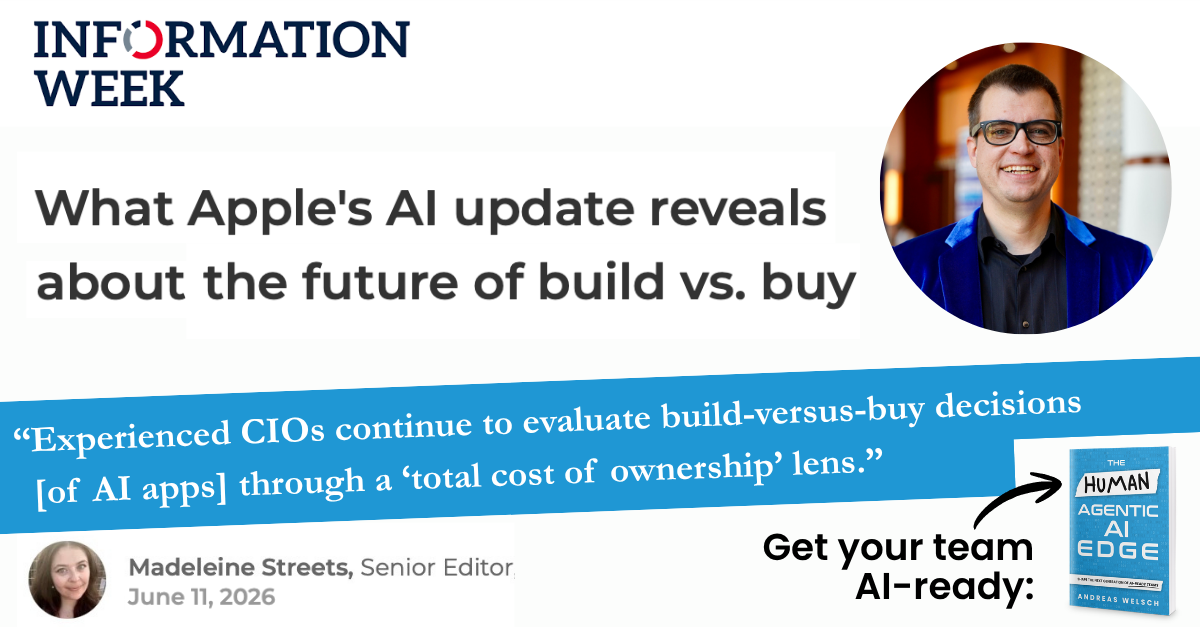
Original source: What Apple’s AI update reveals about the future of build vs. buy
AI leadership is being tested by a familiar CIO question with new urgency: what is worth building in-house versus buying and integrating. Apple’s decision to rely in part on Google’s Gemini models for elements of its next-generation Siri experience has put that tradeoff in front of every executive team.
This media coverage from InformationWeek reframes the debate for the generative AI era, where development can be faster but ownership remains complex. It is also a governance and workforce transformation issue, not only an engineering decision.
Andreas Welsch, an AI leadership expert and Founder and Chief Human Agentic AI Officer at Intelligence Briefing, explains why the real constraint is shifting. AI reduces human bottlenecks in delivery, but it does not remove total cost of ownership, risk, or the need for architectural and business-domain expertise.
Executive Summary
- Welsch emphasizes total cost of ownership, not just build speed.
- AI shifts bottlenecks from coding to review, governance, and risk.
- Differentiation comes from applied AI, data, and semantics.
- AI leadership priorities move toward integration and orchestration.
Key Takeaways
- The historic bottleneck in IT delivery was human capacity.
- Building in-house means CIO teams assume the risk.
- Frame build vs. buy through a total cost of ownership lens.
- AI adoption is early; advantage is in application, not models.
- Tie differentiation to business context plus organizational data and semantics.
- Prioritize integration and orchestration over building from scratch.
What is AI leadership?
AI leadership is the executive discipline of deciding where and how AI is applied, governed, and sustained across the organization. In this context, it includes making build-versus-buy calls using total cost of ownership, managing risk and cybersecurity requirements, and ensuring teams can maintain what they ship. It also includes aligning AI efforts to real differentiation—how AI is applied in business context—rather than assuming advantage comes from foundational technology alone.
Why this media coverage matters
The InformationWeek article is written for CIOs and IT leaders navigating enterprise AI adoption and modernization pressures. Apple’s decision to partner with Google’s Gemini models for Siri is a high-visibility example that legitimizes a pragmatic approach: even sophisticated organizations can choose external AI capabilities where it improves time-to-value.
For AI leadership and workforce transformation, the relevance is direct. The coverage highlights how generative AI changes software delivery speed, while surfacing the longer-term questions of governance, maintenance, and technical debt that executives are accountable for.
Key Insight: Apple’s announcement does not end the build-vs.-buy debate; it elevates it to an AI leadership decision. The strategic question shifts from “can it be built faster?” to “should it be owned for years, with all risks and obligations?”
AI leadership and the new economics of software development
Historically, build-versus-buy decisions were constrained by the high cost of software development: specialized talent, lengthy cycles, and budgets to create and maintain custom applications. Buying commercial software was often the lower-risk path.
Generative AI changes that constraint. Welsch explains that for years IT organizations struggled to keep up with requests to build new applications or improve existing ones, because “the bottleneck was humans.” AI tools accelerate conceptualizing, building, and maintaining applications, increasing throughput.
The article also cites the 2026 State of Code Developer Survey by Sonar: among developers who have tried AI coding tools, 72% now use them every day. Sonar reported AI accounts for 42% of committed code, with expectations of 65% by 2027.
Key Insight: AI may make previously “unaffordable” internal tools viable, but viability is not the same as strategic desirability. AI leadership requires separating development acceleration from long-term ownership, governance, and support realities.
Build software vs. own software: the total cost of ownership reality
Welsch draws a clear line between building an application and owning it. Development may get easier, but maintenance remains difficult, particularly as organizations face existing pressure to reduce technical debt, rationalize application portfolios, and eliminate redundant systems.
Welsch warns that CIOs whose teams build applications in-house are “assuming the risk.” He emphasizes that experienced CIOs still evaluate build-versus-buy through a total cost of ownership lens, including infrastructure, cybersecurity requirements, testing, maintenance, support obligations, upgrades, and ongoing enhancement work.
The article also notes that complexity rarely disappears; it moves. AI-generated code can increase output, while also creating review and governance burdens for senior engineers who must validate and correct AI-generated code.
Key Insight: In the AI era, the “cheapest code” can be expensive to own. Total cost of ownership expands beyond build time to include security, testing, production support, upgrade paths, and the governance workload created by higher volumes of AI-assisted change.
Where the talent bottleneck moves: from coding to architecture and domain
The article includes a complementary workforce signal from Nigel Duffy, CEO and founder of Cynch AI. Duffy argues the talent gap shifts “more toward architecture and understanding of the business domain,” concentrating knowledge in a few key technical experts.
This reinforces an AI leadership concern: dependency risk does not vanish if vendor dependency is reduced. It can reappear as reliance on a small number of architects and domain experts who understand how internally developed systems work, how they integrate, and how they are governed.
At the same time, the article highlights a practical temptation: because building becomes easier, organizations may build more internal applications. AI leadership requires evaluating whether the organization can staff the long tail of maintenance and governance work that follows.
Key Insight: Generative AI reduces scarcity of coding capacity, but increases the premium on architecture, integration know-how, and business-domain understanding. Workforce transformation plans must account for concentration risk and ensure knowledge does not become trapped in a few individuals.
Differentiation comes from applied AI, not foundational models
The article argues that relatively few organizations will gain meaningful competitive advantage from developing foundational AI technology, given the investment required to compete with major AI model providers. The strategic focus shifts to how AI is applied in the organization’s business context.
Welsch underscores that AI adoption is still early. He argues differentiation does not solely come from foundational AI technology itself, but rather from the technology’s application in a business context “in combination with an organization’s data and semantics.”
This positioning aligns build-versus-buy with business strategy. The question becomes where customization genuinely supports unique workflows, proprietary data, specialized operational processes, or distinctive customer experiences.
What to buy: commodity functions and standardized processes
The article points to a pragmatic boundary: commodity functions remain strong candidates for commercial software. Finance, HR, accounting, and other highly standardized processes benefit from mature support ecosystems, regulatory compliance capabilities, and established maintenance models.
In these domains, AI leadership is often better served by selecting dependable products and integrating them well. The goal is avoiding redundant systems and limiting future technical debt while improving time-to-value.
Even where AI makes building easier, ownership obligations remain. Buying does not eliminate governance needs, but it can shift some maintenance burdens to vendors with established release, support, and compliance practices.
What to build: where uniqueness and data context justify ownership
The article suggests that unique workflows and business-specific experiences may increasingly justify custom development as AI lowers development costs. This is where internal development can become economically viable in ways that previously failed cost-benefit analysis.
Still, the article highlights caution. Duffy predicts enterprises will build significantly more software internally as AI reduces development costs, while also warning that many will underestimate the long-term complexity of owning those systems.
Welsch is skeptical of the long-term value of building too much internally. He advises that to increase efficiencies such as cost savings and time-to-value, CIOs should prioritize “integrating and orchestrating AI capabilities rather than attempting to build them from scratch.”
Leadership Implications
- Keep total cost of ownership explicit. Evaluate infrastructure, security, testing, maintenance, upgrades, and support alongside build speed.
- Plan governance for AI-assisted output. Expect higher code volume to increase review, validation, and correction work for senior engineers.
- Design for integration and orchestration. Align build vs. buy decisions to integrating external AI capabilities when it improves time-to-value.
- Invest in architecture and domain expertise. Prepare for bottlenecks moving from coding capacity to system design and business-context fluency.
- Differentiate where it matters. Focus customization on unique workflows, proprietary data, and business semantics rather than foundational technology.
Conclusion
Apple’s decision to use Google’s Gemini models for elements of Siri’s next-generation experience highlights a durable truth: AI changes development speed, not the fundamental tradeoffs of ownership. AI leadership requires treating build-versus-buy as a long-horizon decision shaped by risk, governance, and the organization’s ability to sustain what it builds.
Welsch’s guidance centers the decision where it belongs: on total cost of ownership and differentiation through applied AI in business context. In the AI era, the winning approach is often less about building everything and more about integrating and orchestrating AI capabilities responsibly.
FAQ
What does Apple’s Gemini-for-Siri move mean for enterprise AI leadership?
Apple’s decision to rely in part on Google’s Gemini models for Siri signals that even sophisticated teams may choose partners for visible AI capabilities. For AI leadership, it elevates build vs. buy into a strategic, risk, and long-term ownership decision.
The example reframes the executive question from “can it be built?” to “should it be owned,” including cybersecurity, upgrades, and support obligations over time.
How does generative AI change build vs. buy decisions?
Generative AI changes build vs. buy by reducing the human bottleneck in delivering software, which can make more internal applications feasible. However, it does not remove maintenance, security, testing, and support work that drives total cost of ownership over years.
This is why CIOs still need a total cost of ownership lens even when development time shrinks.
What is the biggest risk when building AI-enabled applications in-house?
The biggest risk is confusing faster development with lower long-term ownership cost. Andreas Welsch notes that CIOs whose teams build in-house are assuming the risk, and total cost of ownership includes infrastructure, cybersecurity, testing, maintenance, support, upgrades, and enhancements.
AI leadership must account for those obligations upfront, not after the first release ships.
Why does AI increase the need for governance and code review?
AI can increase development output, but the article notes it can also create new burdens for experienced engineers who must review, validate, and correct AI-generated code. Governance demands may grow as senior staff spend more time ensuring quality, safety, and compliance.
This turns AI-assisted productivity into an AI governance and workflow-design challenge for leadership.
Where can enterprises differentiate if they cannot build foundation models?
Enterprises can differentiate through applied AI in their business context, not by building foundational AI technology. Welsch emphasizes differentiation comes from applying AI with an organization’s data and semantics. This aligns AI strategy to unique workflows, operations, and customer experience.
The competitive question becomes how AI is used, not who built the underlying model.
What should CIOs buy versus build in the AI era?
CIOs should continue buying commercial software for commodity functions like finance, HR, and accounting, which benefit from mature support and compliance capabilities. Building may make sense where workflows and data context are unique, but ownership complexity and maintenance must be considered.
The decision remains a total cost of ownership and differentiation tradeoff, not a pure speed calculation.
How is the AI talent gap changing for CIOs and CHROs?
The article suggests the talent gap shifts toward architecture and business-domain understanding, concentrating knowledge among a few experts. This workforce transformation dynamic means AI may reduce coding scarcity while increasing dependence on system designers and domain specialists who can govern and integrate systems.
AI leadership should plan for knowledge distribution, documentation, and maintainability to reduce concentration risk.
Why does Welsch recommend integration and orchestration over building from scratch?
Welsch recommends prioritizing integration and orchestration to improve cost savings and time-to-value. In his view, CIOs can capture efficiencies by combining AI capabilities rather than attempting to build them from scratch, while still focusing on differentiation through business context and data.
This guidance connects AI strategy to pragmatic delivery, governance, and long-term sustainability.
Does generative AI automatically mean enterprises should build more software internally?
Generative AI makes building software easier, but the article cautions the equation is more complicated. Maintenance remains difficult, and AI can increase review and governance burdens. AI leadership must weigh technical debt, application sprawl, and staffing realities before expanding internal builds.
Build vs. buy remains a multi-year ownership decision, even when first versions ship quickly.