

Many organizations have deployed Copilot or ChatGPT, yet employees often stop at drafting emails and summarizing meeting minutes.
How can executives boost human potential with AI? Move past tool access. Build skills, start with real business problems, map them to AI features already in the vendor stack, and scale adoption through champions and learning networks. Keep the human brain in the lead, so people can defend their work and avoid low-quality output that creates rework for others.
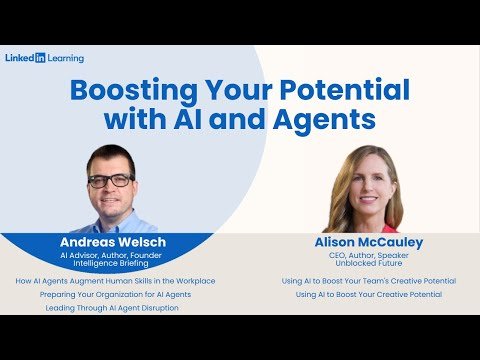
In a LinkedIn Learning Live “office hour” conversation, AI leadership expert Andreas Welsch and fellow LinkedIn Learning instructor Allison Mau discussed what it takes to boost human potential with AI, while avoiding “AI workslop,” the low-quality output that creates downstream rework.
The discussion focused on practical adoption moves leaders can make: shifting from check-the-box tool rollouts to skill building, creating learning networks, and aligning AI efforts with real business problems and existing vendor capabilities.
Executive Summary
- Tool access is not an AI strategy; usage quality determines value.
- “AI workslop” was rising and increases rework for recipients.
- Start with business problems, then map to vendor AI capabilities.
- Scale adoption through champions and learning networks.
- Keep the human brain in the lead to maintain authenticity and expertise.
Key Takeaways
- Andreas Welsch argues that sprinkling Copilot across the organization is not “done” AI strategy; value requires intentional adoption.
- Welsch highlights AI workslop as an accountability issue: low-quality output shifts work to the receiver and can damage credibility.
- Welsch recommends leaders broaden AI thinking from personal productivity to operational efficiency and strategic differentiation.
- Welsch advises executives to inventory current vendor stacks because most tools have added AI features rapidly, often outpacing adoption.
- Welsch points to learning networks and cross-functional champions as a proven change-management mechanism for AI adoption.
- Welsch emphasizes “AI readiness” as a habit built with intent and focus, similar to building a gym or health habit.
- Welsch warns that outsourcing thinking to AI undermines expertise; leaders and employees must be able to defend their work in conversation.
What is AI leadership?
AI leadership is the executive capability to introduce AI in ways that empower teams, improve outcomes, and preserve accountability for quality. In this conversation, Andreas Welsch frames AI leadership as more than tool rollout: it includes AI literacy and upskilling, alignment of AI strategy with business strategy, and practical decisions about where AI improves operational efficiency and differentiation. It also expands “responsible AI” beyond fairness and bias to include responsibility for not creating additional downstream work for colleagues and customers through low-quality AI output.
Why isn’t a Copilot or ChatGPT rollout an AI strategy?
Many organizations can report that Copilot or ChatGPT is “available,” but day-to-day usage often stalls at two basic patterns: drafting emails and summarizing meetings.
Andreas Welsch positions this as a leadership gap, not a technology gap. Making tools available “ticks the box,” but does not automatically produce better decisions, stronger customer outcomes, or workforce transformation.
Key Insight: AI leadership is measured by adoption quality, not adoption optics. Welsch’s point is that executives must move beyond “we deployed the tool” toward “we can show empowered teams, better workflows, and accountable output quality.”
For leaders navigating stakeholder pressure, especially at the C-suite level, the implication is clear: an AI strategy needs a “how we use it well” layer, not just procurement and access.
What does “good enough” AI output cost the receiver?
The conversation surfaced a term that was becoming increasingly common in workplaces: “AI workslop.” Allison Mau defined it as low-quality content generated with AI that is sent with minimal review: “good enough” to the sender, but costly to the receiver.
A concrete example discussed: an AI-drafted report that is “not bad,” yet lacks depth, structure, or critical detail, forcing a colleague to rework it from “meh” to “great.” The conversation also cited studies indicating about 40% of employees had received this kind of subpar, AI-assisted output within the previous month.
Andreas Welsch extends the responsibility discussion: responsible AI is not only about reducing bias in systems. It is also about using tools in a way that does not create more work for the people receiving the output.
Key Insight: AI makes content generation cheaper and faster, but it also makes mediocrity scalable. Welsch’s framing pushes leaders to treat quality control as part of AI governance and adoption, because rework erodes productivity gains and credibility.
How do leaders move from personal productivity to strategic differentiation?
Welsch acknowledges the convenience of personal productivity use cases: AI assistants on phones, quick drafting, fast summarization. But he stresses that AI leadership requires lifting the organization’s gaze.
In his view, the larger opportunity spans operational efficiency and strategic differentiation: using existing data for better insights, engaging customers differently, and even offering new products or services based on available data.
He also suggests a practical “onion layer” approach: begin with individual literacy and thought partnership, then move outward to business-function challenges, and finally to enterprise-wide opportunities.
Key Insight: The fastest path to enterprise value is not “AI everywhere.” Welsch advocates starting with concrete business problems, then matching those problems to capabilities already present in the organization’s technology stack.
Where should executives start to boost human potential with AI? Reduce the paradox of choice
One adoption barrier discussed is choice overload: AI can seemingly do anything, which can freeze teams into the safest, narrowest use cases. The conversation described a practical way to break that pattern.
Allison Mau described convening teams (or working solo) to ask larger questions before talking about tools: what barriers have been holding progress back, what goals have stalled, and what would be possible with no limitations.
From there, teams can take one or two meaningful challenges to AI and use it as a thought partner, asking the system to generate ideas and a plan for how AI can help.
Welsch reinforced that “what would be possible with no limitations” is a powerful reframing. It encourages working backward to identify steps, capabilities, and decisions needed to make progress.
Why this matters for executives
This approach is not “AI theater.” It is a prioritization mechanism. Leaders get a clearer line of sight from meaningful objectives to realistic workflows, reducing the churn of repetitive drafting tasks.
How can leaders use existing vendor AI capabilities without boiling the ocean?
Welsch notes that most organizations already have a significant technology stack, and nearly every vendor had been adding AI features rapidly for the previous three years. Innovation had outpaced many organizations’ ability to absorb, evaluate, and adopt those capabilities.
He recommends a practical sequence for leadership teams: start by defining business problems, then inventory what vendors and applications are already in-house, and finally assess which existing AI features could address those problems, while ensuring security, cost, and applicability requirements are met.
This framing treats AI adoption as both a governance and execution issue: organizations need a process, but that process must be streamlined enough to keep pace with the market.
How do AI champions and learning networks scale adoption?
A recurring theme was that organizations making faster progress are activating internal learning networks. Rather than isolating AI experimentation, they create structures for sharing what works, what fails, and what is transferable from personal use into business use.
Welsch shared an example from a financial services institution that hired its first head of AI and convened both leaders and a group of champions/early adopters recruited across the business. The organization’s intent was to create a forum for sharing breakthroughs and sparking peer-to-peer inspiration.
According to Welsch, that is where “the magic happens”: cross-pollination of use cases, faster pattern recognition, and a more practical understanding of how AI can help beyond routine communications.
Key Insight: Adoption scales socially, not just technically. Welsch’s example shows that “champions networks” can convert scattered experimentation into an enterprise learning loop, reducing fear of falling behind and increasing practical, relevant use cases.
Keep the human brain in the lead to preserve authenticity
The conversation also addressed a growing workplace reality: peers can often tell when someone is over-relying on AI. Welsch described an HR leader’s story in which coworkers asked an employee to “tone it down” because AI-generated communications did not sound like the person.
Allison Mau offered a complementary perspective: in a world of “synthetic everything,” true human authenticity and connection may gain economic value. Her view is that AI can free time for higher-quality human-to-human connection, if people keep their thinking in the lead.
Welsch provided a practical test for expertise: a conversation in a metaphorical elevator. If a stakeholder challenges a viewpoint, the professional must defend the work. If AI produced the thinking end-to-end, that capability erodes quickly.
AI readiness is a habit
Welsch describes becoming “AI ready” as an intentional habit, similar to building a consistent health routine. The conversation mentioned “32 days consecutively” as a “magic number” for habit formation, reinforcing the need for sustained practice beyond initial enthusiasm.
Leadership Implications
- Expand responsible AI definitions. Treat “not creating more work for recipients” as part of responsible use and governance.
- Design for quality, not just speed. Create expectations and review norms that prevent AI workslop from spreading.
- Start with business problems. Define pain points first, then map to existing vendor AI features and data assets.
- Institutionalize learning networks. Formalize champions/early adopter groups to share practices and accelerate AI upskilling.
- Upskill for thought partnership. Train teams to use AI beyond drafting: idea generation, planning, analysis, and scenario exploration.
Why this conversation matters
This conversation took place in a LinkedIn Learning Live office hour format, aimed at leaders and professionals trying to convert AI hype into workplace results.
Its relevance to AI leadership and workforce transformation is practical: executives face pressure to “make AI happen,” while innovation continues to outpace the organization’s ability to evaluate and operationalize new capabilities.
Andreas Welsch’s contributions connect this pressure to execution basics: high-quality adoption, champions networks, and business-aligned prioritization. He also links AI strategy to daily credibility, because workslop, in his framing, is not only inefficient, but reputational.
Conclusion: AI leadership is accountability at scale
AI leadership is not proven by access to tools. It is proven by whether teams can use AI to amplify expertise, close gaps, and deliver high-quality work without shifting rework to others.
Welsch’s core message is that executives can move beyond incremental productivity by focusing on business problems, leveraging existing vendor capabilities, and scaling adoption through learning networks, while keeping human thinking and authenticity in the lead.
Frequently Asked Questions
How can executives boost human potential with AI?
Executives boost human potential with AI by moving beyond tool access to skill building, starting with real business problems, and mapping them to AI capabilities already in the vendor stack. Champions and learning networks scale adoption, while keeping the human brain in the lead protects expertise and output quality.
How is AI leadership different from deploying Copilot or ChatGPT?
AI leadership goes beyond tool availability by ensuring people know how to use AI well, responsibly, and toward business outcomes. Deployment “ticks the box,” but leadership requires upskilling, quality expectations, and aligning AI adoption with strategy and governance.
Andreas Welsch stressed that sprinkling tools across the organization is not the same as having an AI strategy.
How can executives decide where to start with AI adoption?
Executives can start by identifying real business problems and barriers, then mapping those needs to AI capabilities already available in their vendor stack. This reduces the paradox of choice and prevents “boiling the ocean” with scattered experimentation.
Welsch recommends beginning with problems, then asking what current vendors can do, while checking security, cost, and applicability.
What is an effective way to move beyond incremental productivity?
An effective way is to ask bigger questions first, such as what goals have stalled or what would be possible with no limitations, then use AI as a thought partner to generate options and a plan. This shifts teams from task automation to mission advancement.
The conversation described this as a practical “unlock” that can happen in just a few hours with teams.
Why are learning networks and champions critical for workforce transformation?
Learning networks and champions accelerate AI upskilling by making adoption social: people share what works, learn from experiments, and replicate successful practices across functions. This reduces fear of falling behind and helps organizations keep up with fast-moving AI innovation.
Welsch described a financial services institution convening leaders and early adopters to spark ideas and share lessons learned.
What does “responsible AI” mean beyond fairness and bias?
Responsible AI also includes using tools in ways that do not create more work for colleagues and customers. In this discussion, responsibility was framed as accountability for output quality, avoiding AI workslop that shifts labor downstream and undermines trust.
This expanded definition was emphasized as an urgent leadership topic as AI becomes more accessible.
Should teams treat AI like a human assistant?
Teams can use AI as a helpful assistant or thought partner, but they should not outsource thinking and accountability. The discussion warned that over-delegation leads to shallow work and weak expertise, while effective use amplifies what people can accomplish.
Welsch emphasized the need to be able to defend outputs in real conversations, not just send AI-generated text.
What does it mean to be “AI ready” in day-to-day work?
Being “AI ready” means intentionally building habits to use AI to augment skills while keeping the brain in the lead. In this discussion, AI readiness was compared to building healthy routines and reinforced by a “32 days consecutively” habit-building benchmark.
Practically, it shows up in choosing higher-value use cases, reviewing outputs, and learning continuously through networks and training.