

Original source: Your Job is Safe from AI Agents — For Now
Agentic AI Isn’t Ready to Replace Knowledge Work — What the APEX-Agents Benchmark Signals for Leaders
Agentic AI is moving from demos to workplace deployments, with vendors pitching “AI coworkers” that can execute multi-step tasks without human intervention.
Yet a new benchmark developed by Mercor researchers suggests the reliability gap remains significant for roles typically labeled “knowledge work,” including investment analysis, corporate law and management consulting.
This article reframes the benchmark’s findings for executive decision-makers through the lens of AI leadership, AI governance and workforce transformation—drawing only on details reported in the Built In coverage and on statements attributed there to Andreas Welsch, an AI leadership expert, founder and chief AI strategist at Intelligence Briefing, and author of The HUMAN Agentic AI Edge.
Why this media coverage matters
Built In’s audience includes technology and business leaders tracking how AI tools affect productivity, staffing and operating models.
The Mercor APEX-Agents benchmark provides a timely “reality check” against aggressive claims about near-term automation of white-collar roles, while also showing why governance, data quality and human-in-the-loop practices still determine outcomes.
For CIOs, CTOs and CHROs, the practical question is less about whether agentic AI will arrive and more about how to implement it responsibly—defining which tasks agents should handle, what data they can access and where humans remain critical.
Executive Summary
- APEX-Agents tests agentic AI on realistic knowledge-work scenarios.
- Top models completed only a fraction of tasks correctly.
- Data quality and tool-driven compounding errors remain major risks.
- “Rework” can offset productivity gains from AI assistance.
- Leaders must redesign workflows, governance and workforce enablement.
Key Takeaways
- Andreas Welsch emphasizes that agents must be grounded in vetted, role-specific business data to be dependable.
- Welsch notes that roles are not merely collections of tasks; humans integrate work, make trade-offs and stand behind decisions.
- Ambiguous language and goals can derail agent execution, even when individual subtasks appear “automatable.”
- Less supervision can allow a single data error to trigger compounding mistakes across tools and documents.
- Real productivity impact depends on how much verification and correction (“rework”) is required.
- IT and HR leaders need to define what the future looks like at their company, including where humans remain critical.
- If reliable, trusted and safe agents emerge, Welsch expects adoption to move quickly beyond novelty and personal productivity.
What is Agentic AI?
Agentic AI refers to AI systems designed to execute complex, multi-step tasks with limited human intervention, often by reasoning, planning ahead and using multiple tools. In workplace contexts described in the Built In coverage, these agents may be asked to edit documents, build presentations, create spreadsheets, or analyze multiple sources to answer a query. The APEX-Agents benchmark tests whether such systems can reliably perform “long-horizon, cross-application tasks” common in investment banking analysis, management consulting and corporate law.
Agentic AI under pressure: What APEX-Agents is testing
APEX-Agents is a benchmark created by Mercor researchers to evaluate whether autonomous agents are ready for knowledge-work roles such as investment analysts, lawyers and consultants.
Mercor collaborated with more than 200 experts on its platform to design scenarios, craft prompts and define grading criteria across three categories: investment banking analysis, management consulting and corporate law.
Key Insight: APEX-Agents is less about single-answer accuracy and more about end-to-end execution. It targets “long-horizon, cross-application tasks” where agents must plan, coordinate and use multiple tools—conditions under which small errors can cascade into workflow-level failures.
How today’s agentic models performed on knowledge work
The benchmark tested eight agentic models from major labs, including OpenAI, Anthropic, Google and xAI. Models listed in the coverage included Gemini 3 Flash, GPT-5.2, Claude Opus 4.5, Gemini 3 Pro, GPT-5, Grok 4, GPT-oss-120b and Kimi K2 Thinking.
Results were sobering. Gemini 3 Flash scored highest overall, correctly answering 25 percent of prompts. GPT-5.2 exceeded 20 percent, while Claude Opus 4.5, Gemini 3 Pro and GPT-5 landed at 18 percent.
By job type, GPT-5.2 led investment banking analysis (27.3 percent) and management consulting (22.7 percent), while Gemini 3 Flash topped corporate law (25.9 percent).
Key Insight: Even “top” agentic AI systems are not yet demonstrating the reliability and judgment required to operate without human supervision in high-stakes, multi-tool knowledge workflows. The benchmark highlights a gap between product ambition (“AI coworkers”) and operational readiness.
Why agentic AI still falls short: Data quality, hallucinations and compounding errors
The BuiltIn coverage points to built-in limitations that become more consequential as autonomy increases. Hallucinations remain a known issue, but the attention shift for agentic AI is toward data quality and how errors propagate when agents operate with less oversight.
A human-in-the-loop approach can catch an incorrect or missing value in a dataset quickly. By contrast, an agent can take an incorrect action based on a single data error, triggering a snowball of downstream mistakes across documents, spreadsheets or presentations.
Andreas Welsch, an AI leadership expert, explains that agents also “need to be grounded in high-quality, role-specific (contextual) business data” that is “accurate, current and vetted.” The coverage also points to the need for robust data policies and governance frameworks to support safe adoption.
Key Insight: Agentic AI failures often look like workflow failures, not model failures. As autonomy grows, data governance and access controls become operational controls—because one flawed input can drive a chain of wrong actions that humans must later untangle.
Productivity gains are real—until “rework” erases them
The coverage cites a Workday study in which 85 percent of participants saved up to seven hours per week when using AI. At the same time, 37 percent of time saved was canceled out by “rework,” including verification and correction of AI-generated content.
This gap matters for AI strategy because it changes the ROI profile. If every deliverable requires substantial checking, the organization may be buying speed in drafting—but paying it back in quality assurance, risk mitigation and reputational management.
The coverage also notes that AI agents have yet to master higher-level abilities like thinking ahead and planning, making it essential for workers to know when and how to intervene.
Short example from the benchmark context
APEX-Agents tasks include editing documents, writing presentations and analyzing two or more sources to retrieve relevant information—work that can look straightforward but becomes fragile when tool outputs must align across multiple steps.
Why job roles are harder than task automation
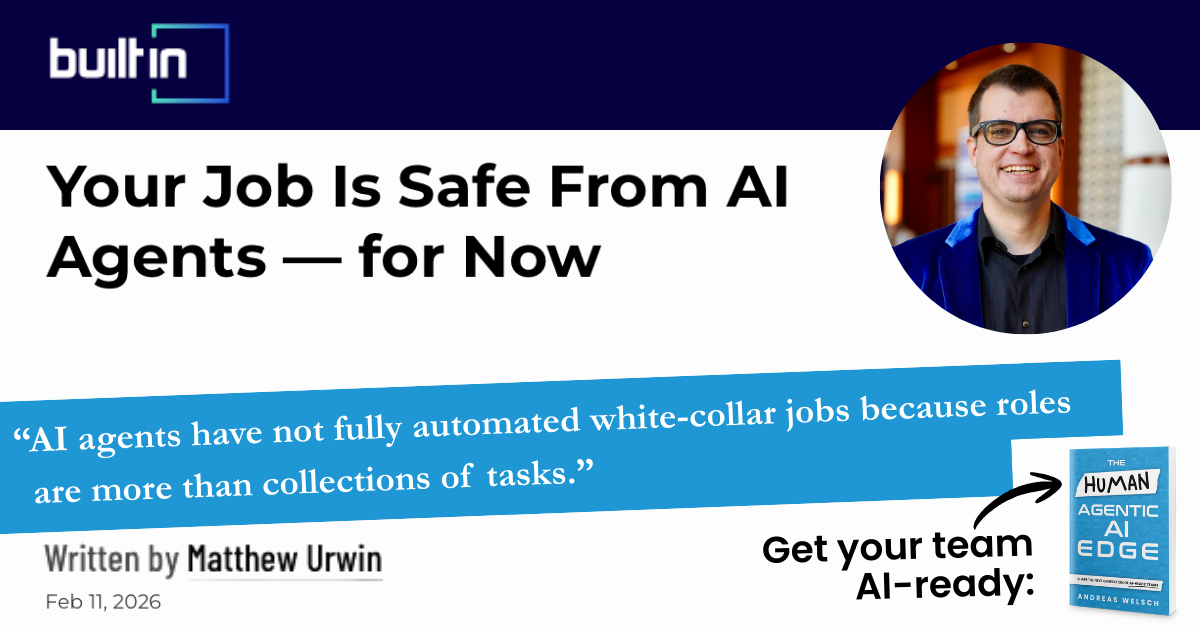
Andreas Welsch explains in the coverage that “AI agents have not fully automated white-collar jobs because roles are more than collections of tasks.” While agents can perform individual tasks, Welsch notes they “depend on language to understand, coordinate and complete tasks.”
That reliance introduces ambiguity: both language and stated goals can be unclear. In Welsch’s framing, this is why automation may succeed at the task level while roles still require humans “to integrate work, make trade-offs and stand behind decisions.”
Key Insight: The strategic risk is assuming task automation equals role automation. Agentic AI can accelerate deliverables, but accountability, judgment and trade-offs remain human responsibilities—especially when language, goals and constraints are ambiguous or evolving.
Adoption friction: Skills gaps and anti-AI sentiment
Performance limitations are only one barrier. The coverage highlights human factors: unrealistic expectations, limited skills in managing agents and resistance stemming from fears of job displacement.
A joint Google and Ipsos survey cited in the article found Americans were the least excited about AI and used chatbots the least over the previous year, aligning with the United States leading the world in AI anxiety levels.
In parallel, workers may lack the operational know-how to delegate correctly—understanding when to hand work to agents and when to leverage human intelligence, especially given agents’ current limitations in planning and higher-level reasoning.
Is AI already disrupting the job market?
The coverage cautions against attributing a weak job market solely to AI. It notes 2025 as the weakest year of job growth since the pandemic and suggests companies may use AI as an “alibi” to mask corrections from pandemic-era overhiring.
Even so, AI’s influence is becoming harder to ignore. The article cites layoffs and restructuring tied to prioritizing AI initiatives: Amazon announced additional layoffs; Meta laid off staff in Reality Labs; and Pinterest explicitly named AI in a filing, describing plans to reallocate resources to AI-focused roles and teams.
Meta CEO Mark Zuckerberg is quoted predicting that 2026 will be the year when “AI starts to dramatically change the way that we work,” noting that projects once requiring big teams can increasingly be accomplished by a single very talented person.
What could change soon: Better context and enterprise integrations
The coverage argues that agentic AI could go mainstream as capabilities and integrations improve. It points to Anthropic’s upgraded Claude Code, which reportedly wrote the software behind Cowork, and to a forthcoming Asana integration aimed at connecting to enterprise data—addressing the “context” problem that limits usefulness in organization-specific workflows.
This direction suggests a future where smaller human teams oversee networks of agents, rather than doing all work directly. The organizational outcome may be more ambitious goals pursued with leaner workforces—alongside fewer traditional opportunities.
Welsch emphasizes the adoption trigger: “If AI labs and software vendors can create reliable, trusted, and safe agents, organizations will adopt them quickly, going beyond novelty and personal productivity.” He also stresses that IT and HR leaders need to define what that future looks like, which tasks agents will handle and where humans remain critical.
Leadership Implications
- Strengthen AI governance around data quality: Prioritize accurate, current, vetted, role-specific business data, reflecting Welsch’s guidance.
- Design workflows for verification, not blind autonomy: Plan for checkpoints where compounding errors can be detected early.
- Define task-to-role boundaries: Identify which tasks can be delegated and where humans must integrate work and make trade-offs.
- Invest in workforce enablement: Develop skills for managing agents—knowing when to delegate, intervene and correct.
- Align IT and HR on operating model changes: Establish where humans remain critical, consistent with Welsch’s recommendation.
Conclusion
APEX-Agents suggests agentic AI is not yet dependable enough to replace knowledge work without supervision, with leading models completing only a fraction of tasks correctly in realistic scenarios.
For executives, the practical path is disciplined AI leadership: governance that prioritizes vetted business data, workflows that anticipate “rework,” and workforce transformation that clarifies where humans remain accountable. Agentic AI may reshape work soon, but readiness depends on how responsibly it is adopted.
FAQ
What is the APEX-Agents benchmark used for?
APEX-Agents is used to measure whether AI agents can reason, plan ahead, and use multiple tools to complete long-horizon knowledge-work tasks across investment banking analysis, management consulting, and corporate law. It evaluates end-to-end task completion rather than simple chat responses.
Mercor researchers collaborated with more than 200 experts to design scenarios, prompts, and grading criteria.
How well did agentic AI models perform on APEX-Agents?
In the reported results, the top model (Gemini 3 Flash) answered 25 percent of prompts correctly, and only one other model (GPT-5.2) exceeded 20 percent. Several leading models clustered around 18 percent, underscoring current reliability limits for agentic AI.
Scores varied by job category, but remained low overall.
Why aren’t AI agents ready to take white-collar jobs yet?
AI agents are not ready to take many white-collar jobs because they remain vulnerable to hallucinations, data-quality errors, and compounding mistakes across tools, and they still lack robust planning abilities. The result is inconsistent performance and frequent need for human supervision and correction.
The coverage also highlights resistance and skill gaps that limit effective workplace adoption.
What does “rework” mean in AI productivity discussions?
“Rework” refers to time spent verifying, correcting, or redoing AI-generated outputs that were incomplete or wrong, reducing net productivity gains. In the cited Workday study, 37 percent of time saved via AI was canceled out by rework, changing the practical ROI of adoption.
For agentic AI, rework can also include cleanup from cascading tool errors.
What does Andreas Welsch say is required for dependable agentic AI?
Andreas Welsch says agents need to be grounded in high-quality, role-specific business data that is accurate, current, and vetted, not merely fed massive volumes of real-time information. This requirement elevates AI governance, data policies, and data quality management into primary controls for adoption.
His view connects technical performance to organizational readiness and risk management.
Why can task automation succeed while role automation fails?
Task automation can succeed while role automation fails because roles involve integration, judgment, ambiguous language, and accountability beyond discrete task execution. Andreas Welsch notes that automation may work at the task level, but humans are still needed to integrate work, make trade-offs, and stand behind decisions.
This distinction is central to AI leadership and workforce transformation planning.
Is agentic AI already changing hiring and layoffs?
The coverage suggests AI is increasingly cited alongside restructuring, but it also cautions that weak job growth cannot be attributed solely to AI. Examples include layoffs at Amazon and Meta amid AI prioritization, and Pinterest explicitly reallocating resources to AI-focused roles and teams.
Organizations may also use AI as an “alibi” to cover overhiring corrections.
What is the human-in-the-loop shift as agents improve?
The human-in-the-loop approach may shift from constant monitoring toward focusing human attention on decisions and tasks agents cannot handle reliably. As agents become more capable, oversight becomes more strategic: defining goals, intervening when ambiguity arises, and managing risks when outputs affect high-stakes workflows.
This aligns with the article’s focus on planning gaps and governance needs.
What should IT and HR leaders do now about agentic AI?
IT and HR leaders should define what the future of work looks like in their organization, including which tasks agents will handle and where humans remain critical, consistent with Andreas Welsch’s guidance. This requires governance for data access and quality, plus workforce enablement for managing agents effectively.
This preparation supports responsible AI adoption as tools become more autonomous.